Bitget stock trading 2.0 is also the 2.0 era of stock trading on cryptocurrency exchanges.
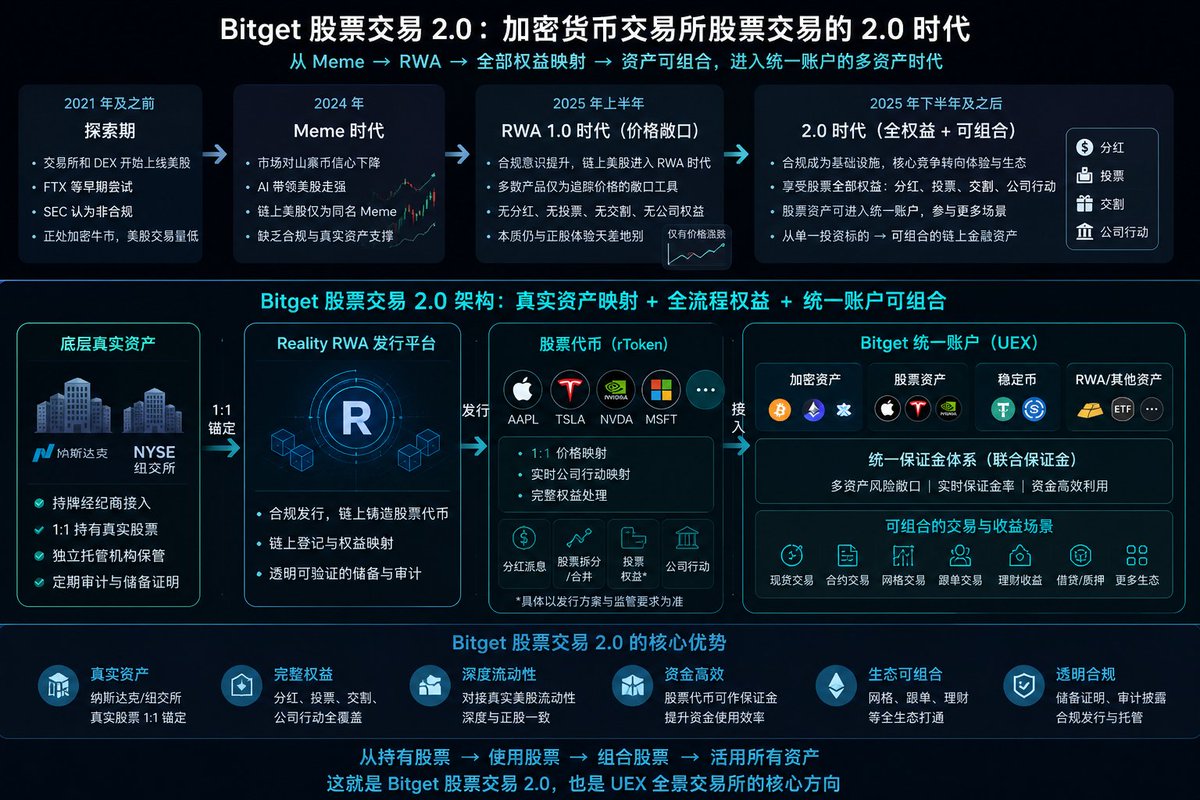
If I remember correctly, in 2021 there were already exchanges and DEXs starting to launch US stock trading, and the most famous at that time should be FTX. However, back then, due to the cryptocurrency bull market, altcoins were experiencing significant ups and downs daily, leading to very low trading volumes for the relatively "stable" US stocks. Moreover, I recall the SEC mentioned that this method of trading US stocks was non-compliant.
I have forgotten who was the first to put US stocks on the chain; it should have been in 2024 when the market had gradually lost confidence in altcoins, and at that time, AI was gradually strengthening US stocks, and voices began to emerge for trading US stocks. I was also among the first to popularize the compliance of on-chain US stocks. At that time, the so-called "US stocks" were merely a meme with the same name.
By 2025, as more individuals became aware of compliance, on-chain US stocks shifted from the meme era to the RWA era. The so-called RWA at that time was just wrapped in a seemingly compliant exterior but was still merely a tool tracking price exposure. There were no dividends or entitlements, not to mention split-ups and stock transfers.
At this point, all exchanges began to lay out on-chain US stocks. As AI continued to improve, interest in US stocks increased. However, since they were merely price exposure, what users received was vastly different from actual stocks—beyond price fluctuations, there was nothing else. This may be considered the 1.0 era of US stocks entering the cryptocurrency sphere.
Now, the so-called 2.0 version, in my understanding, has made compliance less important because all exchanges prioritize compliance as the first element. It's not that everyone's awareness has improved, but rather that only with compliance can one enjoy all the entitlements of stocks, including dividends, voting, and settlement rights; these are the main means to attract users.
When everyone is focused on compliance, it's no longer necessary to emphasize it. I believe the focus should be on stock investment funds that can be part of a unified account margin, co-creating risk exposure with other cryptocurrency assets, and participating in more trading and profit scenarios within the platform.
From this perspective, @Bitget_zh stock 2.0's emphasis is not on the stock itself, but on the changes in asset account structure.
In the past, the main assets in cryptocurrency exchanges were BTC, ETH, stablecoins, and various tokens, with users' risk exposure mainly concentrated in the cryptocurrency market. Now, as traditional assets like US stocks, gold, ETFs, and forex gradually enter the same account, exchange accounts are no longer just cryptocurrency accounts but are starting to become multi-asset accounts.
This is also the reason why @bitget has continuously emphasized UEX, a panoramic exchange.
Users can purchase stocks using stablecoins, use stock tokens as margin, and allocate between cryptocurrency assets, stock assets, and other RWA assets. This represents a trend where financial assets are moving from a single market, single account, and single use towards unified accounts, multi-asset portfolios, and higher capital efficiency.
If this system can continue to improve in the future, especially in terms of underlying asset custody, auditing, liquidity access, dividend processing, corporate action mapping, and account combinability stability, then US stock 2.0 may become an important step in the evolution of cryptocurrency exchanges towards multi-asset platforms.
免责声明:本文章仅代表作者个人观点,不代表本平台的立场和观点。本文章仅供信息分享,不构成对任何人的任何投资建议。用户与作者之间的任何争议,与本平台无关。如网页中刊载的文章或图片涉及侵权,请提供相关的权利证明和身份证明发送邮件到support@aicoin.com,本平台相关工作人员将会进行核查。


