The original text is from Tom Lee
Translation|Odaily Planet Daily Qin Xiaofeng(@QinXiaofeng888)
The new generation of ETH staunch bull Tom Lee is here to recharge everyone's faith.
On June 2nd, Beijing time, Tom Lee, the chairman of the board of directors of BitMine (NYSE: BMNR), the largest treasury-listed company in Ethereum, attended the “Proof of Talk 2026” conference at the Louvre in Paris and delivered a speech 《Crypto Spring: ETH is the Future of Money》(《Crypto Spring: ETH is the Future of Money》).
In his speech, Tom Lee believes that the current bearish sentiment marks the bottom of the market for Bitcoin and Ethereum. He stated that as artificial intelligence and tokenization drive significant changes in financial infrastructure, ETH could ultimately reach $250,000. (Odaily Note: On the day Tom Lee delivered his speech, BTC fell below $66,000, and ETH dropped to a low of $1,820. Currently, BitMine’s holdings in ETH are down about $8.86 billion.)
Moreover, he mentioned that BitMine recently purchased 111,942 ETH, increasing its holdings to nearly 5.4 million ETH, accounting for about 4.47% of the circulating supply. In contrast, the Ethereum Foundation has been selling off its holdings over the years, currently holding only 100,000 ETH, which is a negligible 0.1% of the total supply. He believes that corporate validators will replace the increasingly shrinking Ethereum Foundation as the key administrators of the network.
Here is the full transcript of Tom Lee's speech (with some omissions), translated by Odaily Planet Daily, enjoy~
——————————
Good afternoon, everyone. I have prepared a 30-minute speech, and there is a lot to discuss as there are many topics worth bringing up.
I believe we have entered a crypto spring. Many of you may have lost confidence in crypto due to stagnant prices. Your friends may be exiting, and the crypto space is filled with anger. Many believe that the next star of the market is artificial intelligence. I think these are all phenomena typical of the bottom of a cycle. In fact, I have a few slides here to discuss why Agentic AI is a major pillar of the crypto narrative, and this trend will unfold this year.
So, I will divide this sharing into three parts:
- The first part is a macro explanation, where I will present five reasons I firmly believe that crypto spring has arrived. Even if you don’t believe in many products being built within blockchain and crypto, there will be five major tailwinds this year;
- The second part will explain to you why Ethereum is likely the best example of future currency. I will talk about the foundations and their role in this new system;
- The third part will be, if you want relevant exposure, it is better to invest in crypto treasury stocks (primarily BitMine) than to buy underlying tokens.
1. Has Crypto Spring Arrived?
Why do I believe that crypto spring has arrived?
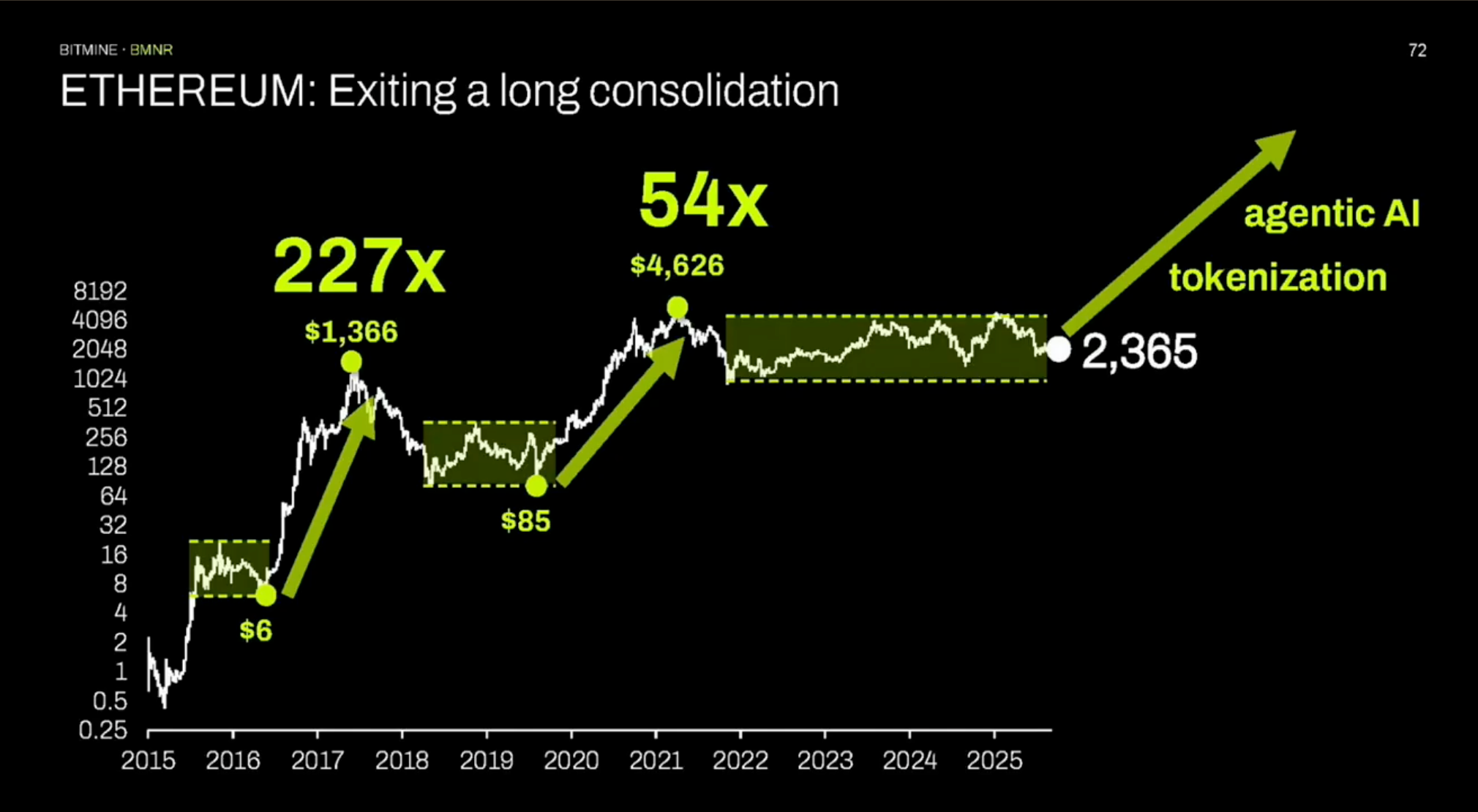
Look at the following price chart of Ethereum. You can see that it has been consolidating for nearly five years, stuck within this range, awaiting a decisive breakthrough. If you are bearish, you might think it will break down. I will explain why I believe it will experience a bullish breakout.
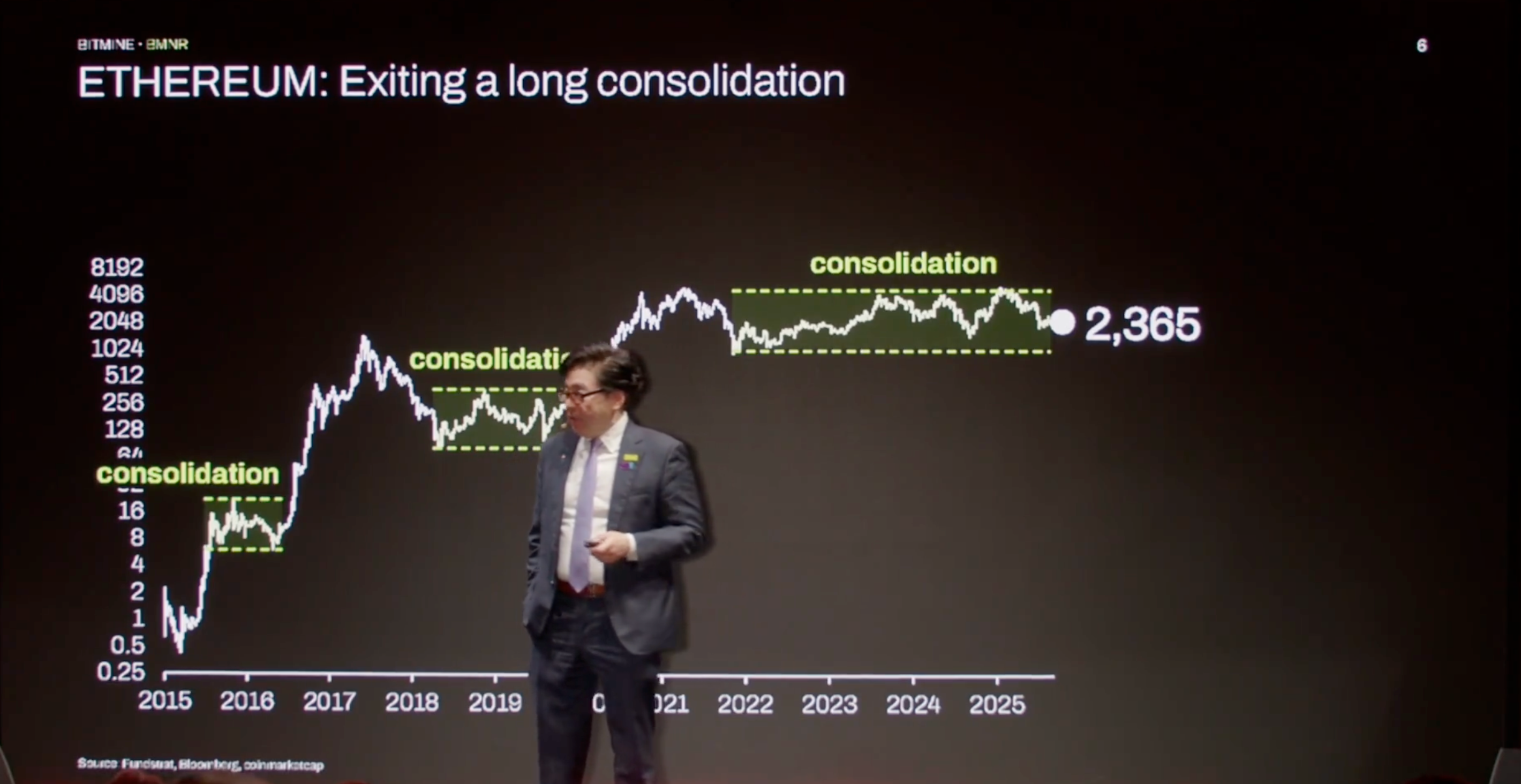
(Odaily: This chart is outdated; currently, ETH has dropped to the $1800-$1900 range)
The first catalyst is: The Iran War is about to end.
I know many believe that crypto prices have nothing to do with the Iran War. But in reality, the Iran War has created issues with oil prices and oil supply.
Oil is a fundamental driver of inflation. If oil leads to an inflation issue, it means that global central banks must tighten their policies: rising oil prices severely affect the supply of oil products, and policymakers are forced to raise interest rates. So once the war ends, the panic premium in oil will disappear. Oil prices might drop to $40 per barrel.
Currently, Ethereum has a high negative correlation with oil prices. In fact, this is the highest negative correlation in Ethereum's history. It is clear that rising oil prices are bearish for ETH prices. We can see this from the statistics.
If you don’t believe my claims about inflation and oil prices, take a look at the following chart. This chart starts from 1985. The top is oil price changes, and the bottom is core CPI. As we can see, each time oil prices soar, core CPI accelerates upward.
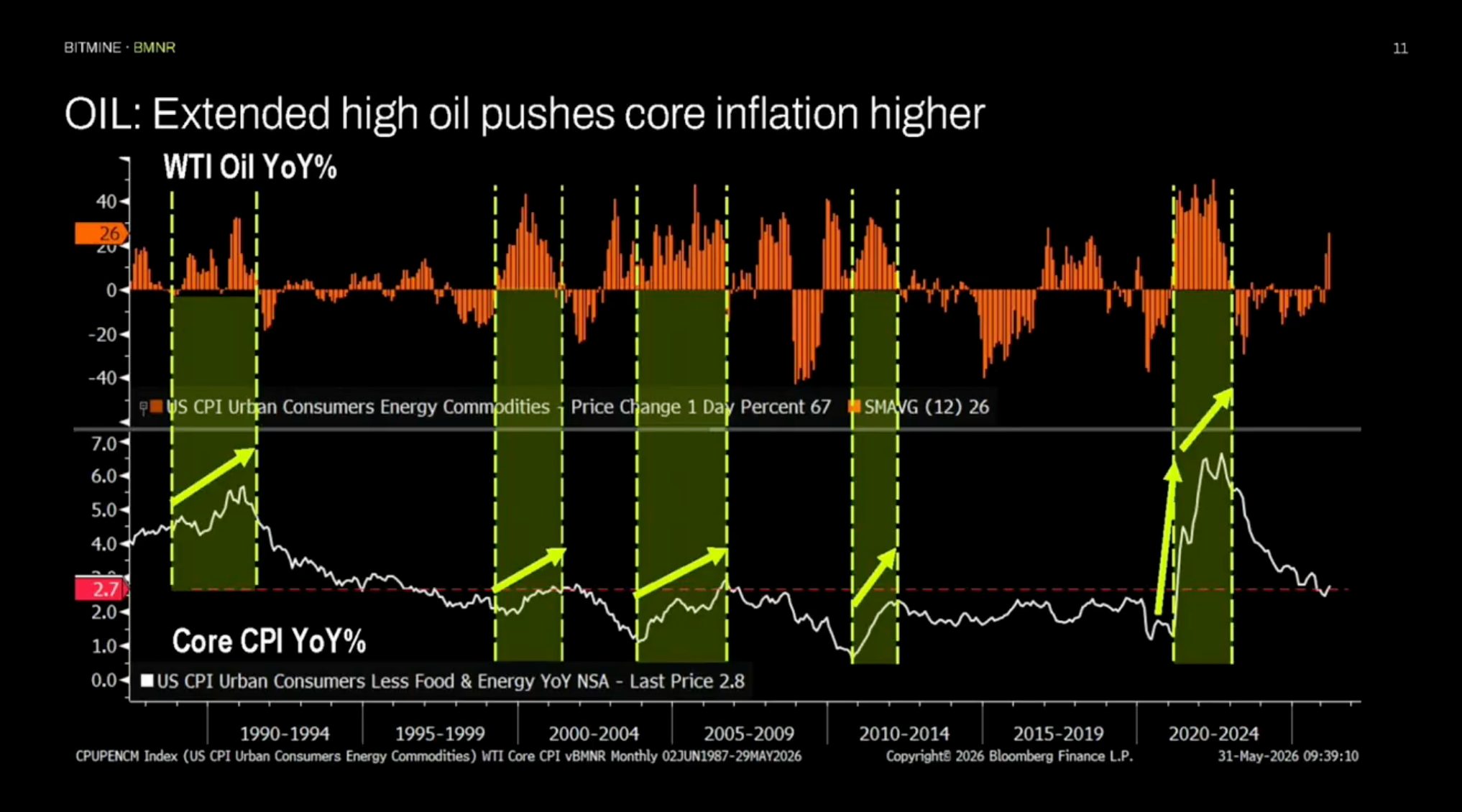
Therefore, if this becomes a protracted war, inflation will come. In fact, last month the Federal Open Market Committee (FOMC) also stated in its meeting minutes: if inflation persists and remains above 2%, it is appropriate to tighten policies. Central banks do not want inflation to exceed 2%, and if oil prices remain high, they will maintain a hawkish stance.
Thus, we are betting that the war is about to end.
The second positive macro catalyst is the Clarity Act, which provides a legal framework for the popularization of crypto in the U.S. as well as for participation by financial institutions.
Unfortunately, the market believes there is only a 56% chance of this act being signed this year. I have spoken to many in Washington, including our own policy experts. The actual probability seems much higher. The prediction markets are trying to find an equilibrium point, but I believe the actual probability is far above 56%.
Of course, I know that large banks do not want this to happen. But remember, policies are not made by large banks; laws serve the people, and many voters want to see the Clarity Act passed. If this act is passed, it will be a massive catalyst.
The third positive catalyst is the government. Don’t forget that the White House supports Bitcoin and crypto, which is also very beneficial for dollar policy, especially regarding stablecoins.
Fourth, we have a new Federal Reserve Chair Kevin Warsh, who is supportive of Bitcoin.
Finally, the stock market also faces enormous favorable factors. I know many of you may be bearish on the stock market because it has risen too much. But at Fundstrat (Odaily Note: An independent research firm founded by Tom Lee), we have been structurally bullish on the stock market.
The following chart relates to the number of people aged 30-50 in the U.S. Each time this number increases, the growth rate of the U.S. economy exceeds trend levels. Due to millennials, Gen Z, and Alpha generation, we are witnessing this super trend growth. As shown, when stock returns are overlaid with the population of those aged 30-50, the stock market always shows a parabolic rise.
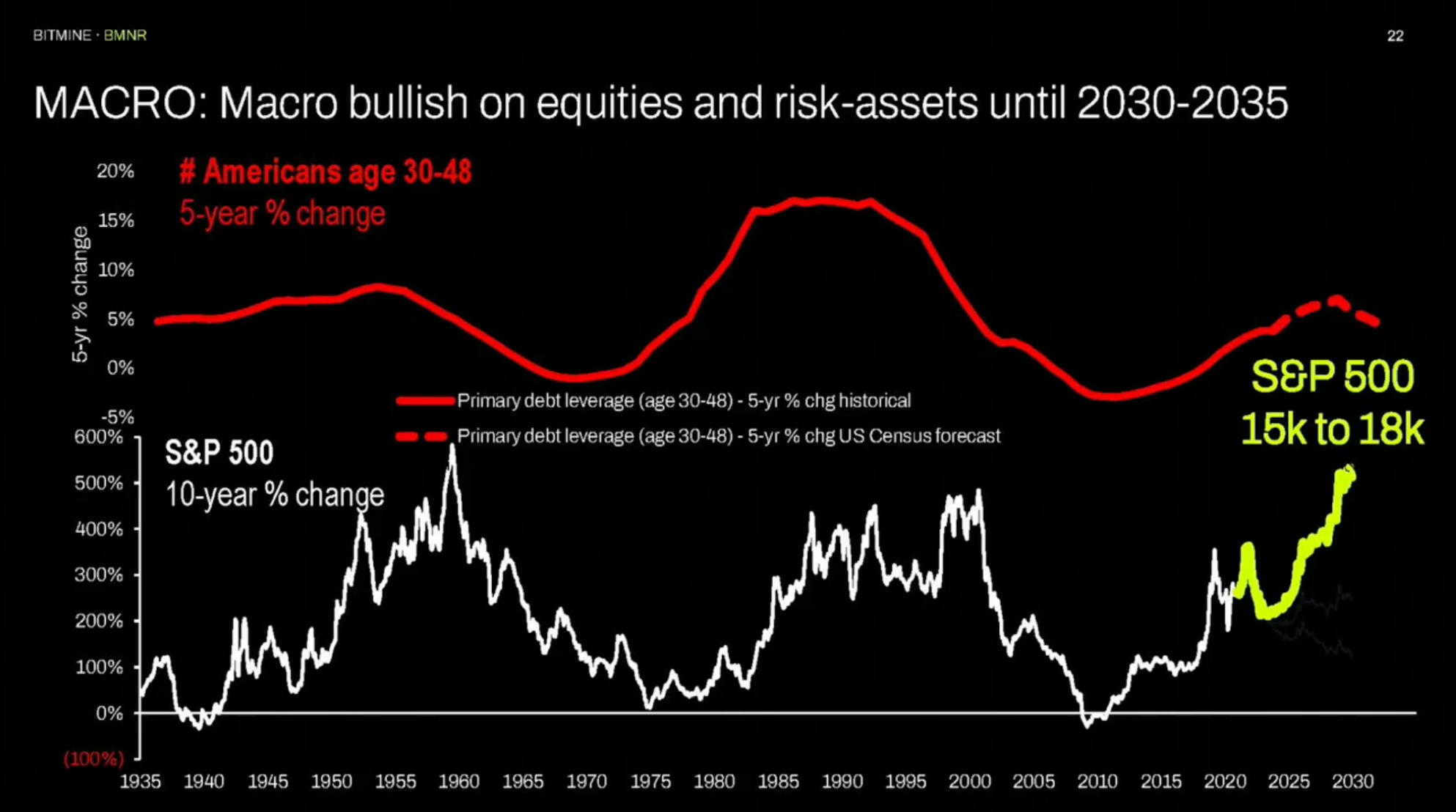
This tells us that by the end of this decade, the S&P 500 index could reach between 15,000 and 18,000 points.
These are all favorable factors for crypto. Of course, you might still wonder why crypto is so weak. I believe it is because people have forgotten that crypto is the future of currency.
2. The Future of Currency
The first point I want to discuss is: Agentic AI and Robotics.
The following chart lists all milestones since the launch of ChatGPT in 2023, marking significant progress in the past three years.
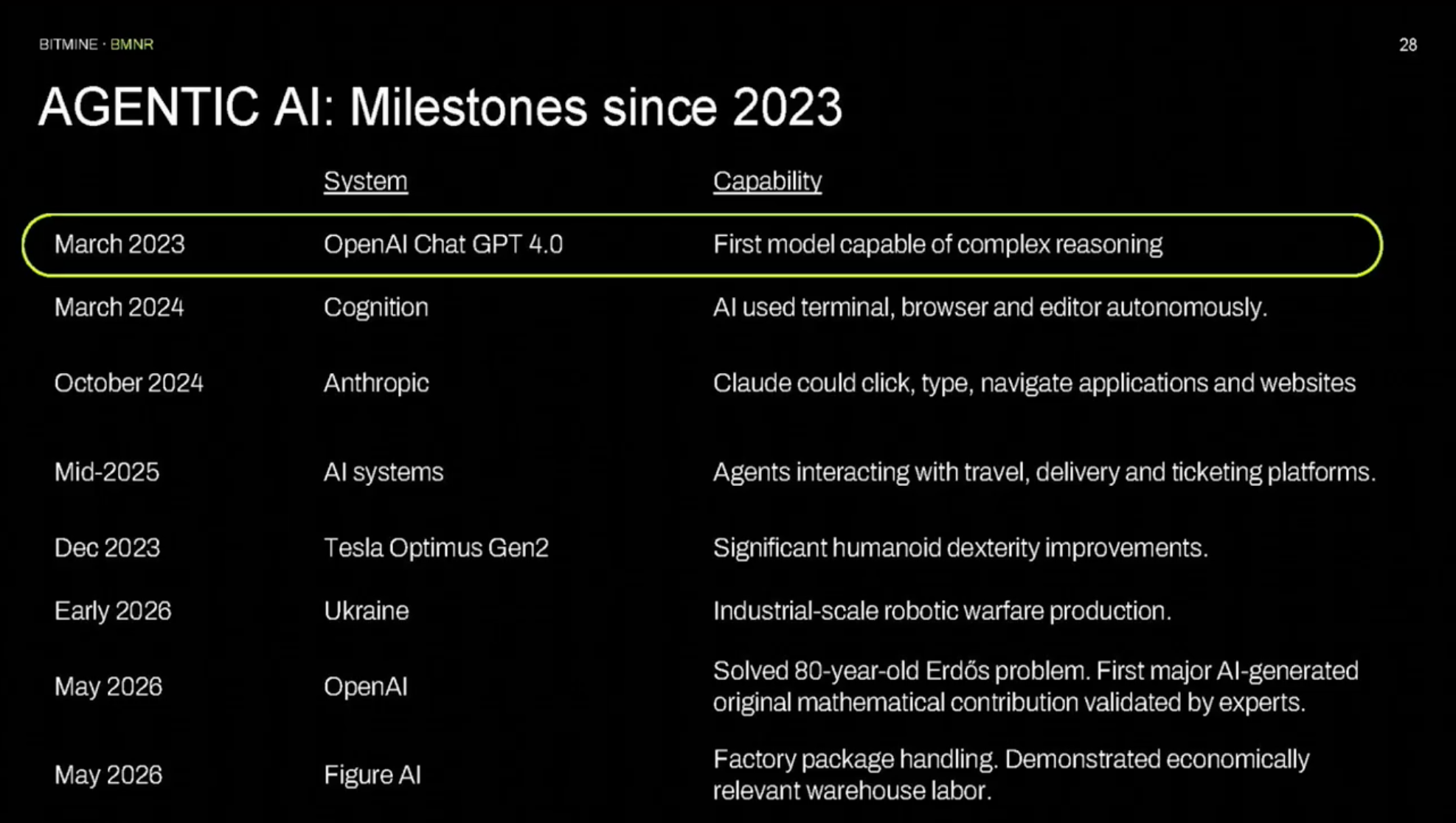
The first milestone is the launch of ChatGPT; the second occurred in 2024, when agent systems began to have the ability to interact with and manipulate websites; the third significant advancement is in robotics—Optimus Prime has made strides in flexibility and operation. Of course, there is also Ukraine’s industrial-scale production of drones.
Finally, we are witnessing the development of superhuman capabilities. OpenAI has solved an 80-year-old problem. Figure AI launched a robot capable of actual construction and large-scale operation in warehouses. This means that in the future, robots will dominate much of the internet’s traffic.
This is why people like Marc Andreessen refer to this trend as a "unification." Because if you have a robot system, you need to control it. And in terms of controlling robot behavior, blockchain is far more efficient than traditional systems. For example, whether it is identity verification, identity recognition, or payment speed, all these can operate better on a crypto system.
You may ask why this hasn’t reflected in crypto prices yet? Because the stock market is still gradually transmitting the impact.
The first group to really benefit from the AI ecosystem is semiconductor companies, which continue to rise. Then there are last year’s storage stocks, experiencing a reevaluation of their value. But as you can see, the market is now beginning to see the benefits of AI for large tech stocks and is starting to transmit this into the software sector. People once thought software would be damaged by AI, but this slight parabolic rise indicates that software companies are benefiting from AI since they are developing for the future AI infrastructure built on crypto.
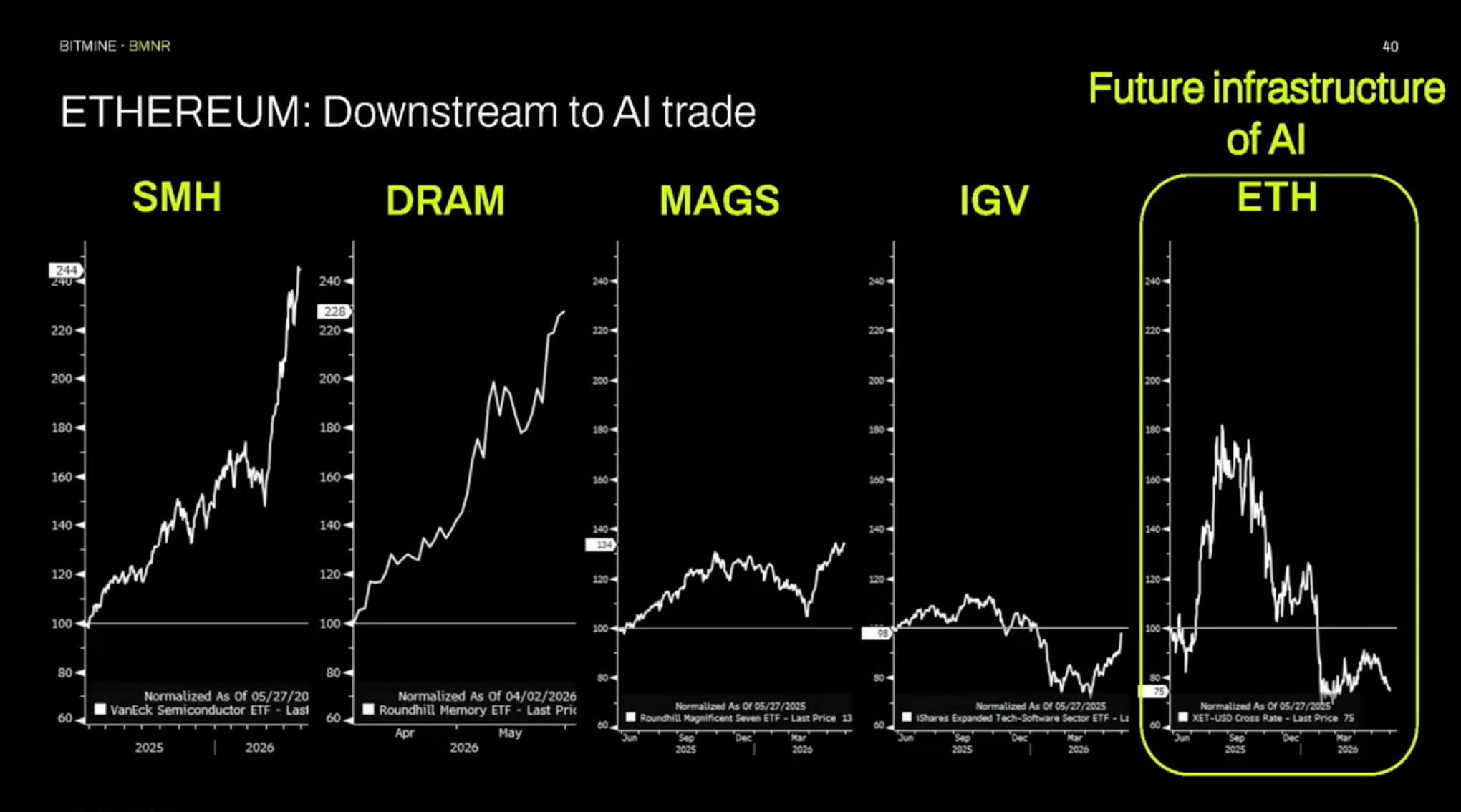
So in my view, this is entirely logical, and we are just gradually moving forward. I believe this will only take a few months. If you think it’s impossible, look at the relationship between Ethereum and software stocks; they have remained in sync over the long term.
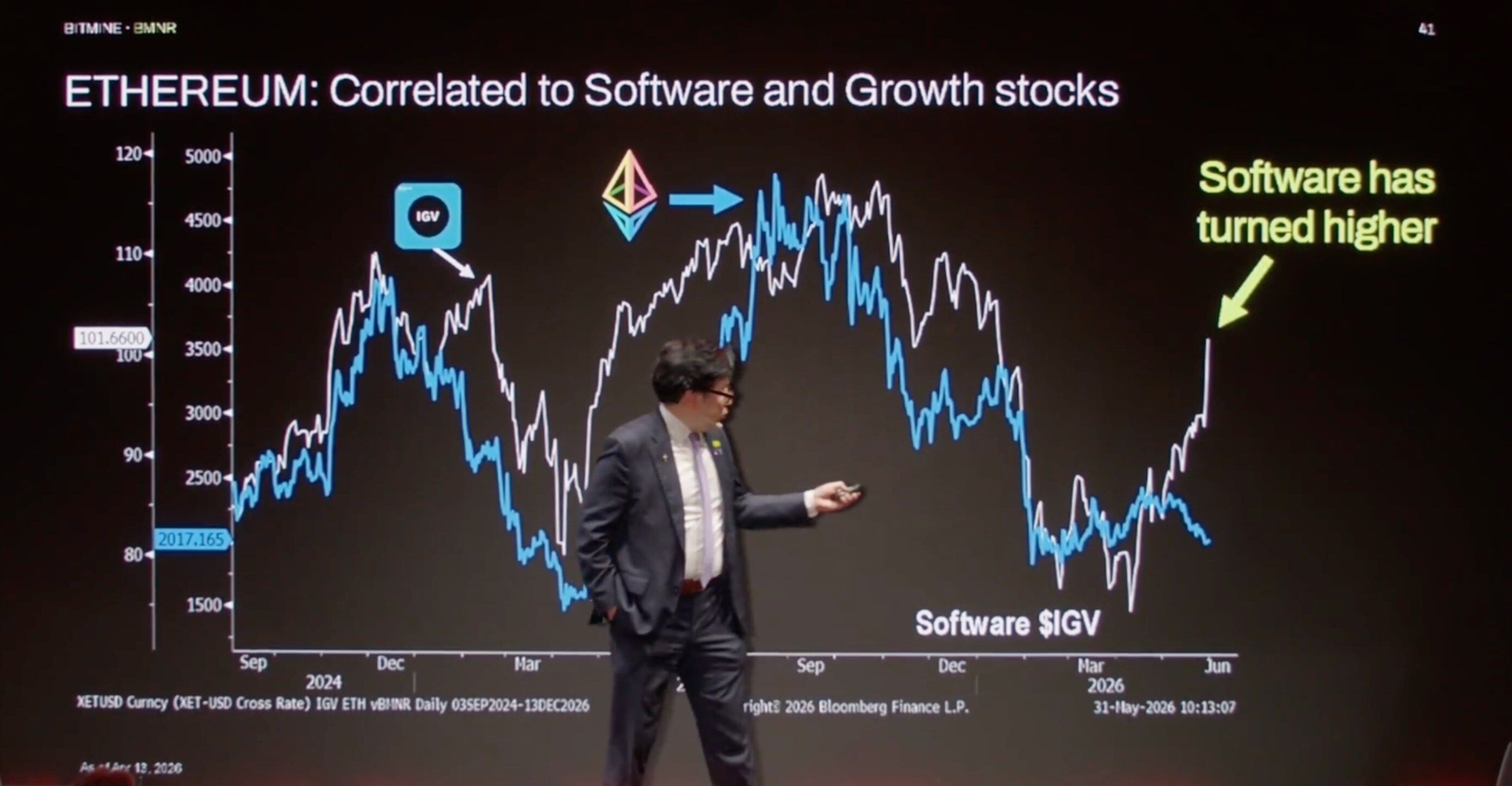
Now we see a divergence; software stocks have shown a parabolic rise. I believe that in a few weeks, the price of Ethereum will reflect this.
The second point is Tokenization. Today’s Wall Street wants tokenization; they also believe that the future of currency is computational power. In fact, many tech founders have already seen this. Part of the reason is that we have already seen the future.
Today, the trading volume of stablecoins has surpassed that of Visa. In the future, the tokenized securities market could reach up to $300 trillion. This will include the tokenization of real estate, fixed income, stocks, derivatives, land, and gold.
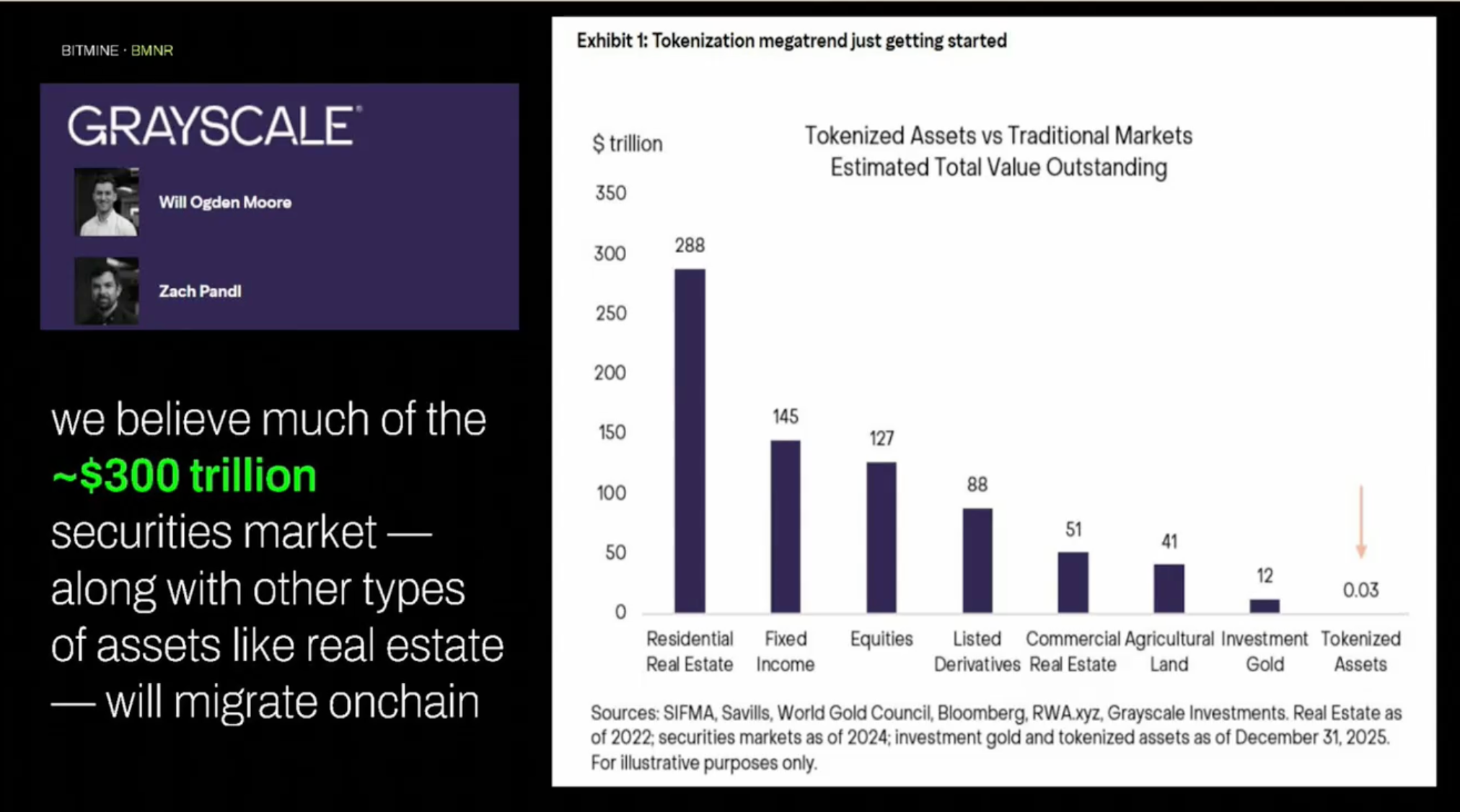
You can see that today’s tokenization market is very small. If the market size reaches $300 trillion, how would that bring more value to crypto assets or benefit them? Remember that the price of crypto assets is highly correlated with the quantity of tokenized assets. Therefore, if the market asset value reaches $300 trillion, the total locked value of the Ethereum network will not remain at $100 billion or $200 billion.
This is the reality: there are very few blockchains capable of operating on a large scale. What does this mean? I believe that crypto technology, which can provide great efficiency, will replace many of today’s most profitable banks.
Let me give you a few examples. JPMorgan is the most profitable bank in the world, with an annual revenue of $60 billion. Yet a company called Jane Street, which primarily does capital transfer, will earn $40 billion this year. That’s almost as much as JPMorgan, but they have only 3,000 employees.
So, with just a thousandth of the workforce, they have nearly matched the profitability level of JPMorgan. This also indicates that merely transferring capital is more valuable than custodial functions.
Crypto technology is very good at capital transfers. Take Tether as an example. Tether could earn $15 billion this year; it is a crypto-native company with only 300 employees; together with Jane Street, they earn more than JPMorgan.
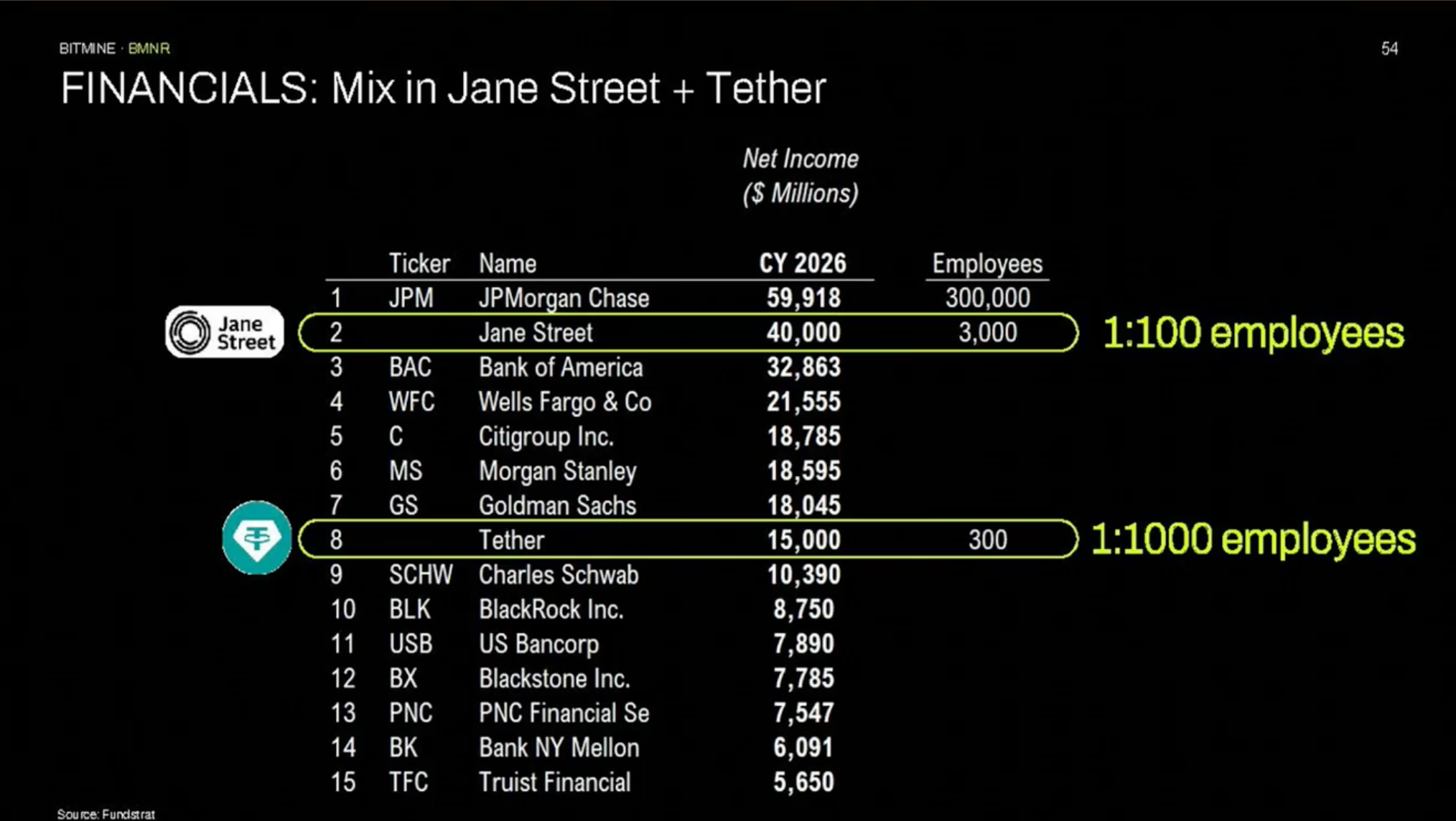
Investors always tend to support existing giants, and they often overvalue them. But as you can see, new entrants are the ones capturing all the value in the end. Therefore, I believe that in the next 10 years, five of the world's top ten financial institutions will be crypto-native companies.
This leads to my third point, these smart contract platforms are likely to become units of monetized value. Because holding ETH for transactions can be argued to be easier than holding dollars.
Elon Musk has remarked that in the future we won’t use dollars as currency; it will just be computational energy. Standard Chartered released a report on Ethereum this week. They compare Ethereum to Amazon, indicating many favorable factors are contributing to ETH accumulation, just like Amazon back in the day—Amazon’s stock was once stuck at $6 and has since risen more than 1,000 times.
So, one indicator to watch in this regard is the ETH/BTC exchange rate.
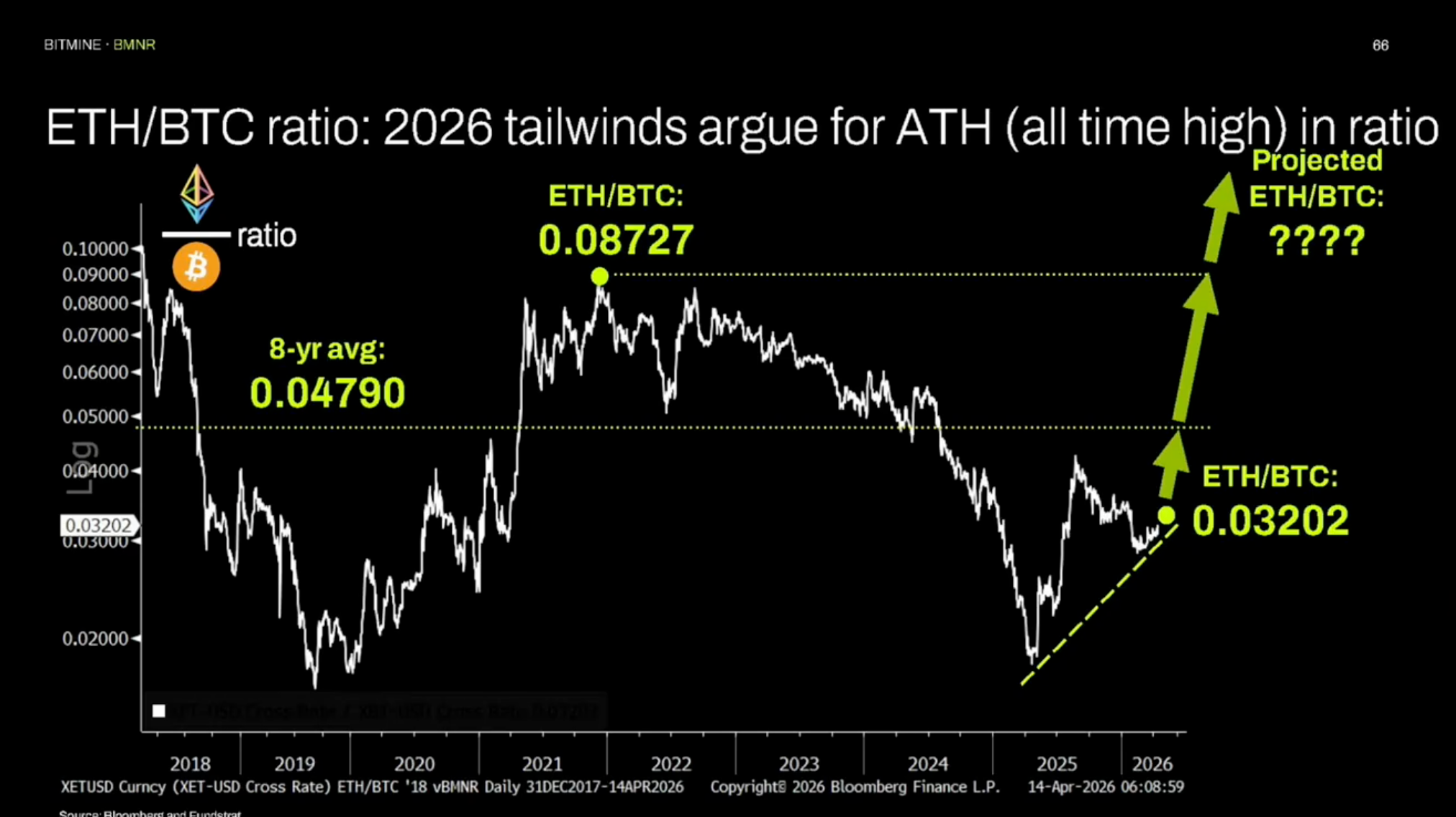
If our thesis is correct, then with the development of tokenization and AI, ETH will break through. And I think a roughly 50-fold increase is a considerable upward space for Ethereum.
Finally, I want to talk about the Ethereum Foundation. Because in this new world, foundations should no longer be the centralized nodes of cryptocurrencies. Vitalik has written articles about this this year. He stated that the Ethereum Foundation would streamline its role, and it will not become the only centralized management agency for all Ethereum affairs.
This makes sense since the share held by the Ethereum Foundation is no longer what it once was. It used to hold 17% of the supply; by 2020, that number had dropped to 1%; last year, when BitMine began treasury operations, it went down to 0.3%; today, the Ethereum Foundation only holds 100,000 ETH, accounting for 0.1% of the supply.
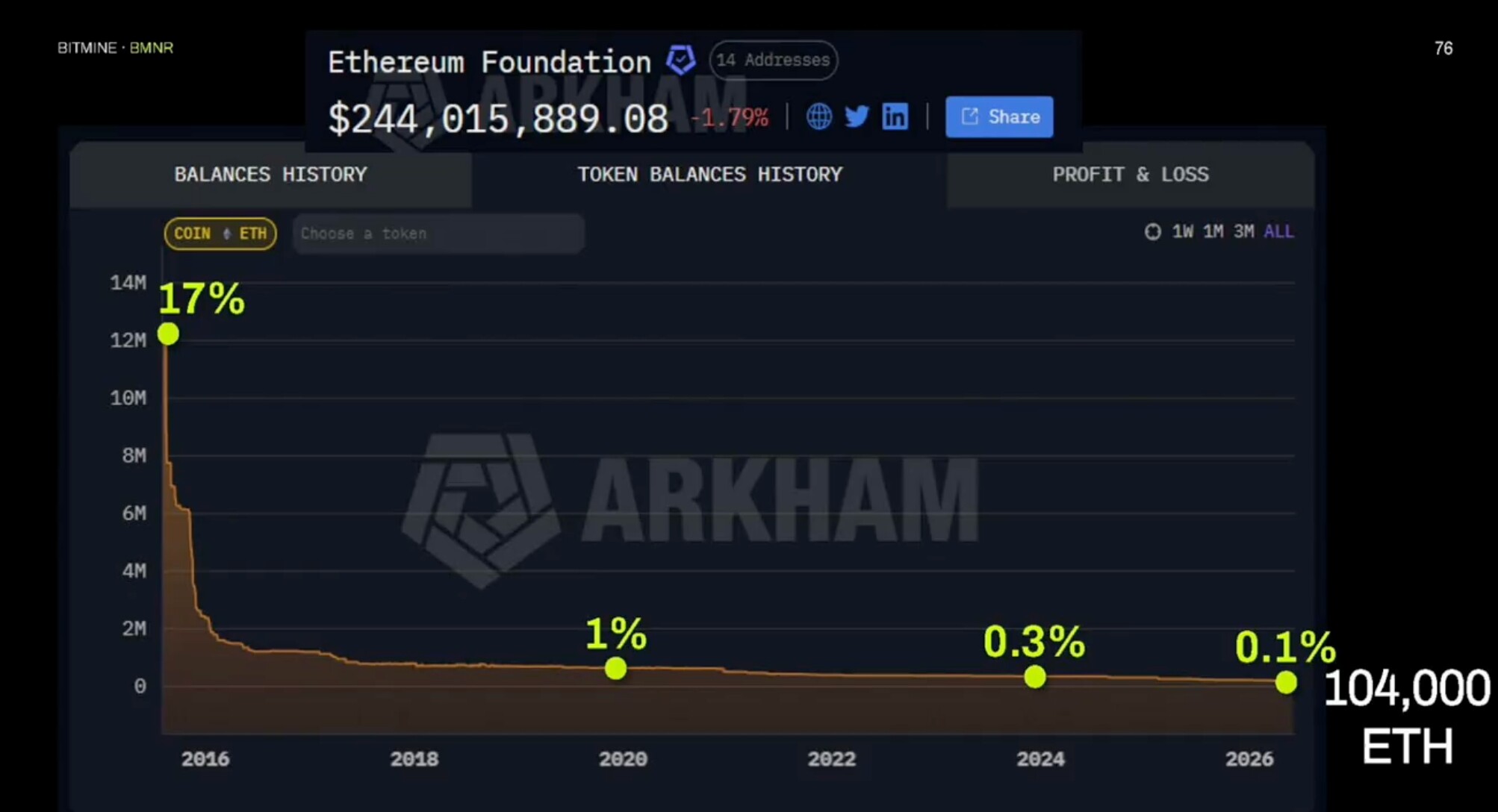
If we follow the typical foundation model—a 5% return rate—they could only support about $10 million in funding projects. But this is precisely where treasury stocks come into play; what I refer to as the Ethereum treasury includes BitMine, Sharplink, etc.—now holding 7% of the ETH supply.
If you are an accountant, you know what treasury stocks are. Treasury stocks are basically supply that is permanently extracted from the ecosystem. We also currently have yield—about a 3% yield. So today, these public treasuries generate $500 million in rewards annually, which is the funding we can use to finance the crypto ecosystem. By the way, BitMine accounts for 4.5% of the total ETH supply and 65% of all ETH treasury holdings.
To summarize, before 2024, with a friendly White House, foundations played an important role in funding public goods, providing much legal and operational infrastructure. Of course, they also coordinated the ecosystem, maintained neutrality, and attempted to drive adoption. These are indeed very important functions. This makes sense in the DeFi world.
But as we find ourselves in 2026, in this new world, the role of foundations has evolved.
First, they would still like to manage long-term research: for instance, anti-quantum computing, privacy, how to keep this blockchain relevant. They hope to coordinate efforts in the private sector. They aim to set standards and best practices. I believe they will play a public role representing the ecosystem.
But they wish to reinforce decentralization. Why is this so necessary? An entity with a network value of $240 billion, which has been running for 11 years without a single day of downtime. It has 1,500 nodes spread across 89 different countries, and 15,000 developers.
I think this scale is too large to be coordinated by a single foundation. In fact, I have done a lot of research, and here are three examples:
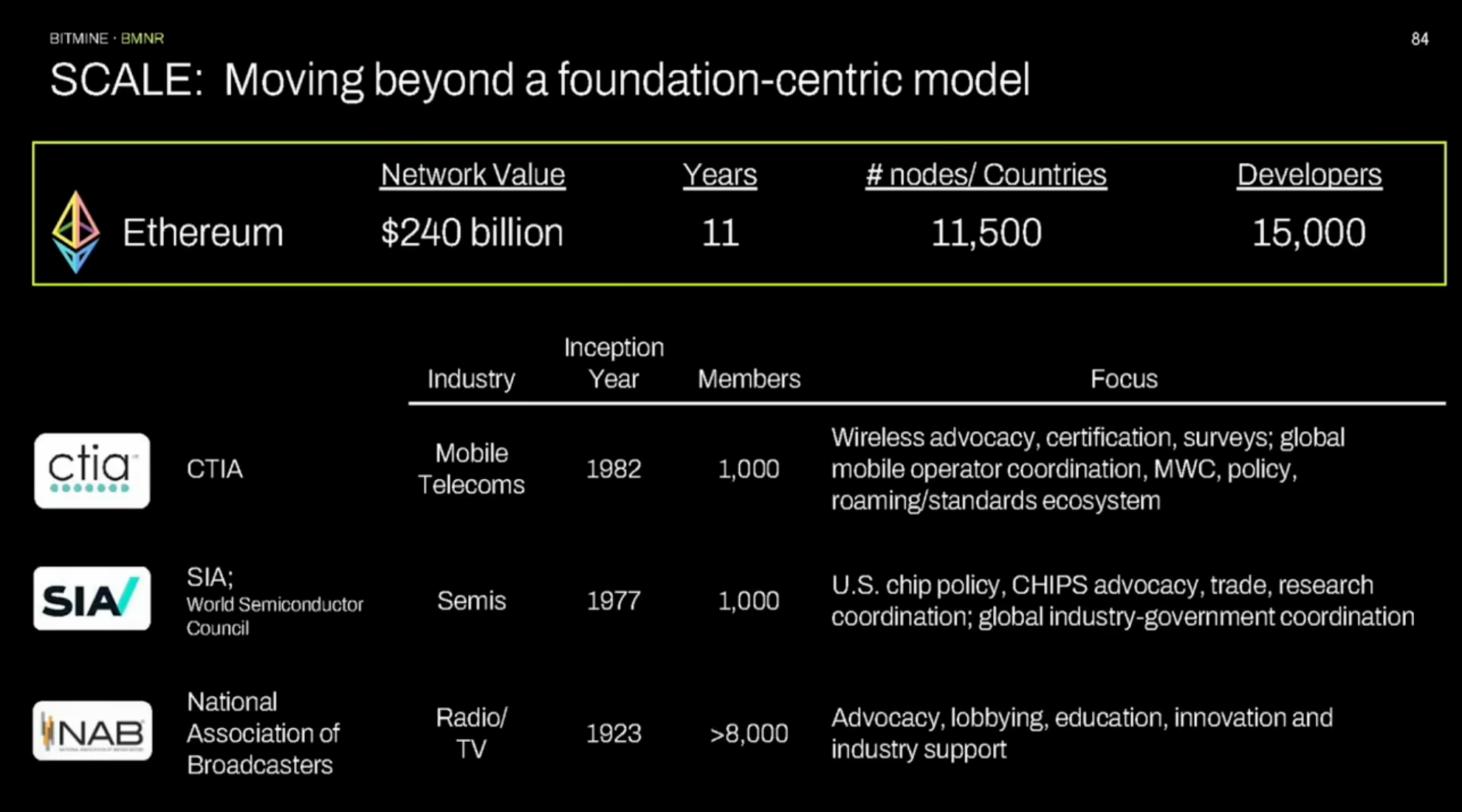
The mobile communications sector—I think this is most similar to what is happening in the crypto space—has an organization called CTIA, founded in 1982. Today it has 1,000 members. They operate and set all mobile-related standards. But each company truly engaged in the mobile business operates independently. This is a very important coordinating center.
The semiconductor industry—of course made extremely important by AI—they have the Semiconductor Industry Association and the World Semiconductor Council. Again, this is a centralized foundation, but its role is very limited.
The third is the National Association of Broadcasters, established in the early days; they were among those who created the broadcasting industry in 1923. Today broadcasting has its own robust ecosystem, but it was initially these people who created it all.
So, when I look at Ethereum, I believe it has already established a similar prototype. Here are some examples of private companies representing the ecosystem that are already collaborating on an enterprise level.
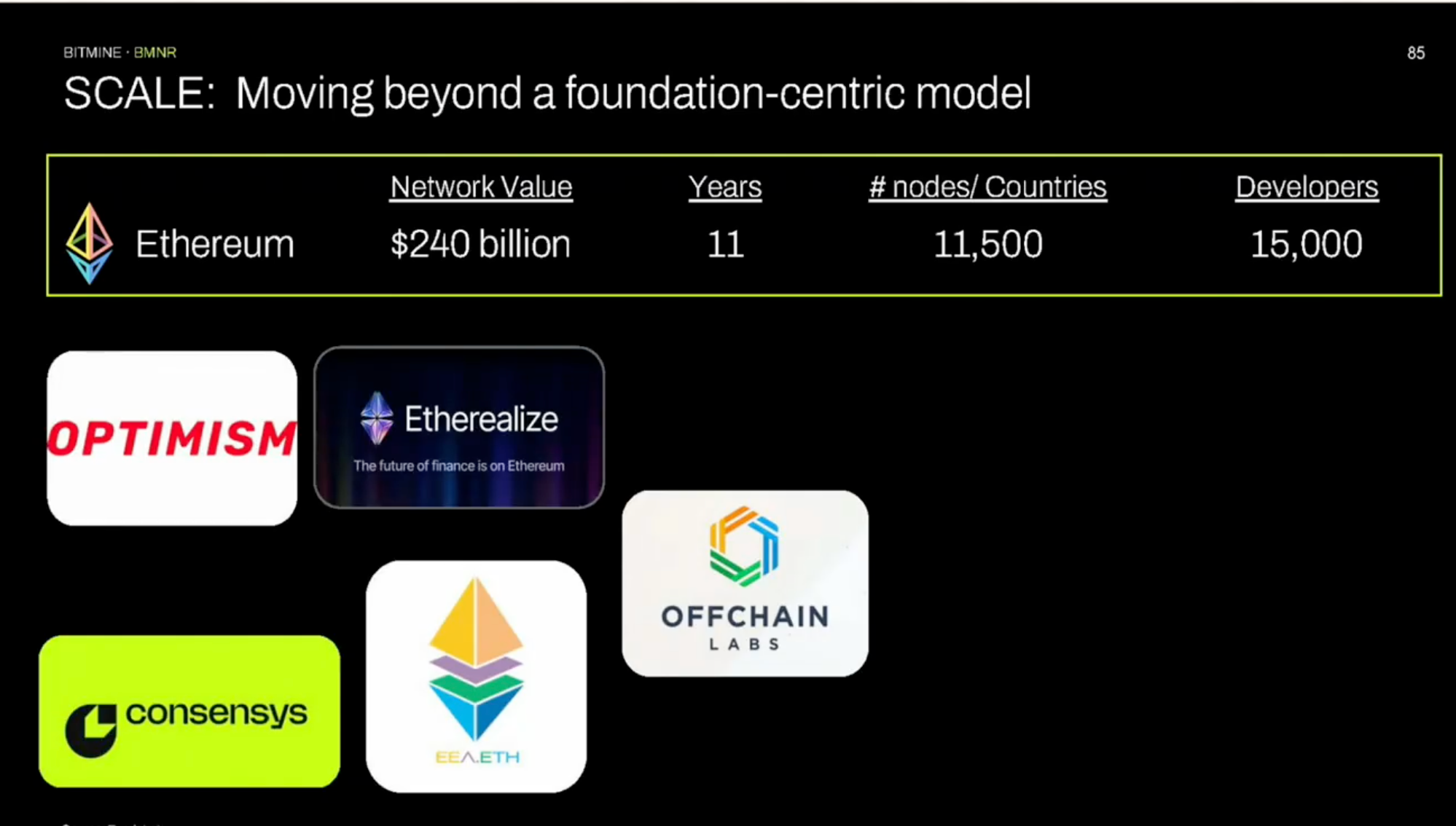
This list does not yet reflect the entities that will separate from the Ethereum Foundation, at least five or more, and BitMine will play a role in funding and supporting any spun-off entities.
To summarize, Ethereum has excellent governance, as foundations will become stronger by maintaining focus. We have many private companies that have established profitable products on Ethereum and important Layer 2 solutions. Of course, treasuries also help provide funding and grants. So I believe that the foundation world after 2026 has already formed a basic framework.
Therefore, if you are bearish now, you are selling at the bottom. Let me emphasize again, if you are bearish today, then you are bearish at the bottom of BitMine and Ethereum.
3. BitMine is Prepared for the Bull Market
In fact, the Ethereum treasury is really prepared for the next bull market cycle. Let me explain why.
Taking BitMine as an example, it has done a lot of building work during this crypto winter.
The first thing we did was invest in a company called Eightco, which focuses on artificial intelligence and identity verification, ticker symbol ORBS. Eightco is also the largest public shareholder of Worldcoin. Worldcoin is Sam Altman's AI project, but it plays a very important role: providing a World ID to prove and verify human identity in a world essentially run by robots.
Remember, as I showed earlier, today, non-human entities dominate traffic—whether it's on Polymarket, websites, emails, or stock trading. Today when you buy stocks, you are basically buying them from robots. Creating websites, product reviews, at least a third of product reviews are fake, even on Twitter and Reddit. In fact, Reddit's CEO, Alexis, has been negotiating with World ID to ensure that people must first prove they are human before they can comment.
Furthermore, ORBS holds other stakes. In the ORBS balance sheet, OpenAI shares account for 28%, MrBeast shares account for 8%, ETH accounts for 8%, and the remaining 34% is cash.
There is another similar company named Found Fund Rise, ticker VCX—they hold similar AI-related assets; their trading price is 13 times their net asset value. If ORBS's trading multiple were the same as VCX's, then the current price of $1 for ORBS should be close to $15 today. So this is definitely a severely undervalued stock.
The second thing BitMine did was launch the largest staking operation globally. It is the largest single staking operator for Ethereum and has already started operations named MAVAN.
In fact, MAVAN has managed and staked about $2 billion in other crypto assets, including Solana and Hyperliquid. I believe they are bringing in several more chains as super nodes.
We have about $14 billion in managed assets; just from the ETH we staked ourselves, we generate a massive amount of rewards, approximately $1 million daily.
So, if you're wondering why you should hold BitMine? If you hold it, remember this company earns a million dollars every day. In my 30-minute speech, that means we have generated nearly $200,000 in staking rewards.
The third thing BitMine did was invest in MrBeast. He is the greatest content creator in the world, and they just disclosed some financial data two weeks ago: current revenue exceeds $1 billion, with a growth rate of 50%. For us, he is the largest content creator globally—already a billion-dollar business, growing over 50%. Now he wants to enter banking and has acquired Step Financial.
In my opinion, MrBeast will become the next Robinhood or SoFi, but targeting Gen Z and Alpha generation. This group consists of 120 million people, which is a substantial demographic.
Today, Gen Z and Alpha may not be very wealthy yet, but they are still growing. The reason they aren’t wealthy is that they are very young. But remember, when the Baby Boomers first started supporting Schwab, they were not wealthy either.
And now, they are the wealthiest generation in history. Generation X created BlackRock and Blackstone. Similarly, Generation X was not financially comfortable in their 20s. Most importantly, a massive wealth transfer is about to occur. Millennials and Gen Z stand to inherit $50 trillion to $60 trillion in the next 20 years.
So, if you want to bet on the next generation of financial companies, bet on those related to Gen Z and Alpha. By the way, this also includes crypto.
Finally, BitMine has achieved some significant milestones. We successfully transitioned to listing on the New York Stock Exchange (NYSE). This is significant because very few companies trade on the NYSE, especially crypto companies, and BitMine also meets the qualification criteria for inclusion in the Russell 1000 index. This news was announced last week, with the inclusion date set for June 26.
Why is this important? Because the Russell 1000 is the most widely-tracked index globally. We will become part of the Russell 1000 index. Every single fund manager globally using the Russell 1000 as their benchmark—this means over $40 trillion of funds—will have to decide whether to hold BitMine.
Assuming there are about 1,600 active fund managers benchmarking to the Russell 1000—currently, BitMine has 25 institutional holders—this means there are 1,575 institutions that will decide on June 26 whether to hold BitMine. Of course, I believe this will be a major catalyst for BitMine stock later this year.
Finally, let me introduce our ETH accumulation situation. We reached 1% of the Ethereum supply in August of last year, reached 4% on April 10 this year, and today we have reached 4.5%. We may reach 5% as early as the end of June.
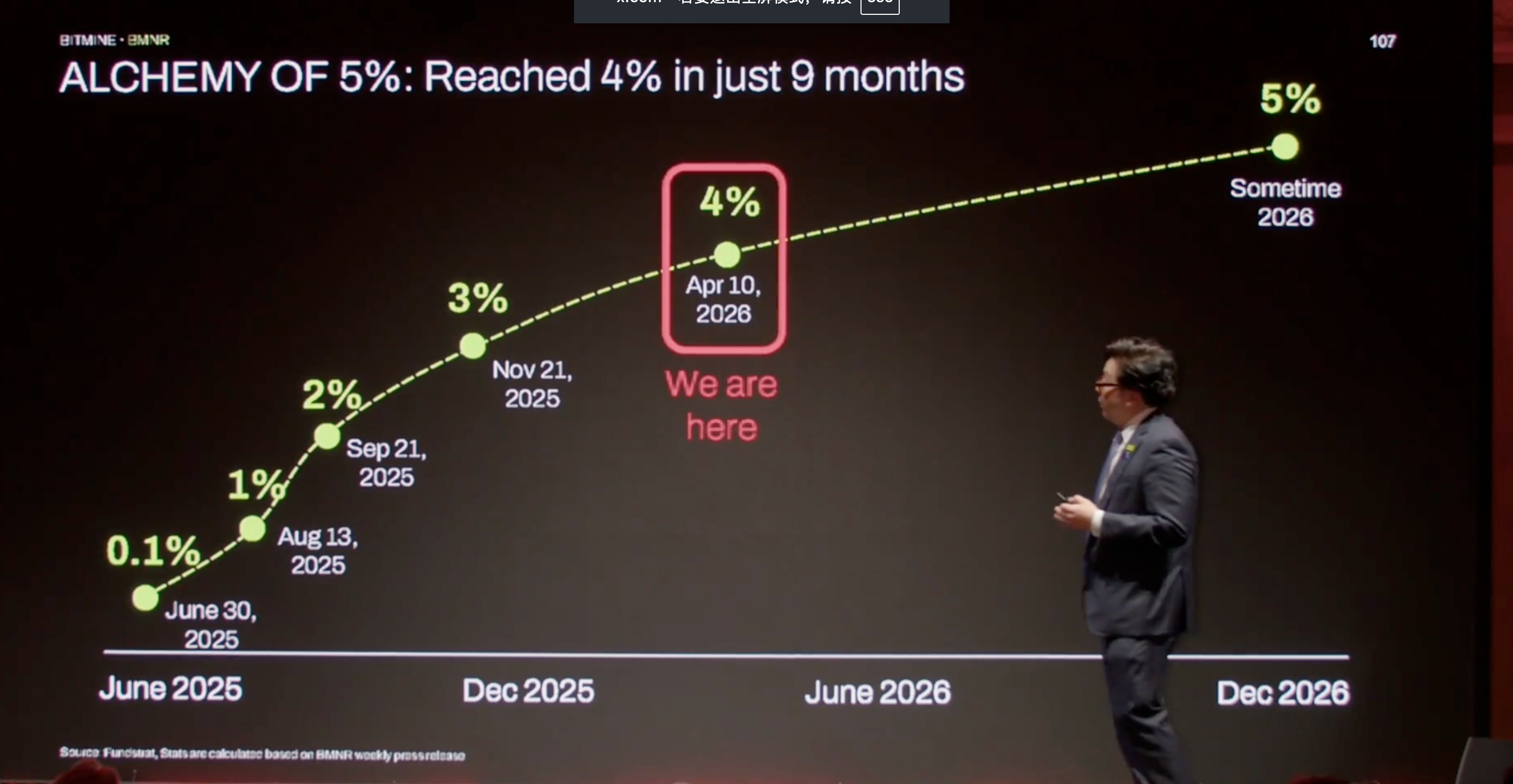
But we may also or may not attempt to do so because we are bullish on ETH. I believe people want to see us complete our acquisitions. But we are also discussing whether it makes sense to hold over 5%. Therefore, before making this decision, we will not rashly cross the 5% threshold but will take it slow. We will slow our accumulation until we make a decision.
Finally, remember that a true treasury stock's performance will outperform crypto assets. Based on last year, from June 30 to December 31, when we founded BitMine, ETH rose by 22%, while BitMine surged by 500%, significantly outperforming Ethereum. This year, while ETH is down, I believe it won’t remain down for the whole year, and you can also see that BitMine performs better when ETH is down.
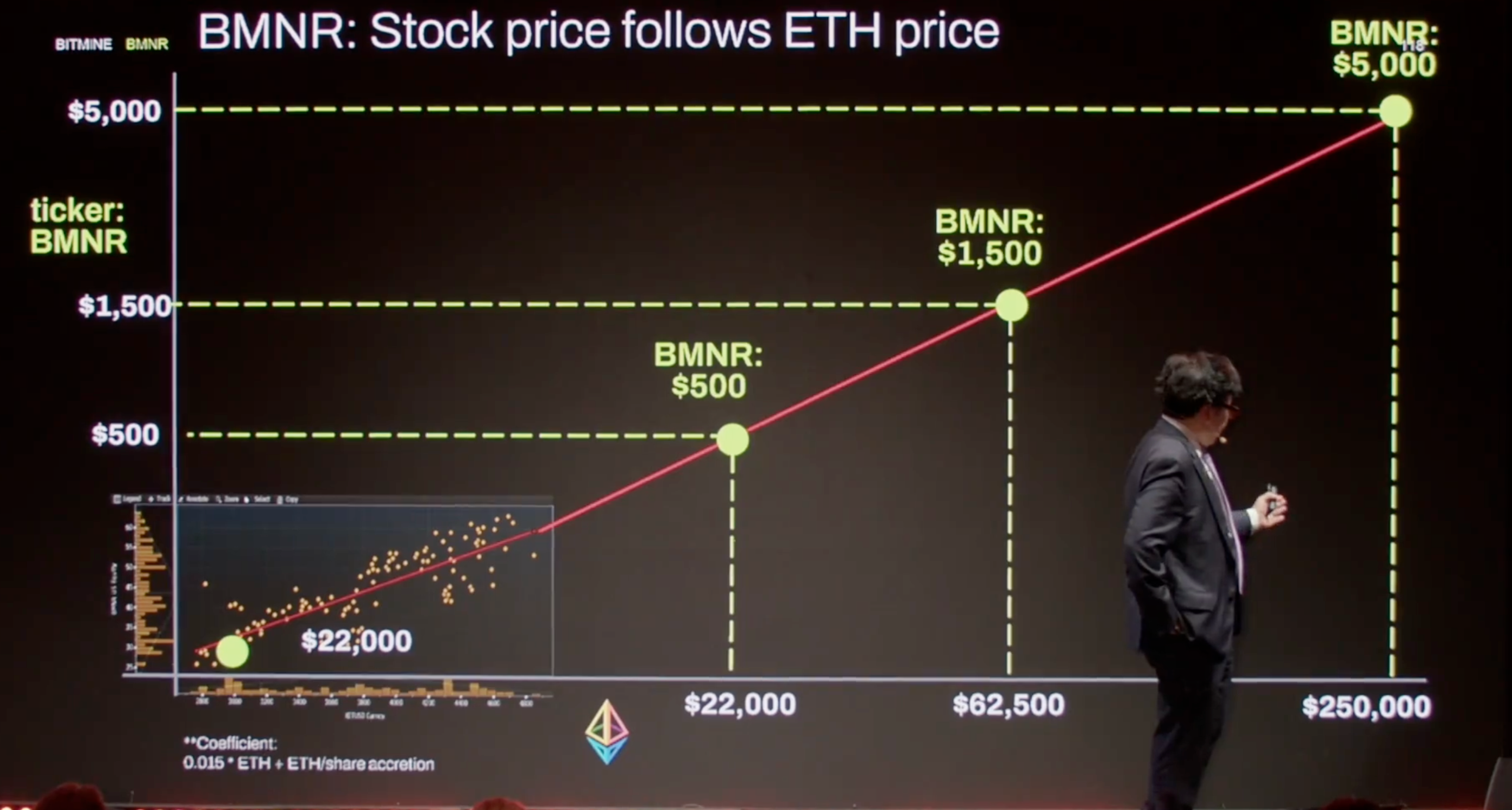
Therefore, if our judgment on the rise of ETH prices is correct: the horizontal axis is the Ethereum price, while the vertical axis is our stock price, with a 90% correlation between the two.
If ETH rises to $250,000, that will be here at the far right of the chart. A $250,000 ETH will make BitMine's stock value reach $5,000. At $18, that is very attractive. If ETH reaches $22,000, I think that is a reasonable price, and our stock will reach $500.
So, if you want to hold liquid crypto treasury assets, then buying treasury stocks is a better choice.
That concludes my remarks, thank you very much.
免责声明:本文章仅代表作者个人观点,不代表本平台的立场和观点。本文章仅供信息分享,不构成对任何人的任何投资建议。用户与作者之间的任何争议,与本平台无关。如网页中刊载的文章或图片涉及侵权,请提供相关的权利证明和身份证明发送邮件到support@aicoin.com,本平台相关工作人员将会进行核查。


