The on-chain environment has never seemed so quiet, except for hackers.
If you look at the data statistics from Slow Mist's "Hacked Archives," you will find that although the current market heat has decreased and on-chain activity has fallen back, hackers are still "diligently" launching attacks in the Web3 world. Among them, cross-chain bridges, DeFi protocols, wallet authorizations, private key management, and phishing attacks remain some of the most common targets for hackers.
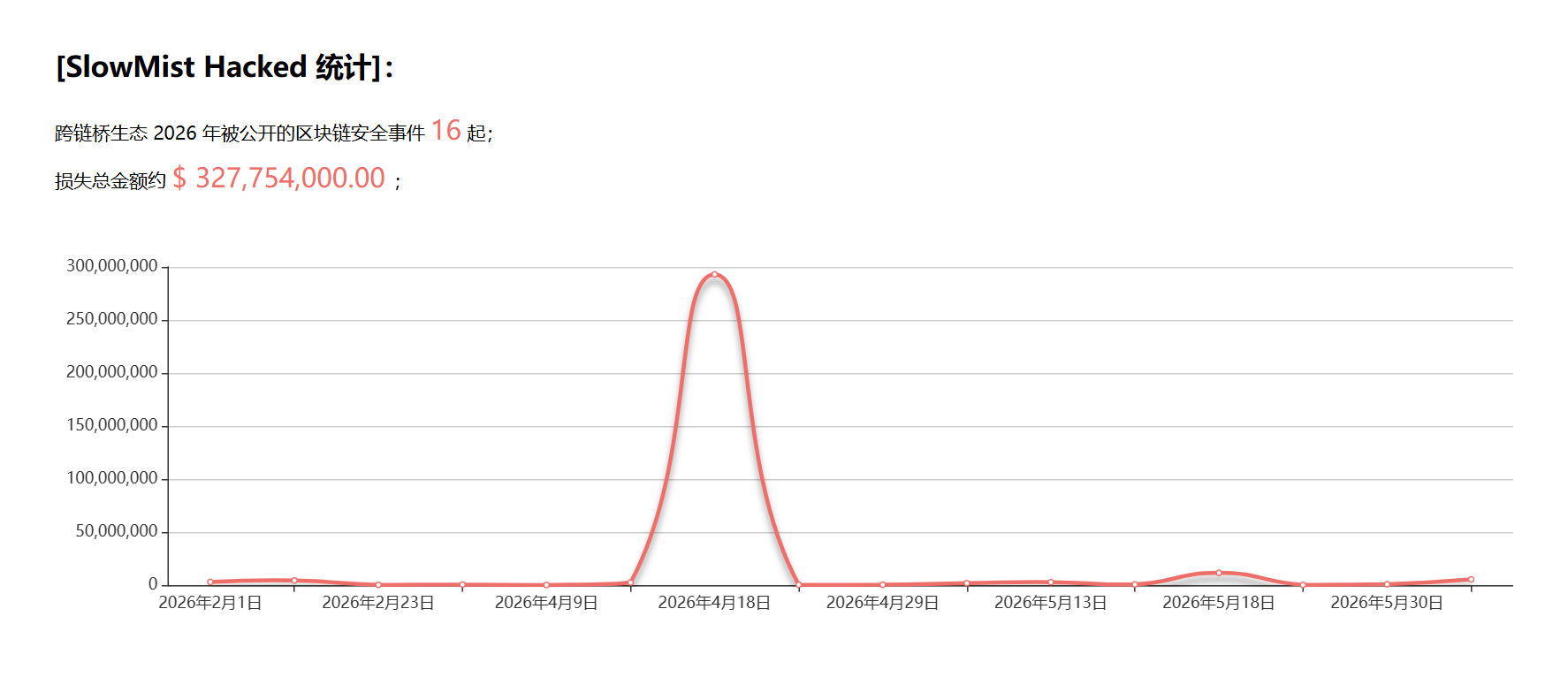
If categorized according to Slow Mist's "Hacked Archives" statistics, since 2026, Web3 security incidents have resulted in cumulative losses exceeding 900 million USD, with more than 16 cross-chain bridge incidents, resulting in losses of about 330 million USD. Taking recent incidents as an example:
The Gravity Bridge was allegedly attacked due to issues related to contract keys or signature authorizations, resulting in the theft of approximately 5.4 million USD in assets; the Alephium TokenBridge Ethereum cross-chain bridge also experienced a vulnerability attack, stealing approximately 815,000 USD in assets in a short period and causing a large number of unbacked Wrapped ALPH to be minted.
These incidents are not entirely the same as the "wallet theft" that ordinary users often hear about; in many cases, the user's mnemonic phrase has not leaked, and the wallet has not actively signed malicious transactions. However, if the verification mechanism, signature permissions, or operational infrastructure of the cross-chain bridge itself encounters issues, the assets on the bridge may still be affected.
This is also the aspect of cross-chain bridge risks that is most easily overlooked.
1. Why are cross-chain bridges always targeted for attacks?
Many users unconsciously understand that when they first use a cross-chain bridge, they are transferring assets from Chain A to Chain B.
However, more accurately, cross-chain is typically not about assets genuinely being "moved" from one chain to another but rather involves a set of bridging mechanisms that complete asset mapping, locking, and minting. In short, the true role of cross-chain bridges is not just as a "channel," but rather as an asset verification and accounting system between two chains.
The problem lies here.
This means that if the bridge's signing key is leaked, an attacker could fabricate legitimate authorizations; if the number of Guardians is too few or the verification mechanism is bypassed, malicious cross-chain messages may be executed as if they were genuine; and if the contract's permission design is unreasonable, an attacker might bypass normal processes to steal locked assets or mint mapping assets on the target chain without real asset backing.
What users see is just one click, but behind it involve multiple layers such as contract permissions, signature mechanisms, message verification, asset custody, off-chain services, and monitoring systems. Any layer that encounters problems can expose assets to risks. To put it simply, the reason cross-chain bridges are easy targets for attacks is not that the "cross-chain" demand itself has issues, but because they naturally concentrate three types of high-value permissions:
- First, cross-chain bridges often hold large amounts of locked assets; many bridged assets correspond to real assets locked on the source chain. If a bridge contract has substantial USDC, USDT, ETH, or other highly liquid assets, it will naturally become a key target for attackers;
- Second, cross-chain bridges must address the issue of "what happens on another chain" since blockchains cannot inherently read the state of another chain. Therefore, cross-chain bridges must rely on some verification mechanisms, such as validator signatures or other relay systems. The more complex these mechanisms are, the larger the attack surface;
- Finally, ordinary users find it difficult to directly assess the real security status of a bridge; the ability to open a cross-chain page does not mean that the bridge is in a secure state. Whether the signers of the bridge are safe, whether the contract permissions are reasonable, and whether the backend services have been breached are not readily observable from the front-end interface;
The recent Kelp DAO security incident has once again pushed relevant discussions to the forefront. Public retrospectives reveal that such incidents do not necessarily stem from code vulnerabilities in smart contracts, but may arise from cross-chain verification configurations, off-chain infrastructure, or operational security issues.
In other words, today, the so-called "interoperability" between many L1, L2, and multi-chain applications still fundamentally relies on a series of trusted relays, validations, and signature mechanisms, and when these mechanisms are misconfigured or breached, they may become the weakest link in the entire system.
This is why cross-chain security cannot rely solely on users to "be a bit more cautious," nor can it depend on protocols being "audited once." It requires wallets, protocols, security teams, cross-chain infrastructure, and users to jointly establish a more comprehensive risk identification and protection mechanism.
2. Cross-chain can be used, but more judgment is needed.
Of course, objectively speaking, cross-chain bridges are not unusable.
The multi-chain ecosystem has become a reality of Web3, and users need to transfer assets between different networks, use applications, participate in DeFi, or manage positions. Cross-chain bridges remain important infrastructure. What truly needs to change is not "completely avoid cross-chain," but rather to not treat cross-chain as an ordinary transfer.
Before cross-chain, users should at least take a few extra steps to judge.
First, confirm that the entry point comes from official channels. Be especially cautious not to enter cross-chain pages from messages in social channels, search ads, unfamiliar tutorials, or links in comment sections. Especially after security incidents have just occurred, attackers can easily take advantage of the situation to forge phishing sites that pretend to be "asset migration" or "emergency recovery," tricking users into connecting wallets, authorizing assets, or inputting mnemonic phrases.
Second, check if the project team has issued any abnormal announcements. If a bridge has just been attacked, do not rush to continue with cross-chain transactions, and avoid blindly trading related wrapped assets. This is because based on historical experiences, many attack incidents do not completely clear risks immediately; attackers may still hold unbacked assets or exploit market liquidity to continue extracting real assets.
Third, conduct small-scale tests; do not transfer large amounts of assets in one go, especially when using an unfamiliar bridge, an unknown chain, or a newly launched bridge. First, use a small amount to confirm the path, arrival time, and status of target chain assets are normal. Although small-scale tests cannot completely eliminate risks, they can reduce large losses caused by path errors, fake entry points, or asset identification issues.
Fourth, when authorizing, try to avoid unlimited authorizations. Currently, many cross-chain operations require prior token authorization to contracts. If only crossing 100 USDT, avoid giving long-term authorizations that are far higher than the actual usage amount. After all, the larger the authorization limit, the higher the subsequent potential risk exposure, especially for long-unused, unknown-sourced, or security status-volatile DApp authorizations, which should be regularly checked and cleared.
Fifth, read the signing and transaction information carefully. Do not click confirm in succession just because you are in a hurry, especially when you see unfamiliar websites, abnormal contract addresses, strange signature content, or authorization requests that do not match your expected actions. You should immediately stop operations.
Lastly, after completing a cross-chain transaction, the security check should not end immediately. Many users may think that once assets arrive, the cross-chain operation is complete. However, from a security perspective, post-cross-chain checks are equally important:
- After completing cross-chain transactions, first use a block explorer to independently check the transaction status on both the source chain and the target chain to confirm whether the assets have genuinely completed the transfer, rather than relying solely on what the front-end page displays;
- At the same time, confirm whether the assets received on the target chain are from official or trustworthy contract issuers; do not casually trade tokens with ambiguous origins, and do not click associated websites or claim entrances just because a certain asset suddenly appears in your wallet;
- Finally, regularly check and clear authorizations that are no longer in use, as many authorizations do not automatically expire. If you have previously granted high-limit permissions to a cross-chain bridge, DApp, or contract, even if you no longer use it, it may continue to bear exposure to risks;
Ultimately, security does not only occur at the moment of mnemonic phrase storage but runs through the entire process connecting DApps, authorizing tokens, signing transactions, cross-chain transfers, and subsequent clean-ups.
3. More hidden than bridges is the "human" being compromised.
Cross-chain bridge incidents remind us that there may be risks inherent in on-chain infrastructure. However, from an ordinary user's perspective, another more common and insidious risk comes from social engineering attacks.
Social engineering attacks do not necessarily rely on complex code vulnerabilities. Their core lies in exploiting human habits, trust, anxiety, and information asymmetry, causing users to unwittingly perform dangerous operations.
In the past two years, phishing attacks, private key theft, malicious authorizations, and address spoofing targeting users have become highly frequent sources of asset losses in Web3. This indicates that hackers are not always fixated on breaching the smart contracts themselves; rather, they are increasingly turning towards user operations and off-chain systems.
Common social engineering attacks typically revolve around one word: deceiving.
For instance, attackers might use dusting attacks, NFT airdrops, fake incentive claims, or fraudulent activity pages to entice users into clicking and authorizing; once users mistakenly believe they are just claiming rewards, they may actually grant malicious contracts permissions to transfer assets, leading to subsequent asset theft by the attacker.
Similarly, attackers might use Trojan viruses, clipboard monitoring, malicious browser plugins, or spoofed input interfaces to steal mnemonic phrases and transaction information. For users, the most dangerous aspect lies in the fact that these attacks often do not occur on-chain but happen in everyday devices and operational habits.
The most noteworthy aspect of these risks is that they do not attack code but attack habits.
Many users do not fall victim due to ignorance of security but rather because they are too accustomed to performing operations. They become so familiar that they click "confirm" when they see it, copy historical addresses, claim airdrops, and follow customer service reminders without critical thinking. Attackers exploit this familiarity to hide risks within the most routine operational pathways.
Therefore, when users operate on-chain, especially when using DeFi, cross-chain bridges, trading tools, or new project pages, authorization management and transaction confirmation must become fundamental habits. Do not grant long-term and high-amount authorizations to unfamiliar DApps, do not input mnemonic phrases on unknown websites, do not trust customer service in private messages, do not directly copy addresses from history, and do not disregard wallet pop-up risk alerts.
In Conclusion
Even though the market is so lukewarm, we must still say that cross-chain bridges are not unusable, DeFi is not to be avoided, and new chains and applications should not be shied away from trying.
What we need to understand is that the more complex on-chain operations become, the more intricate the risk structure becomes. Just like in the past when we discussed wallet security, the focus often was to "not leak your mnemonic phrase." This statement is certainly valid, but in the current actual context, it is no longer sufficient:
Today's security issues have expanded from "who can control your private key" to multiple dimensions—not just safeguarding the mnemonic phrase but also addressing the connection to DApps, authorizing contracts, signing transactions, cross-chain transfers, and clearing historical authorizations. Therefore, the simplest security principle for ordinary users can be distilled into one sentence:
Do not confirm when you do not understand, do not authorize when you are unsure, and do not transfer when you have not verified.
免责声明:本文章仅代表作者个人观点,不代表本平台的立场和观点。本文章仅供信息分享,不构成对任何人的任何投资建议。用户与作者之间的任何争议,与本平台无关。如网页中刊载的文章或图片涉及侵权,请提供相关的权利证明和身份证明发送邮件到support@aicoin.com,本平台相关工作人员将会进行核查。


