TL;DR
- Marvell raised its revenue guidance for fiscal year 2027 to $11.5 billion, with interconnect business growth revised up to over 70%.
- The current growth mainly comes from validated out-of-scale businesses, while technologies such as CPO still need to be verified after 2027.
- Related companies: MRVL (US Stock), AVGO (US Stock), COHR (US Stock)
After Jensen Huang's enthusiastic shouting, Marvell once again confirmed exceptionally strong AI-related orders at the Evercore TMT Summit and adjusted its revenue guidance for fiscal year 2027 to around $11.5 billion, while raising the forecast for interconnect business growth from about 50% to over 70%. Custom ASICs are expected to generate about $2 billion this year, with a target to double next year. Since 2026, the company's stock price has increased nearly 140%-158%, far exceeding peers and the average market level, with several instances of daily increases exceeding 30%, and trading volume has significantly enlarged.
Most reports interpret this series of signals as Marvell firmly holding the leading position in AI interconnect, with data center business becoming absolutely core. However, the reality is that the current main driver of growth is still the out-of-scale businesses that have been validated in the market, relying on the advantages of volume production for PAM DSP, TIA drivers, and pluggable optical modules. In contrast, the more strategic and higher single-cluster value of large-scale optics and CPO (Co-packaged Optics) are still preparing for mass production in 2027. From early deployment to forming hundreds of millions in annualized revenue by 2028, the execution certainty is key to judging whether the growth momentum can continue until 2028, whether the company can pivot from component supplier to strategic partner for cloud vendors, and whether the current high valuation has adequately reflected optimistic expectations.
Summit update shows AI orders are indeed strong
At the summit, Marvell raised its guidance based on already secured AI orders and supply chain commitments, rather than long-term visions. The revenue guidance for fiscal year 2027 has been raised to about $11.5 billion, with the upper limit for 2028 further increased to about $16.5 billion. The interconnect business is expected to grow over 70% year-over-year in 2027, with custom ASICs contributing around $2 billion this year, and a target exceeding $4 billion next year, with external CXL and customized NIC targets exceeding $3 billion for 2028.
These figures have specific backing. Management repeatedly mentioned that demand driven by capital expenditures is very strong, and orders have translated into visible growth paths. Key components like lasers, though facing tight delivery times, have had their capacities secured; PAM DSP maintains a leading pace of mass production for each generation (1.6T is being deployed widely this year, with 3.2T samples expected next year). This aligns with the paths from previous earnings conference calls, pointing to real demand rather than simple optimistic forecasts.
However, the stock price has already traded significantly on this story in advance. Year-to-date returns have far exceeded peers and indices, with volatility and implied options volatility increasing in tandem after a surge. Market discussions have shifted from looking for beneficiaries to questioning "how much longer it can rise" and the risk of pullbacks. This forms a clear contrast: the momentum supported by short-term orders is visibly apparent, yet market pricing has already incorporated considerable medium- to long-term optimistic assumptions.
After the strong guidance, investors will naturally ask where this growth is coming from, and how much each of the out-of-scale and large-scale contributions is.
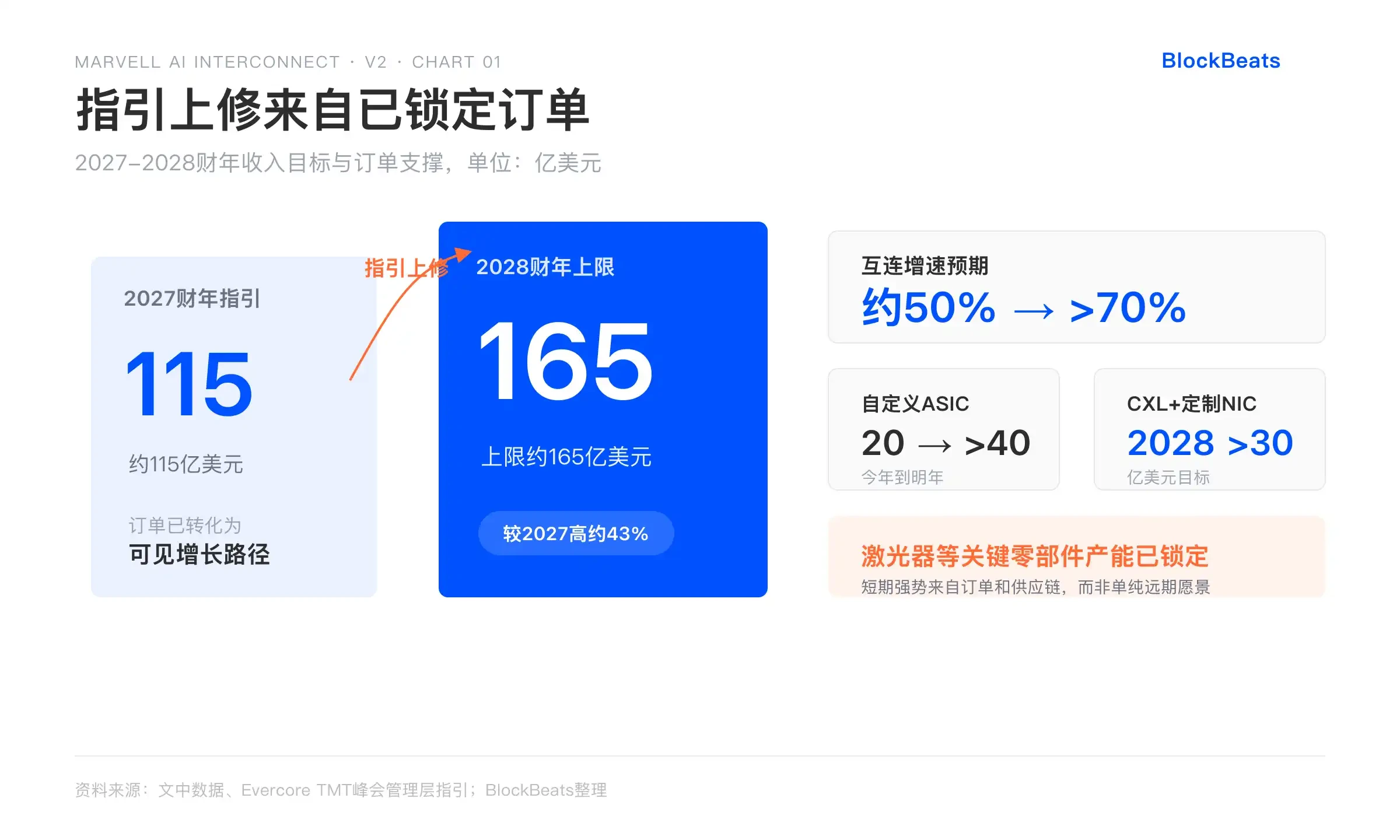
The current main growth driver is mature out-of-scale businesses
The current main thrust of the interconnect business still lies in the out-of-scale segment. PAM DSP, TIA drivers, as well as pluggable optical modules (400G, 800G, and 1.6T) have already formed mature product lines, and each generation's leading pace of mass production helps the company maintain its market share. The annual revenue from TIA with drivers has reached approximately $1 billion. The complete coverage from long-range coherent to lighter high-speed PAM positions the company advantageously in the horizontally expanding market between data centers.
The large-scale business is just entering an accelerated phase from its initial stage. As AI clusters expand from tens of thousands of GPUs or XPUs to millions, the front-end computing power is like engine upgrades, while the back-end interconnect is like a highway needing expansion from a single lane to multiple lanes. The bandwidth demand within the cluster is roughly ten times that of the front-end. Power consumption and density bottlenecks are driving the industry to shift from traditional pluggable optical modules to near-packaged optics and CPO, significantly increasing chip loading per rack and expanding the overall market space.
The core of CPO is to package optical engines with XPUs or switches together, reducing electrical-to-optical conversion losses, thus enhancing bandwidth density and lowering overall power consumption. This is not simply swapping out a component, but a system-level solution to address the new bottlenecks of large-scale clusters. Marvell, leveraging the SerDes IP and DSP capabilities acquired from previous acquisitions and the recently integrated Celestial AI technology, is attempting to establish integrated advantages in this direction. However, the contributions from large-scale businesses are still limited, with actual volume growth expected to wait until the mass production rollouts post-2027.
Large-scale represents greater single-machine content increases and market expansion opportunities, so how is Marvell’s technological path, capacity preparation, and execution capability in this emerging field?
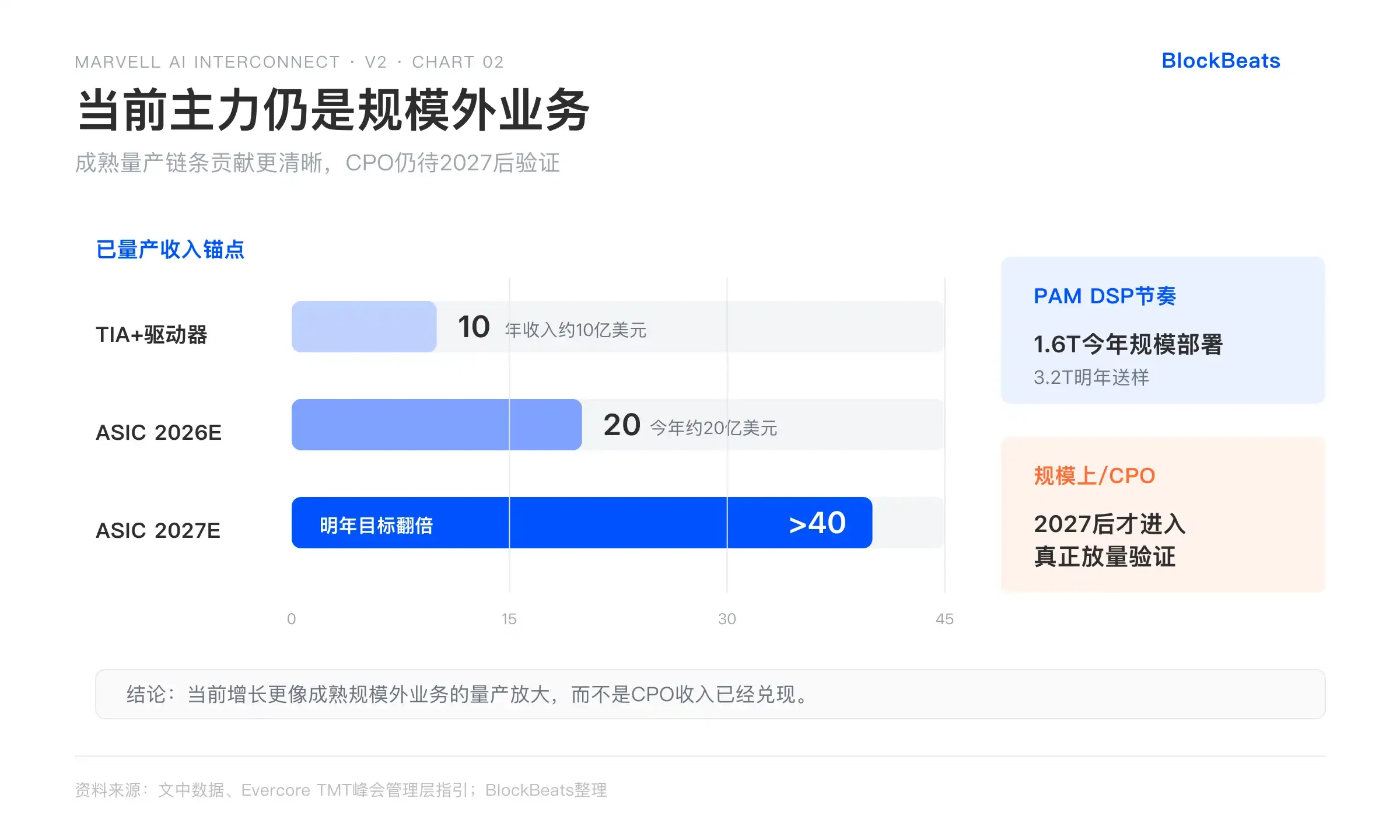
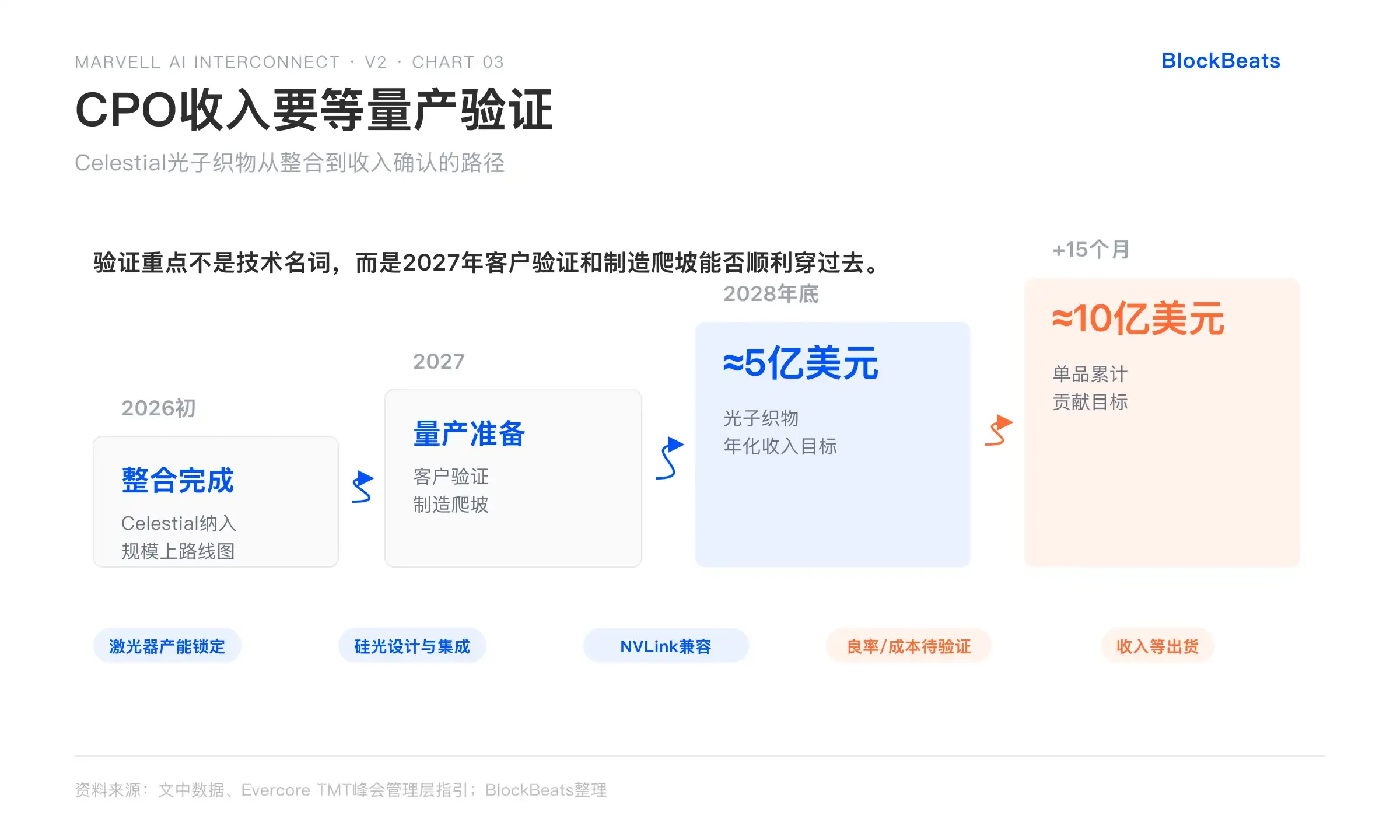
What is the CPO mass production path after the Celestial acquisition?
The acquisition of Celestial AI was completed in early 2026, and its photonic fabric technology has been incorporated into Marvell’s large-scale roadmap, to be jointly packaged with customized XPUs and large-scale switches. Management expects to enter the formal mass production preparation phase in 2027, targeting approximately $500 million in annualized revenue from the photonic fabric by the end of 2028, with plans to eventually double that, cumulatively contributing about $1 billion within 15 months (by product specification). This path has been optimized compared to earlier projections but still relies on customer validation and the smooth advancement of manufacturing ramp-up.
Supply chain details indicate increased certainty. While the delivery time of lasers is tight, Marvell has secured relevant capacities; the company focuses on silicon photonic chip design and integration rather than producing lasers itself. Partnership with NVIDIA on NVLink Fusion further enhances the coverage of silicon photonics, custom XPUs, and networking interoperability with NVIDIA clusters, as well as supporting AI-RAN with OCTEON baseband. This not only enhances technological compatibility but also improves credibility in hyperscaler bidding, making it easier for Marvell's heterogeneous computing solutions to be included in next-generation AI factory plans.
If million-XPU-level clusters widely adopt CPO, with significant reductions in power consumption and increased bandwidth density, it will directly boost Marvell's content value in each rack and support revenue and gross margin expansion. Conversely, if the ramp-up for mass production in 2027 is slower than expected, if customer validation cycles extend, or if yield and cost curves do not meet expectations, contributions in 2028 may fall below current market implied levels, and overall guidance will show pressure to deliver. All current statements still belong to forward-looking guidance, and actual shipping and market share data will only be available in 2027 for more concrete validation.
Under the full-stack layout from SerDes, DSP to optical engines and custom XPUs, and with ecosystem partner support, can Marvell maintain differentiation in the competition and translate it into actual share gains?
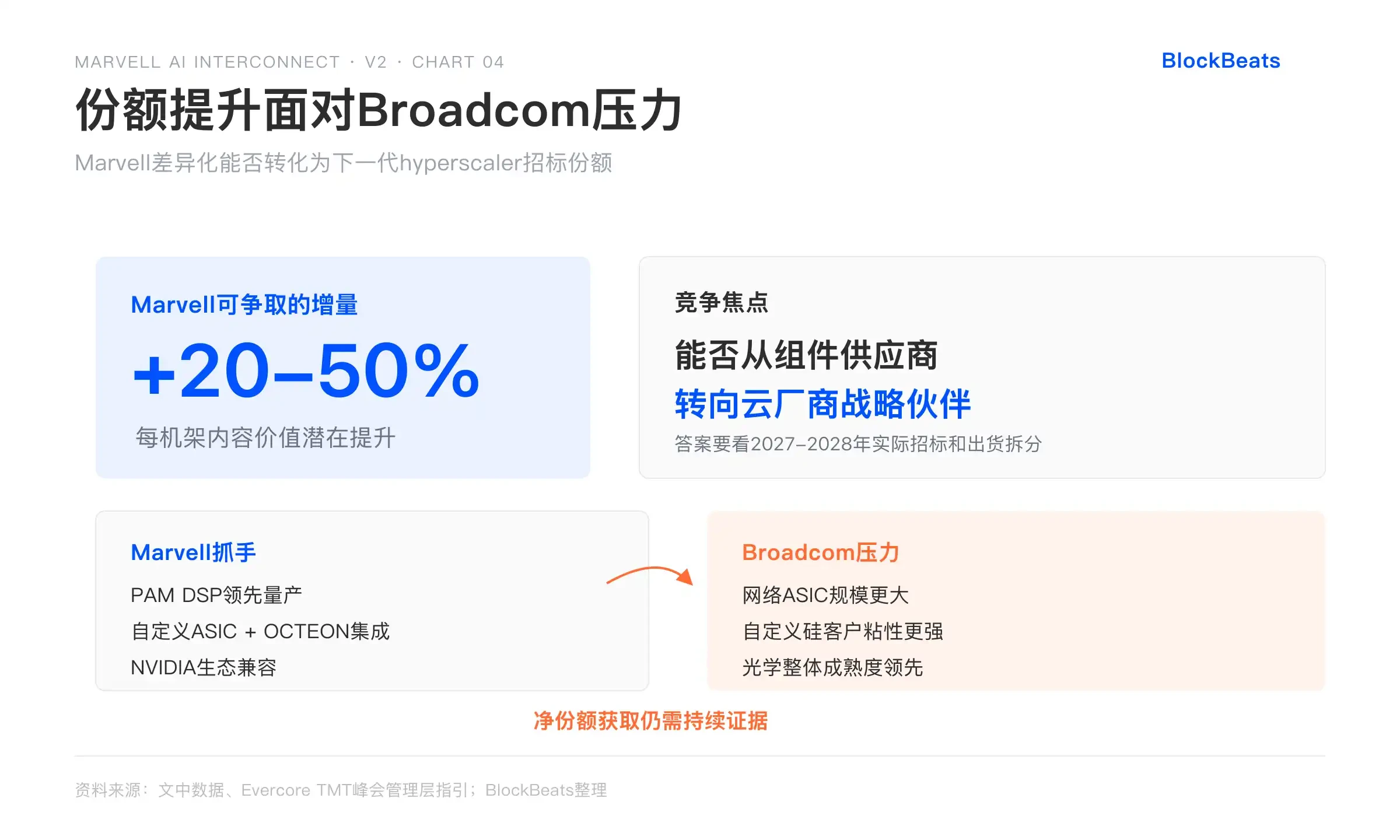
Can Marvell sustain its differentiation in front of Broadcom?
Marvell leads in the PAM DSP market, with comprehensive coverage from long-range coherent to 1.6T and 3.2T, and integration advantages from custom ASICs with OCTEON are real achievements. The cooperation with NVIDIA also provides additional options for heterogeneous computing. These factors make the company competitive in certain hyperscaler projects, especially in scenarios requiring rapid mass production and ecosystem compatibility.
However, Broadcom still maintains a significant lead in network ASICs, optical overall scale, and maturity. Broadcom's custom silicon projects are larger in scale and have stronger customer stickiness, and in some overlapping out-of-scale and large-scale fields, Marvell still needs to rely on higher integration and specific technical routes to compete for incremental share. The positioning as a "strategic partner for interconnections" is still more of a target; whether it can ultimately materialize will depend on actual bidding results and shipment splits in 2027-2028, rather than the current breadth of layouts.
For investors, this means that in the next generation of hyperscaler tenders, the content value of Marvell per rack could potentially increase by 20-50% from current levels, thus supporting revenue visibility and gross margin expansion potential. However, if CPO ramps up slower than the guidance, or if Broadcom dominates in more custom projects, growth in 2028 may fall below the optimal scenarios implied by current valuations, increasing the pressure for a stock price pullback. The current high beta characteristics have amplified the gains under narrative drivers while also magnifying the volatility when execution falls short of expectations.
The large-scale implementation of CPO remains the biggest variable to be verified
Despite the strong AI orders, leading production of PAM, and compatibility with NVIDIA providing real mid-term momentum and option value, CPO as a new technology faces core constraints for sustainable growth in 2028 regarding yield, cost curves, thermal management, supply chain stability, and whether hyperscaler capital expenditures can maintain the current pace from preparation to large-scale deployment. Historical experience shows that new technologies typically require multiple iterations from early mass production to meaningful revenue, and CPO is still in this early stage.
Marvell has a good record of fulfilling previous guidance, but this ramp-up target is relatively ambitious. Valuations have been significantly elevated in 2026, incorporating many best-case scenario assumptions, and rising crowdedness in market discussions has also raised volatility. Broadcom's scale advantages will not disappear in the short term, and evidence of net share gains will be needed continuously. The current phase is one of acceleration, while early signs of post-accumulation have appeared—sharp price fluctuations and the focus of discussions shifting towards delivery pressure are manifestations of this characteristic.
Investors should not just look at the visions presented at the summit but should closely track the actual revenue split in 2027, shipping milestones, specific customer validation progress for CPO, and the capital expenditure rhythm of hyperscalers. These variables are most likely to change the current judgments. If the 2027 milestones are strongly fulfilled, the trend of structural improvement in interconnect content will gain a more solid foundation; if delays or share shortfalls occur, high valuations will face corrective pressures. The structural opportunities in AI interconnect indeed exist, and Marvell’s full-stack layout also offers differentiated options, but the degree of ultimate realization depends on execution details, making 2027 a key verification window.
免责声明:本文章仅代表作者个人观点,不代表本平台的立场和观点。本文章仅供信息分享,不构成对任何人的任何投资建议。用户与作者之间的任何争议,与本平台无关。如网页中刊载的文章或图片涉及侵权,请提供相关的权利证明和身份证明发送邮件到support@aicoin.com,本平台相关工作人员将会进行核查。


