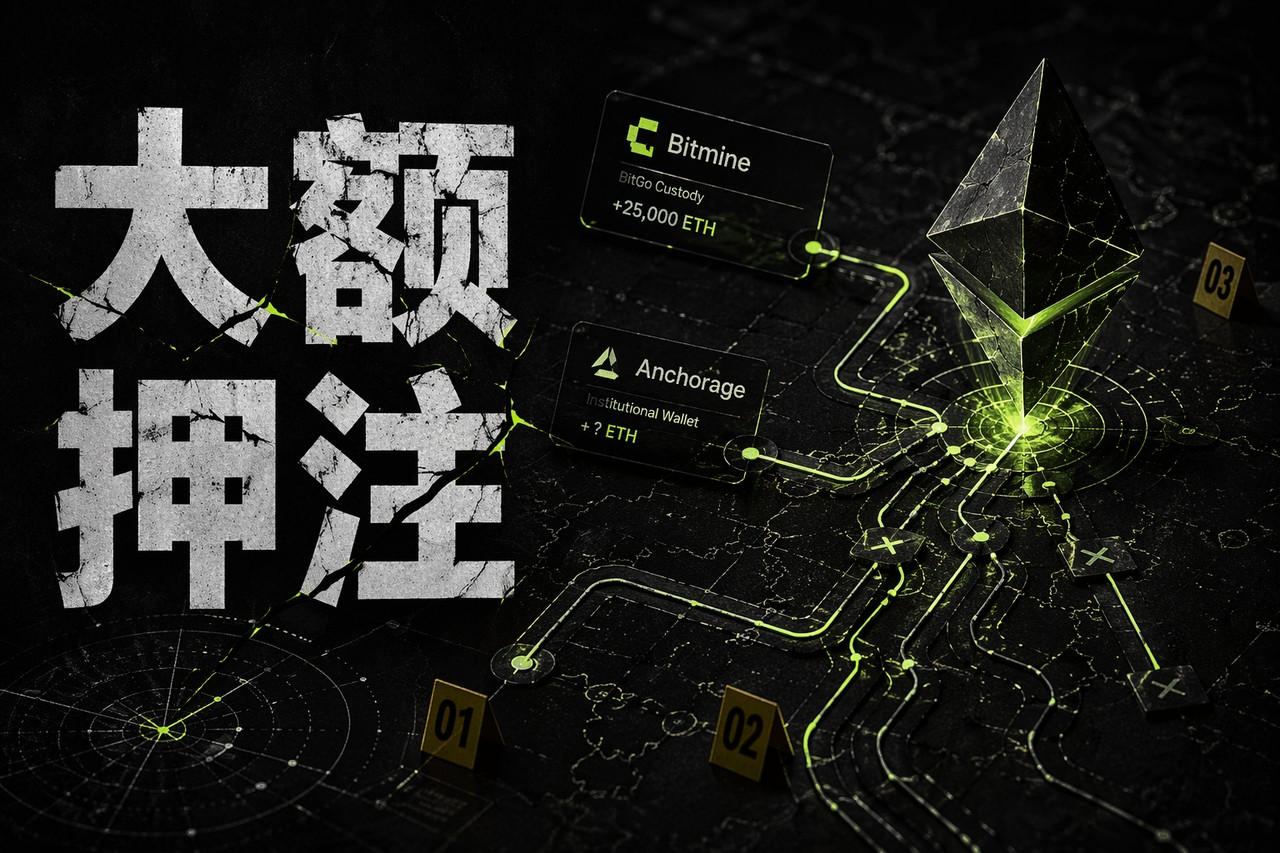
On June 2-3, 2026, Ethena Labs disclosed a key signal in conjunction with Anchorage Digital, the federally chartered digital asset custody bank in the United States: the two parties will collaborate on Ethena's institutional lending business, with Anchorage taking over collateral management through its Atlas Collateral Management platform. The external narrative is simple—Ethena continues to build yield and lending structures around USDe, while Anchorage is responsible for "custody and guarding"; however, the specific design points directly to regulatory gaps: the collateral assets of institutional borrowers are no longer directly on-chain, but remain within the regulated custody system of Anchorage, where it will assume custody, collateral management, and some compliance review functions within the same closed loop, while the lending exposure will connect to DeFi or DeFi-like scenarios. For Ethena, it has started introducing excess collateralized institutional lending assets since April 2026, moving away from a prior heavy reliance on perpetual contracts for hedging and significant exposure in the derivatives market; this collaboration effectively integrates this reserve adjustment into the risk control process of a licensed bank; for Anchorage, it uses Atlas to provide a layer of off-chain custody and review for such on-chain lending, locking collateral behavior that should be exposed on-chain first into a regulated vault. The question is then posed to regulators and institutional capital: when collateral assets are locked in a federal custody bank, only mapping the lending results on-chain, is this "off-chain custody + on-chain lending" a regulatory-recognized risk segmentation, or just a circumvention under the guise of compliance?
The Role of Anchorage as a Federal Custody Bank
Anchorage Digital is not an ordinary "crypto custodian", but a federally chartered digital asset custody bank in the United States, operating within the framework of regulated financial institutions. This means it is legally closer to traditional custody banks: it can manage, record, and isolate risk for on-chain assets held by institutional clients, but its business boundaries are confined to "custody + related management" tracks, rather than participating freely in high-risk proprietary trading. For Ethena, Anchorage is not an unfamiliar role—according to a single source, prior to this collaboration, it was already the issuer of Ethena's institutional token USDtb in the U.S., and now it is expanding its role based on existing cooperation, upgrading from "helping you issue tokens" to "helping you manage collateral."
This upgrade is carried by Anchorage’s Atlas Collateral Management platform. On the surface, Atlas is merely a system for collateral registration and management for institutions, but in Ethena's institutional lending structure, it is endowed with integrated functions of "custody + collateral management + some compliance review": the collateral assets of institutional borrowers can always remain within Anchorage's custody system, with Atlas completing pledge labeling, position monitoring, and default handling plans, while the lending exposure is mapped to on-chain or on-chain-like scenarios. For compliant capital, this design changes a crucial psychological barrier—a significant asset does not need to be directly pledged to a potentially "unclassified" on-chain protocol; instead, it is handed to a federally chartered custody bank, which then acts as a regulated hub to "touch" DeFi. It remains unclear how regulators will characterize the "off-chain custody + on-chain lending" structure, but Anchorage's willingness to bridge this within its licensed boundaries effectively outlines a compliance path that institutional capital can adopt to enter similar scenarios.
Ethena Transitioning from Hedging to Collateralized Lending
Before the intervention of the federal custody bank, Ethena structured a highly "hedge-like" profit machine around USDe: the early structure relied almost entirely on perpetual contracts to generate and maintain a "cash-like" yield curve, with the balance of the entire system dependent on liquidity, fund rates, and counterparty depth in the derivatives market. As long as the perpetual market is efficient and the hedging is smooth, USDe can maintain an appearance of "low volatility + predictable yield"; however, from a regulatory perspective, this model effectively binds the underlying exposure directly to the high-frequency volatility and leverage-concentrated derivatives market. Once exchanges tighten, leverage requirements increase, or liquidity suddenly drops, the entire hedging position behind USDe will shift from a "source of yield" to a "systemic risk amplifier."
According to a single source, since April 2026, Ethena began to make adjustments based on this underlying logic—not simply stopping hedging, but promoting structural adjustments to USDe reserves by gradually introducing institutional lending assets centered on excess collateral, allowing some of the exposures originally tied to perpetual contracts to shift to secured debt backed by real or on-chain assets. For Ethena, this is both a rebalancing on risk management and a forward bet on the forthcoming regulatory environment: given the growing expectations of stricter derivatives regulations, moderately transitioning the underlying support of USDe from "pure derivatives hedge yield" to "collateralized institutional lending spreads" is expected to weaken the sensitivity to funding rates, derivatives leverage policies, and the risk control of individual exchanges, gradually pulling the project from a role heavily reliant on hedging efficiency back to a business track closer to traditional credit and collateral management.
Compliance Layering of Off-chain Collateral and On-chain Lending
In the design between Ethena and Anchorage, the critical cut lies between assets and positions: institutional borrowers put collateral assets into Anchorage's custody system, with this federally chartered digital asset custody bank responsible for custody and collateral monitoring through the Atlas Collateral Management platform; on the other end, the corresponding lending exposure is then taken onto on-chain or on-chain-like scenarios, using on-chain positions and credit limits to express actual risks. This means that institutions do not need to "completely move the underlying collateral on-chain," but merely allow their risk exposure to be mapped on-chain, with custody, valuation, and rights continuing to anchor within traditional financial infrastructure.
For a group of institutions with rigid internal procedures wanting to explore on-chain yields, this layered design itself serves as a compliance "buffer": in compliance review, accounting processing, and risk reporting, they can still use the traditional rhetoric of "regulated custody bank + collateralized credit" rather than directly informing compliance departments that "we are doing DeFi lending." Under the existing regulatory framework, which currently lacks specialized details, "off-chain custody + on-chain lending" thus has room to be claimed as an extension of banking services—essentially, it is as if the custody bank manages the collateral on behalf of the clients and then technically projects the credit results onto the chain, rather than clients personally inserting assets into an unpredictable on-chain pool. Anchorage's involvement as a licensed custodian is wrapping the scene, originally simply labeled as "wild DeFi," back into the banking context, shifting regulatory focus from "whether it can go on-chain" to "who is actually responsible between on-chain and off-chain, and what ledger is used for accountability."
Compliance Signals Between Custodians and Lending Protocols
By packaging collateral management into a compliant service that can directly interface with DeFi or DeFi-like lending scenarios, Anchorage itself demonstrates a "route model" for similar custodial institutions. In the Ethena collaboration structure, collateral assets remain within the system of Anchorage, a regulated federally chartered custody bank, while lending exposure is directed through the Atlas Collateral Management platform to on-chain or on-chain-like scenarios, effectively standardizing the interface for "how to go on-chain and where to go on-chain." For other custody banks and compliance institutions, this releases a clear signal: as long as they can manage entry points in KYC, whitelisting, and risk control parameters, they can open channels for clients towards DeFi yields and leverage within the existing regulatory framework, which also represents competitive pressure—whoever is first to make this service a "compliant product" will seize the gatekeeper position for institutional funds entering crypto lending scenarios.
For DeFi lending protocols, introducing these types of regulated custodians means a substantial change in entry barriers and power structure. If they want to access collateral flows managed by Anchorage, the protocol side must accept its preconditions regarding KYC, whitelisting, and risk control interfaces. Some permissions of "who can borrow and how much they can borrow" shift from DAO governance and purely on-chain parameters to the compliance and risk control system of the custody bank. The custody bank holds information on underlying assets and borrowers, taking on collateral management and some compliance review responsibilities, while the on-chain protocol focuses more on interest rate curves, position parameters, and liquidation logic, becoming a provider of technology and rules that reflect the credit results of the custody side. This division of labor reshapes the boundaries of responsibility: collateral safety, credit review, and anti-money laundering obligations are concentrated on the side of licensed custodial institutions, with substantive recognition of credit risk more easily understood as a "custody bank—institutional borrower" bilateral relationship, rather than a collective gamble by an anonymous pool; the protocol layer can position itself as "transparent rules and automatic execution," resembling an auditable infrastructure rather than a direct lending entity. This restructuring of responsibility is itself a core compliance signal released by the Anchorage model for the entire lending track.
Ethena–Anchorage Gray Zone Packaging
In the Ethena and Anchorage design, institutional collateral is "packaged" and locked within the federally chartered custody bank system, connected through Atlas Collateral Management to on-chain or on-chain-like lending scenarios, effectively inserting a buffer zone under pressure from the custody bank between traditional prudent regulation and DeFi protocols: capital flows and collateral ownership are visible to regulators, while interest rates and liquidations are settled within on-chain logic. However, this "packaging" currently lacks ready rules, as there are no specific regulations in the U.S. governing the "off-chain custody + on-chain lending" structure, and regulators are still cautious regarding how banks engage with cryptocurrency, as well as how to identify the actual risk-bearing of crypto lending, on-balance sheet and off-balance sheet handling, and penetration paths. It remains unclear whether Anchorage is merely managing custody and collateral or is seen as bearing part of the credit risk and licensing obligations; answers are yet to be written into the legislation. If the Ethena–Anchorage model maintains smooth operation in the future, it cannot be ruled out that more project parties will actively seek to construct similar structures with licensed custodians or even banks based on assets like USDe, handing high-risk exposures to regulatory entities, with the latter responsible for KYC, compliance review, and connecting institutional funds within their licensing framework; custodians will need to reassess their own capital constraints and compliance boundaries, and institutional investors will have to determine within multiple layers whether they are betting on DeFi yields or the custodians’ risk management abilities. How this tripartite game is officially qualified by regulators will determine the mainstream path of crypto lending towards the compliant market in the coming years.
Join our community, let’s discuss, and grow stronger together!
Exclusive Hyperliquid benefits for AiCoin: https://app.hyperliquid.xyz/join/AICOIN88
Exclusive Aster benefits for AiCoin: https://www.asterdex.com/zh-CN/referral/9C50e2
On-chain Telegram community: https://t.me/AiCoinWhaleData
On-chain community: https://www.aicoin.com/link/chat?cid=N6OVMor5g
AiCoin on-chain Twitter: https://x.com/aicoinwhaledata
免责声明:本文章仅代表作者个人观点,不代表本平台的立场和观点。本文章仅供信息分享,不构成对任何人的任何投资建议。用户与作者之间的任何争议,与本平台无关。如网页中刊载的文章或图片涉及侵权,请提供相关的权利证明和身份证明发送邮件到support@aicoin.com,本平台相关工作人员将会进行核查。