This White House has a stock god living in it.
According to the latest financial documents disclosed, Trump completed 3,642 stock trades in the first quarter of this year, averaging about 58 trades each trading day. This frequency far exceeds that of most professional fund managers.
If it were just frequent trading, this would not be enough to attract market attention.
What has really started to spark discussions on Wall Street is another set of increasingly hard-to-ignore data: over the past year, the publicly praised listed companies mentioned by Trump have been increasingly overlapping with his holdings, government industrial policies, and the flow of federal funds.
Perhaps the most impressive moment was last year when Trump turned the White House South Lawn into a Tesla product launch event. In front of the media, he sat in a Model S and called Tesla "a great product" and said the Cybertruck had "the coolest design."
Following that, a series of companies such as Dell, Intel, Micron, NVIDIA, IBM, Apple, and Thermo Fisher began to appear on his public praise list.
Some companies saw significant price movements after being named; some had positions established in Trump’s accounts before being praised; while others received government contracts, subsidies, export licenses, or other policy support at the same time.
When these events occur individually, they may just be coincidences. But when more and more coincidences begin to point to the same group of companies, we can’t help but wonder: Is Trump really supporting American manufacturing and technology industries, or is he shaping his own "presidential concept stock" list?
And if this pattern really exists, the question the market cares most about is: who will be the next company named by the White House?
The Commonalities of the Companies Mentioned
Starting from the Tesla show that turned the White House South Lawn into a showroom in March 2025, by May 2026, there have been nine publicly praised or supported listed companies by Trump, and the density of mentions surged in 2026, with Dell and Intel being the most typical examples.
On February 10 this year, Trump built positions of between $1 million to $5 million, and on May 8, he publicly urged people at the White House to "buy a Dell, it's great." On that day, Dell's stock surged by about 14% at one point. Prior to this, the Dell family had already promised to invest $6.25 billion into "Trump accounts."
Intel is another typical case. In August 2025, the Trump administration converted $8.9 billion in subsidies owed to Intel under the CHIPS Act into equity, acquiring about 9.9% of the company at $20.47 per share, thus making the U.S. government Intel's largest shareholder, and the community even dubbed it "a U.S. state-owned enterprise." Six months later, in early March 2026, his personal account also appeared with Intel. Converting subsidies into equity, government support, personal holdings, and public endorsements all became positive news for Intel.
Another iconic moment was on April 10 when he endorsed Palantir (PLTR) on Truth Social by adding the company's stock code, stating it "has proven to have strong operational capabilities and equipment," becoming the first sitting president to do so.
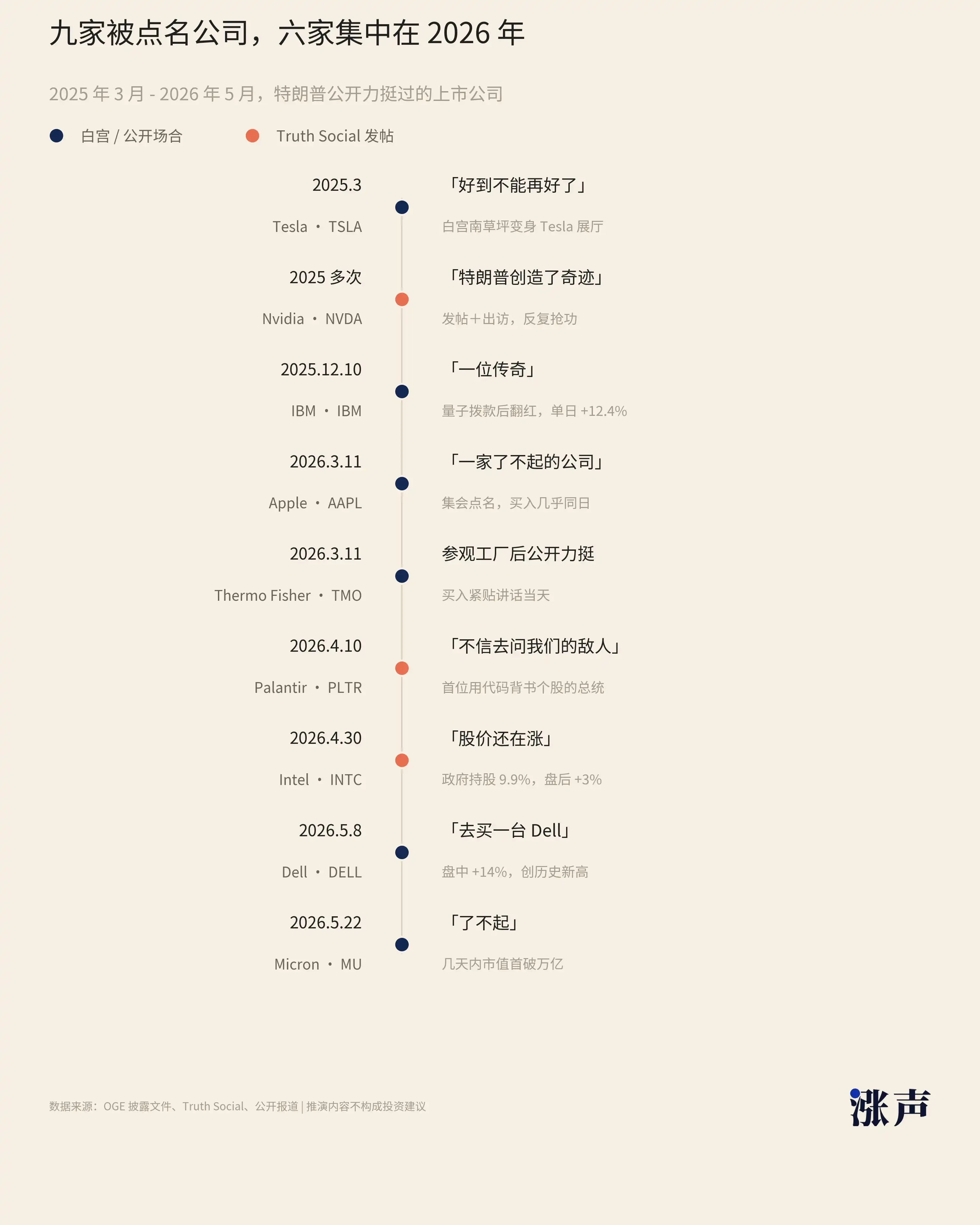
If we broaden the scope from Trump's personal holdings to the listed companies he has publicly praised, we find that the number is far greater than just a few well-known tech giants. According to publicly available speeches, White House events, and Truth Social post records, Trump has explicitly praised at least nine listed companies over the past year or so, which has led to short-term rises in their stock prices, including Intel, Dell, Micron, Palantir, IBM, Apple, Thermo Fisher Scientific, Tesla, and NVIDIA.
The editors at Rhythm have summarized some of their common traits:
Firstly, it is most obvious that they are almost all narratives of "AI new technology," "top American manufacturing," and "re-shoring of production."
Industrially, they are highly concentrated in the chain of AI computing power and semiconductors. Intel, Micron, NVIDIA, and AMD are in chips, Dell in computing hardware, IBM in quantum, and Palantir in AI software.
Secondly, behind every company that has been named, there is a benefit interface that the government can directly influence. For example, Intel has a 9.9% government stake, Palantir is a federal major contractor, IBM and Intel receive funding from the CHIPS Act, NVIDIA and AMD benefit from relaxed export licenses to China, and Dell received a $9.7 billion Pentagon contract after being praised on May 27. Apple was praised because it promised to invest in the U.S. and build iPhone glass at its Kentucky factory; Intel and Micron are domestic wafer fabs, Dell builds AI servers assembled in the U.S., IBM is the quantum foundry in Albany, and on the day Tesla was mentioned, Musk promised to double U.S. production on the spot. Trump rarely praises purely overseas production capacity; he praises the act of "bringing the production line back to the U.S." itself.
To some extent, the narratives of these companies have been packaged and elevated to the themes of "national security" and "competition with China." Chips are critical, and quantum is for cybersecurity. Of course, the prerequisite for being named is often that the CEO has first submitted a sign of loyalty.
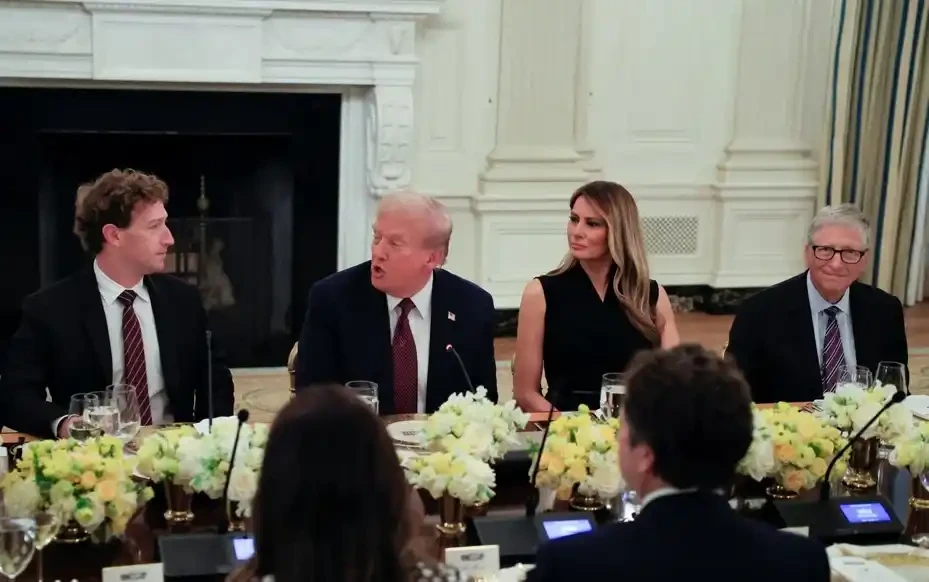
Trump hosted tech giants after taking office, asking them one by one about their investment amounts in the U.S.
All these benefits first hinge on "relationships being in place." These CEOs generally show goodwill or have personal relations with Trump.
Jensen Huang traveled with him on visits, publicly thanked him, the Dell family donated $6.25 billion to "Trump accounts," Larry Ellison from Oracle has been a supporter for many years and deeply involved in Stargate and TikTok transactions, Musk was an ally during the time he was mentioned, and Arvind Krishna was directly named in the room.
Although the unified statement from the administration is that the President's assets are managed by a trust held by his children, and that third-party accounts operate independently, with Trump not participating in specific trades, we can indeed observe overlapping timing between Trump's mentions and his own holdings and trading.
For instance, Palantir was heavily bought in March; weeks later, Trump mentioned it on Truth Social; Dell was acquired on February 10 in the range of $1 million to $5 million, followed by public praise in May; Apple and Thermo Fisher were bought and publicly praised almost on the same day.
If these patterns hold true, then anticipating Trump’s next stock call wouldn’t be difficult.
Who Might Be Next to be Called Out?
Firstly, the group most likely is companies that the government has already invested in: MP Materials (MP), Lithium Americas (LAC), IonQ (IONQ), Rigetti (RGTI), D-Wave (QBTS), and so on.
MP Materials is currently one of the most essential suppliers of rare earth magnets in the U.S., primarily engaged in rare earth mining and separation processing, ultimately used to manufacture permanent magnet materials that directly enter fighter jets, electric vehicles, and missile systems.
In other words, it is not a "resource company," but a part of the defense supply chain.
In July 2025, the U.S. Department of Defense acquired about 15% equity through ownership and related arrangements, transforming it from a typical listed company to what can be seen as a "quasi-strategic asset." More importantly, this action occurred prior to Intel's government investment.
However, an interesting point in the market is that, compared to the frequent discussions about Intel, MP has been relatively low-key and has not been explicitly highlighted in political narratives. This state of being "already in but not yet mentioned" constitutes a lagging pricing.
Lithium Americas is a typical lithium resource development company, with its core asset being the Thacker Pass lithium mine project located in Nevada, one of the largest known lithium resources in North America. The strategic significance
免责声明:本文章仅代表作者个人观点,不代表本平台的立场和观点。本文章仅供信息分享,不构成对任何人的任何投资建议。用户与作者之间的任何争议,与本平台无关。如网页中刊载的文章或图片涉及侵权,请提供相关的权利证明和身份证明发送邮件到support@aicoin.com,本平台相关工作人员将会进行核查。


