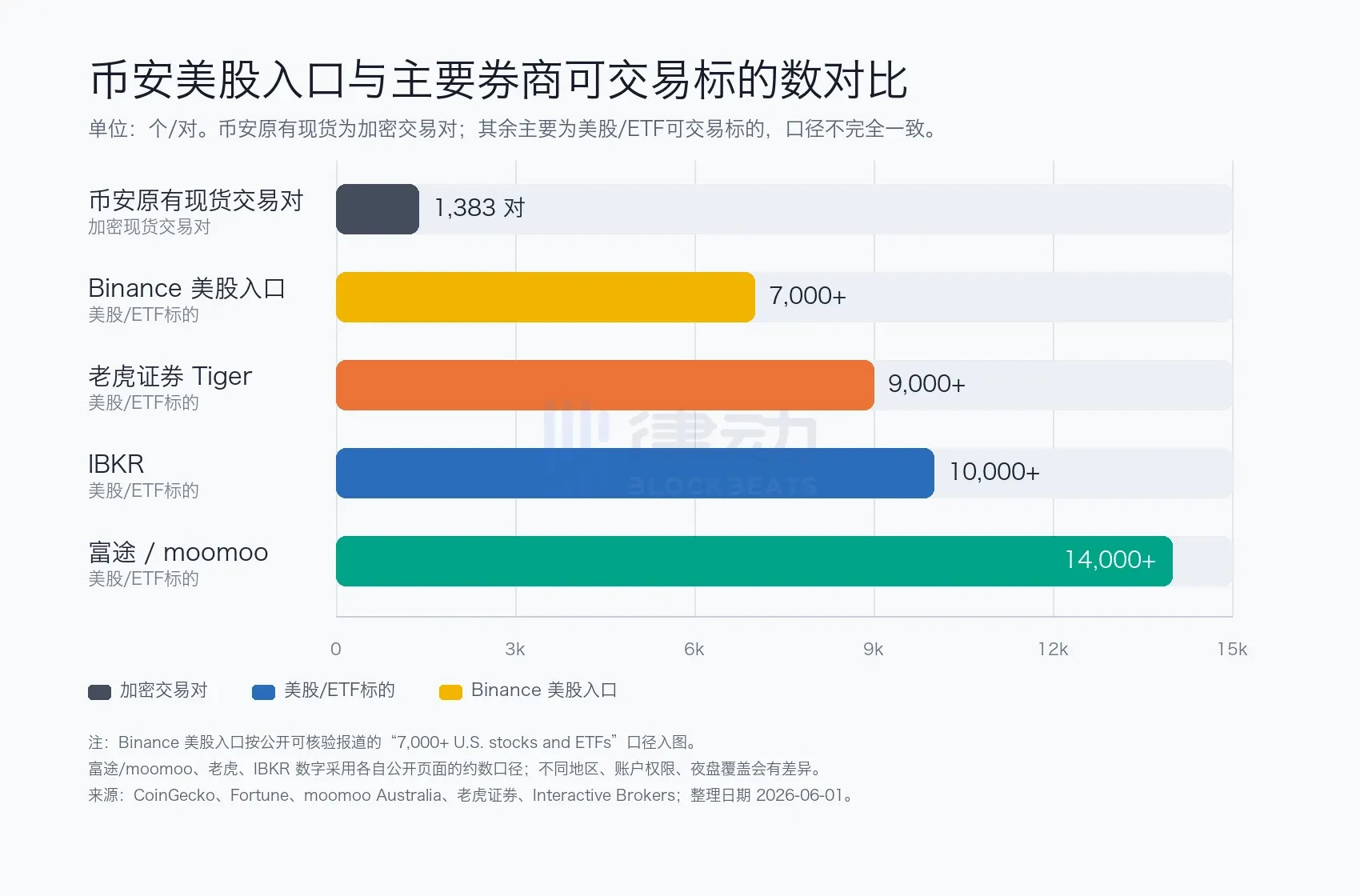
The long-anticipated Binance U.S. stock product has finally arrived. In the Binance app, essentially all U.S. stocks can be traded.
This time, Binance is not just testing the waters with a few tokenized blue chips but has simultaneously opened more than 7,000 U.S. stocks and ETFs, positioning itself as the "multi-asset financial super app," as described by co-CEO Richard Teng. In his statement to Fortune, he said that U.S. stocks account for more than half of the global stock market, but for overseas users, the cost of purchasing them is high and the friction is significant; what Binance aims to do is eliminate this barrier.
The editor tested placing a complete order with NVDA to experience the product comprehensively.
Product Test: How is the U.S. Stock Experience on Binance?
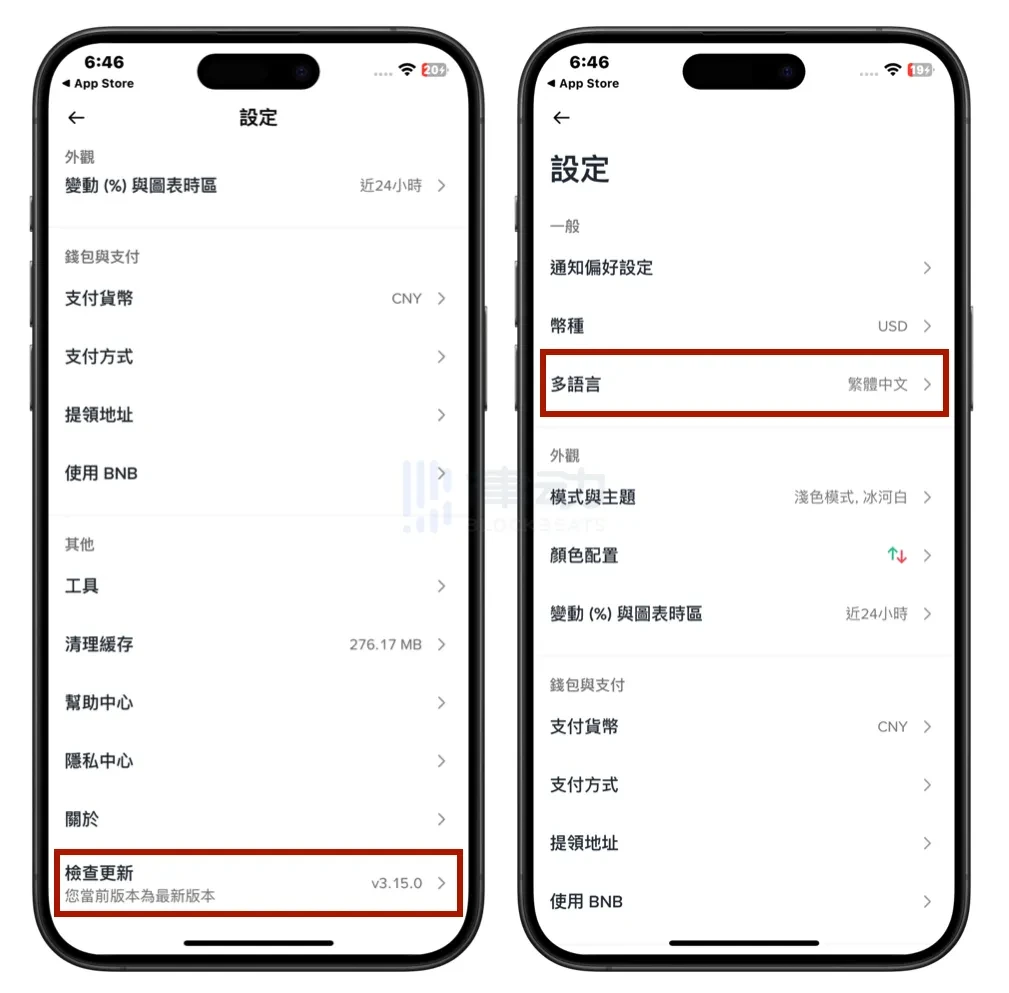
Opening the "Settings" page of the Binance app, the first thing is to confirm the version number: v3.15.0, the latest version. The language has been switched to Traditional Chinese. The prior condition feedback from the community is validated here: Chinese users wishing to participate in U.S. stock trading must switch the language from Simplified Chinese to Traditional Chinese or another language, with Simplified Chinese being excluded.
Switching to the "Market" page, the top tab shows an entry for "Traditional Finance," alongside "Cryptocurrency" and "Alpha." It is further divided into three subsections: Stocks, Spot, and U-Based Contracts. The stocks section is further divided into two filters: "U.S. Stocks" and "ETF."
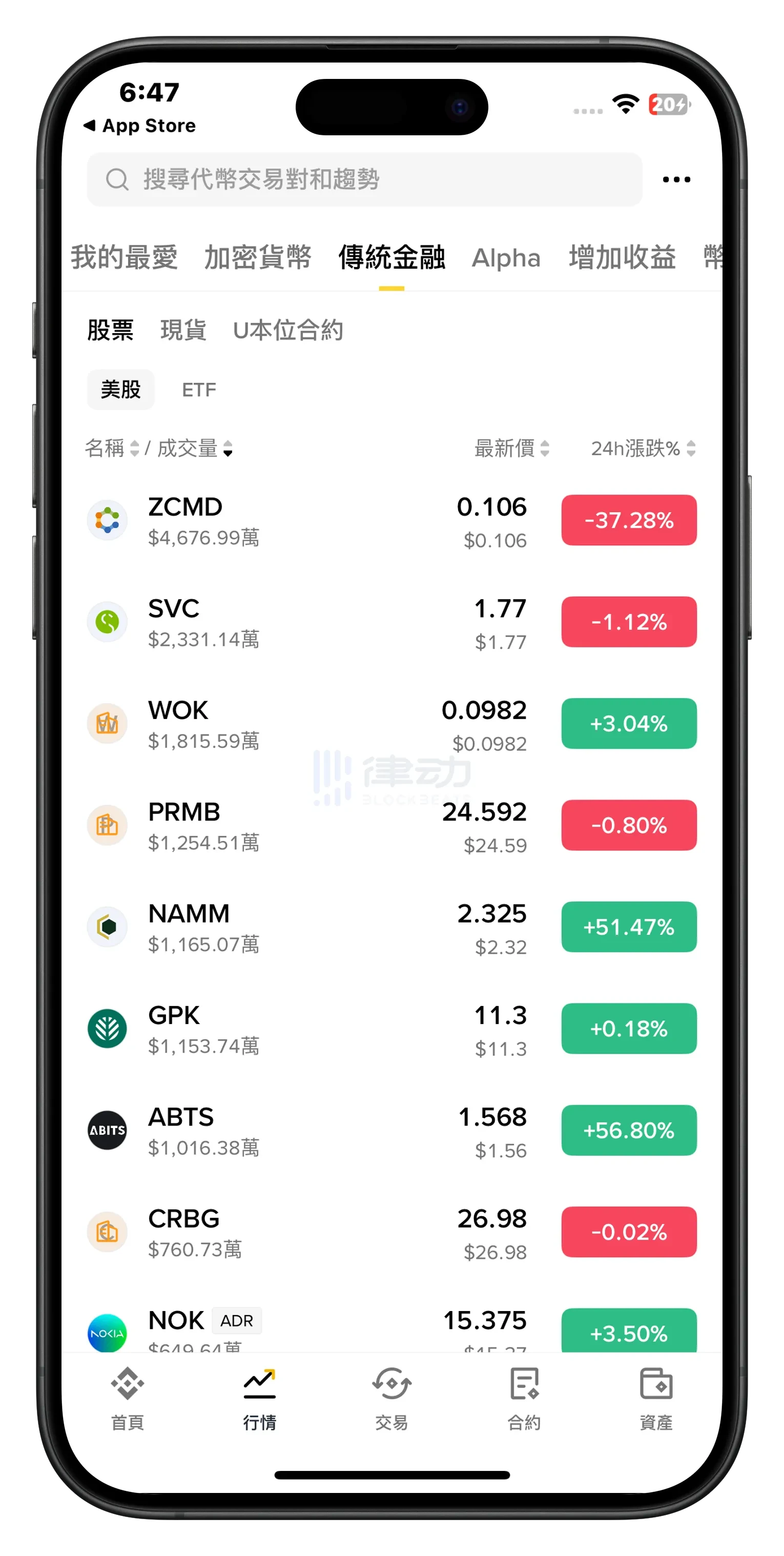
Scrolling through the list, the first stocks seen are not Apple and Tesla, but rather lesser-known small-cap stocks like ZCMD (market cap of about $46.76 million), SVC ($23.31 million), and WOK ($18.15 million), which even seasoned U.S. stock traders may not recognize. Next to NOK, there is also an ADR label. This indicates that the coverage of 7,000 stocks is not just for a few blue chips but genuinely extends to small caps and even ADR levels.
However, if there were other filtering and sorting options to display mainstream large-cap stocks like NVIDIA and Intel at the forefront, the experience might be improved.
Achieving 7,000 U.S. stock trading pairs is made possible because Binance is not following a tokenization route that involves on-chain minting but is utilizing real broker pathways, where the assets are not limited by the issuance of tokens. Compared with others: Kraken's xStocks covers more than 60 blue chips, its underlying issuer Backed Finance currently has about 100 stocks, aiming for over 500 by the end of the year, and Robinhood's tokenization covers approximately 200 companies in the EU. While others are focused on minting and issuing incrementally, Binance has directly taken on the entire U.S. stock market's shelf.
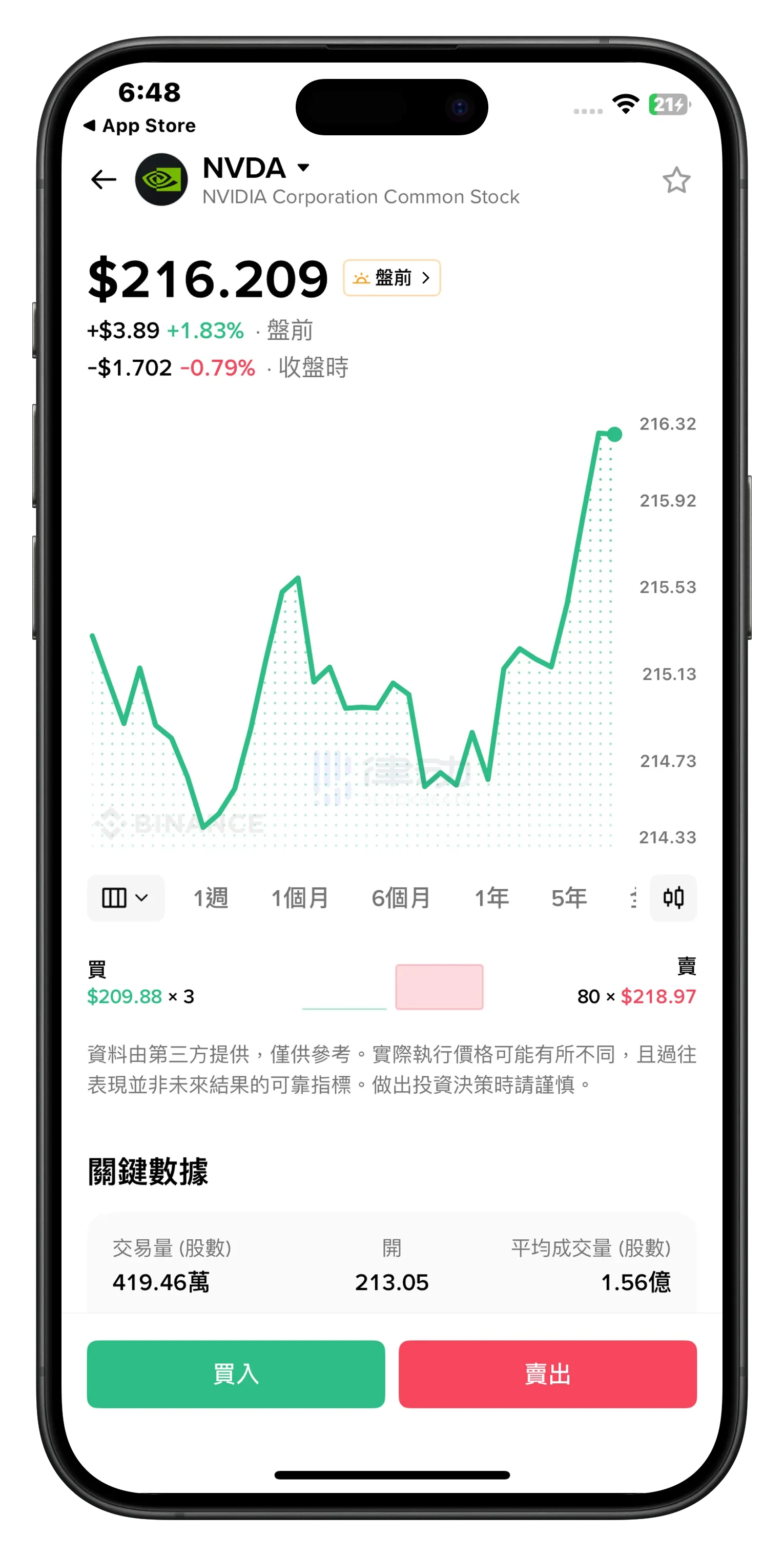
Entering the NVDA detail page, the price is set at $216.209, marked as "pre-market," with an increase of 1.83% before the market opens, after a drop of 0.79% on the last closing day. The K-line supports time spans from 1 week to 5 years, comparable to leading brokerage apps.
Scrolling down brings up a set of "Key Data" panels: Trading volume of 4.1946 million shares, opening price of 213.05, average trading volume of 156 million shares, 52-week high of 236.54, low of 135.40, market cap of $5.11 trillion, P/E ratio of 32.04, earnings per share of $6.59, dividend yield of 0.02%, and free cash flow of $119.076 billion. The data granularity has reached the level of Webull or Robinhood. Further down, there’s a "Company Actions" section indicating a cash dividend on June 4.
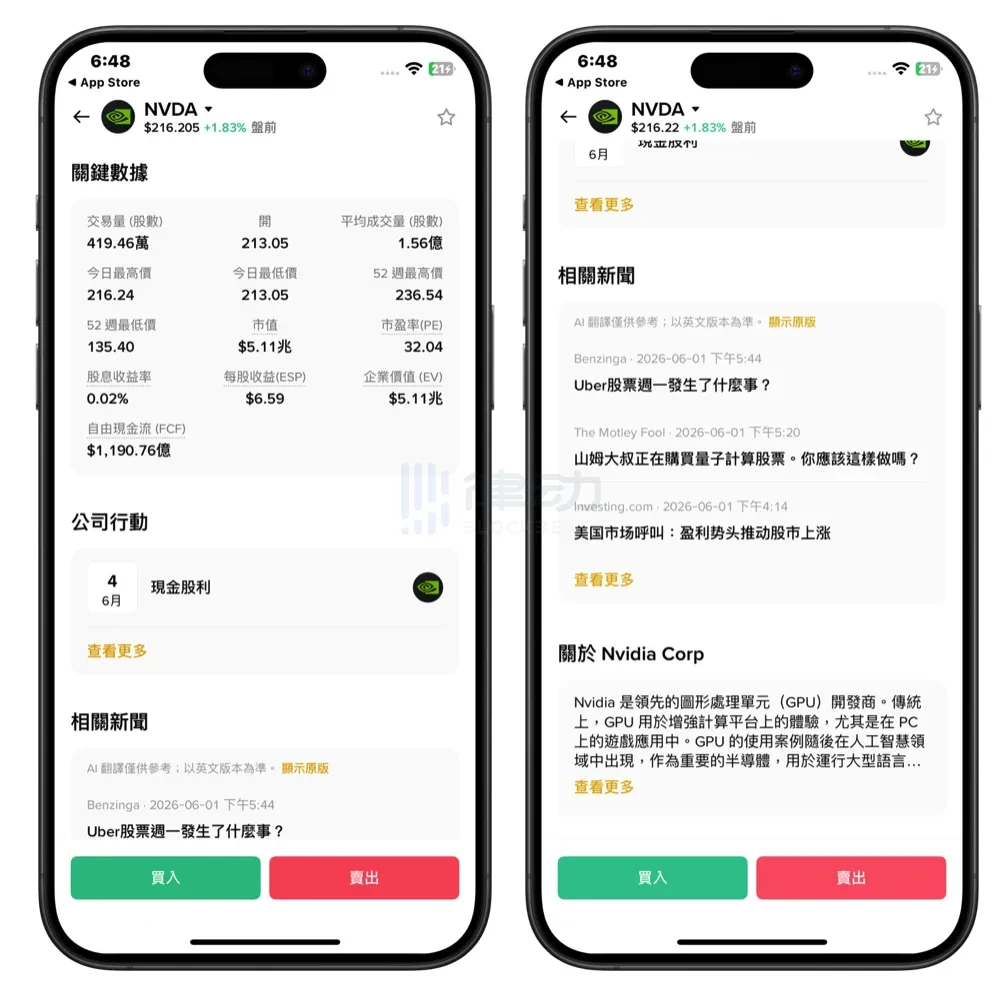
The "Related News" section aggregates third-party sources like Benzinga, The Motley Fool, and Investing.com. At the bottom is a company profile. The overall information architecture is sufficient for new stock investors, but it lacks in-depth data like financial statements, analyst ratings, and institutional holdings, falling short compared to Bloomberg or Eastmoney. For Binance's target users, it might be adequate, but for heavy stock players, it may not be enough in terms of information density and professionalism.
Next, we proceed to place an order.
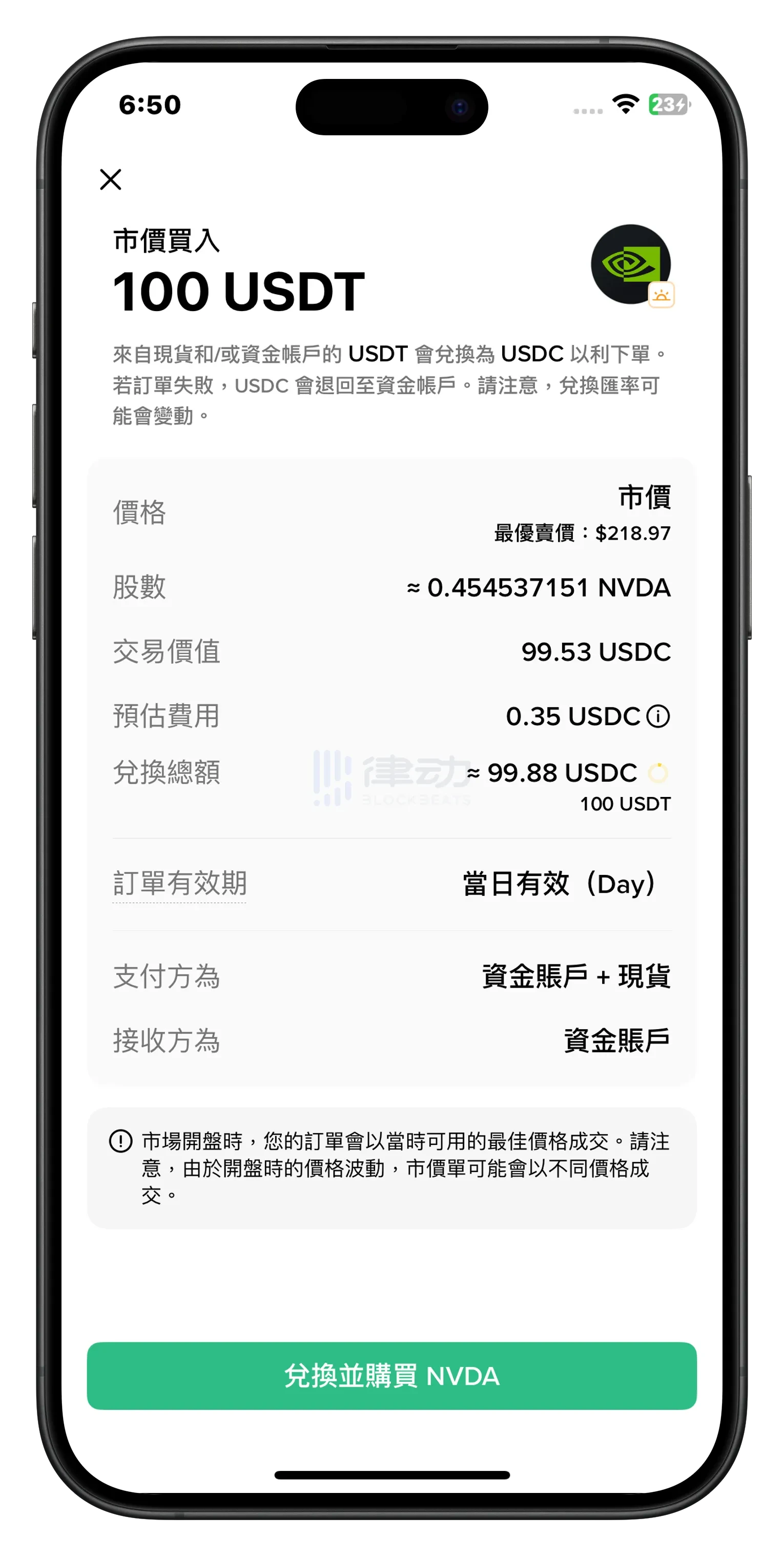
Clicking "Buy," I entered 100 USDT. The system automatically converts this: 100 USDT is first exchanged at an exchange rate of 1 USDT ≈ 0.998859 USDC into about 99.88 USDC, and then buys about 0.4545 shares of NVDA at the market price (optimal selling price of $218.97), trading value of 99.53 USDC, estimated fees of 0.35 USDC.
There’s an unavoidable intermediary step here: whether you use USDT or BNB for payment, all funds will first be converted to USDC, and then USDC will be used to settle the stock purchase. The exchange fee between USDC and USD is 0 (with the price difference borne by Binance), but the conversion from USDT, BNB, and other tokens to USDC "is subject to market price differences." This means that buying directly with USDC is the lowest-cost route, while using USDT or BNB incurs an additional currency conversion cost.
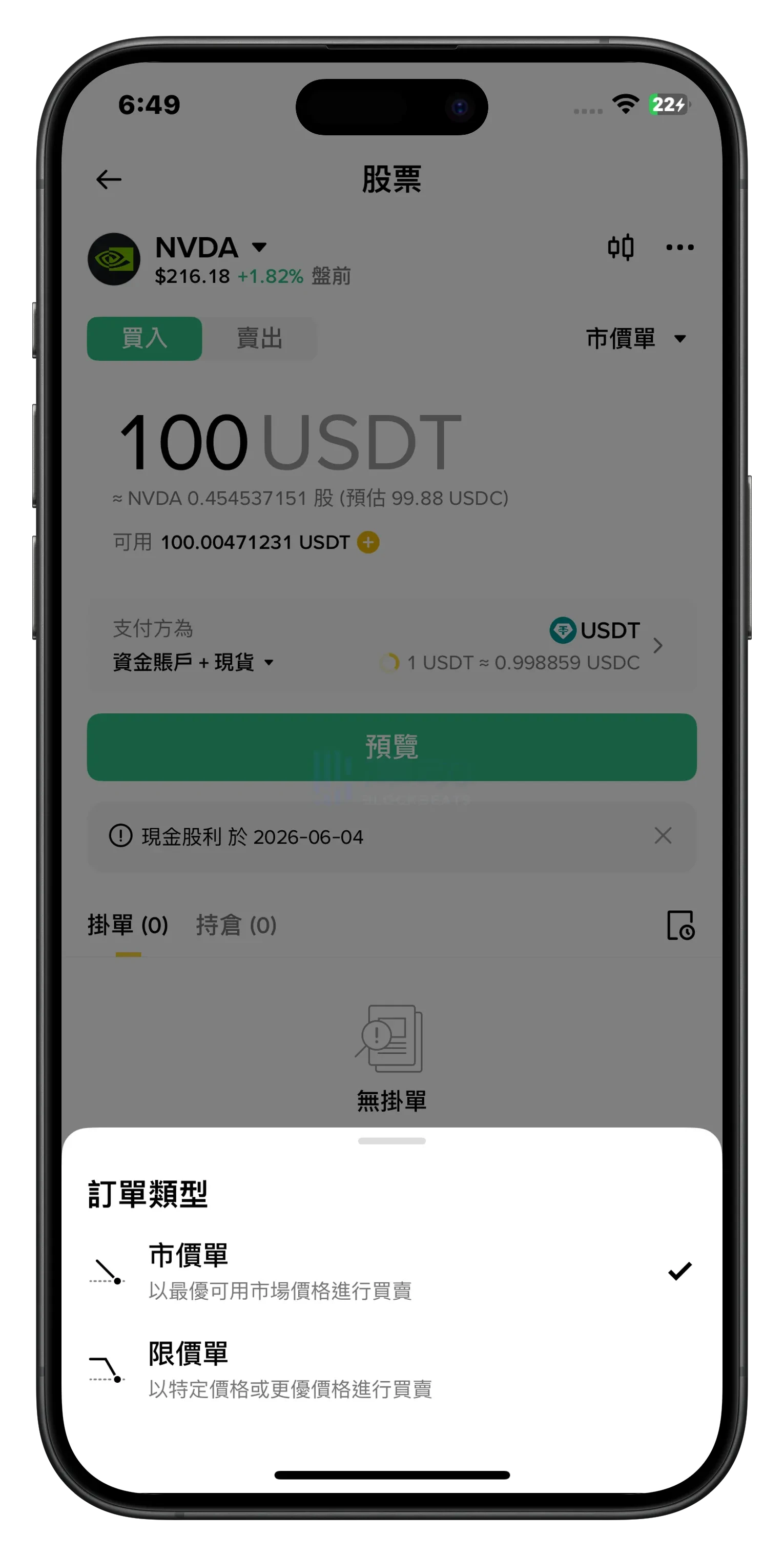
Currently, there are only two types of orders available: market orders and limit orders. The order's validity is "Day." The payment source is "fund account + spot," indicating that the system will automatically grab the balance from both wallets.
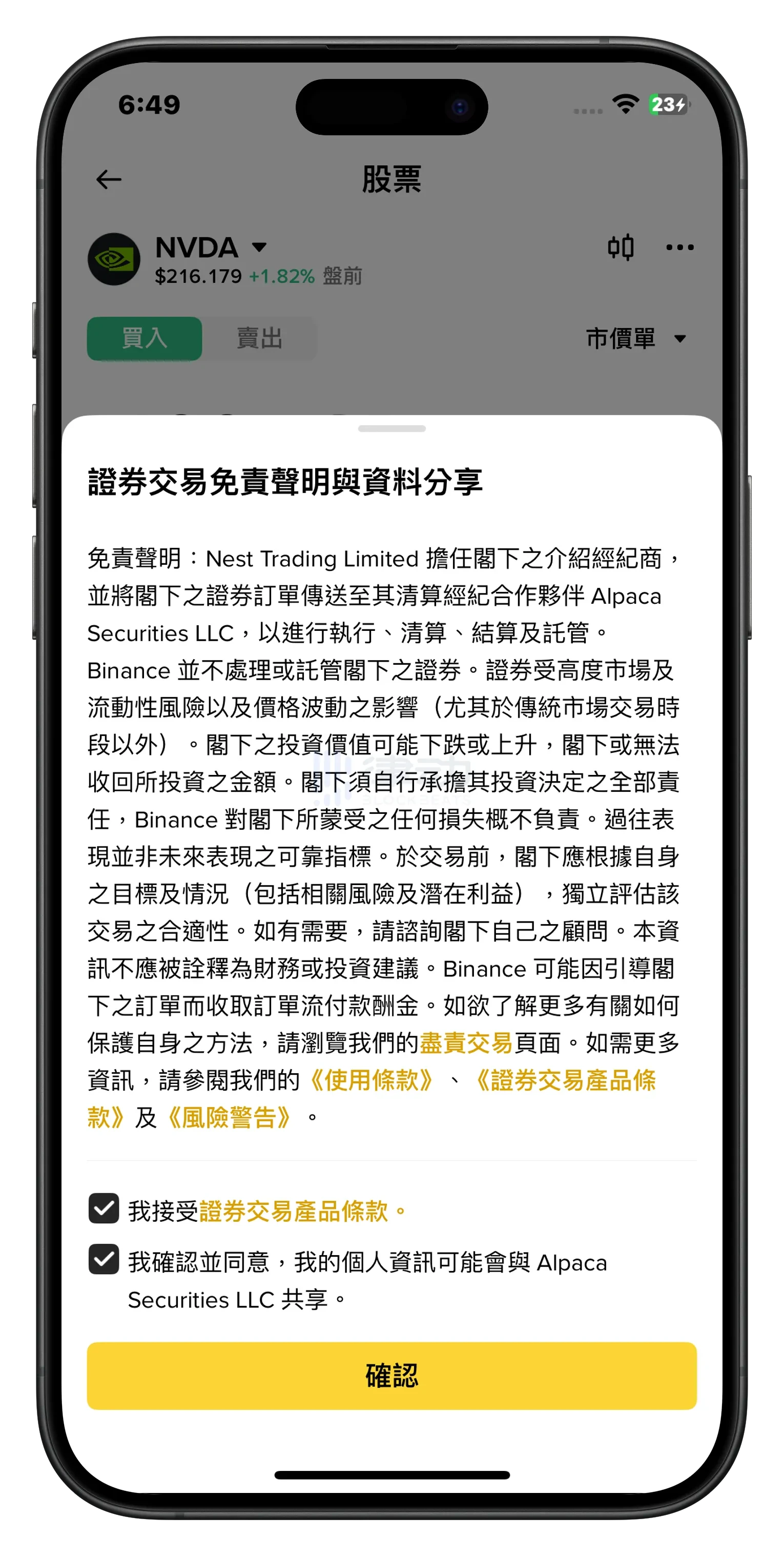
After clicking preview, a "Securities Trading Disclaimer and Data Sharing" notice pops up. The core terms convey in a formal tone that Nest Trading Limited acts as the introducing broker, transmitting orders to Alpaca Securities LLC for execution, clearing, settlement, and custody. Binance does not handle or custody your securities. Two mandatory checkboxes: accepting the terms of the securities trading products and agreeing to share personal information with Alpaca Securities LLC.
The fee details pop-up clearly states: commission fee of 0 USDC, platform fee of 0.35 USDC, and spread of 0 USDC, totaling 0.35 USDC. Three notes are worth highlighting: first, Binance does not charge commissions, but orders will incur platform fees or spreads; second, currently, BNB fee discounts are not supported; third, regulatory fees may be charged in the future (CAT, TAF, SEC fees).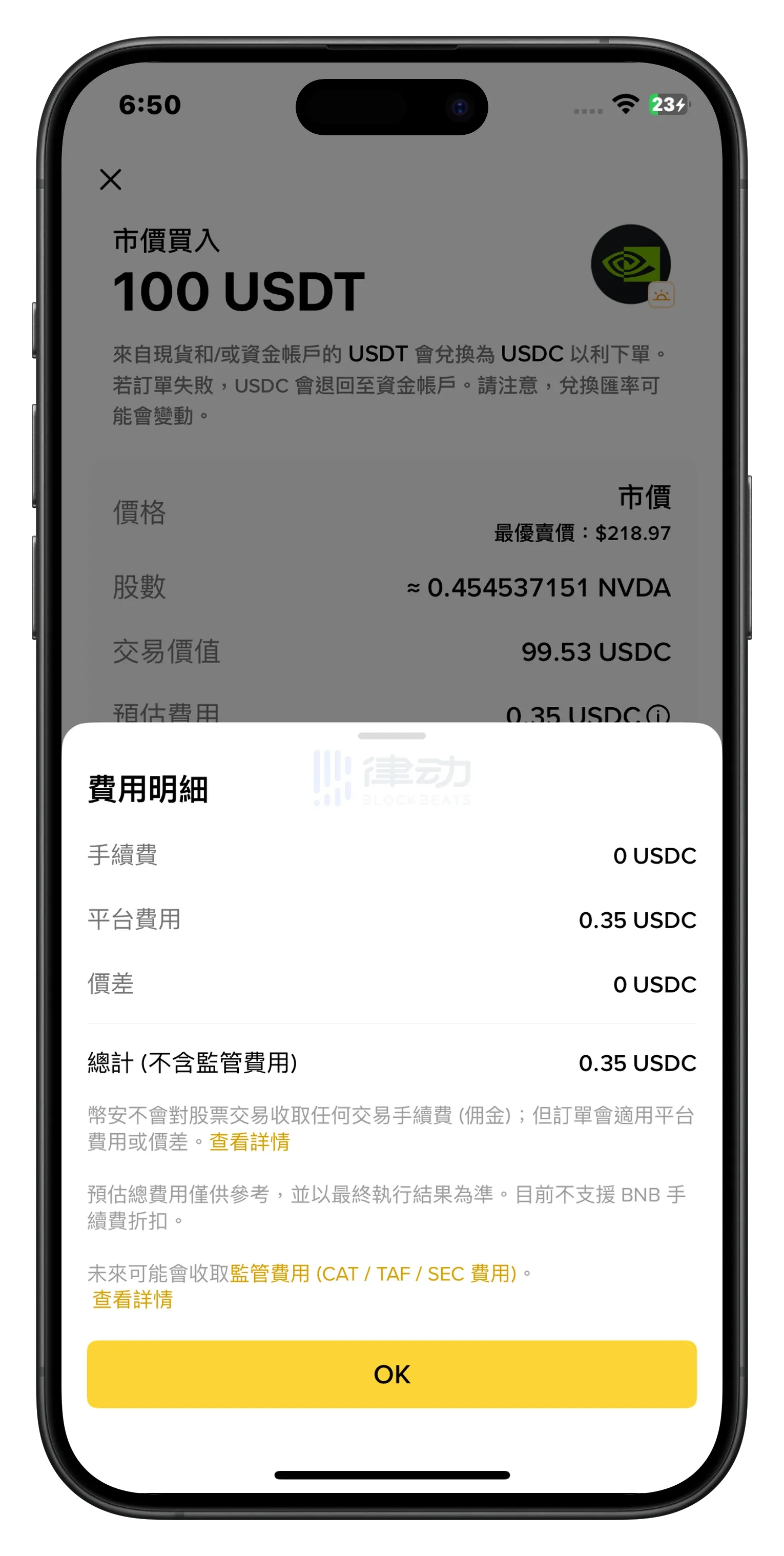
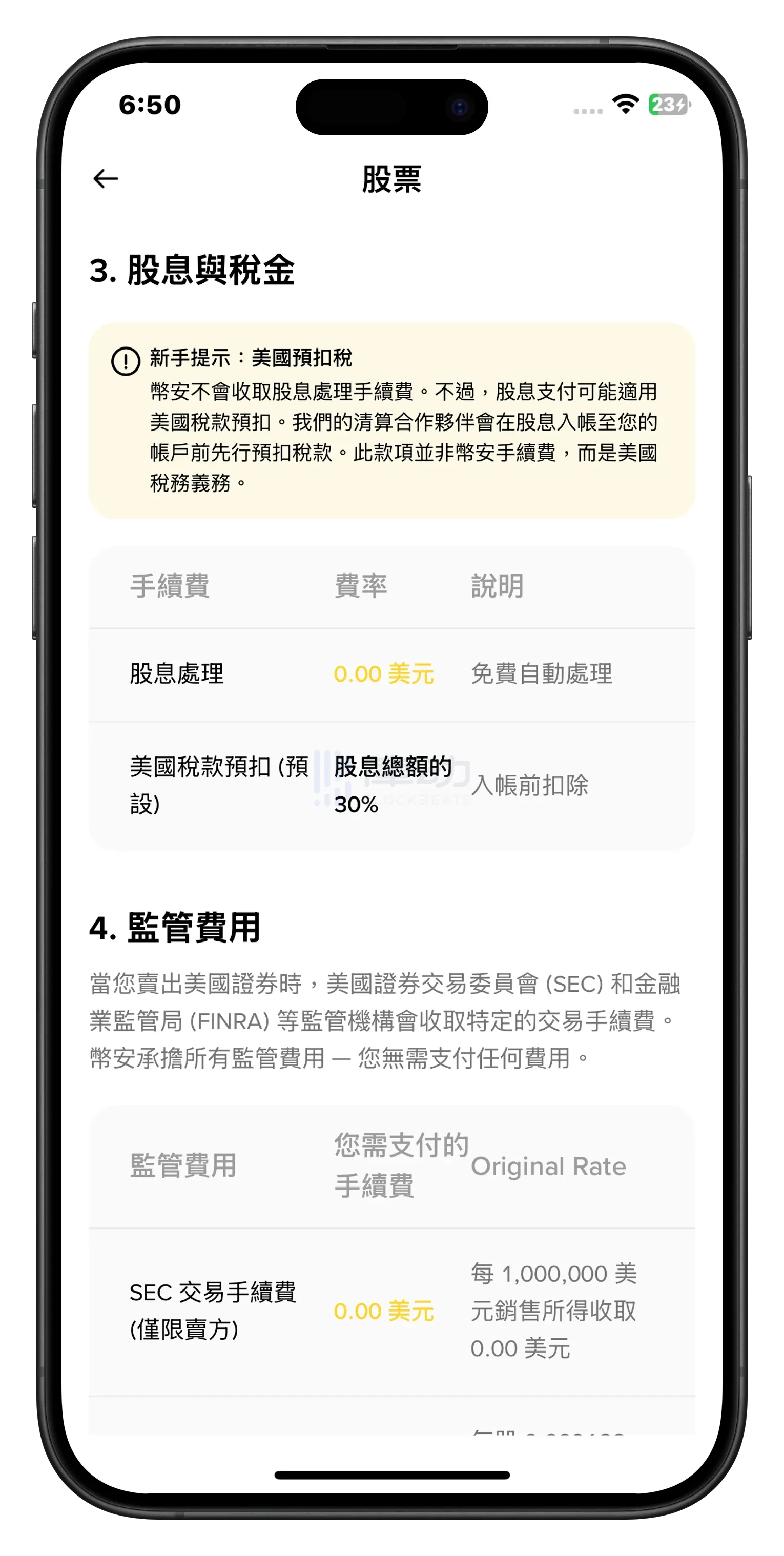
The rate page breaks down the structure further: transaction spread of 0.10%, with a minimum transaction of $0.35; fractional shares are subject to the same fee rate, with a minimum investment of $1; account opening, maintenance, idle, and custody fees are all 0. Regulatory fees for SEC transaction fees (only for sellers) are borne by Binance, with users paying 0.
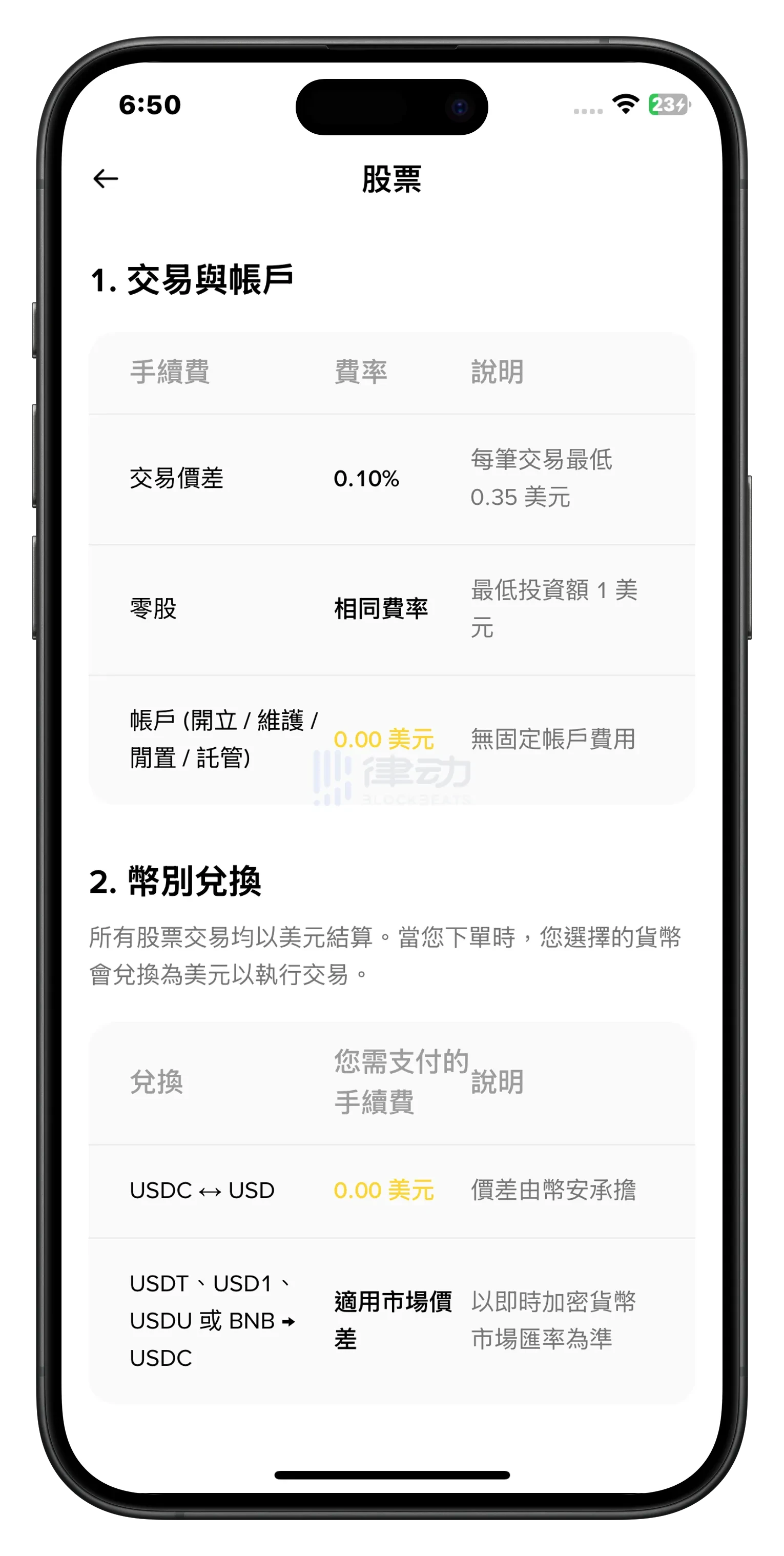
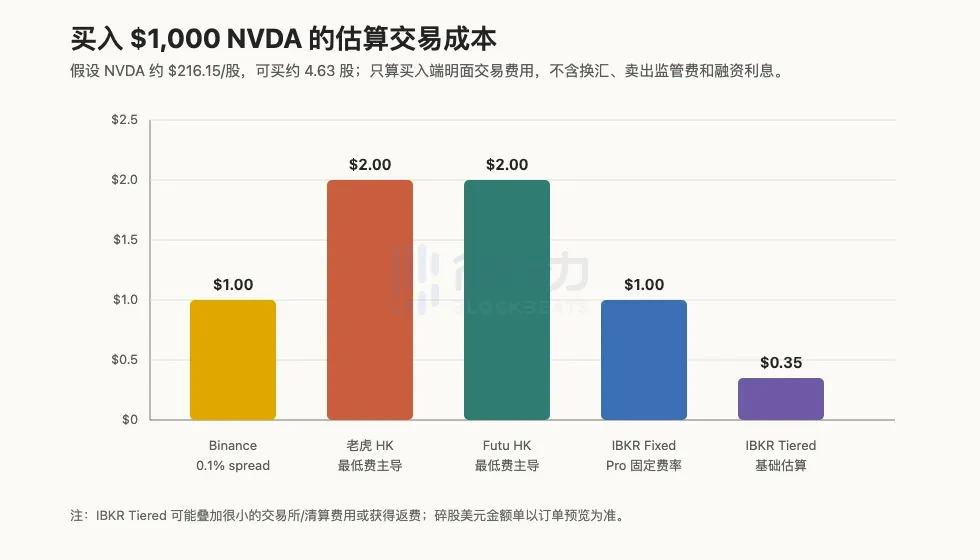
Thus, "zero commission" should be understood as: the commission is indeed zero, but the platform fee of 0.10% (minimum $0.35) is a hard cost, combined with the currency conversion spread for non-USDC tokens as a soft cost. Taking the example of this purchase of NVDA with 100 USDT, a platform fee of 0.35 USDC corresponds to a trading value of 99.53 USDC, resulting in an effective fee rate of about 0.35%. This figure is not low compared to traditional brokers (both Robinhood and Webull are zero), but it is not high in the context of cryptocurrency trading platforms (the baseline for spot trading fees is 0.10%). As for the lack of support for the BNB discount, this is a clear expectation gap in the ecosystem where almost all Binance products allow BNB to offset fees.
Another number with a bigger impact for long-term holders: the dividend handling fee is 0, but the U.S. withholding tax is standardly set at 30% of the total dividend amount, directly deducted before being credited. This is the standard withholding tax rate for non-resident foreigners in the U.S., and not a fee imposed by Binance, but it means the dividends you receive will only be 70% of the nominal amount. NVDA's dividend yield is only 0.02%, so the impact is minimal, but if buying high-dividend ETFs, this 30% cannot be ignored.
It is essential to note that pre-market market orders will not be executed immediately but will wait to transact at the best available price when the market opens.
Trading is available 24 hours a day from Monday to Friday, but liquidity during non-core hours is extremely thin, and market orders may face significant slippage. The disclaimer also clearly states: "Securities are subject to high market and liquidity risks and price volatility, especially outside traditional market trading hours."
For cryptocurrency users, 24/7 trading is commonplace; however, the liquidity in the stock market cannot be replicated simply by extending trading hours. Market maker quotes, institutional participation, and the density of order flows are concentrated in the East Coast time frame from 9:30 to 16:00. The significance of being open 24/7 is mainly to "be able to place orders at any time," rather than "to be able to transact at a reasonable price at any time."
Securities Lending, Another Major Weapon for Binance
Having finished the trading experience, the editor will further analyze Binance's U.S. stock product.
For a cryptocurrency trading platform to run a U.S. stock business, the buy button at the front end is just the lightest layer. The real weight lies in the three pipes of matching, custody, and lending. Binance's approach this time is to strictly define its role as the front-end entry and delegate the backend work to two entities.
The first is Nest Trading Limited. The disclaimer states "introducing broker," which sounds like an external partner, but upon investigation, it turns out to be Binance's own company. In December 2025, the Financial Services Regulatory Authority of the Abu Dhabi Global Market (ADGM) approved licenses for three of Binance's entities: Nest Exchange Limited is responsible for trading platform business (spot and derivatives), Nest Clearing and Custody Limited handles clearing, settlement, and digital asset custody, while Nest Trading Limited (formerly BCI Limited) holds a broker-dealer license responsible for over-the-counter trading and exchange services. In other words, Nest Trading is not a third-party engaged by Binance, but rather its proprietary licensed arm under the ADGM framework, specifically undertaking business that does not go through the trading platform's matching engine. Referring U.S. stock orders is an extension of this type of "over-the-counter" business.
The second is Alpaca Securities LLC. This is the true independent third party. Based in New York, Alpaca is a self-clearing licensed brokerage firm, registered with FINRA, and protected by SIPC (up to $500,000 per customer account), also a clearing member of DTCC, FICC, and OCC. However, it is not a brokerage aimed at retail investors but a B2B infrastructure provider for financial technology companies. Its core product is Broker API, which allows partners to embed trading in stocks, options, fixed income, and cryptocurrencies into their own applications. To date, Alpaca's API serves over 200 fintech clients in more than 40 countries, accommodating over 10 million brokerage accounts. Early partners include Gotrade and Midas, with Binance being the largest cryptocurrency platform integrated.
Another update worth mentioning is securities lending, set to launch on June 4.
Fully Paid Securities Lending (FPSL) allows users to lend qualified stocks fully owned to market participants (usually institutions needing to short-sell, engage in arbitrage, or act as market makers) and earn interest income.
FPSL is a mature business in traditional financial markets. Charles Schwab's securities lending program splits profits 50/50, with a minimum asset threshold of $100,000; Fidelity requires a minimum account balance of $25,000; Interactive Brokers' Stock Yield Enhancement Program also offers a 50% split with a threshold of $25,000; Robinhood launched its own securities lending program in 2022 with the lowest thresholds, calculated daily. The entire securities lending market contributes nearly $10 billion in global revenue annually.
In the cryptocurrency trading platform realm, Kraken is the pioneer. It launched FPSL for its U.S. stock business in 2025, allowing eligible users to lend fully owned stocks and earn interest. This is also one of the critical hooks for Kraken to attract users to transfer stock positions from other brokers through ACATS. Alpaca itself introduced the FPSL function for Broker API partners in May 2025, so Binance's securities lending is likely reusing Alpaca's underlying capabilities directly.
For Binance, FPSL's significance is not just another feature label. It is a critical step in pushing users from "buy and hold" to "buy and earn interest," and it prefaces the future integration of stocks into DeFi lending protocols after the tokenization of bStocks. Running the lending process within the traditional brokerage framework first, then applying the same logic on-chain, forms a coherent pathway.
Not Just Binance: A Race Among Various Trading Platforms
Zooming out, Binance's move is not isolated. The entire early 2026 sees the track crowded with competitors.
Coinbase, OKX, Kraken, and Bybit all announced or launched tokenized stock trading at the beginning of the year, with the market cap of tokenized stocks soaring from $32 million to nearly $1 billion in less than a year.
Coinbase is adopting the "everything exchange" route. At the beginning of 2026, it launched traditional stock and ETF trading for U.S. users, zero commissions, 24/5, and fractional shares starting at $1, complemented by a marketing partnership with Yahoo Finance, clearly targeting Robinhood. However, it deliberately excluded tokenized equity from its licensed broker-dealer and main operating company in the fine print, leaving a regulatory suspense.
Robinhood is the initiator of this tokenization narrative. In June 2025, CEO Vlad Tenev unveiled a three-step plan at an event titled To Catch a Token, beginning with launching tokenized stocks in the EU, covering over 200 U.S. companies, with the core idea being to make tokenization a seamless experience for users. The infrastructure is its self-built chain, an Ethereum L2 based on Arbitrum Orbit specifically for real asset tokenization, set to launch fully in 2026.
Kraken focuses on DeFi integration and self-custody. Its xStocks allows investors to take 1:1 backed equity tokens into private wallets as collateral, settled on Solana and Ethereum, covering over 60 blue chips, and has partnered with Nasdaq. In terms of capital, Deutsche Börse strategically invested $200 million in it in April.
OKX has also secured significant backing. In March 2026, ICE, the parent company of the NYSE, announced a strategic investment of $25 billion in it, centering around a "unified matching engine," placing tokenized equity associated with the NYSE at the core. This marks the first time a traditional trading platform operator has invested in a top cryptocurrency platform for this purpose and secured a board seat.
The remaining players have not been idle.
Coinbase and Bybit are exploring partnerships for tokenization, custody, and distribution of U.S. public and pre-IPO stocks; Bitget and Ondo Finance have launched over 100 tokenized U.S. stocks, with spot volumes exceeding $1 billion in January 2026. On the underlying issuance engine side, Backed Finance's xStocks currently has about 100 targets, aiming for over 500 by the end of 2026, and cumulative transactions have exceeded $25 billion as of March this year. In the on-chain space, the trading volume of tokenized stock derivatives set a single-day record of $3.57 billion on May 18, primarily driven by Binance and Hyperliquid.
It is worth noting that this is not just a one-way approach from crypto towards stocks. Traditional institutions are also moving to the chain. BlackRock has already converted U.S. Treasuries into blockchain-packaged products, and both NYSE and Nasdaq have announced plans to incorporate tokenization technologies into their systems.
Two rivers are converging; we shall see how everyone plays going forward.
免责声明:本文章仅代表作者个人观点,不代表本平台的立场和观点。本文章仅供信息分享,不构成对任何人的任何投资建议。用户与作者之间的任何争议,与本平台无关。如网页中刊载的文章或图片涉及侵权,请提供相关的权利证明和身份证明发送邮件到support@aicoin.com,本平台相关工作人员将会进行核查。


