Original | Odaily Planet Daily (@OdailyChina)
Author | Wenser (@wenser2010)

On June 1, Binance officially announced that it will provide trading for over 7,000 U.S. stocks and ETFs for non-U.S. users, and plans to launch a product called bStocks that allows users to initiate tokenized stock trading in the coming weeks. Coupled with its previous launch of Pre-IPO contracts, event trenches, and prediction market entrances, Binance's focus is rapidly expanding from the crypto market to a global asset pool covering traditional financial assets, crypto assets, RWA assets, and commodities.
In this capital feast surrounding the AI industry and the U.S. stock market, Binance has greater ambitions: starting with crypto, but not limited to crypto. As revealed by Binance co-founder He Yi previously, the goal of “covering 3 billion users globally and serving the financial needs of the general public” indicates that the "10x growth war" brought by Binance will quickly ignite under the strategy of “super apps are super entrances.”
Transitioning from the world's leading cryptocurrency exchange to a global asset and financial super app, Binance is reshaping users’ daily financial experience through the combination of asset scenario matrix, traditional asset coverage, and AI technology empowerment.
Binance's "All-Asset Scenario Matrix"—The Underlying Logic of Super Entrances
For current crypto market users and even global investors, the current investment landscape is undoubtedly fragmented and highly disjointed. Apart from the regional differences in regulatory compliance, the main pain points for users are concentrated in the following aspects:
First, asset types are extremely scattered. Traditional financial markets like U.S., South Korean, Japanese, European, and Hong Kong stocks are highly dispersed, with varying market access mechanisms and capital capacities; commodities like crude oil, natural gas, gold, silver, and precious metals have different market price indicators and scattered liquidity; as for U.S. stocks and pre-IPO assets, they are a chaotic tangle, as investment platforms are spread across different channels, networks, ecosystems, and platforms, with uneven thresholds and numerous entrances.
Second, online and offline scenarios are fragmented. The large-scale adoption of crypto assets has not gone as planned, largely because it is challenging to cover offline scenarios and break through the online and offline liquidity network. Usage in detailed aspects like funding on-chain, stablecoin payments, offline consumption, and merchant channel networks has long been a shortcoming of crypto assets; the exchange between traditional financial assets and fiat currency systems is also a market gap for online funds to gain offline application empowerment.
Third, there is a gap in investment life demands. For a long time, due to the separation of banking systems, traditional financial markets, and the crypto market, individual investors struggle to balance investment assets and life assets, making it difficult to achieve smooth exchanges and seamless usage between the two. It's no wonder that many self-deprecate, saying “life is about patching things up, while the stock market/blockchain is about spending money like dirt.” Given this reality, it is detrimental to users’ consumption and use and lacks returns like asset management and diversified allocation.
In response to these issues, Binance, with over 300 million users, provides a direct answer: “What users and the market need, Binance provides.”
Looking at Binance's main site, mobile app, wallet, and other entrance products, it has already formed a matrix covering three categories of assets: TradFi, CeFi, and DeFi—TriFi (three categories of financial assets)—
- In terms of asset coverage: Binance has opened a self-operated U.S. stock investment entrance, facilitating global investors to invest in traditional financial assets (covering U.S. stocks, pre-IPO assets, commodities like crude oil/gold, etc.), purchase crypto assets and stablecoins, and convert fiat currency.
- In terms of scenario coverage: Utilizing its previous payment network and fiat-stablecoin exchange system, Binance's Binance Pay and Binance Card systems support users in online transfers, payments, and investment transactions, while also meeting offline consumption needs, covering various online and offline scenarios.
- In terms of ecosystem closure: Leveraging Binance as a “super entrance,” diversified assets including crypto assets, traditional financial assets, RWA assets, and commodity assets can be smoothly accessed, allowing users to conduct one-stop trading and allocation according to their needs, covering the full life cycle of user services. While ensuring openness, richness, and user stickiness, it has achieved an ecological inner loop of “fiat currency-stablecoin/crypto assets-global assets-wealth management-consumption.”
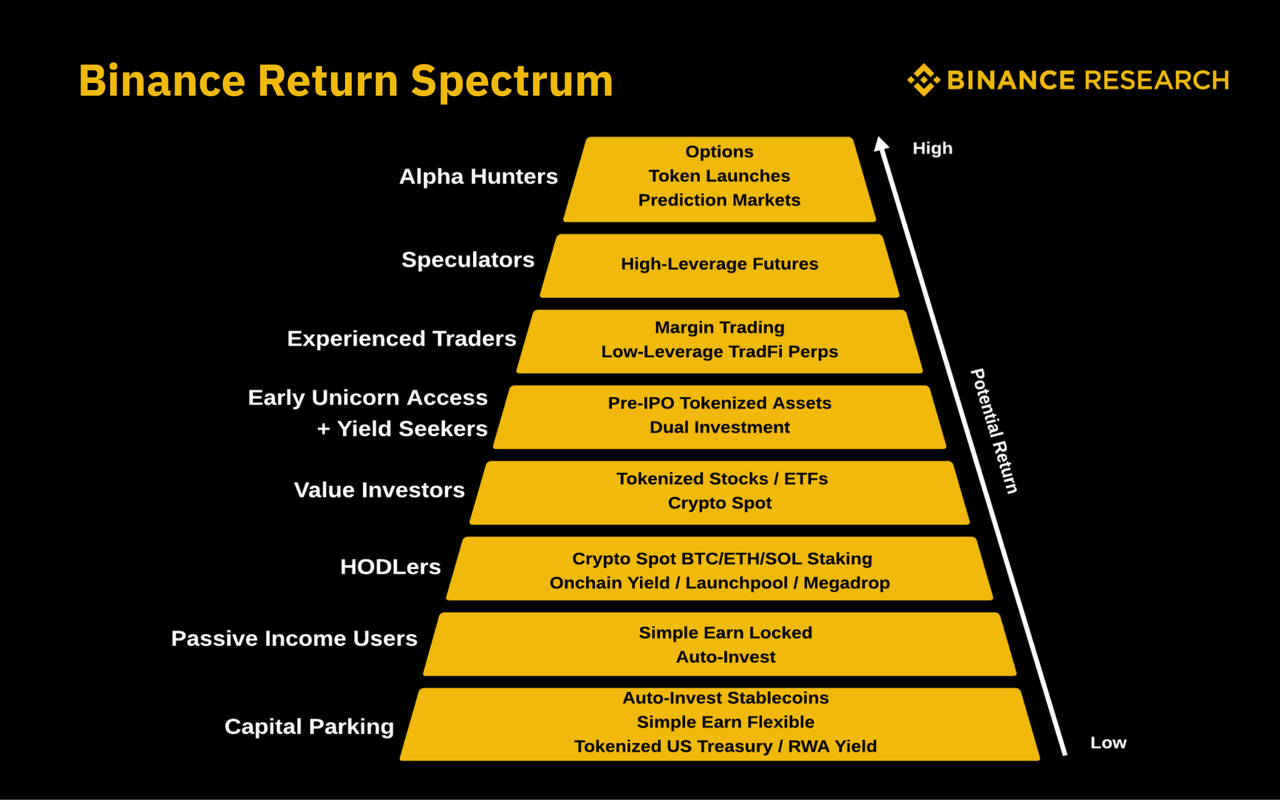
It is evident that Binance's strategic goal is no longer limited to “making crypto assets accessible to more users,” but is instead focusing on financial inclusivity and asset coverage globally. Through super applications, it aims to create super entrances, truly benefiting users' lives with finance and serving their daily needs, rather than being mere speculative tools. This is also the ambitious goal mentioned by Binance co-founder He Yi atthe offline conference in Hong Kong: “The AI singularity is here, Binance aims to serve 3 billion people.”
Based on the concept of an all-asset scenario matrix, Binance's super entrance barrier is being solidified, which can be seen from its recent data on TradFi contracts and Pre-IPO markets.
TradFi Contracts and Tokenized Assets Launched on Binance, Traditional Financial Windows Being Forcefully Torn Open
According to CoinDesk data, after Binance launched its first Pre-IPO perpetual contract—SpaceX pre-IPO asset on May 21, its market share quickly broke 60% and reached about 65% on May 27. In the first seven days after launch, there were 4 days with daily trading volume exceeding 100 million USD. From the data of this single popular asset, it is not difficult to see that Binance still possesses a dominant liquidity introduction and retention capability in introducing TradFi assets.
Moreover, from the data in the TradFi perpetual contract market, Binance remains the leading player in this arena:
- In the past two months, Binance's overall share in the TradFi perpetual contract market has remained around 45%-60%, solidifying its top position in a current daily average market size of approximately 7 billion USD; commodity trading accounted for as much as 65% of the total transaction volume in the TradFi market over the month, with Binance's market share exceeding 60%.
- On the Binance platform, since the launch of the TradFi perpetual contracts on January 28, 2026, its trading volume has grown from approximately 563 million USD to about 8.5 billion USD in the last 7 days, covering over 20 underlying assets, with an overall scale growth of about 15 times, and it continues to expand. As Micron Technology's market capitalization surpassed 1 trillion USD, the trading volume of the MU/USDT perpetual contract on the Binance platform once approached 1.6 billion USD, three times its previous peak.
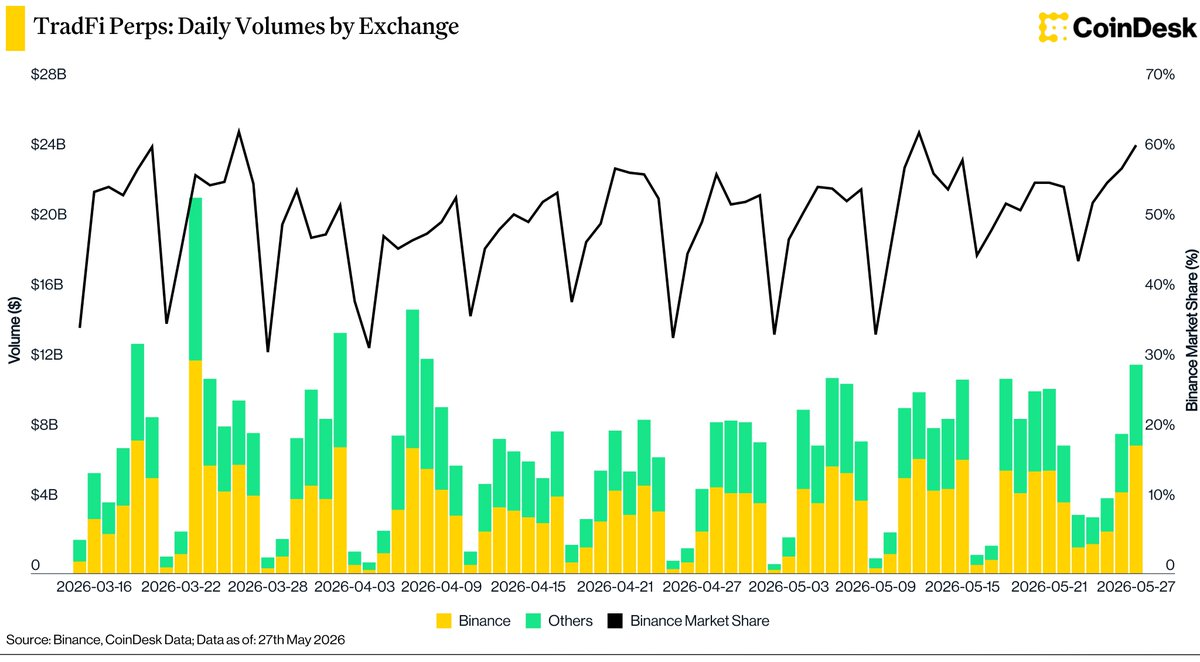
The successive launches of SpaceX Pre-IPO perpetual contracts, OpenAI Pre-IPO perpetual contracts, and Anthropic Pre-IPO perpetual contracts indicate that Binance has broken the “asset wall” that previously existed for crypto users, providing a “super entrance” to crypto traders, derivatives users, retail investors seeking Pre-IPO exposure, and users focused on traditional financial markets to share in the dividends of the traditional financial market era, thereby deeply connecting the U.S. stock market, commodity market, and crypto liquidity.
Yesterday, Binance announced the launch of its U.S. stock trading product, which is also a significant part of this initiative.
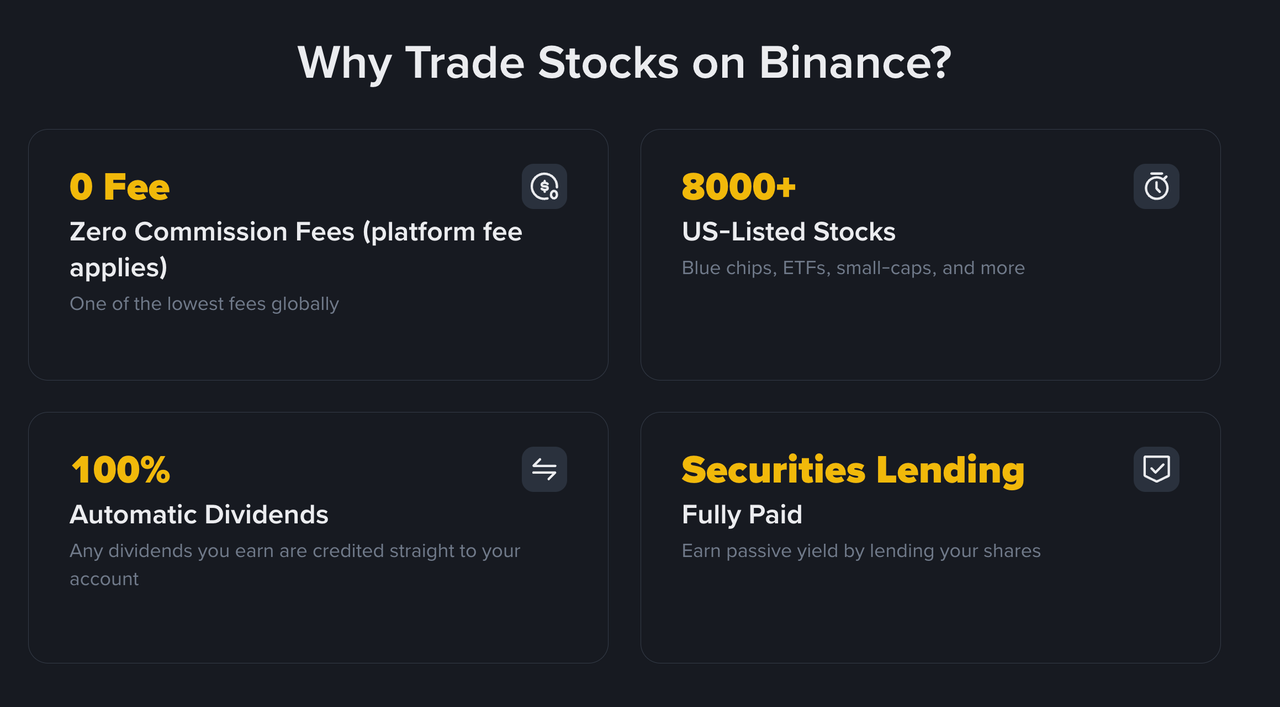
According to official information, this product will connect directly with the underlying assets of U.S. stock brokers, offering non-U.S. investors zero-commission trading opportunities for over 7,000 stocks and ETFs; the minimum investment amount is 5 USD, and users can purchase with cryptocurrencies such as USDC, USDT, and BNB; dividends will be automatically credited to accounts; trading hours are Monday to Friday with 24/7 access. Trading is supported by the broker Nest Trading, with brokerage custody and dividends managed by New York-based Alpaca.
Additionally, Binance plans to launch “bStocks” based on BNB Chain, allowing users to self-convert held stocks into tokenized assets that can circulate on-chain for instant settlement and potential DeFi scenarios (like lending and liquidity provision), further bridging traditional equity with on-chain assets.
Upon closer examination, Binance's actions not only seek short-term transaction fee revenue but also carry medium- to long-term three layers of significance:
First, to compete for essential pricing power of quality assets. By anchoring the prices of Pre-IPO assets, Binance will leap to become a “pricing barometer” for many quality assets, facilitating institutional users and individual users to understand various asset market emotions and price trends prior to IPOs.
Second, to compete for comprehensive liquidity flow. With Binance as a super entrance, the liquidity of TradFi funds and the crypto market will be further deeply integrated, with the former participating in the crypto ecosystem layout in the form of stablecoins and crypto assets, while the latter can inject filterable quality assets into the traditional financial market, further broadening Binance platform's liquidity foundation.
Third, to compete for large-scale user engagement. By covering U.S. stock assets and pre-IPO quality assets, Binance can meet various users’ diverse investment and consumption needs through a single super application, facilitating flexible fund allocation, adjusting investment positions, and enjoying wealth management or early pricing benefits. While expanding the scale effect, it will lead a new wave of explosive user growth.
In summary, by leveraging “single quality assets” to leverage “the entire traditional financial market,” Binance's asset layout not only realizes its “super entrance role upgrade” but further breaks the original asset boundaries of the platform, accelerating the transition to a comprehensive financial platform.
Binance’s “AI Key”—Driving Engine of the Super Application
If the layout of the all-asset matrix provides greater “breadth” to Binance’s liquidity market, then AI serves as the “intelligent engine” empowering Binance to become a “super application” with both “market depth.”
Currently, Binance's AI landscape mainly consists of the following three core applications:
Trading Side: Binance AI Pro allows users to leverage AI tools and AI Agents to implement automated strategies, supporting real-time execution of trading operations while satisfying decentralized management of fund sub-accounts, thus enhancing trading efficiency while meeting users' refined trading strategy needs.
Security Side: Based on past risk management systems, Binance has systematically upgraded security using AI technology. According to reliable data statistics, since 2025, Binance's AI security risk control system has prevented over 10.5 billion USD in risk fraud, achieving remarkable results in thwarting asset phishing, AI deep forgery, and more. Millions of users’ personal assets have been secured, preventing asset losses.
Compliance Side: As a leading exchange in the industry, Binance's efforts on regulatory compliance have always been notable. In the AI era, Binance has integrated AI technology to create a complete “AI Compliance System”—for a wide variety of tokens, Binance has launched the "AI Token Report" feature, making it easy for users to review project risks; in terms of AML anti-money laundering compliance, Binance uses AI to enhance trading monitoring, detect anomalous behavior, and issue suspicious transaction reports; additionally, about 80% of security attacks against Binance involve some level of KYC fraud, with AI serving as a key defense layer in its compliance system.
Thus, leveraging AI large models and application tools, Binance has achieved full-link security management, encircling from research, decision-making, execution, to risk control, greatly enhancing user experience and platform security while solidifying the foundation of asset management and risk control management.
Driven by AI technology, Binance's “super application” will have greater protection and user stickiness, continuously strengthening personalized recommendations, risk warnings, and user-friendly operations.
Conclusion: The Era of Super Applications is Coming, and Binance is the Super Entrance
At present, with the accumulation of 300 million users, the all-asset scenario matrix, the entrance to traditional financial market assets, and the AI security development driving engine, Binance already possesses the fundamental conditions to become a next-generation super entrance, and the journey to becoming a comprehensive global financial platform is just around the corner.
As traditional financial assets and crypto assets merge deeply and the era of 24/7 trading develops rapidly, Binance, which holds a certain first-mover advantage, has become “the first to eat crab in the era of super entrances.”
Since Binance chose to actively seek change, stepping into the embrace of U.S. stock assets and the traditional financial market, its vision of “Exchange The World” is gradually transforming from an ideal into reality. The Binance platform will also evolve from a previous single trading tool to an indispensable “super financial APP” for the future 3 billion users.
More assets, one-stop entrance, this is the era's answer from Binance and also the challenge presented to all leading players in the global financial market.
As the “first cryptocurrency exchange,” Binance shall not be left behind.
Reference Information:
A More Inclusive Financial Future
Super Entrance: The Integration of TradFi, CeFi, and DeFi on Binance
He Yi: The AI Singularity Has Arrived, Binance Aims to Serve 3 Billion People
Data: Binance's AI Security System Has Protected Over 10.5 Billion USD in Assets Since 2025
免责声明:本文章仅代表作者个人观点,不代表本平台的立场和观点。本文章仅供信息分享,不构成对任何人的任何投资建议。用户与作者之间的任何争议,与本平台无关。如网页中刊载的文章或图片涉及侵权,请提供相关的权利证明和身份证明发送邮件到support@aicoin.com,本平台相关工作人员将会进行核查。


