Super detailed interpretation of @binance's stock trading — a layered model of brokerage licenses under extreme caution
After I learned in detail about Binance's stock model, I couldn't help but admire Binance's extreme caution regarding compliance. I can say that most of the stock forms I see from cryptocurrency exchanges are compliant, but Binance does more than just comply; it has a more cautious "license" layered model.
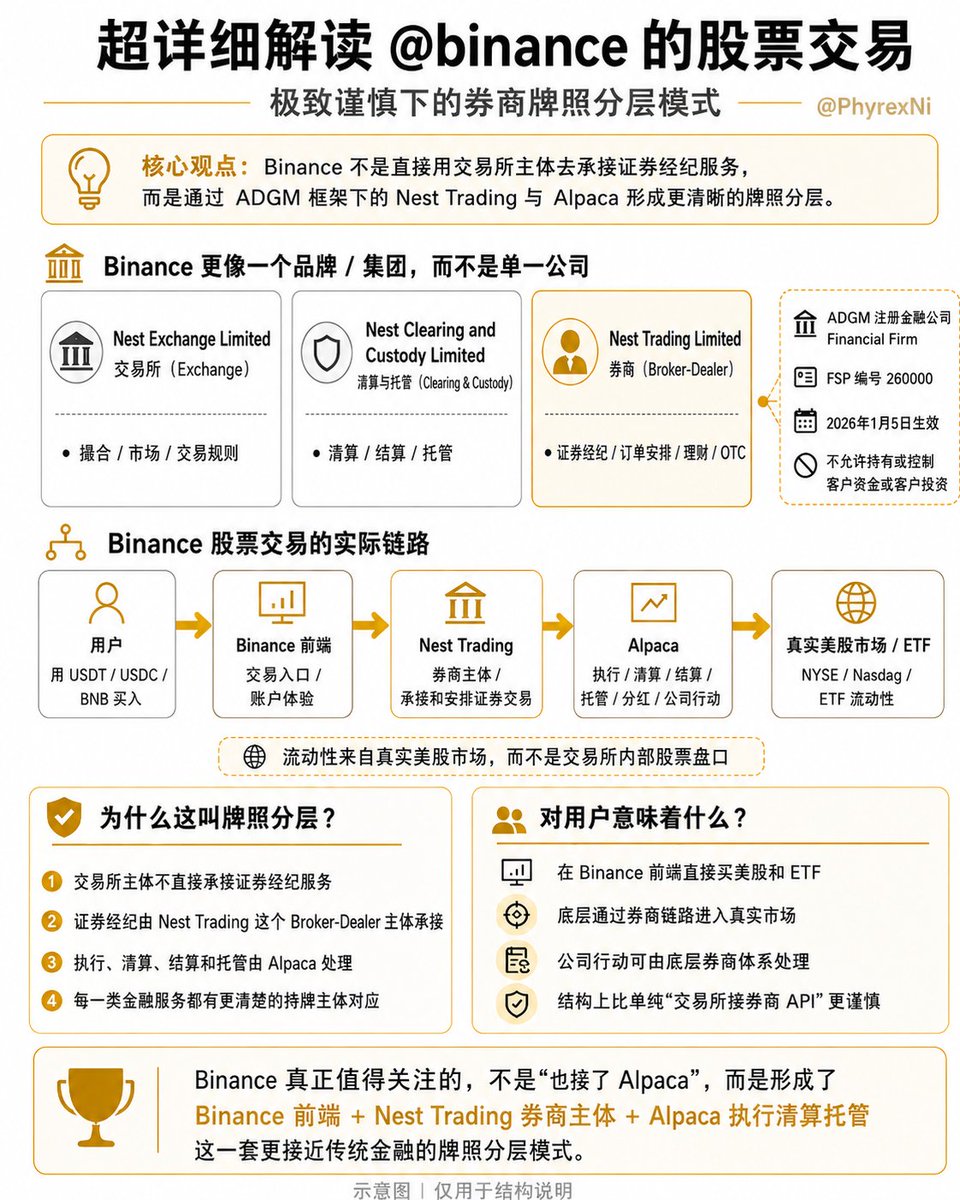
Many exchanges use Alpaca as their underlying broker, which is an openly known secret in the U.S. compliance realm. Although Binance also uses Alpaca, it adds another layer, Nest Trading, a financial company registered in ADGM.
(Financial Firm, FSP number 260000, effective January 5, 2026, Nest Trading is not permitted to hold or control customer funds or customer investments.)
What does Nest Trading do? Before this, some of you might not know what Binance specifically is.
Binance now resembles more of a brand or group rather than a single company. It's akin to how Google actually belongs to Alphabet.
Binance operates under three core entities within the Abu Dhabi Global Market (ADGM) regulatory framework, namely:
Nest Exchange Limited: Exchange
Nest Clearing and Custody Limited: Clearing & Custody
Nest Trading Limited: Broker-Dealer
If understood in traditional finance, it is equivalent to Binance dividing all the internal functions of a previous exchange into these parts: an exchange, a clearing house, a custodian, and a broker.
This structure resembles a model where Nasdaq is responsible for trading, DTCC is responsible for clearing, and brokers handle clients and orders, rather than the past model where one exchange was responsible for trading, clearing, custody, OTC, wealth management, and conversion simultaneously.
Among these, Nest Trading is mainly responsible for:
1. Arranging Deals in Investments
2. Dealing in Investments as Agent
3. Dealing in Investments as Principal
4. Managing Assets
5. Arranging Custody
6. Providing Money Services
In general, Nest Trading is essentially a Broker-Dealer + Wealth Platform + OTC Desk company; in simpler terms, it is specifically responsible for brokerage business.
So #Binance does not connect directly with Alpaca using the exchange entity, but rather goes through Nest Trading to connect with Alpaca. The benefit of this is that Binance does not directly use the exchange entity to offer brokerage services; instead, it places securities-related business under Nest Trading, this Broker-Dealer entity, achieving a clearer business layering from a licensing perspective.
This is what I referred to at the beginning as "license" layering.
If an exchange connects directly with Alpaca, that can certainly be compliant as well. As long as the underlying broker, account opening, KYC, trading, clearing, custody, dividends, and corporate actions are all handled properly, there is no inherent issue with that model. However, Binance's problem is that its user volume, trading volume, regulatory history, and global coverage are too large.
If Binance's exchange entity were used directly to connect with Alpaca, it would be easily misunderstood by the outside world as Binance itself providing U.S. stock brokerage services to global users.
But now with the added layer of Nest Trading, the logic changes to users placing orders in the Binance frontend, Binance providing the trading entrance and account experience, while Nest Trading, acting as the broker entity, is responsible for accepting and arranging securities transactions and routing orders to Alpaca, who is responsible for the actual execution, clearing, settlement, custody, dividends, and corporate actions.
This is the license layering.
PS: This is also why I emphasize that Binance consists of three core entities, one of which is Nest Trading as a core entity, just differently utilized in terms of "license."
As a result, the boundaries of each licensed entity are clearer: Binance is responsible for the frontend access and account experience, Nest Trading is responsible for securities brokerage and order arrangement, and Alpaca is responsible for execution, clearing, settlement, and custody. For regulators and users, each category of financial services has its corresponding licensed entity to undertake it.
This is more cautious than simply having the "exchange connect to the broker API."
For users, this model's greatest significance is that they see US stocks and ETFs being purchased with assets like USDT, USDC, BNB, etc., on Binance, but the underlying stock trading will be arranged through the broker entity Nest Trading and then executed, cleared, settled, and custodied by Alpaca, so liquidity comes from the real U.S. stock market, and corporate actions can also be handled by the underlying broker system, such as dividends, stock splits, consolidations, code changes, delisting handling, etc.
Thus, the upgrade brought by Binance's stock trading is not just that users can buy U.S. stocks and ETFs on the exchange, but that it elevates itself from a single cryptocurrency exchange to a global multi-asset financial gateway.
Through its own Broker-Dealer entity Nest Trading under the ADGM framework to connect with Alpaca, rather than directly using the exchange entity to undertake brokerage services, this preserves the user experience at the Binance frontend while also delineating the securities brokerage, order arrangement, execution, clearing, settlement, and custody to clearer licensed entities.
On the basis of compliance, it reduces the mismatched licenses and regulatory interpretation costs of conducting brokerage business directly using the exchange entity.
Therefore, we have the layered license model of Binance frontend + Nest Trading broker entity + Alpaca for execution, clearing, and custody.
免责声明:本文章仅代表作者个人观点,不代表本平台的立场和观点。本文章仅供信息分享,不构成对任何人的任何投资建议。用户与作者之间的任何争议,与本平台无关。如网页中刊载的文章或图片涉及侵权,请提供相关的权利证明和身份证明发送邮件到support@aicoin.com,本平台相关工作人员将会进行核查。


