Original | Odaily Star Daily (@OdailyChina)
Author | Azuma (@azuma_eth)
As HYPE continues to rewrite new heights, a debate has erupted on X surrounding "HYPE vs SOL".
The center of the verbal battle is Kyle Samani, the former co-founder and managing partner of Multicoin Capital, and a prominent figure in the Solana community (refer to "the man who hyped SOL the most, exiting the crypto world"), while the attackers from the outside are the loyal "believers" of Hyperliquid, represented by BitMEX co-founder Arthur Hayes.
S Guardians vs H Guardians’ Name-Calling
This past weekend, Samani himself posted numerous updates on X, actively “firing” at Hyperliquid, criticizing the project for being fundamentally centralized and having serious regulatory issues.
On May 30 at 6:30, Samani wrote: "Hyperliquid is essentially just a Binance 2.0 without a marketing team (Binance is innocent in this…). It has made thousands of technical decisions in its architecture that are only suitable for a centralized environment, yet completely unsuitable for a permissionless decentralized environment. Now, they are already lagging far behind on this path. Moreover, any real American company will never cooperate with them in the future."
On May 31 at 10:53, Samani stated: "Hyperliquid is as suspicious as Binance (again, innocent…). All the accusations made by the U.S. Department of Justice against Binance apply to Hyperliquid, and evidence for each crime is recorded. The so-called 'communication with regulators' is pure nonsense; Binance has also been communicating with regulators over the years…”
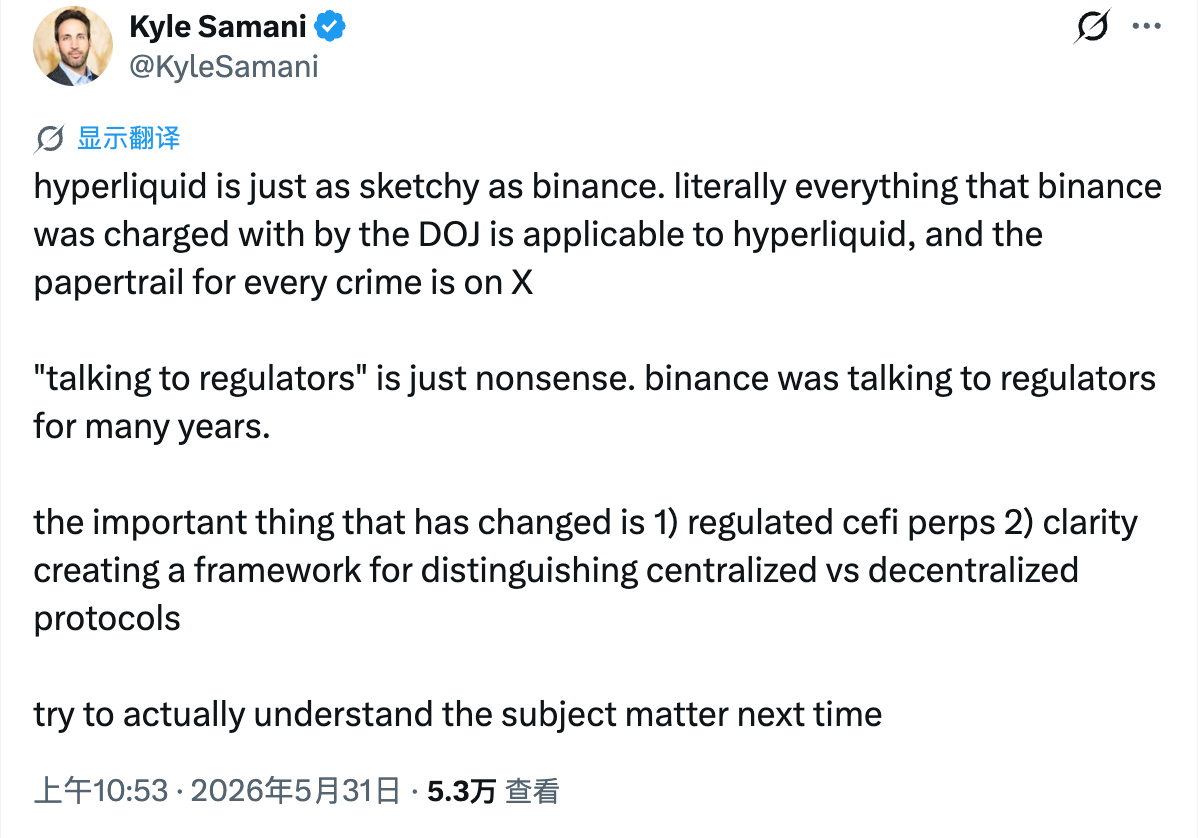
While attacking Hyperliquid, Samani did not forget to kick his old rival ETH again, calling it "reputation neutral but technically flawed", in other words, "completely useless"...
Ultimately, when answering the well-known Bitcoin developer Udi Wertheimer's question about "which token you consider a success case", Samani gave the unsurprising answer - Solana.
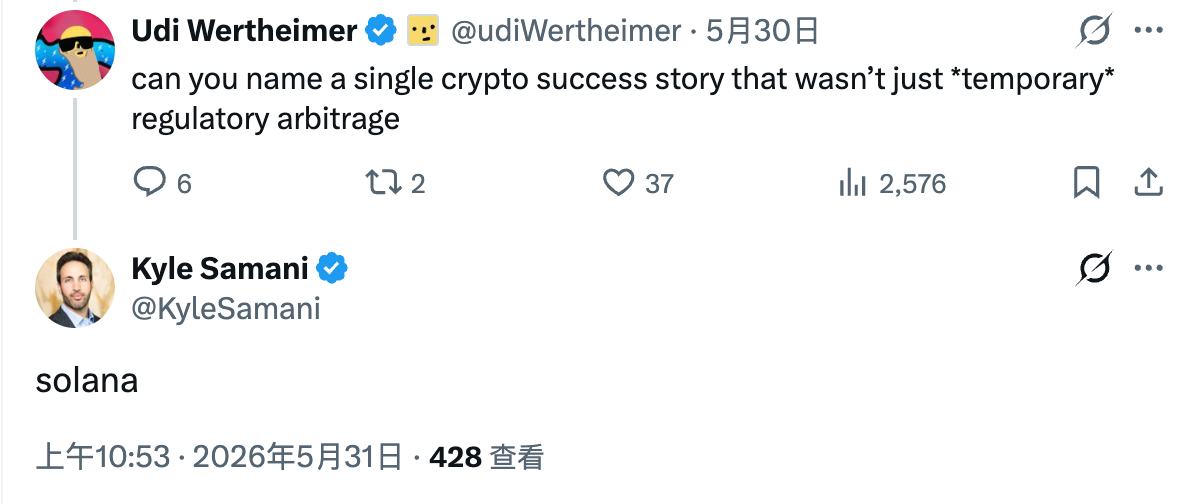
Unsurprisingly, Samani's remarks invoked fierce rebuttals from the community, especially as HYPE was so strong at this time. Investors like Hayes, developers like Wertheimer, and traders like Ansem all provided varying degrees of backlash against Samani's views.
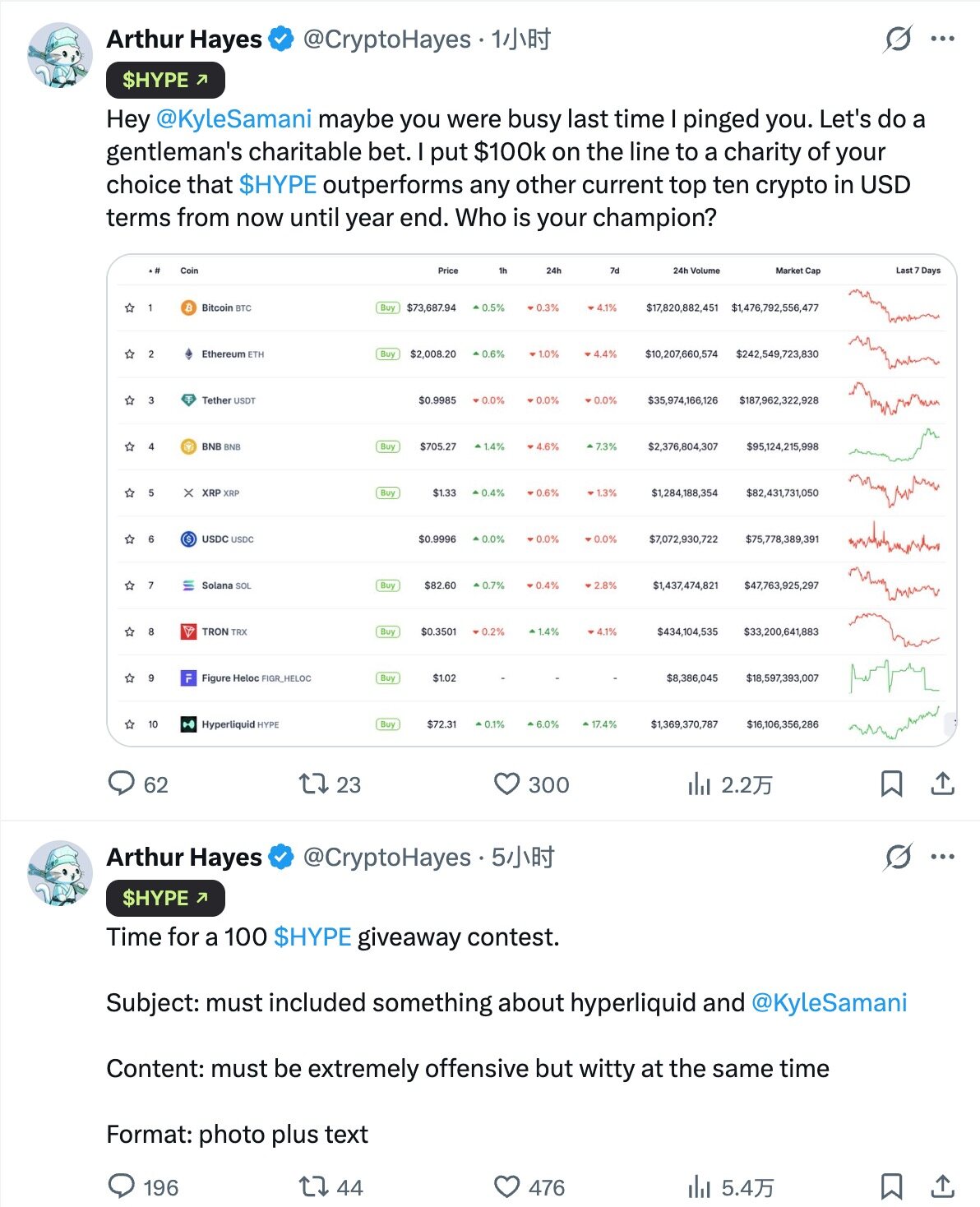
Among them, Hayes' rebuttal was the most direct. On May 31, Hayes published a post suggesting Samani, stating: "Before this market ends, HYPE should at least surpass SOL."
Earlier today, Hayes again posted that he wanted to organize a content competition with a prize pool of 100 HYPE, requiring participants to humorously and offensively rebut Samani... Meanwhile, Hayes also directly challenged Samani, expressing his willingness to wager $100,000 that HYPE will outperform the other tokens in the top ten cryptocurrency leaderboard in the remaining seven months of this year.
Narrative Conflicts Between Solana and Hyperliquid
In recent years, the most successful aspect of Solana has been building a high-speed, low-cost on-chain financial infrastructure. From Meme, DeFi to AI Agents, various assets and applications have chosen to issue and trade on Solana, with the core logic being - liquidity will gather in the most efficient market.
However, Hyperliquid takes this logic a step further.
Unlike Solana, which provides infrastructure and waits for applications and liquidity to grow naturally, Hyperliquid directly addresses the most core demand of the cryptocurrency industry by entering through the perpetual contract market, accumulating users, fee income, and liquidity, and gradually expanding into spot, coin-stock, prediction markets, and more financial products.
As a result, Hyperliquid has formed an extremely rare positive flywheel - more traders bring more fee income; more income feeds back to HYPE buybacks and ecological incentives; rising HYPE prices attract more capital; and more capital further enhances the platform’s liquidity and trading depth. The cash flow capabilities created by this flywheel have even surpassed those of public chain ecosystems, including Solana.
In recent years, Solana's core narrative slogan has been "Internet Capital Market”, but as users, assets, liquidity, and pricing power continue to shift to Hyperliquid, the latter now seems to fit this narrative much better than Solana. In other words, Hyperliquid seems to have become the embodiment of what Solana aspires to be.
As Solana's most loyal standard-bearer, Samani is clearly unwilling to see this situation.
Samani's Tactics: Using Solana's Past Critique Language to Attack Hyperliquid
A close observation of Samani's attack on Hyperliquid reveals a rather dramatic phenomenon.
In the past few years, during the debate between Ethereum and Solana, the most common attack method from the Ethereum camp has been to question Solana's degree of decentralization. High verification node thresholds, high hardware requirements, frequent network outages, overly dependent ecology on a few core institutions... In the eyes of many Ethereum supporters, Solana runs fast but essentially sacrifices decentralization for performance.
And the response from the Solana camp has been quite simple - users do not care about these issues. For the vast majority of users, what they need is faster confirmation speed, lower fees, and better product experiences, rather than a research report on node distribution.
In a sense, Solana's rise itself is a huge victory for the "efficiency first" approach . However, now, as Hyperliquid begins to capture market attention, Samani has raised the flag that the Ethereum camp used to wave.
Centralization, regulatory risks, resistance to censorship... These accusations sound somewhat familiar, but the former "defendant" was Solana, and now it has become Hyperliquid.
This seems somewhat "double-standard", but perhaps in Samani’s eyes, Solana represents that optimal balance - Ethereum is decentralized enough, but too clumsy; Hyperliquid is extremely smooth, but essentially resembles a CEX; meanwhile, Solana, no matter how you look at it, appears to have that "bright-eyed" quality...
In a sense, the essence of this debate is not the competition between HYPE and SOL, but rather an age-old question in the cryptocurrency industry that has persisted for over a decade - should we prioritize decentralization or prioritize products and growth?
Back then, Ethereum and Solana debated this issue endlessly. Now, Solana and Hyperliquid find themselves in the same position.
Only this time, facing a more aggressive opponent, the followers of Solana have become the ones waving the "decentralization" flag.
免责声明:本文章仅代表作者个人观点,不代表本平台的立场和观点。本文章仅供信息分享,不构成对任何人的任何投资建议。用户与作者之间的任何争议,与本平台无关。如网页中刊载的文章或图片涉及侵权,请提供相关的权利证明和身份证明发送邮件到support@aicoin.com,本平台相关工作人员将会进行核查。


