Can opening a brokerage account definitely make money? Is buying AI guaranteed to be profitable? What is the most suitable option for beginners?
Recently, there have been many tutorials on X about brokers or deposits and withdrawals, seemingly suggesting that as long as you can successfully open an account, you will definitely make money, but is that really the case?
Although AI is very popular right now, this does not mean that buying AI stocks will definitely be profitable, nor does it mean that any price at which you buy is reasonable. The U.S. stock market is essentially a risky asset; popular sectors will also experience corrections, excellent companies might have limited upside, and not all friends have a clear understanding of the assets they want to buy.
Currently, with the boom in AI, computing power, storage, electricity, data centers, and semiconductor equipment may all be future growth points. However, for many friends, stocks that have already risen five to six times are daunting to buy, while those that haven't risen cause worry about insufficient fundamentals. Seeing Hynix rise seems too high, and they want to chase other storage sectors, while seeing NVIDIA rise makes them feel they missed out and they want to find "the next NVIDIA."
But the hardest part of investing lies here: truly good companies are often not cheap, and cheap companies may not really have opportunities. Ordinary investors, lacking sufficient industry research capabilities, can easily switch back and forth between different concepts, ultimately leading to chasing highs and selling lows.
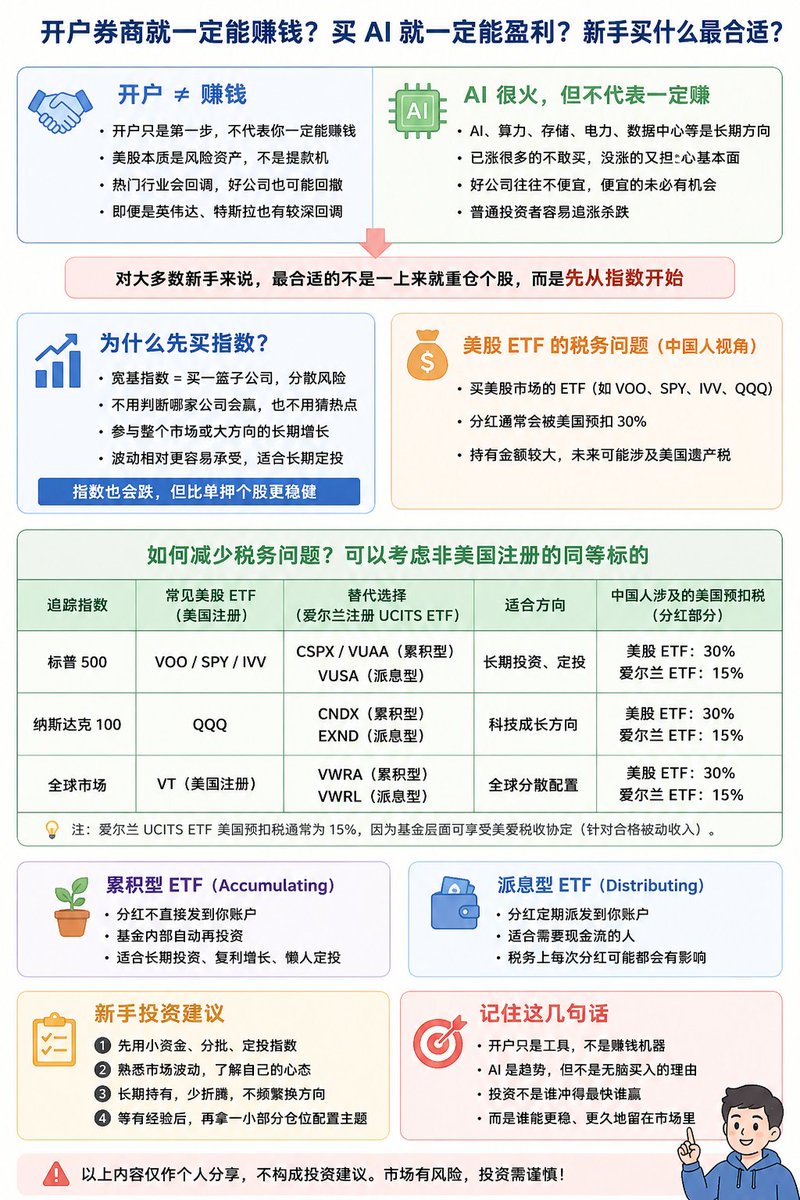
So, for some novice friends, the most suitable approach is not to start with heavy investments in AI stocks or daily research on which stock will double, but to start with indices.
For example, broad indices like the S&P 500, Nasdaq 100, or total market indices essentially use a basket of companies to diversify risk. Of course, indices can also fall, and they are not guaranteed to win, but compared to betting on a single AI stock, indices are more friendly to beginners, their volatility is relatively easier to bear, and they are more suitable for long-term systematic investing.
It’s important to note that if you buy index ETFs in the U.S. stock market, such as the common S&P 500 ETFs VOO, SPY, IVV, or Nasdaq 100 ETF QQQ, for many non-U.S. tax residents, directly buying these ETFs usually involves U.S. withholding tax on dividends. If the held amount is large, it may also involve U.S. estate tax issues in the future.
If you want to reduce such tax issues, you might consider equivalent assets from other countries. For instance, if you want to buy the S&P 500, you can look into assets like $CSPX or $VUAA. If you want to buy the Nasdaq 100, you can consider assets like $CNDX.
The main difference between these assets and VOO or QQQ is the fund's registration location and tax structure. For example, CSPX also tracks the S&P 500, but it is not a U.S. registered ETF; it is a UCITS ETF registered in Ireland. For some non-U.S. investors, such ETFs may be more suitable than directly buying U.S. registered ETFs when held long-term.
Of course, it's not that buying CSPX, VUAA, or CNDX means there are no taxes at all; just that structurally, the tax may be lower than that of purely U.S. ETFs. For example, for Chinese users, the U.S. only withholds 15% at the fund level (reflected in the net asset value increase of the ETF), which is half of the 30% deducted if buying VOO or QQQ directly.
Another detail here is that if you plan to invest long-term and do not need cash dividends, you might consider accumulating ETFs, that is, Accumulating. This type does not distribute dividends directly to your account but reinvests internally, making it more suitable for long-term compounding and lazy systematic investing.
Conversely, if you need cash flow and want to receive dividends regularly, you can look into distributing ETFs, that is, Distributing. But for most beginners starting to invest, if the goal is to accumulate assets long-term rather than live off dividends, accumulating ETFs might be simpler.
Therefore, my personal suggestion is that beginners can start by using small amounts, in batches, and systematically investing in indices. First, familiarize yourself with market fluctuations, understand your reactions when your account declines, and then gradually consider whether to allocate a small portion to buy AI, chips, storage, electricity, and these themes.
免责声明:本文章仅代表作者个人观点,不代表本平台的立场和观点。本文章仅供信息分享,不构成对任何人的任何投资建议。用户与作者之间的任何争议,与本平台无关。如网页中刊载的文章或图片涉及侵权,请提供相关的权利证明和身份证明发送邮件到support@aicoin.com,本平台相关工作人员将会进行核查。


