Original | Odaily Planet Daily (@OdailyChina)
Author|Golem(@web 3_golem)
Every year, there is always one or two mining coins emerging in the crypto market, reigniting the emotions of the mining circle. The project that appeared this year is called Pearl.
On April 27, the Pearl mainnet quietly launched, but it wasn't until this week that it drew attention. The trigger was on May 27 when a member of the Pearl community, @optimist, stated on the X platform that a wallet suspected to be linked to a16z had quietly accumulated more than 1.5 million USD worth of Pearl network tokens PRL. After the news spread, the price of the PRL token surged from about $0.6 to over $1.5, with a 150% increase in just two days.
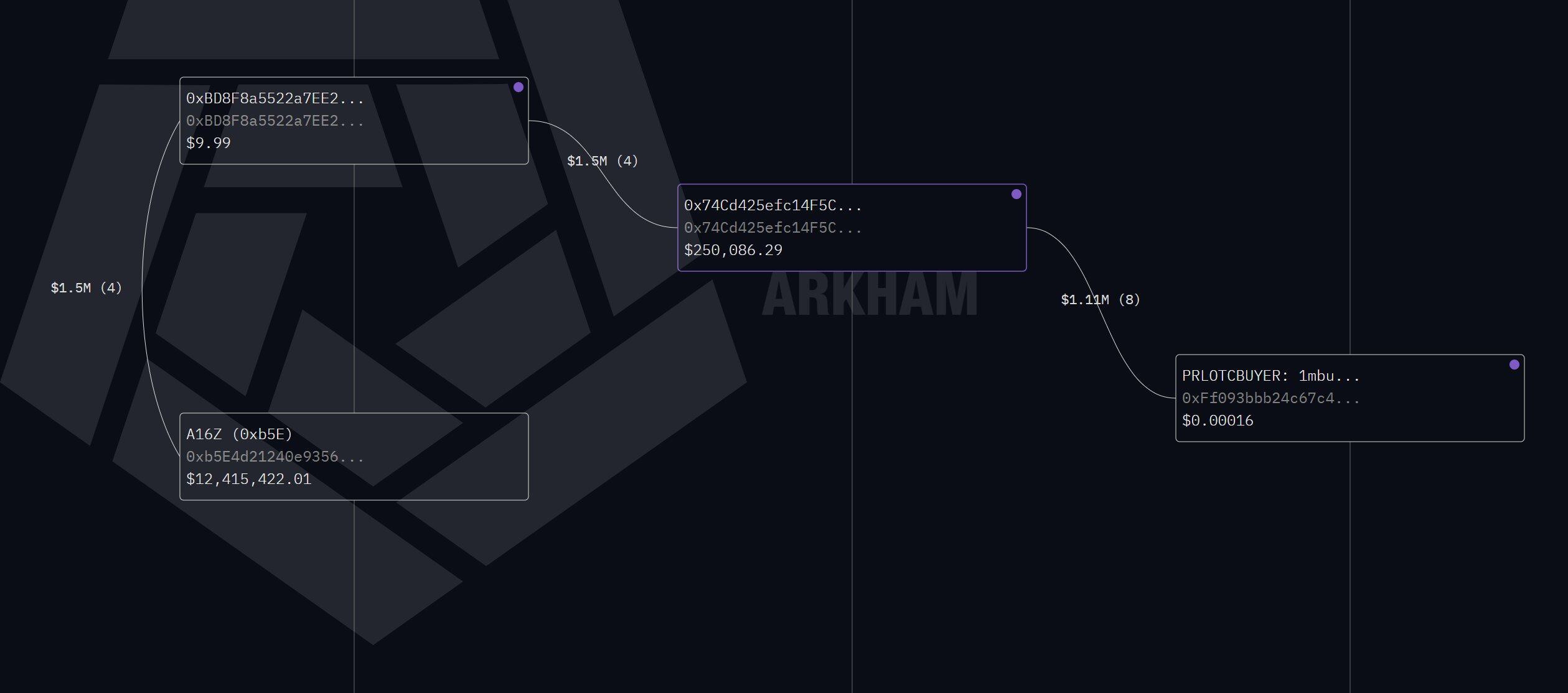
Rumored a16z linked wallet hoarding PRL
However, it is still uncertain whether this wallet truly belongs to a16z; it is highly likely that the community deliberately exaggerated and spread the news to attract attention to the Pearl community. However, it is confirmed that a16z has indeed had contact with this project: on January 26, 2026, a16z crypto research published an article introducing the PoUW algorithm proposed by Pearl founder Omri Weinstein, which is the core of the Pearl network (Odaily Note: the article has been deleted).
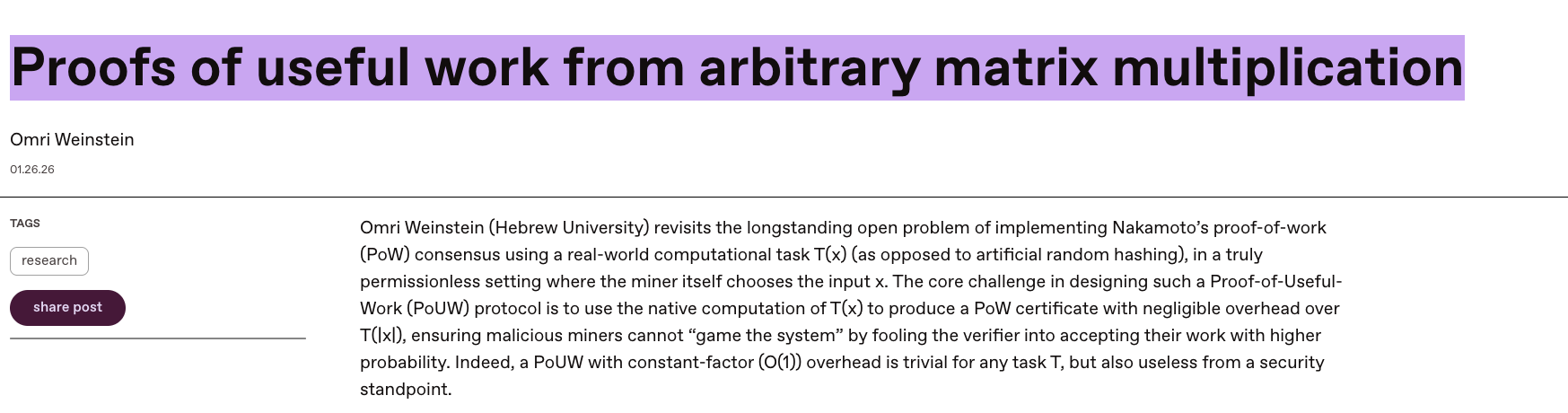
Practical Proof of Work (PoUW): Combining AI Inference Tasks with Mining
The core model of Pearl is still users using mining machines (GPUs) to mine coins, and the network design is similar to that of the Bitcoin blockchain, but its uniqueness lies in proposing a new proof of work mechanism called Practical Proof of Work (PoUW) based on POW.
In past POW blockchains, miners primarily secured the network by solving cryptographic puzzles with computers. This type of computation has often been criticized as meaningless computation—other than safeguarding blockchain security, it serves no other purpose, particularly in today's AI wave, it wastes precious computational resources.
To prevent the waste of computational power, Pearl's PoUW abandons the SHA-256 algorithm and adopts matrix multiplication (MatMul / GEMM) used in AI computations. The computational resources contributed by users' GPUs to the Pearl mainnet will not only be used to secure the Pearl network but also execute AI workloads, providing AI training and inference services for large model vendors, thus genuinely creating value. From this perspective, the tokens generated from mining are essentially rewards for users providing computational power to participate in AI calculations.
The reason Pearl's PoUW is called practical is that it enables GPUs to achieve blockchain proof of work while simultaneously engaging in AI training and inference workloads and generating tokens. Currently, Pearl has partnered with the large model training platform Together AI to launch the Gemma-4-31B-it-Pearl endpoint (based on Google's Gemma 4 31B model), and developers using this endpoint will receive a 25% discount, subsidized by the mined PRL tokens.
The token generated by the Pearl network is PRL, with a total supply of 2.1 billion coins. The average block time set by the network is 194 seconds, but the number of tokens produced per block in the Pearl network is not fixed and does not have a halving mechanism; instead, it is determined by a distribution curve. One of the core formulas of this curve is A(t) = t / (t + H), where A(t) is the cumulative distribution ratio of tokens, t is the current block height, and H is a fixed value of 650226 (the block height corresponding to four years).
Based on the cumulative distribution ratio of PRL, one can estimate the number of tokens produced per block. Of course, as an ordinary user, we can directly visit the Pearl block explorer to check the current total token production, block reward numbers, block height, and average block time information without needing to calculate it ourselves.
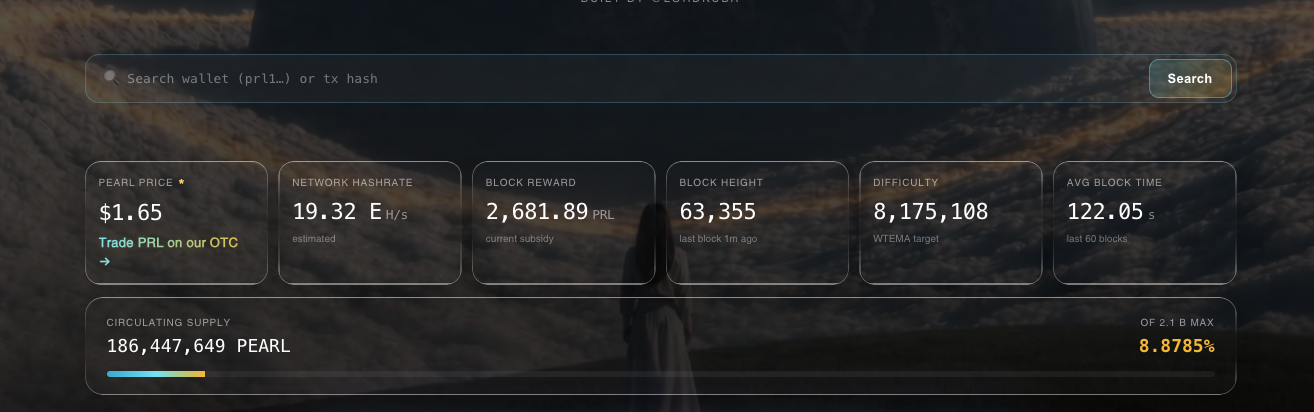
As shown in the above image, currently over 8.8% of PRL tokens have been mined, and with a price estimation of $1.65, the circulating market value of PRL has exceeded $300 million.
Complete Introduction to Mining and Ecology
Given the current crypto market conditions, PRL's market value may appear somewhat overestimated, but this is also due to increased mining costs. Pearl supports users in mining with their own GPUs, as well as renting cloud GPUs directly on the platform. As shown in the image below, Pearl has launched three packages, all of which have sold out due to the project’s rising popularity.
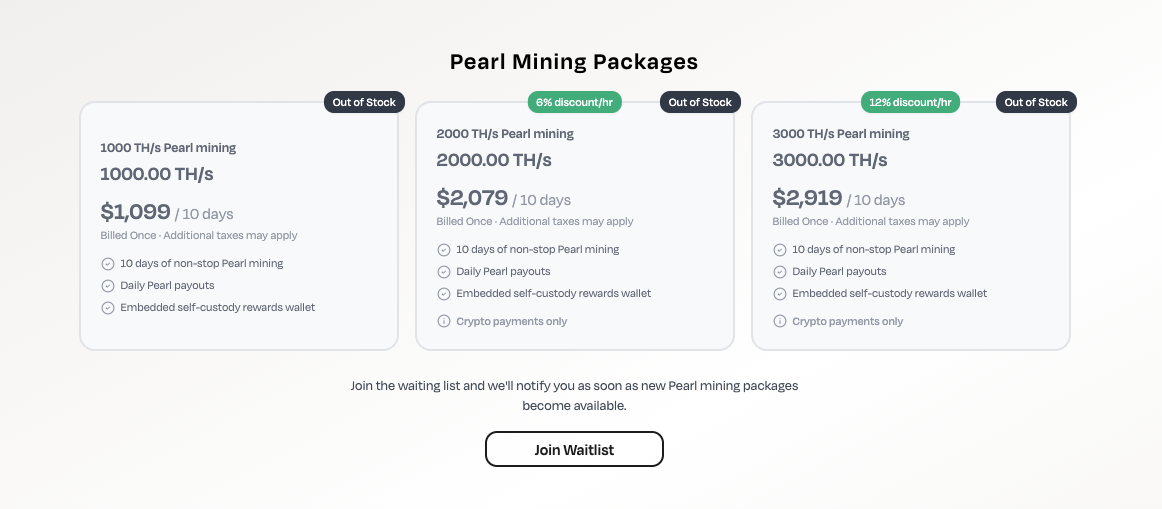
The mining costs of these three packages are not cheap. For example, for Package One, at $1099, one can rent 1000TH/s to mine continuously for 10 days, with the cost of renting 1000TH/s being approximately $4.57 per hour. Community member @AKAKAY04 has created a simple PRL mining cost estimator. By inputting the hourly cost and computing power of Pearl Package One, the average cost of mining each PRL is estimated to be around $1.51-$1.77, which is quite close to the market price of PRL. Even purchasing Package Three only lowers the cost of PRL to $1.33-$1.56.

Therefore, if one wants to participate in Pearl network mining and make a profit, it is essential to rent GPU power at a sufficiently low cost. Currently, the most recommended platforms for renting cards in the community are runpod and vastAI, with prices for the 4090 and 5090 graphics cards varying between $0.5-$2 per hour.
Once the card is successfully rented, users can choose to join a Pearl mining pool to participate in mining. Currently, the Pearl ecosystem mainly has four mining pools, namely pearlhash, alphapool, Akoya, and mineprl. Community member @peterdai111 has summarized the characteristics of these four pools, and users can choose after evaluating them. (Odaily Note: specific processes can be queried from AI or refer to the tutorial written by community member @0xtonixie)
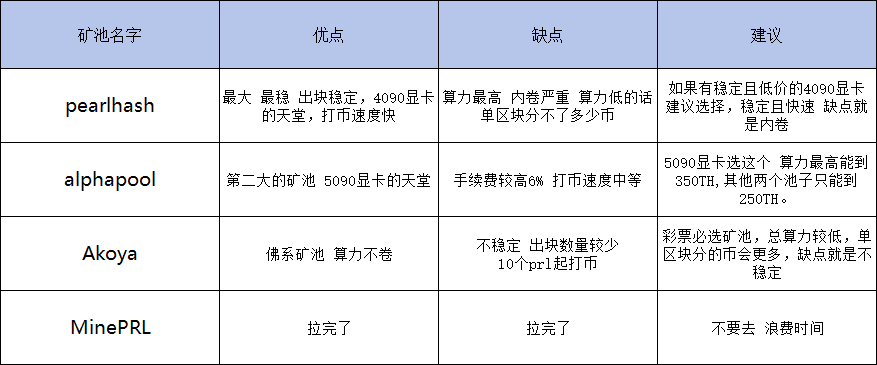
Since the mainnet of Pearl went live just a month ago, for a new project, its ecosystem has developed quite well. Beyond spontaneously launching mining pools and block explorers, the community also hosts cross-chain bridges, OTC platforms, and NFT activities.
PearlBridge is the first cross-chain bridge project on the Pearl network, allowing users to lock their native PRL tokens and mint WPRL on Ethereum at a 1:1 ratio. The project charges a 1.5% deposit fee (minimum 4 PRL), but there are no fees for exchange. Currently, this project has locked over 320,000 PRL, and users holding WPRL on EVM chains can freely trade on OKX Web3 wallet or other DEXs.
Users can also trade native PRL tokens on the pearl-otc platform, which is a non-custodial trading platform allowing USDC to transfer directly between buyers' and sellers' wallets, while PRL is held in a “2-of-2” multisignature custody account jointly signed by the seller, preventing the platform from unilaterally transferring funds. This platform is currently the main reference for PRL prices, featuring high liquidity and allowing users to view PRL's price fluctuation chart.
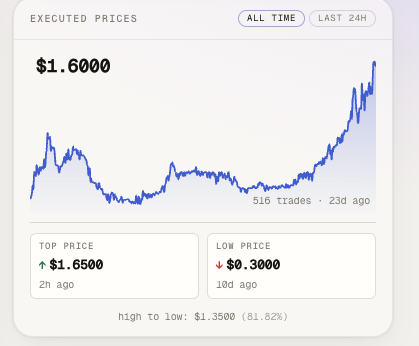
PRL's price fluctuation chart
On May 23, the crypto exchange SafeTrade also listed PRL, but this trading platform is relatively small and not well-known, so users should be cautious about funds security while trading PRL on this platform.
The Non-“Invisible” Flywheel of Mining Coins
One unspoken rule in the mining circle is that regardless of how the mining coin model innovates, the core logic is always “mine, withdraw, and sell.” POW mining is essentially a mathematical game, with only cold machines, precise input-output calculations, and the greed to squeeze the last bit of profit before a collapse. It is not a conventional project token, as it has no fundamental value. It is also not a meme, as it lacks attention and cultural consensus.
Therefore, the flywheel effect of mining coins is no longer invisible: “miners mine tokens — design buy pressures — token prices rise — generate wealth effects — more people are willing to mine.” The core supporting this model is always the existence of buy pressure, but there is no perpetual motion machine in this world, and the market cannot have infinite buy pressure. It can be said that mining coins are like a train heading towards a cliff from the start, visible to everyone, and yet everyone believes they will get off just in time.
In the past, some mining projects created pseudo-demand in the market through a “self-mining and self-pulling” approach, where their main profit was not from selling coins but from making money off users buying mining machines. However, when the market-making cost exceeds the mining machine profit, such models will also collapse.
Looking at Pearl, some viewpoints suggest that it is not just a mining coin and has the potential to grow into the next Bittensor Trust (TAO). This is because the most significant difference between Pearl and past mining projects is that the computational resources it consumes are not only used to price PRL but also provide AI training and inference services for large model vendors in the physical world—this is the value of Pearl's practical POW, making Pearl more like a DePIN project.
However, considering the current project development progress, this value is more of a gimmick. The core implementation of the Pearl network is currently based on precise integer matrix multiplication, while modern AI workloads (especially large model training) are not conducted in INT (integer) environments. Instead, they rely on low-precision floating-point formats, and extending the current PoUW mechanism to floating-point data types presents significant technical challenges.
Thus, whether Pearl can escape the death spiral curse of mining coins in the future requires genuine technical strength, capital, actual institutional support and a platform, rather than just relying on today's “unlimited imagination” about a16z.
免责声明:本文章仅代表作者个人观点,不代表本平台的立场和观点。本文章仅供信息分享,不构成对任何人的任何投资建议。用户与作者之间的任何争议,与本平台无关。如网页中刊载的文章或图片涉及侵权,请提供相关的权利证明和身份证明发送邮件到support@aicoin.com,本平台相关工作人员将会进行核查。


