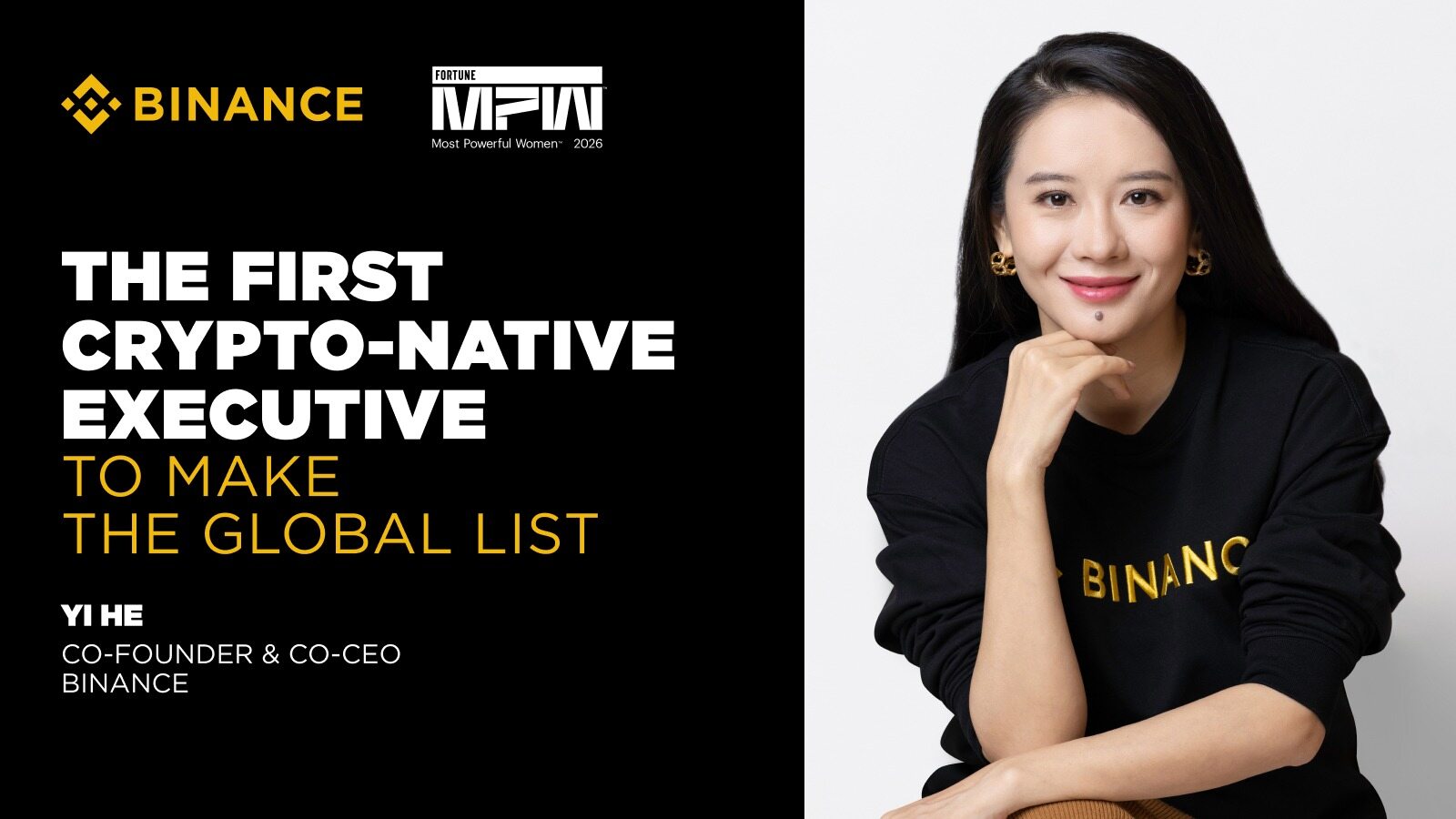
Editor's Note: On May 27, Binance co-founder and co-CEO He Yi was selected for Fortune magazine's “Most Powerful Women in Business” list. Binance officially stated that He Yi's selection marks the first time a crypto-native executive has appeared on this list; this is an important milestone for He Yi, Binance, and even for the entire industry. He Yi later published a thank-you message and reflected on her journey. Below is the original text reposted.
1. From the Margins to the Spotlight
When I first learned that I would be selected for Fortune’s “Most Powerful Women in Business” list, my first feeling was one of unworthiness, and my second feeling was the heavy responsibility on my shoulders.
This recognition carries my name, but it belongs to the Binance team, to Binance users, and even more so to Satoshi Nakamoto, and to every community member who has turned this industry from an idea into a global wave.
If a crypto-native entrepreneur had appeared on such a list a few years ago, it would have been unusual; today, it feels more like our industry has gradually stepped from the margins of finance and technology into the spotlight, this is not my “achievement,” I just saw the wave coming and bravely stood on the surfboard, learning clumsily to ride the wave. But this recognition represents another step in the long journey of the blockchain industry transitioning from niche geek players to everyday life. Yet, the road ahead is long; we must push forward, step by step, to build and refine, which is what we do every day.
I often refer to myself as the “Chief Customer Service,” and I love this title. At Binance, all colleagues entering the management team first spend a month doing frontline customer service, and each quarter they must return to rotate in that role—I do the same. The logic is simple: the things you cannot see from your office are being observed by users every day.
Last year in Dubai, a young man from Kenya stopped me as the event was ending. He sends money home to his mother every month through Binance. He didn’t ask about blockchain architecture or token economics. He just wanted me to know how much faster his mother receives the money and how much less money disappears on the way. He does not need to be “educated” about what cryptocurrency is; he needs a usable product.
He is not alone. In the past five years, over 34 million people have completed remittances through Binance Pay, accumulating more than $87 billion. Based on the World Bank's global average remittance fee rate of 6.36%, we have saved users over $5 billion—this money has not disappeared in the hands of intermediaries but has returned to family dinner tables, children’s tuition, and startup funding for small businesses.
2. That Door, We Must Dismantle
I was born in a small village in Sichuan, a place that is hard to find on a map. When I was a child, we occasionally experienced power outages, and I needed kerosene lamps to do my homework; the young girls in the village would enter factories with someone else’s ID before the age of 16.
When I was 9 years old, my father passed away, and my uncle told my mother, “It would be better to save the money for your son’s wedding than to send a girl to school.” But my mother was exceptionally resilient; while working as a substitute teacher, she also farmed and managed to support the entire family, sending me to university for teacher training.
Over the years, I have often been asked: Why are you working so hard when you are already financially free? To be honest, not everyone has the chance to change the world, but I am making history, and since I am here, why not give it a try? As the ancients said: “When in poverty, one should cultivate oneself; when one achieves success, one should benefit the world.”
In second and third-tier cities in India, there is a group of women aged 36 to 50. Their mothers never had their own bank accounts, and they didn’t have them a year ago either. Over the past year, they have become one of our fastest-growing user groups. Those who were not heard are quietly reclaiming their rights to understand and decide their family’s future from outdated systems, entering a more convenient, efficient, and low-cost financial world; they are starting to think, like I did 12 years ago, “What is money?” This is more important than any grand narrative.
In recent years, Binance has done thousands of small things in rural areas of South Africa, Brazil, and India: scholarships, training, and basic financial literacy courses. They may not be large, but they are happening one by one. I do not like the term “empowering women.” It sounds like someone is holding the key and deciding whether to open the door for you. I would rather dismantle the door, allowing more people to enter. They should determine what kind of person to become and what kind of life to lead.
3. From 300 Million to 3 Billion
When we said that Binance aimed to serve 1 billion users, many people thought we were dreaming; today, we have over 300 million users, and 1 billion is no longer a distant dream. Therefore, this year we have changed our goal to 3 billion.
To be honest, before I said this, I also wondered: Is this number correct? Do we deserve this? But one thing I am certain about is: If we don’t set the goal here, no one will set it for these 3 billion people.
3 billion is about the adults globally who have yet to enter the formal financial system. This means what we need to do is no longer just a cryptocurrency exchange but a financial infrastructure that can support the daily lives of 3 billion people.
AI is reshaping productivity. But if productivity only belongs to a few companies, that is not a revolution, it is a new monopoly. In the past year, we have gradually given ordinary users access to many tools previously only available to professional institutions: allowing someone who does not understand code to have AI help optimize decisions; enabling someone who is new to crypto to ask questions in natural language. Finance should not just be the language of the few.
What blockchain aims to solve is another issue: allowing everyone who uses AI to receive a share of the value created by AI that rightfully belongs to them. Only by combining these two things can we potentially support the journey from 300 million to 3 billion.
Someone once said something very simple: If you do not like this world, then go change it. I walked step by step from that small village in Sichuan to the county seat, to the provincial capital, to the world; I understand better than anyone that the world you desire, like Rome, will not be built in a day.
So let us continue to work, pushing forward little by little, knowing that our efforts will not be in vain.
免责声明:本文章仅代表作者个人观点,不代表本平台的立场和观点。本文章仅供信息分享,不构成对任何人的任何投资建议。用户与作者之间的任何争议,与本平台无关。如网页中刊载的文章或图片涉及侵权,请提供相关的权利证明和身份证明发送邮件到support@aicoin.com,本平台相关工作人员将会进行核查。


