In the past two months, if there is one main theme that has been the hottest in the U.S. stock market, it is undoubtedly AI hardware, computing power, Nvidia, optical communication, electricity, and data centers.
In addition, there is another direction that has been quietly recovering — software stocks.
This is not hindsight. In the article “Oil Prices Soar, Interest Rates Hard to Lower, Seven Sisters Lying Flat: Which Main Lines to Watch for Excess Returns in Q2 U.S. Stocks?”, Maitong clearly mentioned the "valuation correction" in the software sector and emphasized that what is worth paying attention to is not all SaaS, but security software, leading corporate platforms, and highly elastic divergence pools, including PANW.M, CRWD.M, NET.M, CRM.M, NOW.M, ZS.M, INTU.M, ADBE.M, MDB.M, SNOW.M, DDOG.M, TEAM.M, and others.
Looking back now, this judgment has already been somewhat validated: from March 31 to May 22, the software ETF IGV rose from $80.05 to $94.01, with an increase of about 17.4%, meaning that software stocks have experienced a noticeable low-level recovery.
However, the bigger question is whether this round of rebound is just a technical recovery after a significant drop, or if AI Agents are causing certain software companies to be repriced by the market?
1. Beyond the Rebound, Why Were Software Stocks Previously Disliked by the Market?
As shown in the figure below, let’s first look at a set of data.
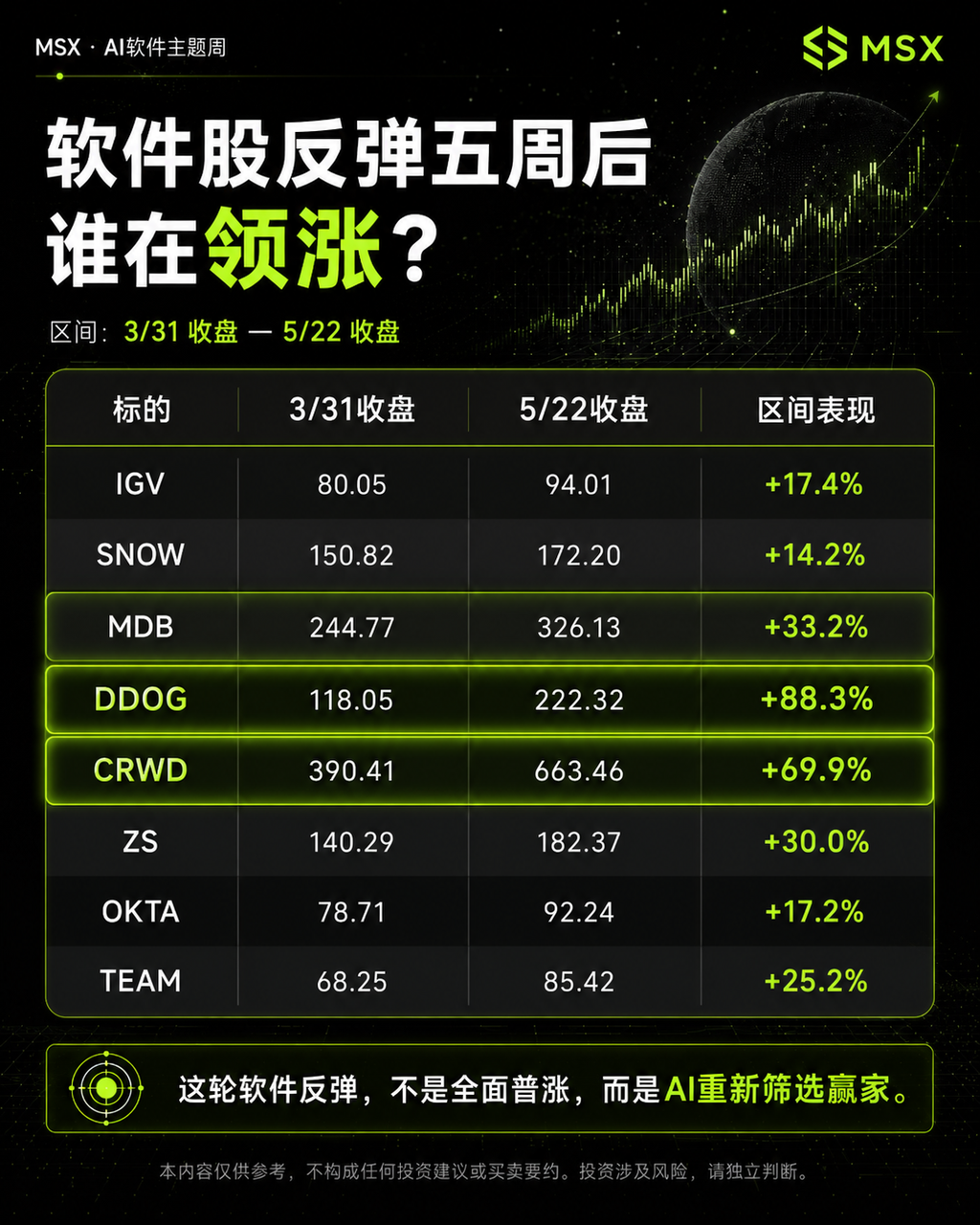
In fact, this set of data illustrates a very intuitive issue: Software stocks are not completely unpurchased; the market has already repriced in some directions, especially for companies like cloud monitoring, security, databases, and data clouds, whose rebound strength has even exceeded that of IGV itself.
But this doesn’t mean that “all SaaS is about to enter a bull market again.”
More accurately, this round of software rebound is AI selectively screening for winners, as the market begins to distinguish which software will be replaced by AI Agents and which software will become more important because of the implementation of AI Agents.
As is well known, software stocks have been suppressed recently, not just because of declining performance, but because the market has begun to doubt the business model of traditional SaaS.
Traditional SaaS often charges per headcount or per seat. Companies pay subscription fees based on how many sales seats, customer service seats, or collaboration seats they purchase. However, after the emergence of AI Agents, the market began to ask a very sharp question: If, in the future, one AI Agent can do the work of multiple employees, will companies still need that many SaaS seats?
This is the core logic behind the devaluation of software stocks in the past.
AI Agents may automatically write emails, follow up on customers, generate contracts, analyze data, handle work orders, and execute approvals. Once these tasks are automated, the traditional software logic of “the more people, the more seats, the higher the income” will be challenged.
Meanwhile, corporate AI budgets have recently been more directed toward GPUs, cloud computing power, data centers, and infrastructure, putting software companies in a squeezed position. What’s more problematic is that if AI only brings more R&D and computing power costs but doesn’t improve profit margins, then the valuation pressure on software companies will continue to exist.
In our Q2 outlook, we also mentioned that for enterprise software, platform technology, and cybersecurity companies, if AI can only increase input without improving profit margins, the valuation pressure will continue to rise.
So, what the market really dislikes about software stocks is not just the growth rate, but the certainty of the business model.
2. The Key Is Not "Whether There Is AI," But Whether AI Can Generate Revenue
The market is also beginning to realize that AI Agents do not work in a vacuum.
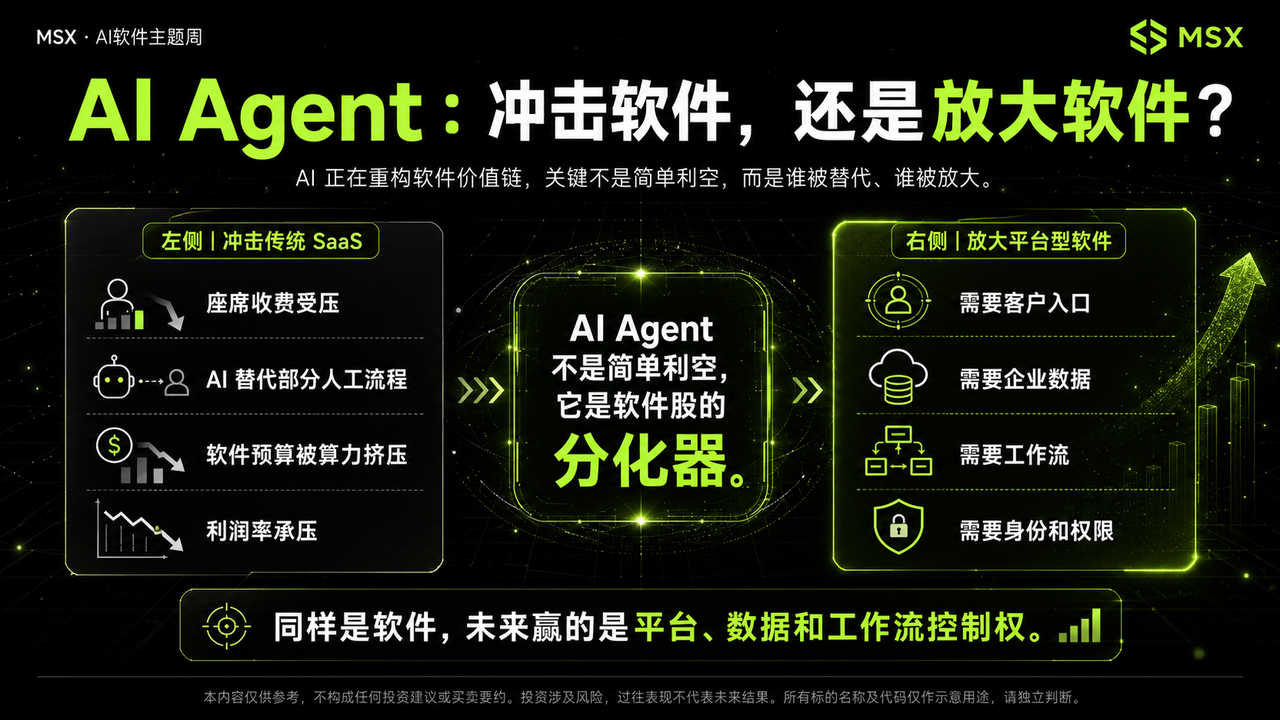
A truly viable enterprise AI Agent needs at least four things:
- First, it needs an entry point, such as sales, customer service, marketing, IT work orders, and office collaboration, which are the actual places where enterprise work occurs;
- Second, it needs data, as without internal enterprise data, AI Agents can only provide generic answers and find it difficult to make real decisions;
- Third, it requires process, as enterprises do not want to engage AI in casual conversations but hope AI can initiate approvals, update CRMs, handle work orders, generate quotes, and drive business closure;
- Fourth, it needs permissions and security, as in the future not only humans can make mistakes, but Agents may also misoperate, access without authorization, or leak data, so identity, security, and auditing will become even more important;
This is why software stocks are beginning to show recovery logic, because AI Agents are not necessarily bypassing software but may need to be positioned on top of software.
In other words, AI Agents will indeed impact a portion of "those that only sell seats, lack data and process barriers" SaaS, but for software companies that control customer entry, enterprise data, workflows, and permission systems, it may instead become a new growth entry point.
This week, one of the most critical software earnings reports is Salesforce.
Salesforce will release its FY2027 first quarter financial report after the market closes on May 27. The company has also clearly positioned itself as “#1 AI CRM,” claiming that Salesforce helps businesses become agentic enterprises, integrating humans, agents, apps, and data into a unified platform.
Market expectations currently anticipate Salesforce’s revenue for this quarter to be about $11.05 billion, up about 12% year-over-year; adjusted EPS is about $3.11, higher than last year's $2.58. The options market also indicates that traders expect CRM stock price to experience about a 9% fluctuation after the earnings report.
However, the true focus of this earnings report is not whether traditional CRM revenue can slightly exceed expectations, but whether Agentforce can prove that AI Agents can indeed be commercialized.
The market will look at several questions: Does Agentforce have real orders? Are AI features driving improvements in RPO and subscription revenue? Are customers willing to pay extra for AI Agents, or are they merely viewing them as additional functions of existing software? Can profitability and buybacks continue to support the valuation of mature software companies?
The answer from CRM is crucial because if Salesforce can prove that AI Agents do not replace CRM but enhance it, then the rebound of software stocks will not just be a valuation recovery, but may enter an AI revaluation stage.
Another critical earnings report is Snowflake.
Snowflake will post its FY2027 first quarter earnings report after the market closes on May 27, defining itself as an AI Data Cloud, emphasizing its platform helps enterprises obtain value from data, applications, and AI.
SNOW.M and CRM.M operate under different logic.
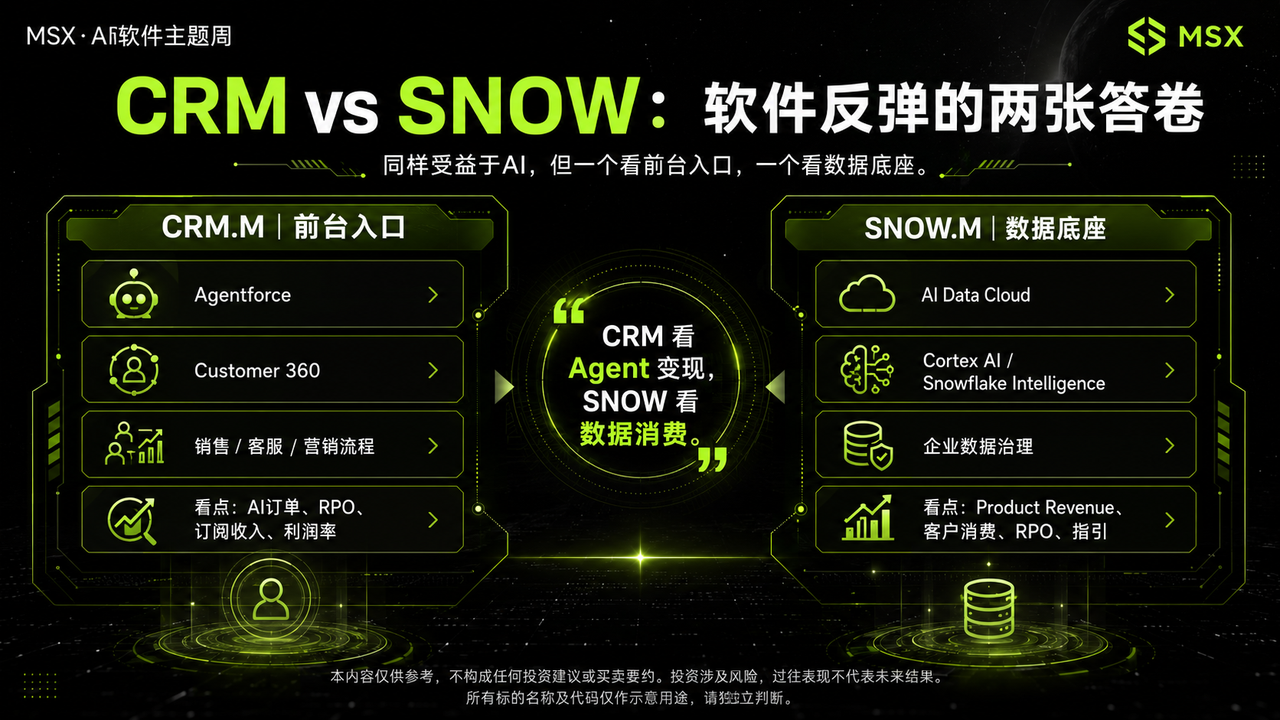
CRM is more like a front-end entry, while SNOW is more like a back-end data foundation. For AI Agents to assist enterprises in decision-making, they must first access, understand, and govern internal enterprise data. No matter how strong the model is, without clean, unified, and callable data, it will be difficult to implement in reality.
Before the earnings report, Snowflake guided FY2027 Q1 product revenue to be $1.262 billion to $1.267 billion, corresponding to a year-over-year growth of about 27%; Zacks consensus expects the Q1 product revenue to be around $1.26 billion, up about 26.9% year-over-year. The market will also focus on the number of million-dollar customers, total customer count, net revenue retention rate, and adoption rates of AI products like Snowflake Intelligence and Cortex Code.
Thus, the key for SNOW.M is not “whether there is an AI narrative,” but whether the AI narrative can be translated into more data consumption.
If product revenue exceeds the upper limit of guidance, and customer spending continues to recover, along with improvements in RPO and large customer numbers, it suggests that enterprise AI is not only staying at the model level but is beginning to drive the usage of data platforms.
Conversely, if the AI products are discussed enthusiastically but consumption growth and guidance are not strong enough, the market may interpret this rebound as "valuation recovery" rather than "fundamental revaluation."
In summary, CRM.M looks at whether Agents can generate revenue, while SNOW.M looks at whether AI can drive data consumption.
3. How to Layer Examine Software Stocks?
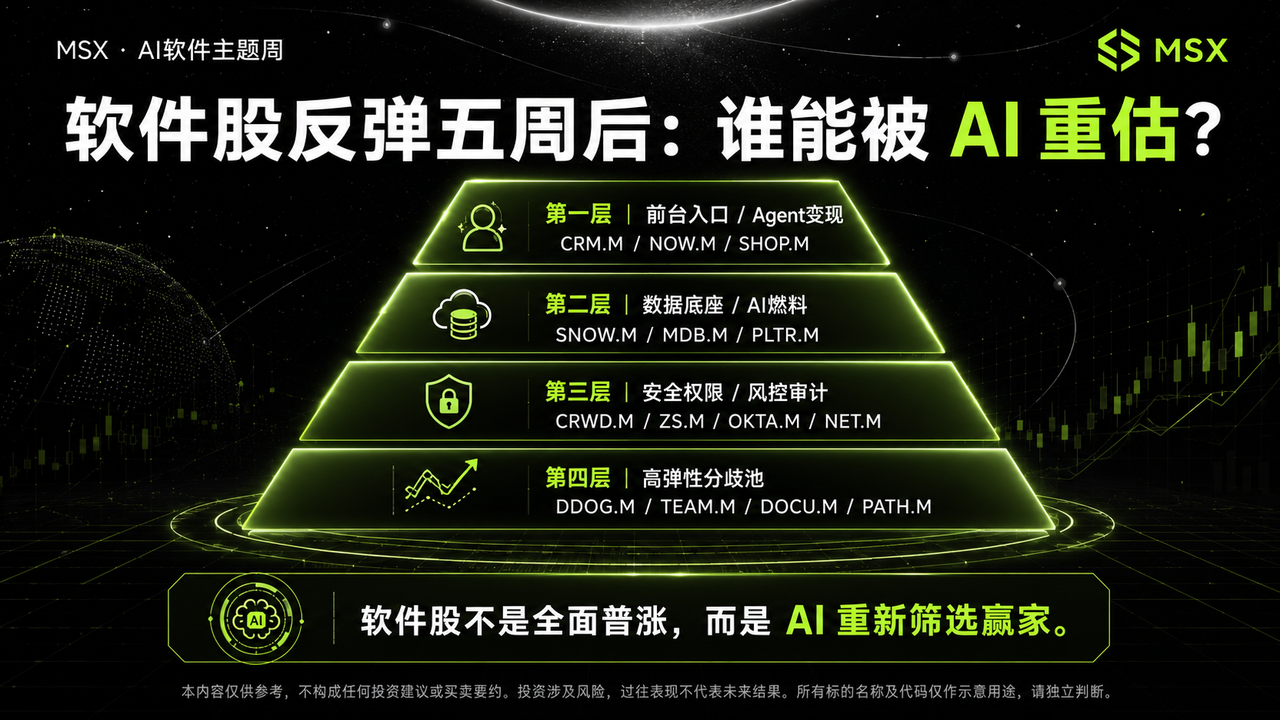
This software rebound cannot simply be viewed as all software rising together; a more reasonable approach is to layer it according to the capabilities required for the implementation of AI Agents.
- The first layer is front-end entry and Agent monetization, representing companies like CRM and NOW that control sales, customer service, business processes, and corporate work entry points. If AI Agents can truly be integrated into workflows, they have the opportunity to turn AI into a chargeable product;
- The second layer is data foundations and AI fuel, representing companies like SNOW, MDB, and PLTR that AI Agents must call upon internal enterprise data to understand the enterprise. The more complex the data, the more important governance becomes, and the value of such platforms increases;
- The third layer is security, identity, and permissions, representing companies like CRWD, ZS, OKTA, and NET. The more automated the Agent, the more enterprises need to manage permissions, audit behaviors, and prevent data leaks. In the future, security software will not only protect people but also the behavioral boundaries of Agents;
- The fourth layer is high elastic divergence pools, such as DDOG, TEAM, DOCU, and PATH. These companies demonstrate high elasticity, but they also rely more heavily on earnings reports to validate. If AI can enhance usage frequency, customer stickiness, and revenue growth, they can continue recovering; if it’s just a valuation rebound, the sustainability will be much weaker.
So, is the AI Agent a killer of software or a savior of software?
The answer is that it can be both.
For software companies that lack data barriers, process barriers, and customer entry, AI Agents may compress their value; but for platform software companies that hold customer relationships, enterprise data, business processes, and security permissions, AI Agents may actually become a new growth entry point.
This is also why software stocks have rebounded for five to six weeks, but the market has not yet provided a final answer.
The true answer will be revealed in the upcoming earnings reports — CRM needs to prove whether Agentforce can bring real orders; SNOW must demonstrate that enterprise AI can drive data consumption; security software needs to prove that in the era of AI automation, permission and risk control demands will only grow stronger; and high elastic software stocks must prove that the rebound is driven by income, profit margins, and guidance, rather than just sentiment.
In short, true value withstands scrutiny. In the end, companies with entry points, data, processes, and permissions have the chance to turn from “AI victims” into “AI beneficiaries.”
免责声明:本文章仅代表作者个人观点,不代表本平台的立场和观点。本文章仅供信息分享,不构成对任何人的任何投资建议。用户与作者之间的任何争议,与本平台无关。如网页中刊载的文章或图片涉及侵权,请提供相关的权利证明和身份证明发送邮件到support@aicoin.com,本平台相关工作人员将会进行核查。


