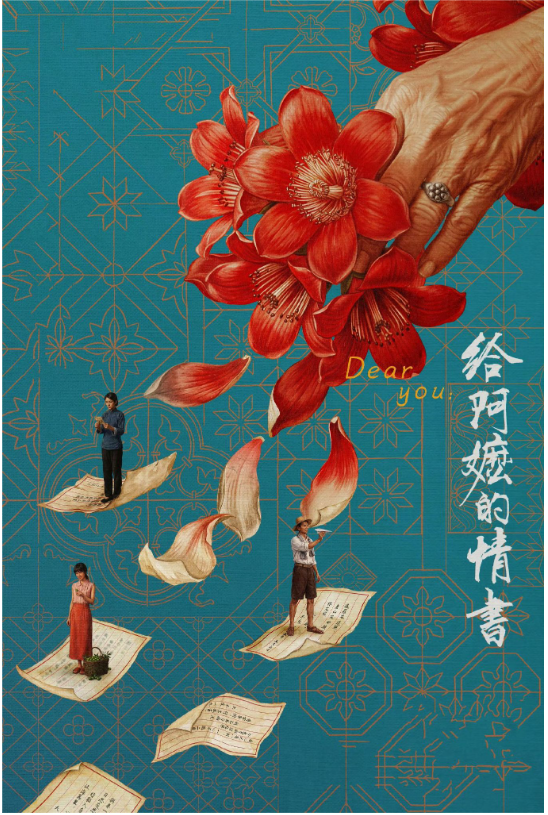
In 1960, Zheng Musheng passed away the day before he was to return home. The news of his death was intercepted by one person—Xie Nanzhi.
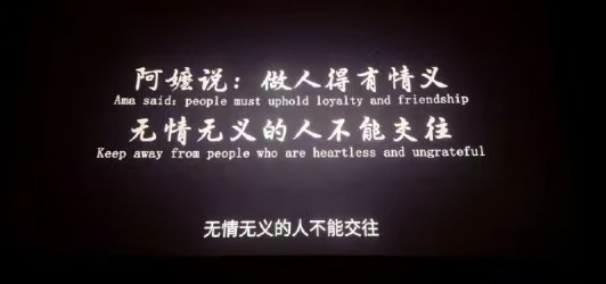
For the next eighteen years, she wrote overseas letters, sent money, and created one lie after another about a homecoming that never happened, all in Zheng Musheng's name. Grandma Ye Shurou received those letters, believing her husband was still alive but unwilling to return. Nanzhi was not a mistress; she was a guardian who took on the responsibilities of two families as a substitute for a man who had long since passed away. “One must have loyalty; those without feelings and loyalties cannot be trusted.” The large characters at the beginning encapsulated the promise ingrained into the bones and blood of all Chaoshan people. This promise was upheld by Xie Nanzhi for eighteen years. She had other options. A major fire destroyed her inn, her father fell gravely ill, and her future was ruined. Some urged her to marry a wealthy man and be done with it. But she refused. She sold rice cakes from a stall, shouting her wares during the day and working by a kerosene lamp at night to learn how to write letters from the overseas correspondence, transforming from a “walk-about” into the pillar of support for two families. When she stood at the blackboard writing “The thread in a loving mother's hands,” no one knew that this emaciated woman had been feeding three mouths thousands of miles away for over a decade, on behalf of a man who had long ceased to exist.
This is the story that the movie “A Letter to Grandma” brings to the world. With a budget of only 14 million, it opened with a score of 9.0 on Douban, climbing to 9.2, surpassing 1 billion in box office gross within 25 days, and receiving over 600,000 five-star reviews, with predictions that the final box office will approach 1.8 billion. How did a film with 95% of its dialogue in the Chaoshan dialect and featuring entirely amateur actors move 31 million people? The answer lies in Xie Nanzhi—she exemplified the rarest quality in human economic history: an eighteen-year-long, selfless commitment to bearing others' responsibilities on her shoulders—a “long-termism.” And this just happens to be the very gene that the top global cryptocurrency exchange OKX has ingrained in its structure over the past six years.
Let us return to 1960.
It was a world without instant messaging, cross-border payments, or blockchains. Overseas letters were the only link—“批” in Chaoshan dialect means “letter,” more precisely, it is the proof of combined letter and funds. A thin piece of paper, a few casual words, mixed with a sum of money essential for survival, had to cross the entire South China Sea, facing typhoons, smuggling, customs, and postal checkpoints, taking months to reach the trembling hands of a wife in some small town in Chaoshan. The journey of each overseas letter was a “gamble on trust”: the sender did not know if it would arrive, and the recipient did not know if it would sink into the sea along the way. In a world where “Siam is on this side, Tangshan is on that side, you are in my heart,” trust was a luxury as well as a necessity.
When Zheng Musheng was alive, his “trust” was maintained through the overseas letters to his wife and children who were thousands of miles away. After his death, the person transmitting this “trust” became Xie Nanzhi. She was under no obligation to send money on his behalf, nor to write letters for him, and no one knew she was doing this. Over the eighteen years, the Musheng family acquired a bicycle—that was “redeemed” by Nanzhi in letters; three children grew up and went to school—that was the tuition she saved up penny by penny from selling rice cakes. She received almost no return from all of this. If there was to be said, it was probably on a certain Mid-Autumn Festival when that letter she wrote for Musheng was crumpled and unfurled again by Shurou, eventually pressed beneath her pillow, not even the most acerbic sister-in-law could bear to throw it away. This is the weight of trust—in an era of extreme information scarcity, trust is the only currency that can cross rivers and seas.

Today’s financial world no longer needs overseas letters. From Bangkok to Chaoshan, transfers take just a few seconds. Information asymmetry has been smoothed out, logistics compressed, but a deeper issue has never disappeared: how do you know if the other party is trustworthy? Just as Ye Shurou spent her life waiting for that late letter, today there are countless people facing unfamiliar financial institutions, impenetrable capital pools, and rules that can change at any time, feeling the same helplessness. The cost of trust can sometimes be higher than the freight charge across half the world.
From a certain year onward, OKX has laid down “digital overseas letters” worldwide. However, this “Nanzhi” is not a person but a system.
Today, OKX has established an operational network in over 100 countries worldwide, received a virtual asset service provider (VASP) license in Dubai, an EU payment license in Malta, completed registration in Australia, holds central bank approval for payment business in Singapore, acquired remittance transmission licenses in 45 states in the United States, and has officially launched trading operations in the U.S. Behind each license is a multi-year process of application, review, and rectification—tedious, lengthy, and providing no short-term profits. But OKX regards it as equally important as sending overseas letters: not to show off to others but to gain their trust.
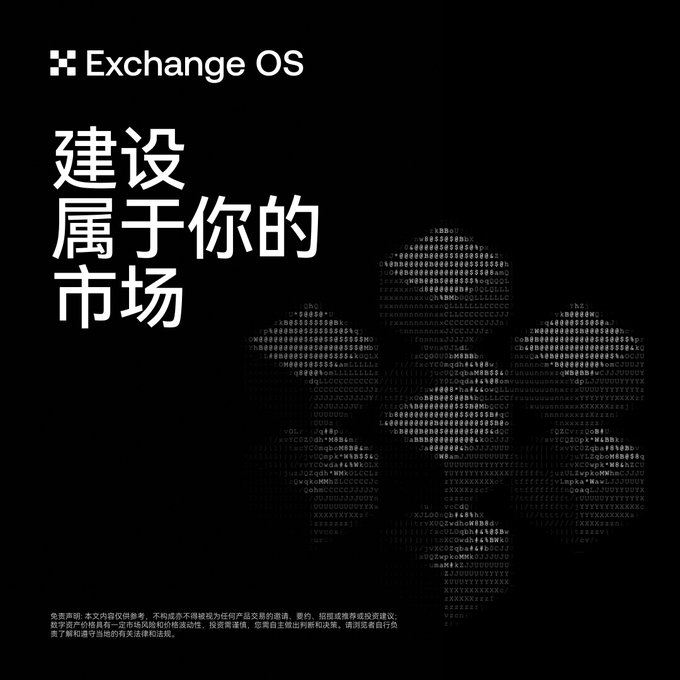
However, the infrastructure of trust goes far beyond compliance. Just a few days ago—on May 26, 2026—OKX released Exchange OS, sinking all capabilities of matching, margin, clearing, settlement, and unified accounts down to the protocol level, allowing any developer and institution to use OKX’s institutional-grade tech stack to build their own trading venues. This means: OKX is not just a financial port; it is a “Nanzhi” that teaches you how to build a port while also backing your traffic. Exchange OS supports three major market types: spot, perpetual contracts, and prediction markets, allowing for unified accounts across markets, where users can freely allocate the same funds across multiple market types. All data is supported on-chain by Glassnode, with ecological partners such as Chainlink, Nansen, Centrifuge, and Pyth Network participating together. It is no longer an isolated exchange but a whole set of open protocols that “invite everyone to participate in building financial infrastructure.” Behind this stands years of unwavering technological investment from OKX: the matching engine latency has been reduced to under 2 milliseconds, with peak throughput reaching 500,000 transactions per second, equivalent in performance level to Nasdaq.
But who cares about these cold numbers? Today, there are very few users who weigh “which exchange ranks where.” Just as there was no concern in 1960 about how much income Zheng Musheng made out there, the concern was solely whether that letter arrived. Similarly, the ultimate question people ask when choosing a trading platform today has never been “which has the lowest fees?” or “which has the most coins?” but circles back to the same question from the times of Ye Shurou and Xie Nanzhi: Can I trust you?
Xie Nanzhi did not betray that trust. Eighteen years later, the truth emerged; the gray-haired Ye Shurou stood up in the humid rainy season—she had only one thing to do: meet Nanzhi.
In the last meeting in the film, the amnesiac Nanzhi could not recognize the elder before her. Ye Shurou softly asked her: “Is the salty pork delicious?” Just that one sentence melted away a misunderstanding and barrier that had been upheld for half a lifetime. They did not exchange real dialogue, nor was there a hug. But that bond, spanning forty years of misunderstanding and half the globe, silently completed a perfect delivery.
Users in the crypto world may not need such a hug. But behind every transaction confirmation, every fund custody, and every on-chain data verification, an invisible “overseas letter” is being handed from the user’s hands into OKX’s trust network: “I’m giving you this money; can you help me pass it on?” And OKX’s response has never relied on touching language—it relies on a global compliance license in over 100 countries and regions, on an Exchange OS protocol that fully opens the core capabilities of the exchange to everyone, on a monthly updated proof of reserves, and on all the fragmented, long-term, and little-known infrastructural investments. Just like Xie Nanzhi
calm and collected, but never absent.
A letter home that was eighteen years late was finally understood on a rainy day; a meticulously laid blockchain track has finally found its true destiny through thousands of transactions.
If Nanzhi’s story teaches us anything, it is this: true value often exists in the moment when someone whose name you do not know works silently behind the scenes. And today, that “someone whose name you do not know” might just be OKX itself — devoid of emotional fluctuations, without selfish calculations, yet treating the delivery of “trustworthy service to every user” as the one thing worth putting half a lifetime into on this planet.
🎁 Exclusive registration benefits from AiCoin are here!
Register for OKX through the exclusive AiCoin link for a permanent 20% rebate!
👉 Register for OKX now:
https://jump.do/zh-Hans/xlink?checkProxy=true&proxyId=2
📢 Join the AiCoin community for more information on new coins and earning opportunities on exchanges!
Official Telegram community:
AiCoin Chinese Twitter:
OKX benefits group:
https://aicoin.com/link/chat?cid=l61eM4owQ
免责声明:本文章仅代表作者个人观点,不代表本平台的立场和观点。本文章仅供信息分享,不构成对任何人的任何投资建议。用户与作者之间的任何争议,与本平台无关。如网页中刊载的文章或图片涉及侵权,请提供相关的权利证明和身份证明发送邮件到support@aicoin.com,本平台相关工作人员将会进行核查。