Thousands of years ago, the market was originally point-to-point. Two people met at a market, one with food and the other with fabric, and they traded without needing any approval from anyone. The market was spontaneously formed, with the pricing power in the hands of both parties involved in the transaction.
Later, intermediaries appeared in the market. Power shifted from individual vendors to a few large trading venues. Stock exchanges, commodity exchanges, regulatory agencies, and clearing houses decided what could be traded, what could not, who was qualified to open a market, and who was not.
After the emergence of blockchain, users can trade point-to-point, and assets can flow freely on the chain, no longer requiring centralized institutions to provide endorsement. But the reality is, even on the chain, the question of "who can create a market" is still determined by a few platforms and protocols. Want to open a perpetual contract market? Either build your own matching engine, margin system, and clearing logic from scratch, or hand your market over to a platform for approval, giving up pricing power and users.
Today, the Exchange OS released by OKX aims to completely change this: to return the right to open markets to everyone.
How Exchange OS Restores Markets
Exchange OS is an open protocol infrastructure built by OKX based on X Layer. Matching, margin, clearing, settlement, unified accounts—these core abilities of exchanges have been transformed from isolated platform products into protocol layer services that anyone can invoke. In other words, it is not an exchange, but an infrastructure that can be used to build any exchange.
Let’s understand this with a more intuitive analogy: the role Exchange OS plays in the financial market is analogous to the role of HTTP in the internet world. HTTP opens communication protocols, allowing anyone to build websites and provide services based on it, without having to create protocols, servers, or routers themselves; Exchange OS provides the same open foundation whereby anyone can open markets.
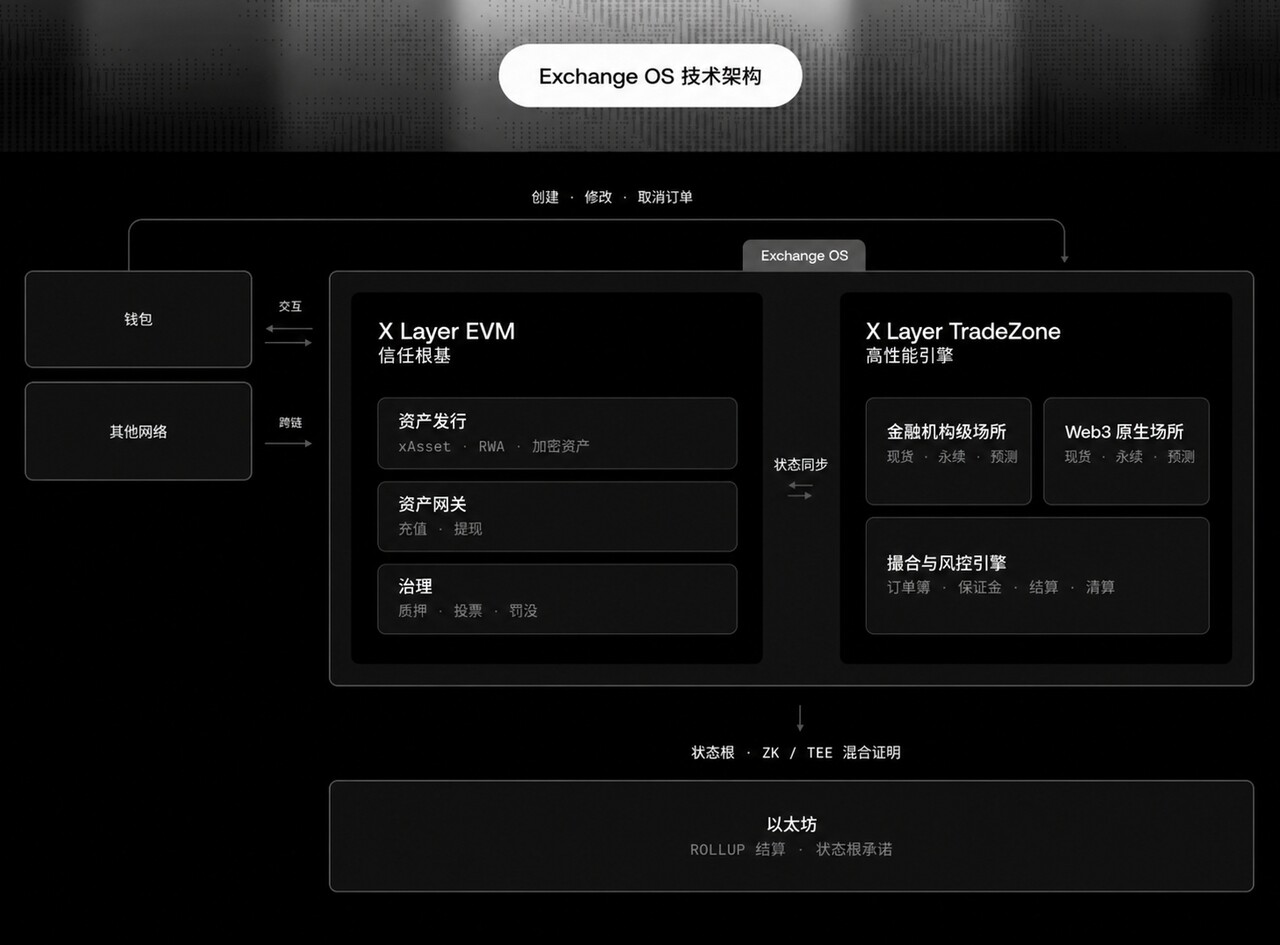
If you want to create a market, just pledge the core assets of X Layer, and you can deploy your own market on Exchange OS, including spot, perpetual contracts, and prediction markets, without needing to apply to anyone or wait for any platform’s approval. The core capabilities of exchanges, such as matching engines, margin systems, and clearing mechanisms, are already set up at the protocol layer, and you can call them directly, allowing you to focus on the market you want to create instead of wasting time and energy.
Those who open markets can be quantitative teams, RWA institutions, new public chain projects, or any users who have identified a trading demand and want to turn it into a real market.
Different deployers can set up different forms of markets based on Exchange OS. Some choose to embed the market into a CEX app, allowing users to enter with one click, offering an experience similar to traditional exchanges; others choose to let users connect directly using self-hosted wallets, retaining complete on-chain autonomy. Both forms share the same set of protocol foundations, with consistent rules and infrastructure. Deployers can choose their deployment method based on their own judgments about users and compliance; OKX only provides the infrastructure, without pre-setting or endorsing any specific compliance model.
One Account for All Markets
For ordinary users, the most direct change brought by Exchange OS is a significant improvement in account experience.
Today, an active on-chain trader often has to operate simultaneously in multiple places: participating in a prediction market on Polymarket, trading perpetual contracts on a DEX, and buying spot on an exchange. Accounts are separated, funds are separated, margins cannot be used interchangeably, and once a new market emerges, funds must be reallocated to new market accounts.
This experience resembles the lack of interoperability on social platforms: you have one set of follow lists on Weibo, another on X, and you have to restart on Xiaohongshu—every time you switch platforms, you have to re-register, reset your profile, and rebuild your network, spending several times the effort to do the same thing. What Web3 social aimed to resolve was this issue: using the social graph on the chain to consolidate identity and relationships, creating a universal identity and attention relationship that applies across all platforms; you maintain it once, and it is effective everywhere.
Like Web3 social, Exchange OS is working on “unified identity and funds” in the trading world. One account, one fund, can operate across spot, perpetual contracts, and prediction markets, with funds managed uniformly at the protocol layer. You can participate in multiple markets simultaneously without needing to transfer funds back and forth, manage multiple accounts, or resubmit funds every time a new market goes live. You cover all markets with the effort of maintaining one account.
For professional traders, this means a fundamental improvement in capital efficiency. The same amount of capital is no longer scattered and locked in different platform accounts but can serve multiple markets and strategies simultaneously. While participating in a prediction market, you can use the same margin to hedge contracts on corresponding underlyings; this level of capital reuse was nearly impossible to achieve before today, but it is natively supported on Exchange OS.
Any Verifiable Event Can Become a Market
For those who want to open a market, Exchange OS provides another possibility.
Imagine a few scenarios: a user focused on crypto technology finds that the question of "whether a certain L1 can surpass Ethereum this year" is worth pricing; an RWA institution wants to turn a certain private equity fund's shares into a tradable asset on-chain; a quantitative team discovers an arbitrage opportunity in the perpetual contract of a certain small coin and wants to open a market themselves.
How can they achieve this? Either they build a complete system from scratch, which is a huge engineering effort usually only affordable by top institutions, or they partner with a platform, but platforms have their own review logic, publishing cycles, and revenue-sharing requirements, and may not be willing to make a niche market. Although the demand exists, the market cannot be established.
Exchange OS eliminates this barrier directly: users can turn hot events into prediction markets, communities can turn topics into tradable judgments, and institutions can turn assets into on-chain markets. Everyone just does what they are best at, while the infrastructure issues are left to Exchange OS to solve.
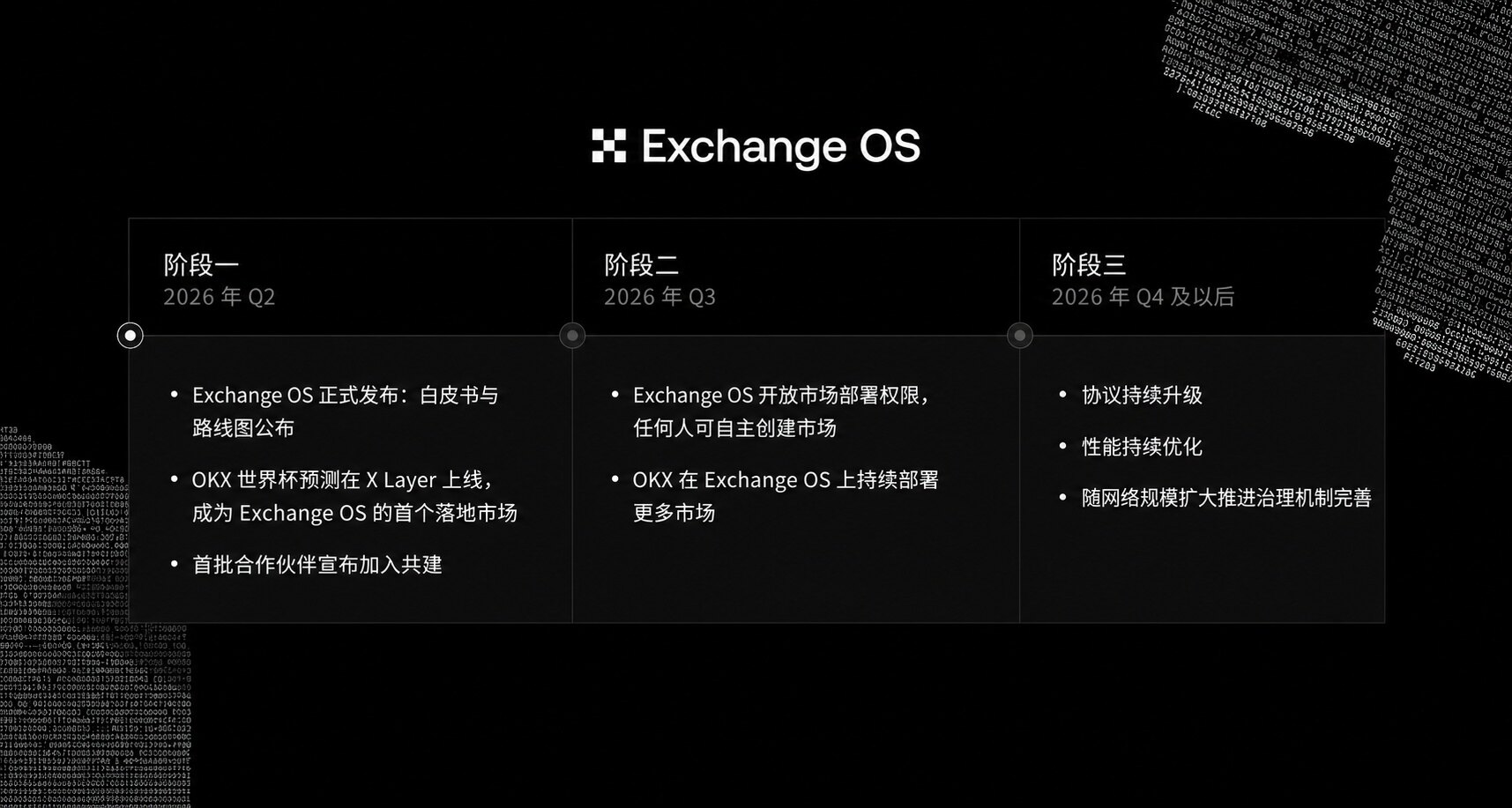 In the past, what could be traded was determined by platforms. It was mainly those few hundred coins, occasionally adding a few derivatives, and niche demands often waited a long time for listing opportunities. Now, as long as an event is verifiable, it can theoretically become a market on Exchange OS. The boundary of the market is no longer delineated by the platform but by the boundaries of verifiable events in the real world.
This has significant implications for the entire ecosystem: the number and types of markets will no longer be constrained by the operating capabilities and willingness of any platform, but driven by actual market demand. Wherever there are people who want to trade, there can be a market.
Entrusting Fund Security to Code
Any discussion of open markets cannot avoid one question: Is it safe? This question is particularly heavy in the crypto market. Over the past few years, too many platforms have attracted users to deposit assets under the banner of “decentralization,” only to run away with the money in various ways. Users have begun to realize that a platform claiming safety and being truly safe are two completely different things.
Exchange OS answers this question by locking user funds in protocol contracts that cannot be unilaterally accessed by anyone, including the deployers opening the market and OKX itself. This is not guaranteed by trusting an institution but by code and protocol rules. The protocol is open and transparent, and anyone can audit every line of logic.
The worst-case scenario is that a deployer opens a low-quality market, rather than the platform running away with your funds. These two risks are fundamentally different: the former is market risk, while the latter is trust risk. Exchange OS eliminates the latter.
Moreover, the markets opened by OKX on Exchange OS and those opened by any external deployer follow the same set of protocol rules. OKX has no backdoors at the protocol level, no platform privileges, and cannot bypass rules to give its own market a green light.
Of course, “anyone can open a market” also means that there needs to be a mechanism to constrain malicious behavior. Exchange OS's approach is that opening a market requires pledging X Layer core assets as economic guarantees from the deployer. If the deployer's behavior harms user interests, the governance committee can impose penalties on the pledged assets, and the severity of the penalties is tied to the degree of malice. Opening a market comes at a cost, and wrongdoing must also come at a cost; this is the economic foundation for the entire mechanism to operate.
The Historical Context of Exchange OS
If we want to understand the significance of Exchange OS, we need to place it within a longer time frame.
Over the past decade and a half of blockchain, there have been nodes that have truly changed the power structure at intervals. Bitcoin made it possible to transfer value point-to-point, allowing people to transfer funds without going through banks for the first time; Ethereum allowed anyone to issue assets, opening the act of "token issuance" that was previously reserved for institutions to everyone; the emergence of AMMs allowed anyone to create liquidity pools, removing the need for professional market makers; prediction markets made "events" tradable for the first time, expanding the boundaries of markets from asset prices to all verifiable judgments in human society. Each step releases a kind of power that was previously held by a few into the hands of a larger number of people.
What Exchange OS aims to do is the next step along this line: to enable anyone to create complete financial markets. What was previously only within the capabilities of top-tier exchanges is now available as protocol-level services callable by anyone. This is the release of the right to create a market. Analogous to the evolution of the internet: in the Web1 era, content was produced by a few websites and institutions, and ordinary people could only browse; by Web2, anyone could write articles and start channels, distributing the right to create content to every individual with the spread of technology; Web3 extended this openness to the asset layer—anyone can issue tokens and create liquidity pools, significantly lowering the barriers to financial participation.
What Exchange OS aims to do is the next step on this evolutionary path: to make the act of "opening a market" something anyone can achieve. If Web3 resolved the question of "who can issue assets," Exchange OS is set to resolve "who can create markets"—this is precisely the shape that the next generation of financial infrastructure should take.
In the markets of a thousand years ago, anyone could open one. What Exchange OS does is restore this capability on the chain.
Read the Exchange OS White Paper and join us in building the future of trading markets.
免责声明:本文章仅代表作者个人观点,不代表本平台的立场和观点。本文章仅供信息分享,不构成对任何人的任何投资建议。用户与作者之间的任何争议,与本平台无关。如网页中刊载的文章或图片涉及侵权,请提供相关的权利证明和身份证明发送邮件到support@aicoin.com,本平台相关工作人员将会进行核查。


