$BTC has fallen, $ETH has fallen, altcoins have been bloodied. Yet, $HYPE is stirring.
It’s not "relatively resistant," it’s not "only down 15%," but rather completely flat.
When the entire market is bleeding, it stands there steadily as if it has nothing to do with the market.
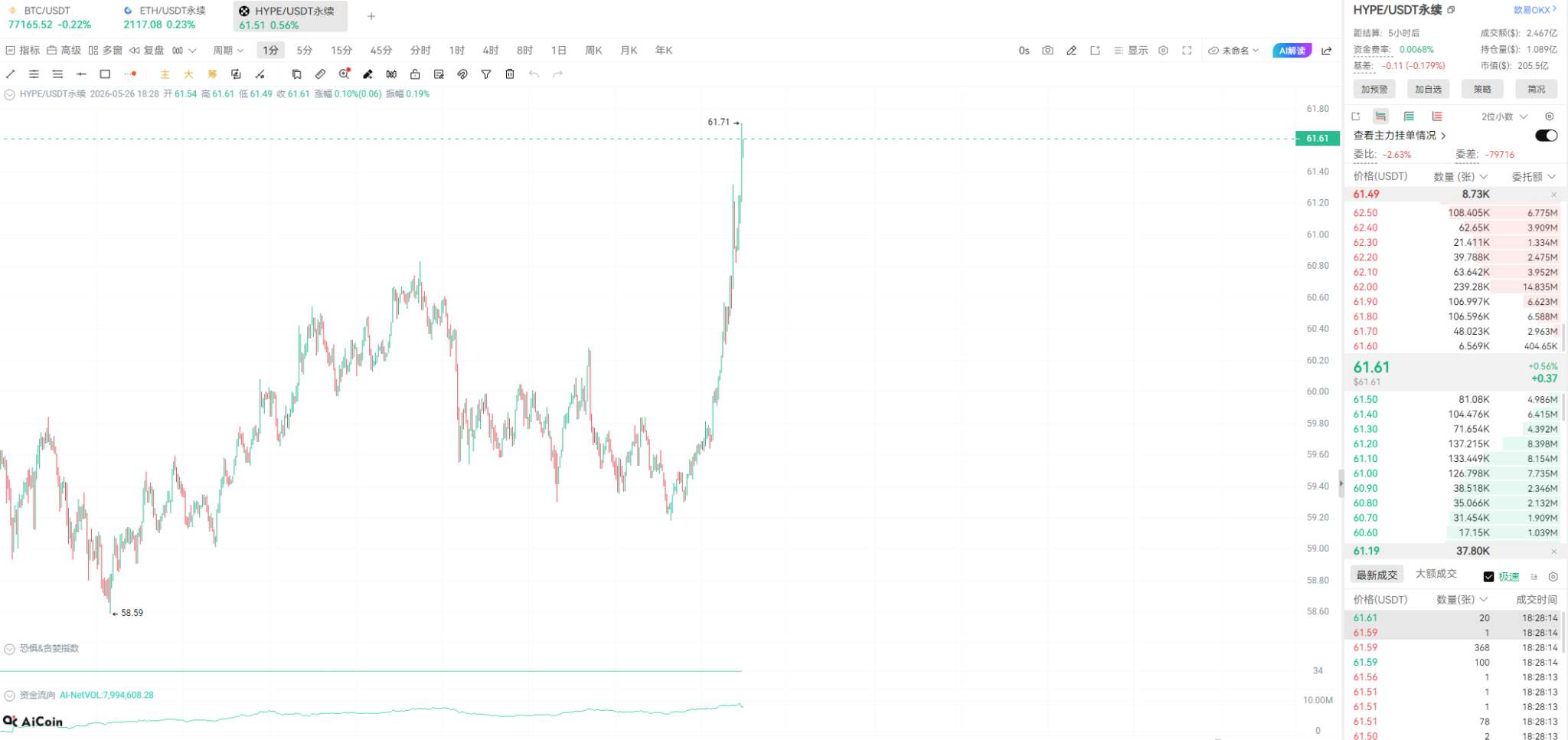
This is not luck, it’s structural strength.
@Hyperliquid’s annual platform revenue is approaching a new high, with 7-day trading fees increasing by 120% month-over-month and trading volume up by 80%. While revenue for most protocols is collapsing, Hyperliquid is accelerating
While revenue for most protocols is collapsing, Hyperliquid is accelerating.
The core reason is HIP-3. What has HIP-3 changed?
In October 2025, Hyperliquid will allow anyone to stake 500,000 HYPE to create any asset’s perpetual contract without permission—stocks, commodities, forex, indices, anything.
At that time, gold and silver surged due to geopolitical risks, oil fluctuated sharply due to the Middle East situation, and U.S. stocks were thrown into chaos by AI narratives and tariff policies. As a result: the share of TradFi assets in Hyperliquid's total trading volume increased from less than 5% in December to 31.6% by the end of January, a sixfold increase within 30 days.
More importantly, this directly sparked the migration of RWA (real-world assets).

According to official data, the open interest (OI) for RWA perpetual contracts has reached a new high of $2.6 billion, doubling within two months. Daily trading volume for silver perpetual contracts exceeded $1 billion, and commodity derivatives OI also set a historical record in early March.
"The RWA Migration (HIP-3)" points out: "The platform no longer waits for permissioned channels; various tokenized stocks and pre-IPO assets are directly deployed onto HyperCore, with RWA demand exploding."
Hyperliquid is no longer just a crypto derivatives DEX; it has become an on-chain trading platform for all asset classes. This positioning has made $HYPE no longer as volatile as an ordinary crypto asset.
👉 [Trade $HYPE now to seize the strongest bonus channel]
https://jump.do/zh-Hans/xlink-proxy?id=4
Structural advantages that CEX will never learn
CEX needs compliance checks, legal reviews, and regulatory approvals to launch new derivatives, which can take weeks to months; whereas the HIP-3 market can launch in a few hours.
When a geopolitical event breaks out, Hyperliquid is already open while others are still going through procedural processes.
And the HIP-3 market can launch in a few hours.
Geopolitical risks do not take a break. Hyperliquid has no trading hours. When there’s only one place in the world where you can trade oil and gold on weekends, capital naturally flows in.
This is not functionality; it’s a monopoly-level market access that no compliant exchange can replicate.
DEX is actively eating away at CEX; this is not just Hyperliquid, but a structural change happening across the entire sector. The market share of perpetual DEX increased from 2.0% in January 2024 to 10.2% in January 2026, a fivefold increase in two years.
Hyperliquid alone holds 73% share, with weekly trading volume, open interest, and six-month cumulative trading volume in the tens of trillions, already on par with Coinbase.
All of this, without airdrops, without points, without any bribes.
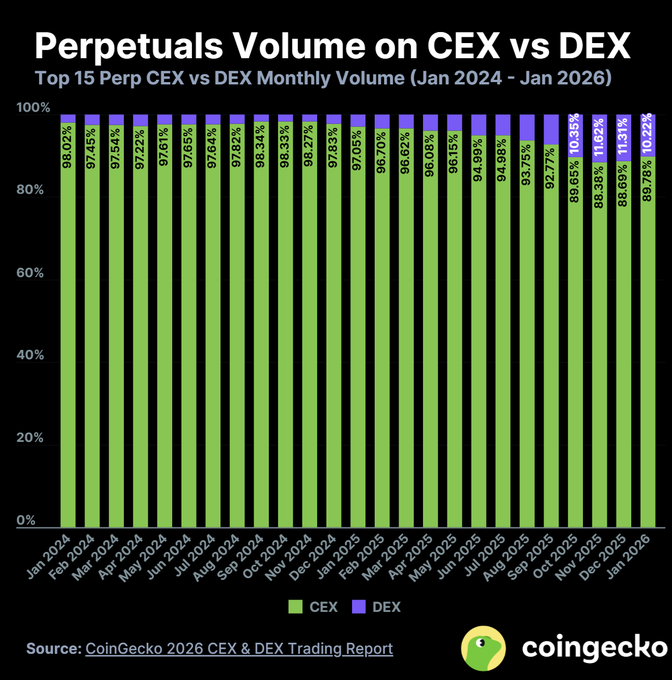
Once competitors’ incentives end, users leave (Lighter’s trading volume plummeted nearly 70% after the December airdrop), while Hyperliquid's trading volume continues to grow. Organic trading volume and continuous growth without bribery—that’s what a real product is.
Flywheel effect: RWA trading volume directly boosts HYPE deflation
All trading volume (especially the RWA portion) directly feeds back to the supply of $HYPE. Approximately 97% of core trading fees go into an aid fund, buying HYPE on the open market and permanently destroying it.
Currently, over 48,000 HYPE are destroyed daily, while only about 26,790 are issued daily, the destruction rate is 1.8–2.3 times the issuance amount. The larger the RWA trading volume → the more fees → the more destruction → the tighter the supply.
On March 6, although core contributors unlocked about 9.92 million HYPE, there is pressure; however, under such a strong structural destruction, the net deflation trend remains solid.
The price of $HYPE has risen about 10% from the old ATH, while the market cap is still $1 billion lower than the ATH—completely opposite to most altcoins.
And trading volume is now pouring in from all directions. In summary, the core argument is: no matter how capital preferences shift—crypto bull market, crypto bear market, geopolitical crises, traditional market turmoil—Hyperliquid can capture trading volume. That’s why $HYPE can still rally while others are bleeding.
"RWA transactions occur 24/7 on the true order book of the whole chain, which is why Hyperliquid is becoming the number one blockchain ‘housing all finance’." Now, the RWA advantage of HYPE is no longer a concept, but real trading volume and liquidity moat.
Those who missed out may truly regret it.
It is no longer just a crypto asset,
it is infrastructure.
Join our community, let’s discuss and become stronger together!
Official Telegram community:
AiCoin Chinese Twitter:
HTX benefits group:
https://aicoin.com/link/chat?cid=pR10DlG6
免责声明:本文章仅代表作者个人观点,不代表本平台的立场和观点。本文章仅供信息分享,不构成对任何人的任何投资建议。用户与作者之间的任何争议,与本平台无关。如网页中刊载的文章或图片涉及侵权,请提供相关的权利证明和身份证明发送邮件到support@aicoin.com,本平台相关工作人员将会进行核查。