The stability of the RMB exchange rate, who bears the cost?
Recently, a lot has been written about the RMB, CRS, foreign exchange controls, and capital outflows. Many friends have raised a question: why does China maintain strict management of the RMB exchange rate and capital flows for a long time, while many countries allow their local currencies to be freely convertible, letting the exchange rate absorb shocks through market fluctuations?
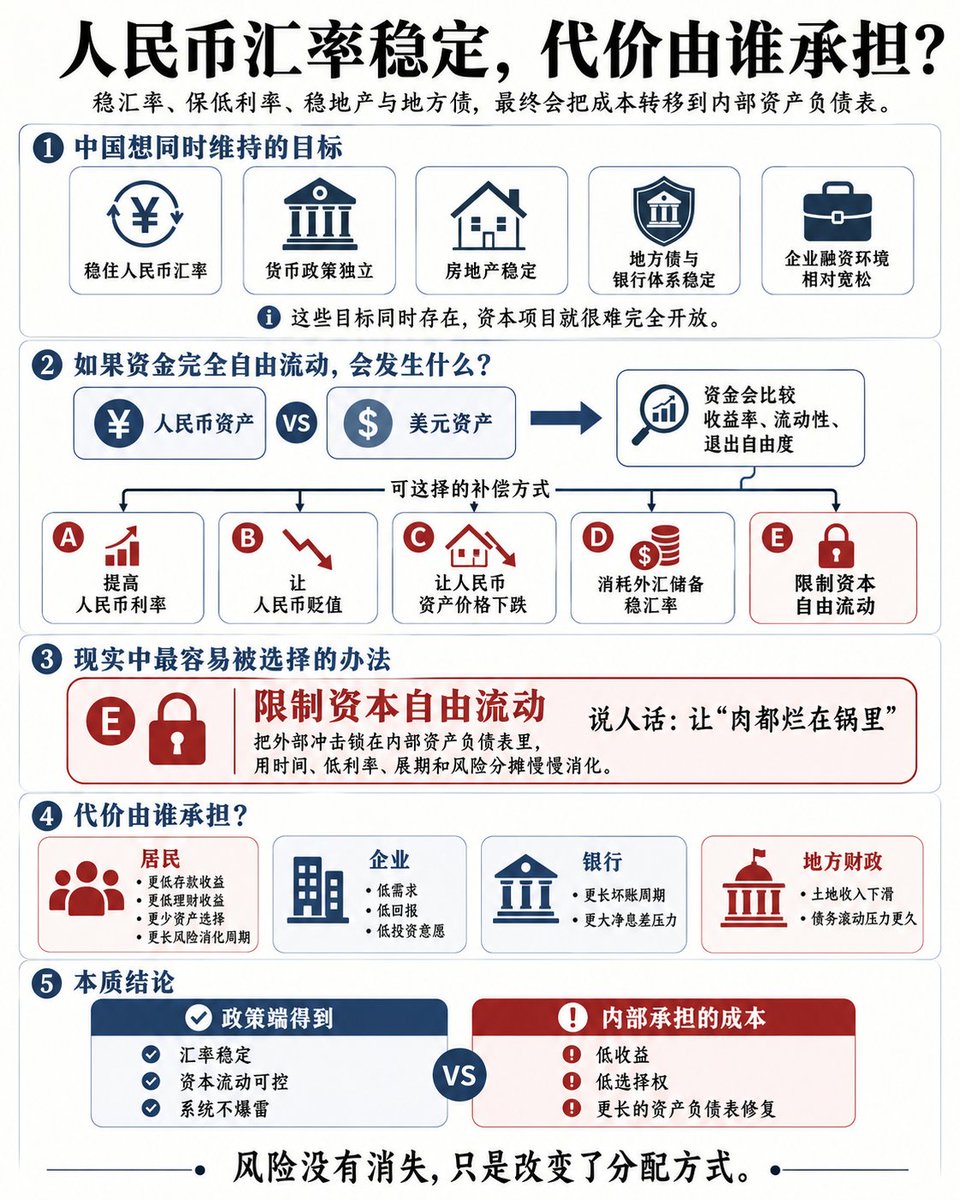
The core reason is that China both wants to stabilize the RMB exchange rate and does not want domestic interest rates to be completely driven by USD rates, while also wanting to maintain stability in real estate, local debt, the banking system, and corporate financing. As long as these goals exist simultaneously, the capital account is hard to fully open. Because once funds can be freely exchanged, freely flow, and freely allocated, RMB assets will have to compete directly with USD assets.
If USD interest rates are higher, USD assets are more liquid, and exits are freer, then to retain funds in RMB assets, a compensation must be offered. This compensation could be higher RMB interest rates, a depreciation of the RMB, a drop in RMB asset prices, a consumption of foreign exchange reserves to stabilize the exchange rate, or a slowdown in capital outflows through capital controls.
However, each choice comes with a cost.
Raising RMB interest rates will pressure the real estate market, local debt, urban investment, and corporate financing. A free depreciation of the RMB will increase import costs and external debt pressure, and will also weaken confidence in RMB assets. A substantial drop in RMB asset prices could complete market self-adjustment, but it could complicate the situation for real estate, bank collateral, local finances, and household wealth. Long-term consumption of foreign exchange reserves to intervene in the exchange rate will also be constrained by the scale of reserves and market expectations.
Thus, the easiest method to choose in reality is to restrict the free flow of capital. This can maintain a relatively stable CNY exchange rate, preserve a relatively independent monetary policy, and avoid forcing domestic interest rates to rise significantly during USD high interest rate cycles. The cost is clear: funds cannot flow freely between RMB assets and USD assets.
In simple terms, China's ultimate choice is to let "the meat rot in the pot." As long as the meat remains in the pot, for China, it's an issue of internal balance sheets. As long as the problem stays internal, it can be slowly addressed over time, through interest rates, extensions, administrative coordination, and risk sharing.
The result is that household savings remain in the RMB financial system and local asset pools, forced to reallocate within deposits, wealth management products, bonds, insurance, real estate, A-shares, and limited cross-border investment channels. This is essentially a form of financial repression.
When residents have no better place for their savings, banks can continue to obtain low-cost liabilities, local debt and corporate financing can continue rolling, and real estate and urban investment can have more time to digest risks.
From a macro perspective, this is stability. From a micro perspective, residents are using low returns, low choices, and a longer time to subsidize the slow recovery of the entire RMB credit system. The money is still in the system, asset prices haven't collapsed quickly, and debts haven't concentrated their explosion, but residents bear the opportunity cost, businesses cope with a low return environment, banks manage longer bad debt cycles, and local finances face slower debt digestion.
This is key. Risks haven’t disappeared; they’ve merely changed their distribution. The exchange rate hasn't depreciated sharply, capital hasn't flowed out massively, and asset prices haven't cleared all at once; ultimately, these pressures will slowly manifest in residents' incomes, corporate investments, bank profits, local finances, and asset prices.
The cost is that residents receive lower deposit yields, lower returns from wealth management, fewer asset choices, and longer risk digestion cycles. Enterprises face low demand, low returns, and low investment willingness. Banks encounter longer periods for bad debt digestion. Local finances contend with debt rollover pressures after land income decreases.
The government gains exchange rate stability, controllable capital flows, and a non-exploding system. Residents endure low yields, limited choices, and an extended period for balance sheet recovery.
This is the true cost of the stability of the RMB exchange rate.
免责声明:本文章仅代表作者个人观点,不代表本平台的立场和观点。本文章仅供信息分享,不构成对任何人的任何投资建议。用户与作者之间的任何争议,与本平台无关。如网页中刊载的文章或图片涉及侵权,请提供相关的权利证明和身份证明发送邮件到support@aicoin.com,本平台相关工作人员将会进行核查。


