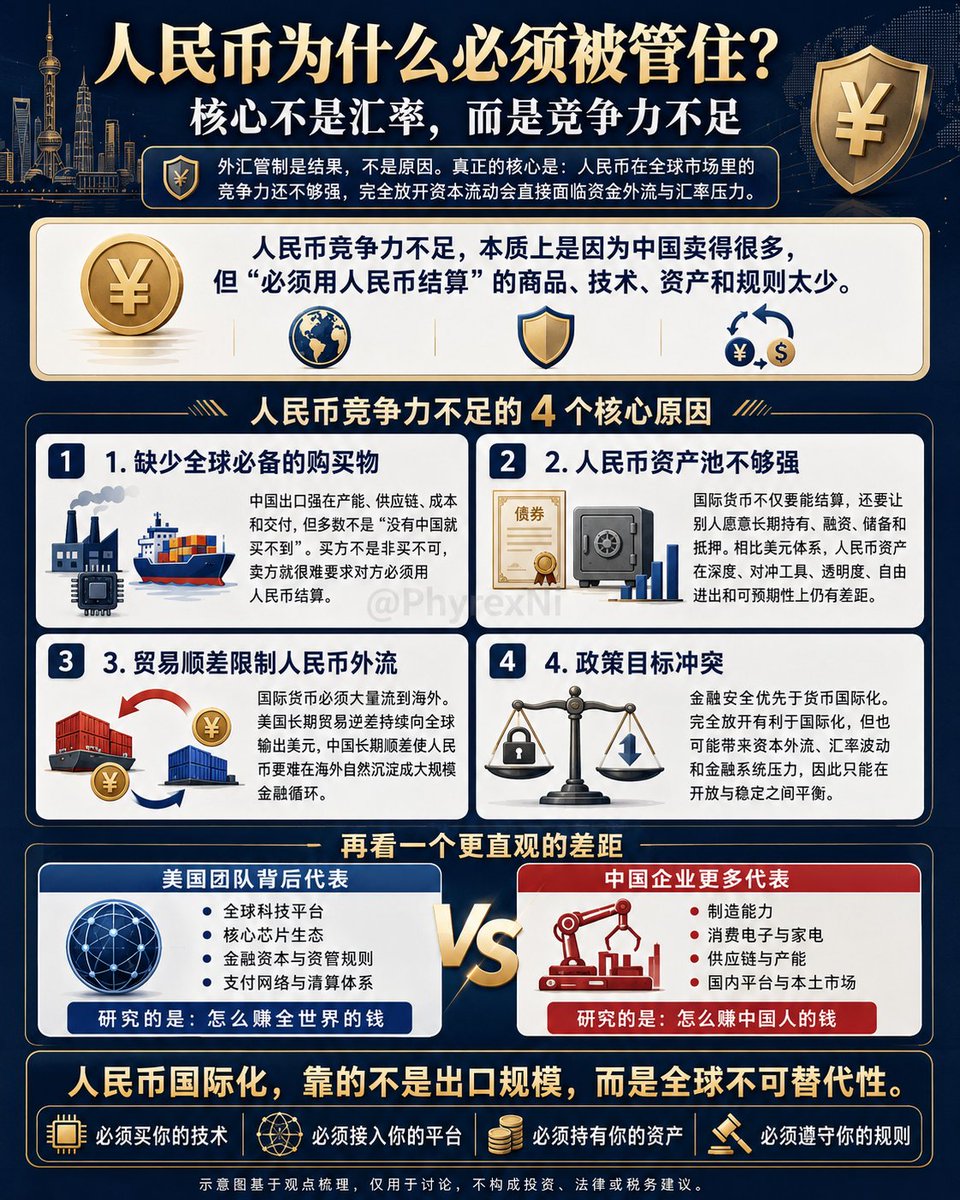
Why must the RMB be controlled? The core issue is not the exchange rate but the lack of competitiveness.
Recently, a lot has been written about the RMB, CRS, foreign exchange controls, and capital outflow, but returning to the fundamental question, why does China need to stabilize the RMB exchange rate through foreign exchange controls? Why prevent large-scale capital outflow? The core issue is that the RMB itself lacks competitiveness in the global market.
The lack of competitiveness of the RMB can be attributed to several reasons:
First, China lacks essential global purchasing goods.
China exports a lot, but most of it is due to capacity advantages, supply chain advantages, cost advantages, and delivery advantages, but there is almost no absolute pricing power advantage. Buying Chinese goods is often because they are cheap, fast, large in quantity, and stable, rather than because they are irreplaceable. As long as the buyer does not have to buy, the seller finds it hard to demand that the buyer must settle in RMB.
Why is the dollar strong? It's not just because of America's financial openness but because the U.S. has control over high-end chip ecosystems, operating systems, cloud services, software platforms, financial markets, U.S. Treasury assets, the dollar debt system, the global clearing network, and military security order that cannot be bypassed.
Even if one dislikes the dollar, many countries, companies, banks, funds, and central banks cannot bypass it. The issue with the RMB is exactly the opposite; China sells many things, but not enough strong products to compel others to settle in RMB.
Second, the RMB asset pool is not strong enough.
For a currency to internationalize, it’s not enough for others to accept RMB, but rather whether they are willing to hold it long-term, whether they are willing to finance in RMB, whether they are willing to regard RMB assets as reserves, and whether they are willing to use RMB bonds as collateral.
Behind the dollar, there are U.S. Treasury bonds, which are the most central secure asset, liquidity tool, and collateral in the world. Although the RMB is backed by Chinese Treasury bonds, the Chinese banking system, and Chinese assets, from the perspective of international investors, market depth, hedging tools, legal transparency, capital mobility, and policy predictability still cannot compare with the dollar system.
Third, China's long-term trade surplus instead limits the outflow of RMB.
International currencies must flow massively overseas; only then can others hold your currency. The U.S. has a long-term trade deficit, which means continuously exporting dollars globally. China has a long-term trade surplus; after selling goods, foreign exchange flows back to China. Coupled with capital controls, it's hard for the RMB to naturally settle into a large-scale financial cycle abroad. The RMB can be used for some trade settlements, but a settlement currency does not equal a reserve currency, let alone a global financing currency.
Fourth, conflicting policy objectives.
For China, financial security is prioritized over currency internationalization, so the RMB cannot flow freely like the dollar. As long as capital cannot move freely in and out, the RMB will struggle to become a truly global currency, but if it does move freely under current conditions where RMB asset competitiveness is lacking, it easily leads to capital outflow and exchange rate pressure.
So the lack of competitiveness of the RMB is not merely because the exchange rate is controlled, but because the RMB has not yet formed a complete global currency closed loop.
On the product side, there is a lack of enough irreplaceable high-tech pricing power; on the asset side, there is a lack of a sufficiently deep global safe asset pool; on the financial side, there is a lack of an adequately open financing and collateral system; and on the institutional side, there is a lack of a free exit mechanism that reassures global capital for long-term holding.
The real problem with the RMB is that there are too few "products" sold by China that must be settled in RMB.
In fact, this issue is straightforward; by observing the recent U.S. visit to China, one can see the disparity through the commercial representatives brought by the U.S. team and the entrepreneurs attending from China.
The U.S. team included companies like Tesla, Apple, Nvidia, Qualcomm, Citigroup, Goldman Sachs, and BlackRock, which represent global tech platforms, core chips, financial capital, payment networks, and asset management rules. China also has very outstanding entrepreneurs, but what more they represent need not be said.
To say an unflattering joke, American businessmen are studying how to earn money from the world, while Chinese businessmen are studying how to earn money from Chinese people.
For the RMB to internationalize, relying on export scale is not enough, relying on trade surplus is not enough; what is truly needed is global irreplaceability. Only when others must buy your technology, must join your platform, must use your financial assets, and must comply with your industry rules, does your currency qualify to be held long-term by others.
#Bitget has arrived, it's VIP! Crypto, US stocks, CFD, global opportunities in one stop.
免责声明:本文章仅代表作者个人观点,不代表本平台的立场和观点。本文章仅供信息分享,不构成对任何人的任何投资建议。用户与作者之间的任何争议,与本平台无关。如网页中刊载的文章或图片涉及侵权,请提供相关的权利证明和身份证明发送邮件到support@aicoin.com,本平台相关工作人员将会进行核查。


