The CRS relationship between Singapore and China may have information you need to know.
Today, I happened to have lunch with a private banking client manager and a product manager from a large bank in Singapore. During the conversation, we talked about the issue of CRS in Singapore, and I can provide some clarification for my friends.
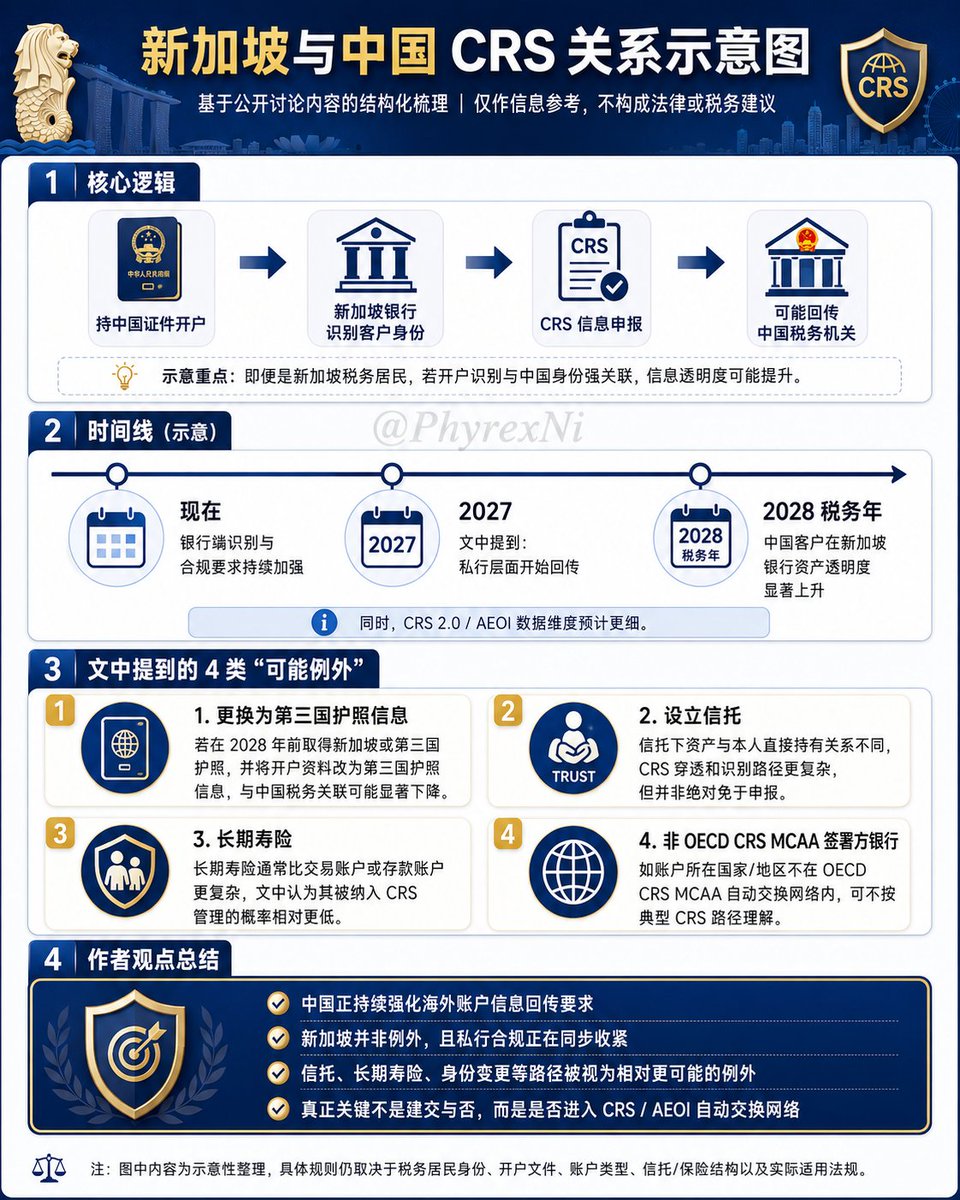
Overall, regarding Singapore, China has similar requirements to the United States, demanding that all users who open accounts with Chinese identities (including but not limited to passports, identity cards, and driver's licenses) must report back to China. Even if you are a tax resident of Singapore, as long as you open an account with Chinese documents, your information must be reported back to China.
Currently, private banks will start to report back in 2027, meaning that for the tax year 2028, Chinese users' assets in Singapore banks will almost be completely transparent. From the current perspective, this is unavoidable. Not only Singapore, but all CRS member countries have been required by China to report data.
As of now, there are three possible exceptions:
1. 100% exception: If you obtain a Singapore or third-country passport before 2028 and change all account information to reflect the third-country passport, then there will be no relation to Chinese taxes.
2. The most likely exception: Establishing a trust, as a trust indicates that the assets are no longer directly related to you but are distributed according to your wishes. Therefore, it currently does not involve CRS, but it is not entirely exempt. However, when the property is given to the beneficiaries through the trust, there may still be a requirement for CRS. The main focus of CRS remains on transaction or deposit users.
3. A somewhat probable exception: Purchasing insurance, but it must be life insurance. Annual dividend policies do not qualify; only long-term life insurance is applicable. Life insurance is not taxed. Although there might be potential CRS implications during settlement, managing such cases is generally more complex compared to transaction users and bank deposit users, making the probability of CRS lower, but still higher than trusts.
From a global perspective, there is one more possible exception:
4. Banks from countries not on the OECD CRS MCAA signatory list, such as the United States, Bhutan, Taiwan, Vietnam, the Philippines, Cambodia, Laos, Myanmar, Bangladesh, Nepal, Sri Lanka, Iran, Iraq, Jordan, Egypt, Algeria, Ethiopia, Bolivia, Cuba, Venezuela, Zimbabwe, North Korea, Turkmenistan, Uzbekistan, etc., can disregard CRS issues.
Furthermore, China currently does not have a deposit tax. If there is a deposit tax in the future, it could lead to more problems. However, based on the current situation, these three types are highly likely CRS exceptions.
The new CRS 2.0 is expected to be fully implemented by 2027. The latest policy will require a vast amount of data to be submitted. The tax authority, upon reviewing the data, can virtually deduce all your cash flow for that year.
免责声明:本文章仅代表作者个人观点,不代表本平台的立场和观点。本文章仅供信息分享,不构成对任何人的任何投资建议。用户与作者之间的任何争议,与本平台无关。如网页中刊载的文章或图片涉及侵权,请提供相关的权利证明和身份证明发送邮件到support@aicoin.com,本平台相关工作人员将会进行核查。


