The difference between offshore renminbi and onshore renminbi, which one is the real "renminbi"?
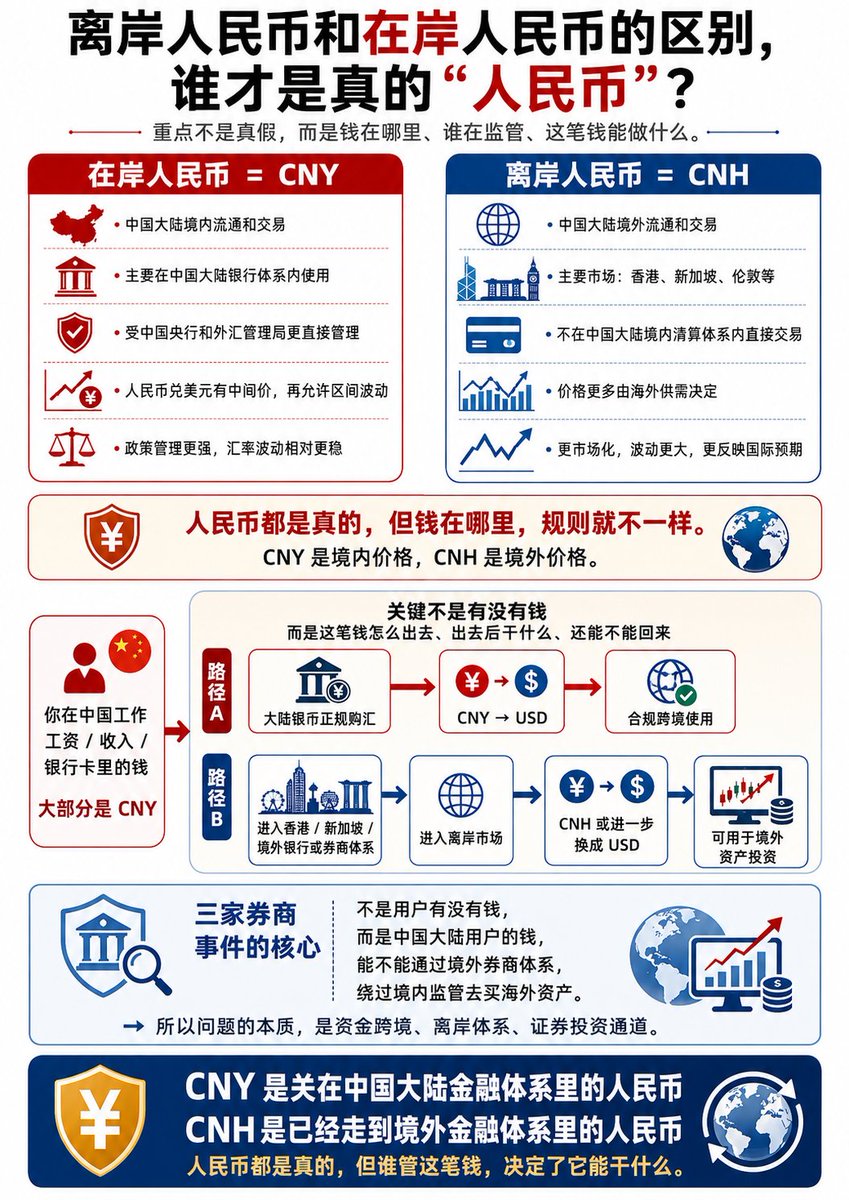
Onshore Renminbi = CNY
Refers to the renminbi that circulates and trades within mainland China, primarily used within the mainland banking system. It is subject to more direct management by the People's Bank of China and the foreign exchange administration. The onshore exchange rate of the renminbi against the dollar has a daily midpoint price and is then allowed to fluctuate within a certain range.
Therefore, the exchange rate of CNY is not completely freely floating but rather has strong policy guidance. For example, the exchange rate of the dollar against the renminbi seen in mainland Chinese banks is usually within the CNY system.
Offshore Renminbi = CNH
Refers to the renminbi that circulates and trades outside of mainland China, with main markets including Hong Kong, Singapore, and London. Offshore renminbi is not directly traded within the mainland clearing system, with relatively more market-oriented regulation, and prices are determined more by overseas supply and demand.
Thus, CNH typically experiences greater fluctuations than CNY and more easily represents international market expectations for the renminbi's trend. For example, the renminbi used by overseas institutions, offshore banks, OTC, or in Hong Kong bank accounts is often CNH.
The core difference can be simply understood as CNY being the renminbi within the mainland with stronger policy management. CNH is the renminbi outside the mainland, with stronger market pricing. If there are international concerns about the depreciation of the renminbi, CNH usually fluctuates before CNY, and the fluctuations are more intense. For instance, USD/CNH may rise first, suggesting that offshore renminbi depreciates first, followed by CNY.
PS: The word "may" is key. You need to understand it yourself.
Generally, if you work in China, most of your salary, income, and money in your bank account is CNY, that is, onshore renminbi. This renminbi is the real renminbi, within the banking system of mainland China, and hence is subject to Chinese foreign exchange management rules.
However, if you need to spend abroad, then CNY won't work, converting the CNY from mainland China into usable money in the offshore financial system is what matters.
If you purchase foreign currency through a mainland bank, then it is CNY exchanged for dollars. If you circumvent this restriction and transfer the money to Hong Kong, Singapore, or an offshore brokerage account, entering the offshore banking system, then this renminbi is no longer simply within the domestic CNY logic, but has entered the offshore market, becoming CNH or is further exchanged for USD.
This is the core of the punishments imposed on three brokerages, whether mainland Chinese users' money can bypass domestic regulation through the overseas brokerage system to purchase overseas assets.
This can help better understand the distinction between CNY and CNH. CNY is within the mainland Chinese system, subject to mainland regulation. CNH is within the offshore system, more affected by overseas markets and local regulations. They are both renminbi, but where the money is located determines the rules.
If you want to buy US stocks with the renminbi in your mainland bank card, having money is not enough to buy directly. Because this money is still CNY, and the regulation concerns how it goes out, what it does after going out, and whether it can come back!
The renminbi in your Hong Kong or Singapore account, or funds already in offshore brokerages, is a completely different situation. Because this money has already entered the offshore system, the regulatory logic changes to the KYC, AML, securities licensing, and cross-border compliance of the local financial institutions.
In summary, CNY is the renminbi trapped in the mainland Chinese financial system, while CNH is the renminbi that has entered the offshore financial system. Both renminbis are real, but who manages this money determines what it can do.
#Bitget is here, just VIP! Crypto, US stocks, CFD, global first-mover layout in one stop
免责声明:本文章仅代表作者个人观点,不代表本平台的立场和观点。本文章仅供信息分享,不构成对任何人的任何投资建议。用户与作者之间的任何争议,与本平台无关。如网页中刊载的文章或图片涉及侵权,请提供相关的权利证明和身份证明发送邮件到support@aicoin.com,本平台相关工作人员将会进行核查。


