
Have you ever calculated such an account?
Assuming you are a relatively high-frequency trader, with an average monthly trading volume exceeding 1 million dollars, even a 0.01% difference in fees could result in thousands or even tens of thousands of dollars in accumulated transaction fees over a year.
In the past bull markets, such discrepancies were easily masked by market fluctuations. Capturing a surge or a hot trend that gains dozens of points in a single day is often enough to cover most of the fee costs. However, as the market gradually enters a stage of maturity, more and more traders begin to realize: what truly determines long-term earnings is no longer just how much can be earned from each trade. To achieve results in today's market, it is essential to manage the profit and loss ratios of each trade more meticulously.
This has brought a term that was once somewhat distant from ordinary users back into public view—VIP. In the past, ordinary users often held a defensive attitude towards the term VIP, subconsciously thinking it was a privilege reserved for “whales” with tens of millions of dollars in their accounts, too far removed from themselves. However, from the market trends observed in the first half of 2026, this conventional understanding is being broken. Leading exchanges are consecutively lowering the entry barriers for VIP status. Unlike the past where competition mainly relied on attracting new users, subsidies, and coin listings, current exchange competition is clearly entering a phase of “service enhancement.”
Since exchanges are actively lowering thresholds, for ordinary users, especially those with limited assets but relatively mature trading strategies—VIP is no longer just a vanity title, but a concrete channel for increasing efficiency.
Therefore, this article will not discuss market trends or trading strategies, but will instead take the perspective of ordinary users to break down the VIP systems of leading exchanges such as Binance, OKX, and Bitget. In this context of continuously lowering VIP thresholds and exchanges fully enhancing services, which proposal is most suitable for today’s traders?
Comparison of the VIP Systems of Three Major Exchanges
Before making a formal comparison, we first need to address an important issue. The VIP system architectures of major exchanges vary widely. Trading, positions, lending, options, OTC, invitations, migrations… each exchange supports a variety of different paths for VIP upgrades.
For ordinary users, it is not necessary to thoroughly study all the rules. To help everyone avoid cumbersome terms, before aligning the accounts, we can first outline a user stratification judgment framework based on fund size and trading habits. You can check which category you belong to and thus identify the most suitable upgrade path for yourself.
- In terms of trading style, users in the market can generally be divided into two categories: “low-frequency holding” and “high-frequency trading”. The former typically does not have many daily trades and tends to maintain a certain amount of assets in the account for the long term, making it more suitable to focus on VIP upgrade paths related to “position amount”; the latter has higher trading frequency, and even with a lower fund size, the cumulative total trading volume tends to expand rapidly (especially for futures users), thus paying more attention to “trading volume” upgrade paths and actual fee discounts.
- If we look at asset sizes, the market users can be roughly classified into three categories: “small traders”, “growing users”, and “big players”. “Small traders” and “big players” are self-explanatory; the former struggles to reach the VIP thresholds at major exchanges, while the latter can easily unlock the top VIP benefits across exchanges (at this level, the benefits do not differ much). The key emphasis here is on the increasing number of “growing users” in recent years.
所谓“成长型用户”是指,资产规模还没有达到传统意义上的“大户”标准,但已经开始形成稳定的交易习惯,也会主动优化费率、滑点、资金利用率等细节的潜力群体。 This type of user is actually one of the most targeted groups in the current competition among major exchanges because they have significant potential to become core users in the future.
1. Entry Thresholds
During March to April of this year, major exchanges have successively lowered their entry thresholds.
Binance officially announced on March 18 that it has lowered the BNB holding thresholds and contract trading volume requirements for VIP levels 1-3: the BNB holding threshold for VIP 1 has been reduced from 25 coins to 5 coins, and the contract trading volume requirement has been lowered from 15 million dollars to 5 million dollars. At the same time, Binance has also launched the VIP “Rising Star Program”, which is aimed at users with an average daily net asset balance of 30,000 dollars (including 5 or more BNB) over 30 days; qualified users can receive exclusive VIP support, participation in selected activities, and faster opportunities to upgrade to Binance VIP.
OKX officially announced on March 24 that it has lowered the 30-day contract trading volume threshold for VIP levels 1-3 (VIP 1 from 10 million dollars to 5 million dollars); and on April 8 it announced that it would lower the threshold for the priority customer service channel to "current asset balance or 30-day average asset balance not less than 30,000 dollars". Although this does not directly lower the VIP threshold, it allows users who meet this condition to enjoy the same service response priority as VIP users.
Compared to Binance and OKX, Bitget has focused on “how to cover more people” rather than “how high to set the threshold” since the day it built its VIP system: assets of over 30,000 dollars, or 500,000 dollars in spot trading volume, or 5 million dollars in contract trading volume are enough to upgrade to VIP 1. In addition, Bitget launched the “VIP Fast Track” event on April 2, aimed at precisely incentivizing those currently at level V0 or only hold temporary experience permissions, providing additional rewards to reduce friction and assist them in accelerating their upgrade to formal levels 1-3 VIPs.
The VIP upgrade requirements of the three exchanges can be referenced in the image below. 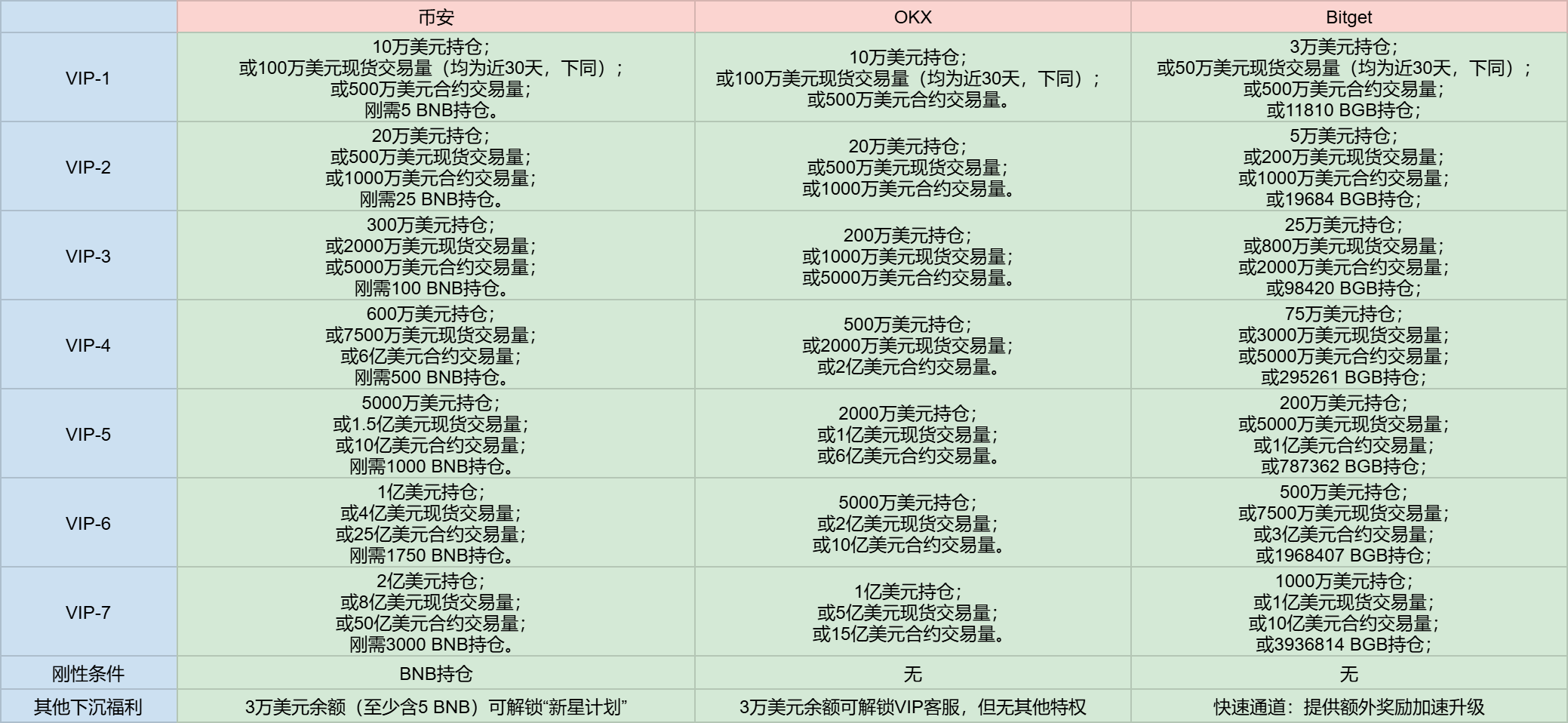
In summary, the 30,000 dollars holding balance is a user profile interval that all major exchanges are aggressively competing for, this holding scale basically covers the mainstream user group within the industry, especially those “growing users” who have the potential to become core users in the future. Both Binance and OKX have granted some VIP benefits to this user group, while Bitget has set this as the formal VIP entry threshold.
Additionally, it is clear that the difficulty of upgrading to VIP on Bitget is significantly lower than that of Binance and OKX. Compared to the other two exchanges, which often require billions or tens of billions of dollars in holding and trading volume, Bitget only requires 10 million dollars in holding to unlock the highest level VIP-7.
As shown in the image above, if your total asset value is 50,000 dollars, you have not reached the VIP threshold on Binance and OKX, but you can upgrade to VIP-2 on Bitget; if your total asset value is 1 million dollars, you can only achieve VIP 2 on Binance and OKX, but can reach VIP-4 on Bitget; if your total asset value is 10 million dollars, you can directly unlock the highest level discount on Bitget, achieving zero fees on spot and contract orders.
Faster upgrade progress means users can more efficiently unlock high-level VIP exclusive rights.
2. Asset Supply
Besides VIP thresholds, another factor increasingly influencing users’ trading experience is the platform's asset supply capacity.
As the narrative around RWA and asset tokenization intensifies, traditional financial assets such as U.S. stocks, precious metals, commodities, and Pre-IPO equity are being transferred to the chain at an accelerating pace. In contrast to the past, when competition was mainly centered around cryptocurrencies, more and more trading platforms are evolving towards “multi-asset one-stop trading entrances.”
From the current market landscape, exchanges like Binance, OKX, Bitget, and emerging DEXs like Hyperliquid, Trade.xyz are all making strides in this direction.
For example, Binance maintains its mainstream trading advantage by relying on its strongest liquidity and broad asset coverage, and recently provided users with opportunities to arrange assets like U.S. stocks by launching contract products and derivative tokens; OKX has also launched a TradFi version tracking traditional assets, continuously strengthening the integration of its on-chain ecosystem and Web3 trading scenarios, allowing users to diversify their asset arrangements directly on-chain through its wallet; Bitget, on the other hand, was the first to introduce the UEX (Universal Exchange) panoramic trading strategy last September, which directly opened up the channel between cryptocurrencies and traditional finance, becoming the first exchange to launch U.S. stock contracts and the primary source of traffic for Ondo's U.S. stock tokens. From the actions taken in recent months, Bitget's asset coverage is continuing to expand, and significant acceleration can be seen in areas like U.S. stocks, CFDs, and Pre-IPOs.
Personally, I usually buy U.S. stock tokens through OKX's wallet, then open equivalent contract short orders on Binance to collect funding fees. Recently, I have also executed several active trades on Bitget. Firstly, last week I wanted to position myself in Rocket Lab (RKLB), which has gained a lot of attention due to SpaceX's upcoming IPO. I found that Bitget was the only exchange that had launched RKLB's stock token. Secondly, last week, Bitget was the first among the three major exchanges to launch CBRS's Pre-IPO contracts before the opening, so I quickly placed a small order. Additionally, I participated in two of Bitget's Pre-IPO launches (preSPAX and preOPAI), both of which have seen a continuous rise since their opening. As of this writing, the former is quoted at 894 dollars, up 37.5% from the subscription price of 650 dollars; the latter is quoted at 928 dollars, an increase of 28% from the subscription price of 725 dollars.
3. Other Benefits
Furthermore, other small benefits that come with VIP status, such as token airdrops, physical gifts, sports event tickets, private event qualifications, global travel, etc., while not the core factors for users when selecting a trading platform, do influence the long-term user experience for highly active users.
Exchanges Entering the “Service War”
Fee discounts and asset supply test the platform's “hardware” capability, but what ordinary users need goes far beyond this. During various unexpected situations, the efficiency and proximity of platform communications and other “software” aspects often determine whether users can retain their loyalty.
As industry bonuses peak at certain stages, the VIP systems of major exchanges are evolving from static numerical rules into an all-encompassing “service enhancement” silent battle. On Binance's part, even as the largest exchange in the industry, He Yi still personally engages with users on social media every day to answer inquiries; on OKX's side, significant reductions to the thresholds for VIP exclusive customer service have made better service capabilities available to a larger user base; Bitget has recently emphasized the “Everyone is VIP” service philosophy and has brought the VIP client manager team out into the open—making them publicly visible and active on social media, with its Greater China regional head, Xie Jiayin, frequently appearing in users' field of vision. Presenting the real service team to users has, to some extent, lowered their psychological barrier when seeking help.
These are all reflections of the exchanges concentrating their efforts on “service enhancement”. In an era where asset types are increasingly rich and trading products are more complex, the factors affecting trading experiences go beyond just fee discounts; they also encompass risk control responses, product rule synchronization, problem handling efficiency, and a whole set of service capabilities. For trading users, “the ability to quickly find someone”, “whether there is a timely response when issues arise”, and “how quickly problems are solved” have become increasingly important components of platform experience.
The underlying logic here is that, as the industry shifts into a mature competitive stage, exchanges find it increasingly difficult to achieve rapid growth through mere traffic expansion. Those who can better serve active users and accompany them in their growth will have a better opportunity to gain an advantage in the next stage of competition.
How Should Ordinary Users Choose?
It can be said that, in this “hardware and software service war” initiated by exchanges, the biggest beneficiaries are actually the trading users on the front lines of the market. Whether it’s a lower entry threshold, a more transparent growth path, or a more complete service system, essentially, these are exchanges' re-competition for core and potential core users during the stage of mature competition.
Conversely, for ordinary users wishing to better manage long-term trading, they should actively seize this precious “VIP sinking dividend.”
As for what ordinary users should choose? Overall, Binance still possesses the strongest liquidity and global depth; OKX has a clear advantage in integrating its proficient on-chain ecosystem; Bitget aims to cover rapidly growing trading users with lower thresholds and earlier services while providing opportunities for diversified asset arrangements through its UEX panoramic strategy.
If you value trading depth and global liquidity, Binance remains the safest choice; if you focus on the on-chain ecosystem and Web3 trading experience, OKX may be more suitable; and if you are currently in a phase of rapid growth in trading scale and wish to unlock complete VIP benefits earlier while having asset allocation needs in U.S. stock trading, Pre-IPO, and other varieties, then Bitget’s system design will better fit your actual situation.
To some extent, this may be the most noteworthy change in this round of industry shifts. In the past, VIP status felt like a privilege only accessible to a few big players, but now, more and more platforms are attempting to transform VIP into a capacity to serve users earlier and accompany them as they grow.
For ordinary users, this may be the truly valuable change.
免责声明:本文章仅代表作者个人观点,不代表本平台的立场和观点。本文章仅供信息分享,不构成对任何人的任何投资建议。用户与作者之间的任何争议,与本平台无关。如网页中刊载的文章或图片涉及侵权,请提供相关的权利证明和身份证明发送邮件到support@aicoin.com,本平台相关工作人员将会进行核查。


