Those familiar with my followers know that #SOL and #SUI are my largest public blockchain holdings! Today, I researched SUI's zero gas fee stablecoin transfer, and the more I think about it, the more excited I become. This guy is really going to recreate the glory of Libra and change the game rules in the crypto space. 🧐
Let's first talk about why this matters.
In the past, when we transferred USDC on-chain, in addition to the transfer itself, we also had to prepare a bunch of native tokens as gas fees. It's like going to a convenience store to buy a bottle of water, and the clerk tells you: Sorry, you need to exchange some in-store tokens before you can pay. Is that a hassle?
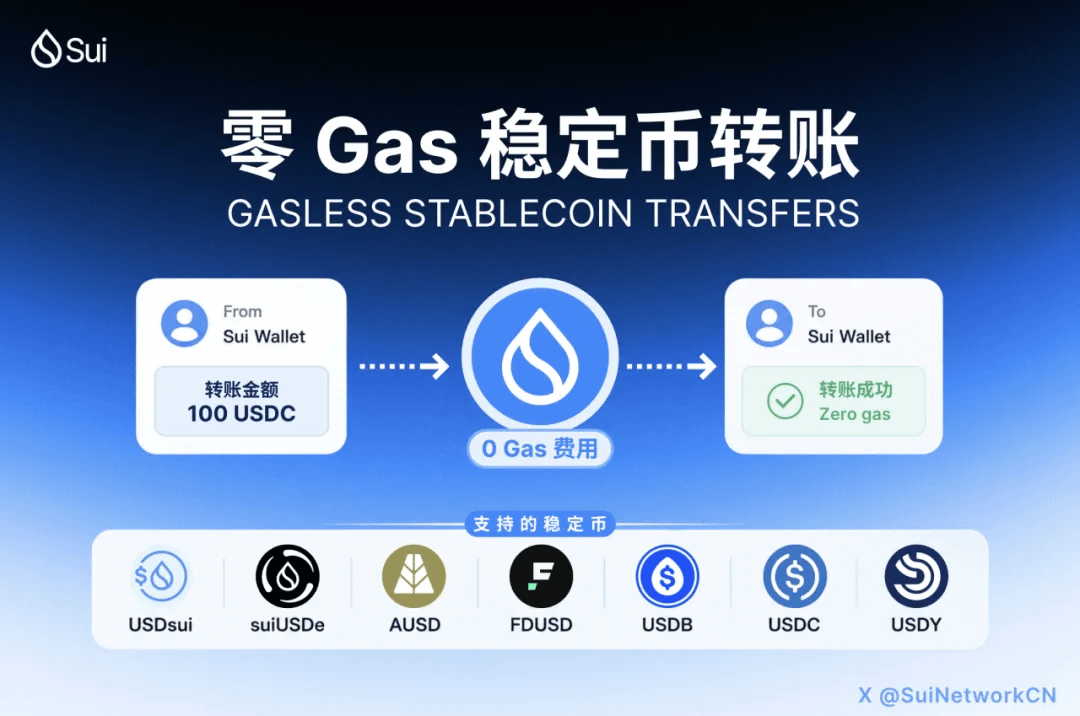
SUI has directly cut out this logic. Zero gas fees, protocol-level native support, not some subsidy activity, but a real underlying architectural innovation.
We can transfer USDC just by holding USDC, without needing to hold SUI, without needing to precharge, and without worrying about gas token price fluctuations. Currently supporting mainstream stablecoins like USDsui, suiUSDe, AUSD, FDUSD, USDB, USDC, USDY, etc.
Does it sound like just a small optimization? Wrong.
Behind this hides two major weapons: AI payments and global large-scale commercial payments.
1️⃣ Let's talk about AI first.
In the future, AI agents will become major economic participants. They are not human; they will only choose the lowest cost and most efficient paths to execute tasks.
If an AI agent needs to make 1,000 small payments of $0.10 each, on traditional chains, the gas fees alone could be a significant expense, and the gas fees might even exceed the amount transferred. Would one still do this business?
SUI's zero gas model allows AI agents to execute payments of any scale frictionlessly, even micro-payments of $0.01 become worthwhile. That's why the co-founder of Mysten Labs said: SUI is becoming the default payment infrastructure for AI agents.
This is not just marketing language; this is real business logic.
2️⃣ Now, let's talk about global payments.
What do enterprises and financial institutions fear the most? Complexity and uncertainty.
If you make a multinational corporation use stablecoins for settlement, it has to prepare various native tokens for gas, manage gas token inventory, and hedge against gas token price fluctuation risks. Just this whole process could deter half of the enterprises.
SUI has cut all of that out.
Fireblocks, as an enterprise-level platform that has secured over $14 trillion worth of digital asset transactions, integrated this feature immediately. Why? Because this is exactly what institutions need: simplicity, predictability, and low cost.
In terms of cost structure, since August last year, the total volume of stablecoin transfers on SUI has surpassed $1 trillion. Now that gas fees have been cut to zero, what does this mean for payment-intensive businesses?
It means a redistribution of profit margins, it means a restructuring of business models.
Past scenarios where small, high-frequency payments could not be made due to high gas fees can now all be realized.
eCommerce platforms, content payments, tipping, in-game purchases, cross-border remittances, supply chain settlements... all scenarios requiring large-scale, high-frequency, small-value payments have been optimally resolved by SUI.
And this is not a temporary subsidy; it is a permanent change at the protocol level.
It is well known that the essence of payment is to reduce friction.
Why did Alipay eliminate cash? Because it is more convenient. Why did WeChat Pay rise? Because it is more accessible. Now, SUI has reduced friction to an extreme in the on-chain payment arena.
In the future, we may see the following situation:
• AI agents automatically execute payments on SUI because it has the lowest cost
• Enterprises prioritize using SUI for stablecoin settlements because the process is the simplest
• Consumers use it unconsciously because the experience is the smoothest
This is the power of infrastructure.
When a public chain perfects its infrastructure, applications will naturally emerge.
Currently, SUI's stablecoin ecosystem is rapidly expanding, with USDsui issued by Bridge, SuiUSDe issued by Ethena, and the three ETP products of SUI (21Shares, Grayscale, Canary Capital) that have already launched this year, institutional funds are accelerating their entry.
My judgment is: SUI may have truly found a differentiated breakthrough this time.
Not competing with Ethereum in terms of ecosystem, not competing with Solana in terms of speed, but directly excelling in the payment infrastructure arena.
Payments are a basic need; they are the largest market.
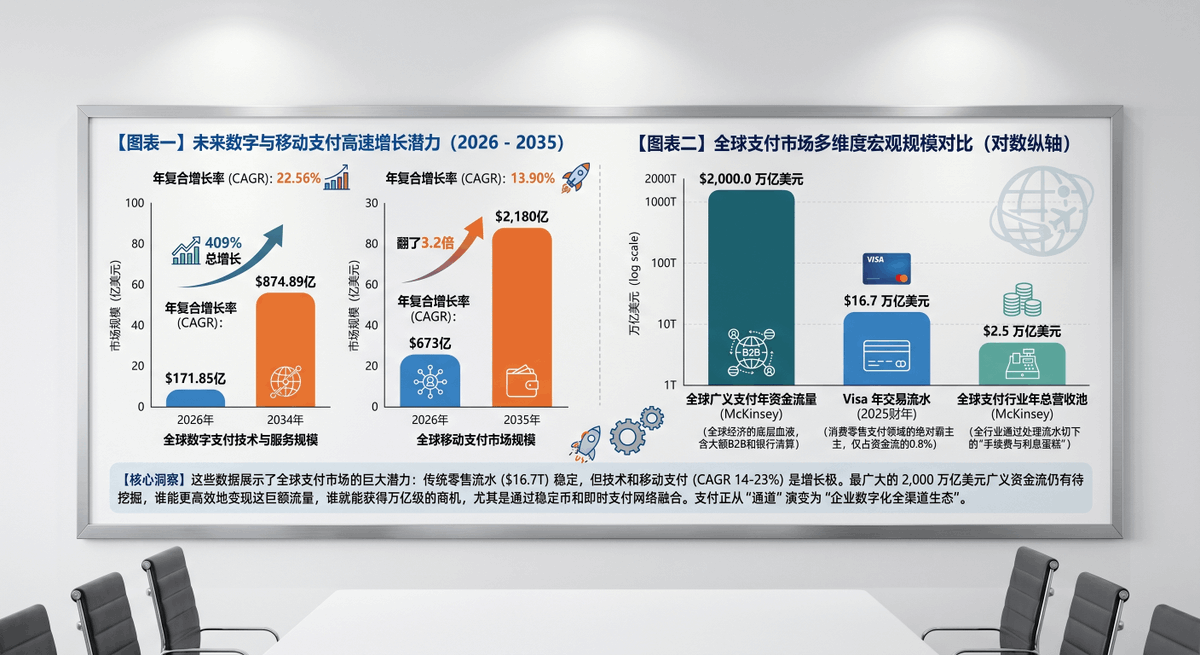
Visa processes $16.7 trillion in transaction volume annually, and the global payment market exceeds $20 trillion. If on-chain payments could capture even 10%, that would be an enormous market. As shown in 👇 Figure 2.
SUI's zero gas fee may be the fulcrum for leveraging the payment market.
Of course, no matter how good the technology is, it still depends on implementation.
Next, we’ll see if SUI can truly attract enterprises, AI agents, and consumer-level applications, and if it can run scalable cases in payment scenarios.
But at least, from an underlying architecture perspective, SUI has indeed done something right this time.
As a holder of #SUI, I will continue to pay attention to SUI's developments in payment scenarios, as this may be one of the most promising directions to bet on in the coming years.
DYOR🙏
免责声明:本文章仅代表作者个人观点,不代表本平台的立场和观点。本文章仅供信息分享,不构成对任何人的任何投资建议。用户与作者之间的任何争议,与本平台无关。如网页中刊载的文章或图片涉及侵权,请提供相关的权利证明和身份证明发送邮件到support@aicoin.com,本平台相关工作人员将会进行核查。


