Original|Odaily Planet Daily (@OdailyChina)
Author|Wenser (@wenser 2010)

Months later, the long-silent privacy token sector is warming up again, and ZEC has once again become the "most eye-catching one." This morning, the price of ZEC skyrocketed, briefly surpassing 689 USD, with a 24-hour increase of over 20%.
As the overall market weakens, the slogan of "privacy version BTC" is frequently brought up again in the market. However, compared to the price surge driven more by sentiment and capital games last November, this time ZEC's consecutive days of soaring are clearly supported by realities in regulations, liquidity, institutional channels, and ecological development.
Behind this surge is a privacy coin that once walked in the shadow of "delisting by exchanges" and "marginalization by regulation," now being re-accepted by the mainstream financial market and being "jointly supported" by institutions.
The Four Supports for ZEC's Surge: Regulation, Liquidity, Mining Pools, and Trading Channels
In the past few years, ZEC had been delisted or restricted by multiple exchanges worldwide, and Binance had placed it on the observation list. Although it has not completely detached from the mainstream like Monero, it has long been on the edge of regulatory and compliance systems.
However, things have changed this year: the SEC ended its investigation, Grayscale moved forward with ETFs, Robinhood launched trading, Foundry introduced exclusive mining pools, publicly listed companies began hoarding ZEC, and Hyperliquid whales engaged in high-leverage long positions... ZEC is transitioning from a "marginal anonymous asset" back to an "institutionally tradable asset."
SEC Ends Investigation: ZEC Begins to Shed 'High-Risk Privacy Coin' Label
In mid-January, the US SEC officially ended its investigation into the Zcash Foundation and clearly stated that it would not take any enforcement actions.
For the privacy coin sector, which has long been under regulatory pressure, this is a landmark event. Over the past few years, the market has questioned whether privacy coins can legally exist within the financial system, especially after coins like XMR faced delisting; ZEC has also been viewed as a "high-risk asset." The change in the SEC's attitude is a significant turning point.
Subsequently, in March, the SEC and CFTC officially released explanatory documents categorizing crypto assets into five types, most of which do not fall under securities. The regulatory pressure faced by ZEC has significantly eased, and the introduction of liquidity on compliance grounds is gradually being opened up.
ZEC Enters 'Privacy Asset ETF Era': Grayscale as the Key Driver
The SEC's action alleviates risks, and Grayscale's backing truly begins to endow ZEC with the attribute of "institutional asset allocation."
In February, at the Hong Kong Consensus conference, Grayscale's Chief Legal Officer Craig Salm publicly praised ZEC's "selective disclosure" mechanism. He stated: "The most interesting aspect of privacy-preserving tokens like Zcash is the 'selective disclosure'—you can selectively disclose information to certain parties, like proving to the IRS that you have correctly paid your taxes while keeping privacy in everyday business or personal transactions. Therefore, we believe this is a very interesting currency."
This statement is quite significant; Grayscale conveys a new logic to the market: privacy and compliance do not necessarily have to be in opposition. He also emphasized, "Grayscale holds a significant amount of ZEC trusts and is working to convert them into ETFs."
On May 8, Grayscale officially submitted its first Zcash spot ETF application to the SEC, with ZEC's market cap entering the top 15 of the crypto market, briefly surpassing Cardano.
Tushar Jain, co-founder of Multicoin Capital, also stated that this move corresponds to the market's expectations for the growing demand for privacy assets in the context of the US wealth tax legislative proposal.
For ZEC, this could mean that Wall Street is starting to consider "privacy coins" as a long-term asset allocation option.
ZEC 'Sucking' BTC: Real Market Exists Behind Privacy Demand
All along, the anonymity of BTC has been seen as one of the important functional attributes of cryptocurrencies.
However, the incidents involving Qian Zhimin and Chen Zhi have led to heightened skepticism regarding the understanding that "BTC is an anonymous asset" within the crypto market and even the global market. As on-chain analysis tools, AI monitoring capabilities, and regulatory collaboration systems strengthen, the market perception that "BTC is sufficiently anonymous" has noticeably weakened.
In this context, privacy tokens like ZEC are regaining attention and are even gradually being viewed by some funds as "alternative privacy assets" to BTC. At the beginning of May, the US Bitcoin spot ETF witnessed a net outflow of 268 million USD, with some funds beginning to shift toward privacy and AI infrastructure tokens.
Grayscale analyst Michael Zhao pointed out in a report in March: The development of AI monitoring and on-chain transparency might drive privacy from a niche demand back to a core financial function, while the market is currently undervaluing this, as the price of ZEC was only around 224 USD at that time.
From a narrative perspective, when all on-chain actions can be permanently recorded, "selective privacy" itself may again become a financial scarce commodity.
Public Companies Hoarding ZEC: The 'Treasury Logic' of Privacy Coins
Beyond market sentiment shifts, what has actually allowed ZEC to start having sustained liquidity support is the real capital of "ZEC treasury companies."
In March, Cypherpunk Holdings, a ZEC treasury company listed on NASDAQ, released its fiscal report for 2025. It disclosed that as of March 12, 2026, the company held a total of 294,743.1 ZEC, accounting for approximately 1.78% of the total circulation, with an average purchase price of 335.89 USD.
The financial report shows that the company's net profit for the 2025 fiscal year reached 4.8 million USD, with the main reason for the profit growth being about 50.4 million USD of unrealized gains brought about by the fair value of ZEC tokens in the company's treasury.
Meanwhile, the Zcash Open Development Lab, founded by former Electric Coin Company CEO Josh Swihart, completed over 25 million USD in funding in early March.
Investors include Paradigm, Andreessen Horowitz, Coinbase Ventures, Winklevoss Capital, Cypherpunk Holdings, Maelstrom, Chapter One, Balaji Srinivasan, David Friedberg, Haseeb Qureshi, James Nicholas, and others.
Its core goal is to develop an open, self-hosted private financial platform aimed at expanding ecosystem interoperability through collaboration and pushing protected ZEC transactions to the global mainstream market.
ZEC is no longer just an "old privacy coin"; capital is beginning to repackage it as "privacy financial infrastructure."
Foundry Launches Mining Pool: Institutional Miners Begin to Reinvest in ZEC
In April, Foundry, a mining giant under Digital Currency Group (DCG) that accounts for about 31% of Bitcoin's hash rate, officially launched an exclusive mining pool for Zcash (ZEC).
Compared to traditional anonymous mining pools, Foundry provides compliance and auditable institutional-level mining services. Institutional miners are also publicly re-engaging with the ZEC network.
This move is also seen by the market as an important signal that privacy coins are regaining institutional endorsement.
Robinhood Launches ZEC: Completing the Last Piece of Mainstream Retail Liquidity Puzzle
In late April, Robinhood Markets officially launched ZEC.
Besides "adding a new trading entry," this also means that ZEC has regained direct access for mainstream retail funds in the US.
The biggest dilemma for privacy coins in recent years has been the gradual loss of mainstream trading platforms and compliant funding channels. Robinhood's launch has completed the last key piece of retail liquidity for ZEC. Subsequently, ZEC's trading volume began to soar, and the price gradually warmed up.
The ZEC Team Behind the Price Surge: Fixing Bugs, Unified Management, Rebuilding Ecology
Aside from external positive stimuli, the ZEC team has actually completed several key actions internally in the past few months.
Fixing Key Security Vulnerability Involving Over 25,000 ZEC; Security Researcher Received Over 50,000 USD in Rewards
In April, the ZEC project teamdisclosed and fixed a key security vulnerability that could potentially be exploited by malicious miners to transfer over 25,000 ZEC (about 6.5 million USD) from the deprecated Sprout privacy pool. Security researcher Alex "Scalar" Sol disclosed that the vulnerability originated from the zcashd node skipping proof verification when processing transactions involving the Sprout pool. The official stated that this vulnerability had existed since July 2020 but was not actually exploited, and user funds have always been safe; the development team has released version v6.12.0 to complete the fix, and major mining pools have upgraded within days. Moreover, unaffected Zebra full nodes have the capability to trigger a chain fork, providing additional protection if the vulnerability is exploited.
It is reported that although the Sprout pool closed new deposits in November 2020, about 25,424 ZEC remain untransferred. Even if the vulnerability had been exploited, Zcash's "turnstile" mechanism could prevent inflationary issuance, ensuring that the total supply does not break through.
Notably, this vulnerability was discovered with the aid of AI, and the researchers will receive a total bounty of 200 ZEC (about 51,000 USD).
ZEC Foundation Officially Unifies Management of Core Community Assets
In early May, the Zcash Foundation announced that it would officially take over the management of multiple core Zcash community assets, including the Zcash GitHub Organization, website and domain name, and the official account @Zcash on Platform X.
As Zcash development gradually centers around Zebra and infrastructure maintained by the foundation, unifying these community assets under foundation management helps enhance long-term coordination efficiency and clarify responsibilities. Among them, the Zcash GitHub organization includes core codebases like librustzcash, zips, lightwalletd, and zcashd. The Zcash Foundation will be responsible for access permissions and repository governance, but existing open-source licenses, community contribution rights, and collaborative development models will remain unchanged.
While the departure of Electric Coin Company, the core development team of Zcash, is indeed somewhat regrettable, the ZEC Foundation's actions ensure the steady operation and robust development of the ZEC project to some extent, and the former is still committed to developing the ZEC ecosystem; it has merely changed companies, preserving the living construction force of the ZEC ecosystem.
Arthur Hayes and Hyperliquid Whales: ZEC's 'Market Sentiment Amplifier'
At the beginning of May, after repeatedly revealing his positions, BitMEX co-founder Arthur Hayes stated again that ZEC's target price is 10% of BTC's price, indicating there is still substantial room for growth.
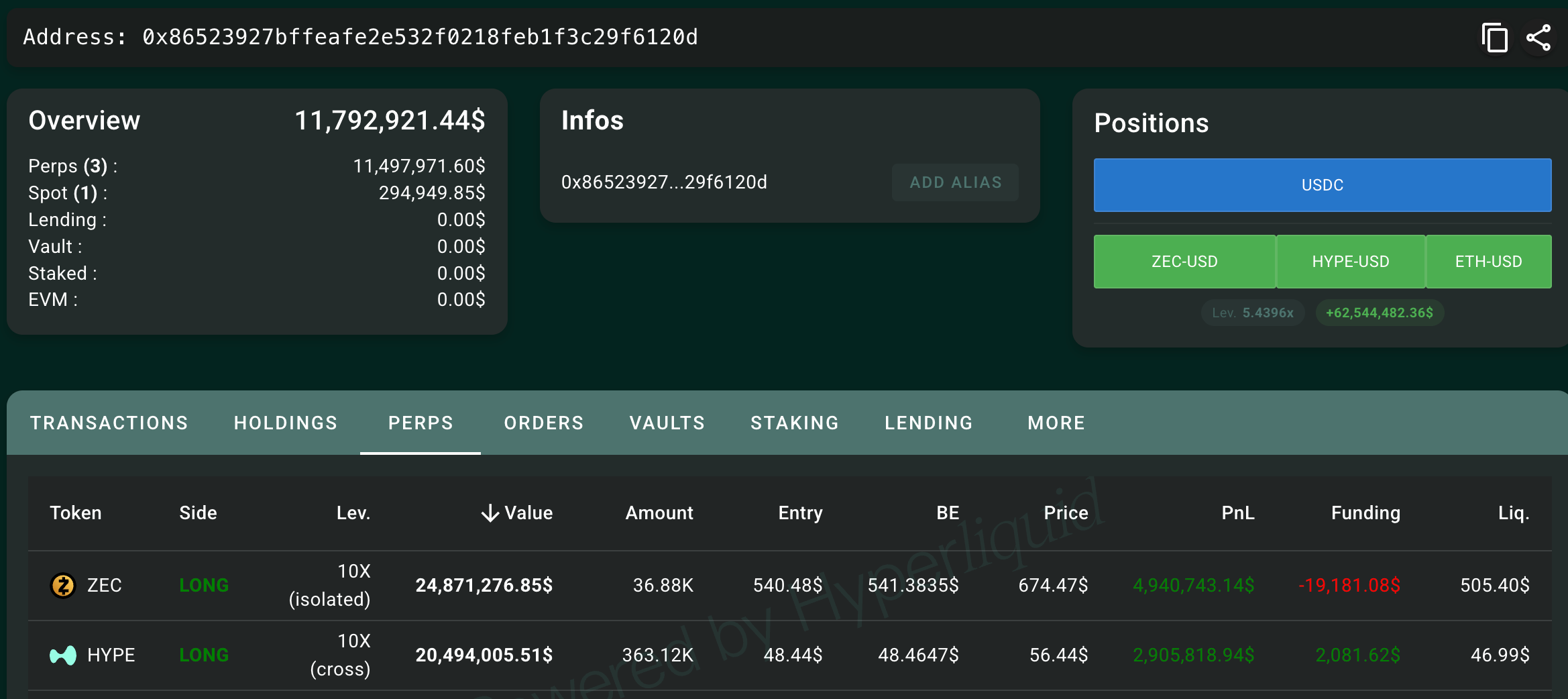
Additionally, recently, crypto whale Evaded (@ICanPlug) also took a long position of 36,875 ZEC (worth 21.59 million USD) on the Hyperliquid platform with 10 times leverage. Along with its HYPE long position, it generated a floating profit of 2.1 million USD in just two days. Currently, this whale's long position remains active, with the floating profit growing to around 4.94 million USD.
These high-leverage, public large bets are continuously reinforcing market attention on ZEC and fostering FOMO sentiment.
Over the past few years, ZEC, as an old mainstream coin, has always been in an awkward position, teetering on the edge of regulation, exchanges, and market sentiment.
Now, it is evident that it is returning to the mainstream table from the margins.
Wall Street, institutional miners, trading platforms, and market whales are joining forces to bring ZEC back into the spotlight amidst the weak crypto narrative bear market.
Recommended Reading:
Buying ZEC to Smash BTC? The Four Major Industry Truths Behind the Surge of Privacy Coins
The Hidden Narrative Behind ZEC's Surge: The Refuge Migration of "Chen Zhi and Qian Zhimin"
免责声明:本文章仅代表作者个人观点,不代表本平台的立场和观点。本文章仅供信息分享,不构成对任何人的任何投资建议。用户与作者之间的任何争议,与本平台无关。如网页中刊载的文章或图片涉及侵权,请提供相关的权利证明和身份证明发送邮件到support@aicoin.com,本平台相关工作人员将会进行核查。


