😂I really can't understand, I only objectively stated the fact of China's structural power shortage, why there are so many people criticizing it.
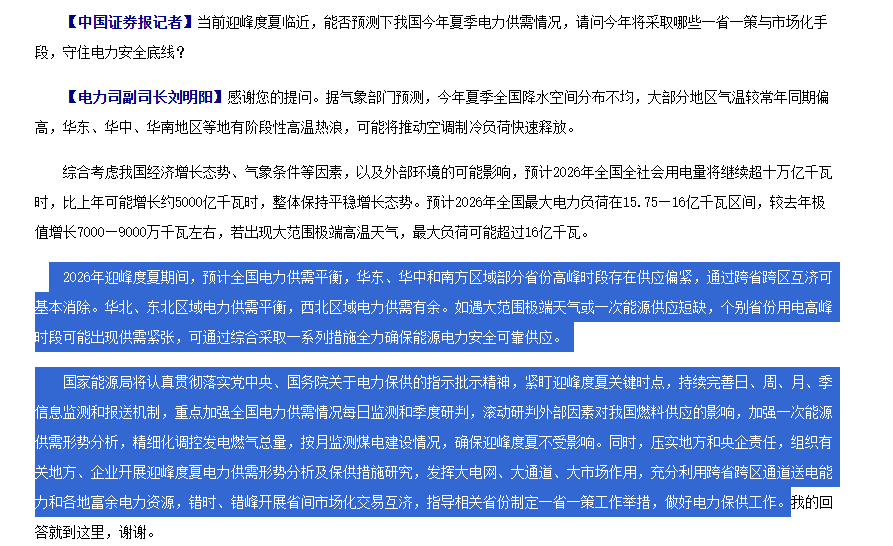
The National Energy Administration's own judgment in 2026 is also "nationally balanced, but the peak is tight in some provinces in East China, Central China, and the South," which basically equals an official acknowledgment that it is not an overall power shortage, but a regional and peak power shortage.
This is what the Chinese government itself said, how did it turn into me talking nonsensically here, still outdated information from ten years ago, pretending to understand?
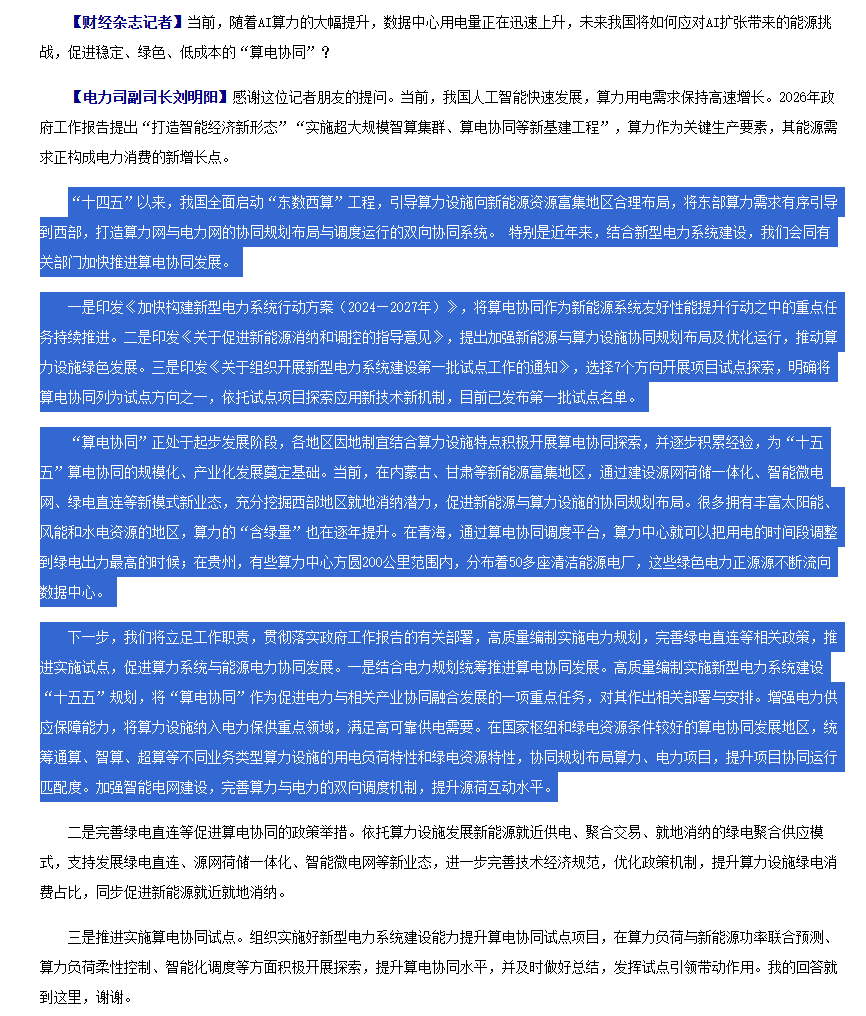
Moreover, the Chinese government also states that due to the rising demand for computing power from AI, China is fully launching the "East Data West Computing" project to guide the layout of computing power facilities to areas rich in new energy resources, indicating that electricity usage is tighter in Eastern China, hoping to shift large power consumers westward where electricity is abundant.
China's western, northern, and desert areas have abundant wind and solar resources, but the main electricity load is in the east, south, coastal, and urban clusters. The availability of electricity in Xinjiang, Gansu, Qinghai, and Inner Mongolia does not mean that the data centers, factories, and air conditioning peak in Shanghai, Guangdong, Zhejiang, and Jiangsu can immediately use it.
Electricity is not a commodity in inventory; it is not that if the west generates more today, the east can freely take it tomorrow. It requires transmission channels, substation capacity, distribution network load capacity, peak-shaving power sources, energy storage, and power market dispatch to work together.
Energy storage is not a cure-all either. By the end of 2025, China's new energy storage capacity is expected to reach 136 million kilowatts / 351 million kilowatt-hours, with an average storage duration of about 2.58 hours. This scale is already quite large, but it mainly addresses short-term peak shaving, peak clipping, filling valleys, and fluctuations of new energy, not storing solar power from noon in summer for long-term use at night or in winter, or unlimited cross-province allocations.
Simply calculating, 351 million kilowatt-hours seems large, but if we consider that the national maximum load in 2026 could reach 1.575 to 1.6 billion kilowatts, the total electricity of these new energy storages, theoretically used to peak nationwide, would only correspond to a few minutes' worth of national load electricity. In reality, there are also constraints regarding storage distribution, grid connection locations, dispatch rules, discharge power, lifespan, and commercial returns, so it cannot be understood as "China has energy storage, so electricity can be stored indefinitely."
As for "it can be sold to foreign countries," this statement is also very misleading. China indeed has cross-border electricity exchanges; for example, in recent years, cross-border electricity exchanges between China and ASEAN have accumulated over 75 billion kilowatt-hours, but compared to China's annual electricity consumption of over 10 trillion kilowatt-hours, this is not a quantity that can change the national supply-demand structure.
China's power allocation is indeed already quite impressive, but that doesn’t mean it is perfect. How can it be said that discussing regional power shortages is unacceptable? Let me say again, this is not me saying it; it is what the Chinese government itself said, so if you want to criticize, direct it at the National Energy Administration.
Original article address: https://www.nea.gov.cn/20260427/09f3dbc015664a74b9cbe2444c4891bf/c.html
It's like having a brain disease!
免责声明:本文章仅代表作者个人观点,不代表本平台的立场和观点。本文章仅供信息分享,不构成对任何人的任何投资建议。用户与作者之间的任何争议,与本平台无关。如网页中刊载的文章或图片涉及侵权,请提供相关的权利证明和身份证明发送邮件到support@aicoin.com,本平台相关工作人员将会进行核查。


