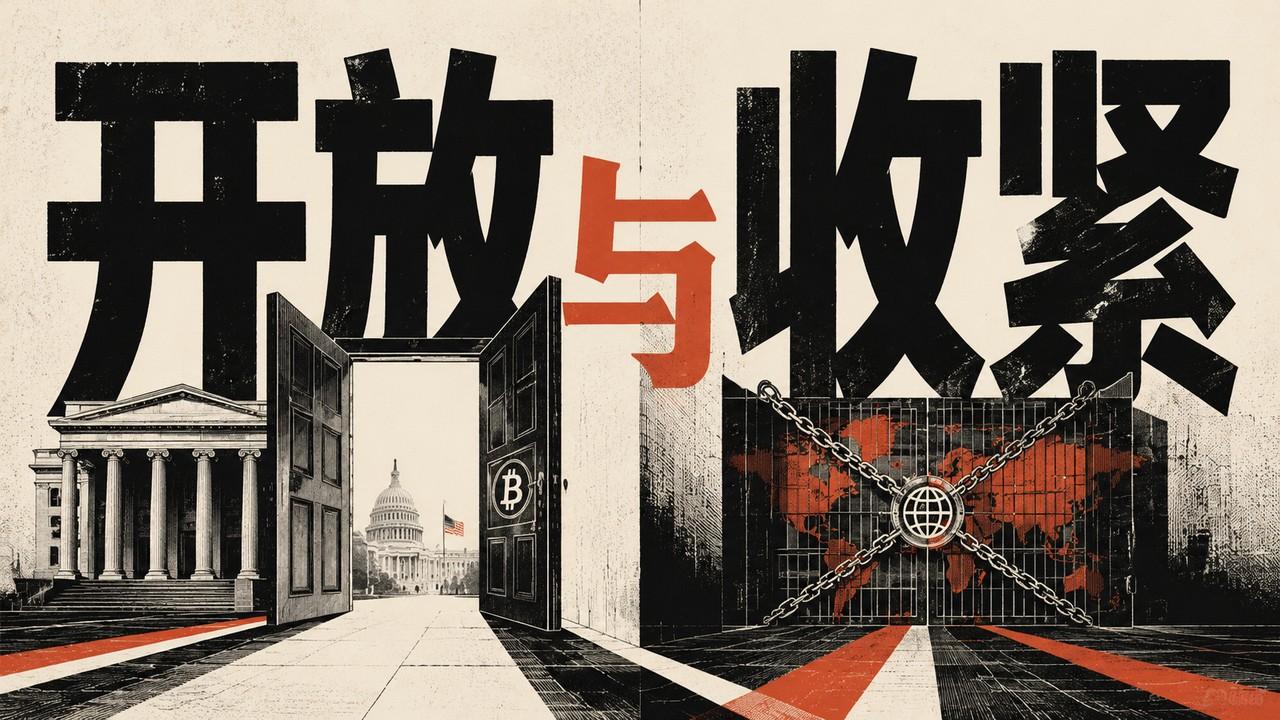
On May 19, 2026, at the moment the Governor of South Carolina signed S.163, this document, which was originally just a number in the legislative process, was officially elevated to state law: it enshrined three things—individuals have the right to self-custody Bitcoin private keys without being forced to hand them over to third-party custodians; the state tax system must not impose additional burdens on Bitcoin and must treat it neutrally; and Bitcoin mining reliant on proof-of-work mechanisms enjoys explicitly recognized operational space within the state. From then on, South Carolina joined Oklahoma and Louisiana, which had previously passed similar "Bitcoin Rights Acts," sending a signal to Bitcoin users and miners that "the rules here are clearer." However, while the state legislature and the governor delineated protective boundaries with the legislative tools they wielded, the regulatory debate at the federal level continued to pull in all directions: the federal government has yet to provide a unified framework covering key aspects such as self-custody, taxation, and mining, requiring local new friendly rules to find their place under this undefined federal regulatory shadow.
Self-custody Written into State Law: Wallets No Longer a Gray Area
The most concrete aspect of S.163 is that it pushed Bitcoin self-custody from a "common practice" into state legal text. The bill explicitly states: individuals may self-custody their Bitcoin private keys, and this practice is recognized and protected as a legitimate choice within South Carolina, rather than a stopgap measure skirting the regulatory edge. Self-custody means "the keys are in one's own hands"—users no longer entrust their assets to exchanges or centralized custodians but use their own wallets and backups, taking on the responsibility for custody and risk management. In contrast, U.S. regulatory bodies have historically focused their attention on licensed intermediaries, with self-custody long lacking a unified, clear regulatory framework, making it difficult for users to discern their legal standing once they choose to manage their money themselves.
This uncertainty was magnified in the wake of multiple incidents of centralized exchanges and custodians facing bank runs, bankruptcies, and account freezes around 2022: while the market voted with its feet, with more people beginning to withdraw coins back to their own wallets, there was also concern—if one day the policy winds shift unexpectedly, could self-custody be viewed as a "troublemaker"? The answer provided by S.163 is to clearly draw the red lines at the state level: in South Carolina, as long as you have the private key, state law recognizes that portion of Bitcoin as your property and acknowledges your right to self-custody. This does not eliminate the yet-to-be-defined regulatory shadows at the federal level, but it sufficiently fills in the crucial piece of trust for a generation of users educated by custodian risks—at least in this state, self-custody is no longer a matter to be approached with apprehension; it is a right written into law that can be expected and relied upon.
Prohibiting Discriminatory Taxation: Bitcoin Dining at the Same Table as the Dollar
After confirming "private key in hand, property rights clearly defined," the second action of S.163 is to clarify the tax stance: Bitcoin cannot be discriminated against and taxed differently. The bill prohibits the imposition of discriminatory taxes on Bitcoin, which simply means that the state government cannot design a heavier tax regime or tax rate specifically for Bitcoin, nor can it impose additional hurdles when declaring and paying state taxes just because one uses Bitcoin. It does not promise tax-exempt privileges for Bitcoin but establishes a boundary—taxation is allowed but must be on the same starting line as similar assets and transactions.
For individual investors, this "tax neutrality" means one thing: when making asset allocations, Bitcoin no longer carries the "invisible burden" of state tax policy, allowing you to compare it with dollar-denominated assets on the same sheet regarding risk and return, without fearing that the state tax authority will impose an additional burden. For businesses, this directly affects long-term decisions—whether to list Bitcoin on the balance sheet or to build products and services around Bitcoin, at least in South Carolina, they will not be labeled as "high-risk, high-tax" solely due to the Bitcoin designation; in payment scenarios, merchants willing to try settling with Bitcoin also face less uncertainty related to state taxes. Viewing this in the broader context of interstate competition in the U.S., it becomes clearer: with federal-level rules not yet shaped and states possessing substantial tax legislative autonomy, states like Oklahoma and Louisiana have already implemented similar prohibitions on differential tax burdens through their "Bitcoin Rights Acts," and South Carolina, through S.163, effectively sends the same signal to the market—there will be no additional penalties for your Bitcoin choice, instead placing it at the same dining table as the dollar and other assets.
Backing for PoW Mining: A New Migration of Computational Power Awaits
If tax neutrality is meant to appease the holders, then S.163’s statement to "protect proof-of-work Bitcoin mining activities" points directly to a whole set of buzzing mining machines. The legislators essentially made a commitment: participating in the Bitcoin network through PoW in South Carolina will not be singled out as a regulatory target merely due to "intensive computational power" but will enjoy a predictable legal status. This "explicit protection," in a time when federal rules have not yet formed, and other regions are tightening conditions for PoW mining under the guise of environmental or energy burdens, does not mean giving miners more benefits, but rather reducing their future imagination of suddenly facing electricity restrictions, mining bans, or differential treatment.
For mining companies, site selection has always been a multivariable equation: electricity prices, electricity policies, regulatory friendliness, tax arrangements, and the ability to maintain consistent policy expectations over the long term—all are essential. Bitcoin PoW mining is heavily dependent on large, stable, and sufficiently cheap electricity resources; even a slight rise in electricity prices or a sudden shift in regulatory tone could place "moving" back onto the board's agenda. In recent years, global computational power has frequently migrated, with policy changes repeatedly proven to be critical variables affecting geographic distribution. In this context, South Carolina's enactment of S.163 to include "protection for mining" in state law is equivalent to scoring points for its "policy risk" on the site selection checklist for mining companies. It may not automatically draw computational power from around the globe, but it is enough to ensure that South Carolina competes in the same group as "Bitcoin-friendly states" like Oklahoma and Louisiana in the race for miners, thus qualifying itself seriously for consideration in the next round of computational power migration.
State Law Takes the Lead while Federal Hesitates: A Fracture in Crypto Regulation
When South Carolina signed S.163 on May 19, 2026, it did not make this choice in a vacuum; it took up the "Bitcoin-friendly state" banner already ignited by places like Oklahoma and Louisiana. During the period from 2022 to 2025, the overall regulatory framework at the federal level remained mired in debates and sporadic enforcement, with core issues such as self-custody and mining still lacking unified legislation, while several states took the lead by passing their versions of the "Bitcoin Rights Act," clearly stating provisions like "self-custody is protected," "mining can operate legally," and "tax burdens cannot discriminate." The implementation of S.163 effectively declares that South Carolina has officially joined this line of state-level legislation, bringing Bitcoin users' private keys, miners' meters, and businesses' tax bills under a relatively clear local regulatory framework.
However, this round of "state law taking the initiative" is destined to operate under the federal shadow. The constitutional structure of the United States is quite clear: once the federal government develops codified rules covering these areas in the future, in the event of a conflict, federal law takes precedence, and states are only allowed to operate within the spaces of property rights protection, state taxation, and state-level licensing. Therefore, the "certainty" that S.163 can offer has its boundaries—it can ensure that self-custody of Bitcoin by individuals in the state no longer resides in a gray area, allow PoW mines to discount policy risks when selecting sites in the state, and enable accountants to process state taxes related to Bitcoin without worrying about suddenly imposed punitive tax rates, but it cannot replace potential future federal regulations. Industry participants see before them a mismatched landscape of "federal uncertainty + state-level competition": computational power and business layouts are starting to vote with their feet, first settling in states that have written friendly clauses and then watching Washington's slow movements. This is precisely the significance of South Carolina currently choosing to bet on the Bitcoin Rights Act.
From Rights Written into Law to the Next Round of Computational Power Migration
The moment S.163 was signed into law, South Carolina had clearly written the three most sensitive matters in the Bitcoin world into its regulations: individuals can legally self-custody private keys without worrying about falling into a gray area for "not delivering to a third party for custody"; state tax provisions cannot impose additional burdens on Bitcoin, providing ordinary users and businesses with an expectation anchor of "treated like conventional assets" when accounting and filing taxes; and proof-of-work mining is explicitly protected, giving potential miners one more reassurance of "no regulatory reversals" beyond evaluating electricity prices and locations. For residents of the state, this means an added layer of state law backing in the event of future custodian collapses or shifts in regulatory winds; for miners and related businesses considering relocation, this means they can place South Carolina alongside "friendly states" like Oklahoma and Louisiana on the same site selection table, voting with computational power and capital. The history of Bitcoin computational power has seen multiple forced migrations due to policy changes; in the coming years without a defined federal regulation, these state-level "Bitcoin Rights Acts" will continue to dominate the direction of this geographical reallocation, and when future federal rules finally come into being, they will either be elevated as chips in negotiating federal baseline standards or be forced to give way and reposition as supplementary provisions. Regardless of the path taken, the legislation represented by S.163 will be regarded as an early annotation on how the U.S. settles the rights terrain of Bitcoin.
Join our community, let’s discuss and become stronger together!
Official Telegram community: https://t.me/aicoincn
AiCoin Chinese Twitter: https://x.com/AiCoinzh
OKX Welfare Group: https://aicoin.com/link/chat?cid=l61eM4owQ
Binance Welfare Group: https://aicoin.com/link/chat?cid=ynr7d1P6Z
免责声明:本文章仅代表作者个人观点,不代表本平台的立场和观点。本文章仅供信息分享,不构成对任何人的任何投资建议。用户与作者之间的任何争议,与本平台无关。如网页中刊载的文章或图片涉及侵权,请提供相关的权利证明和身份证明发送邮件到support@aicoin.com,本平台相关工作人员将会进行核查。