Video Title: Anthropic's hunt to find the next Claude Code
Video Author: ACCESS Podcast
Translators: Peggy, BlockBeats
Editor's Note: In the context of continuous leaps in large model capabilities and the rapid popularization of AI programming tools, industry discussions are shifting from "can the model complete the task" to "how model capabilities can be organized into products, workflows, and business systems."
In the past year, products like Claude Code, Codex, and Co-work have successively entered the developer and knowledge worker scenes. AI is no longer just a chat box answering questions but is becoming a production interface that can call tools, perform tasks, and verify results. However, as "agents will become the next generation of software forms" gradually becomes consensus, a more critical question emerges: who can first transform model capabilities into reusable, distributable, and scalable working systems?
This article is compiled from ACCESS Podcast's interview with Mike Krieger. Mike Krieger is the co-founder of Instagram and is currently the Chief Product Officer at Anthropic, responsible for Anthropic Labs, aiming to lead the team in exploring the next batch of frontier product directions after Claude Code.
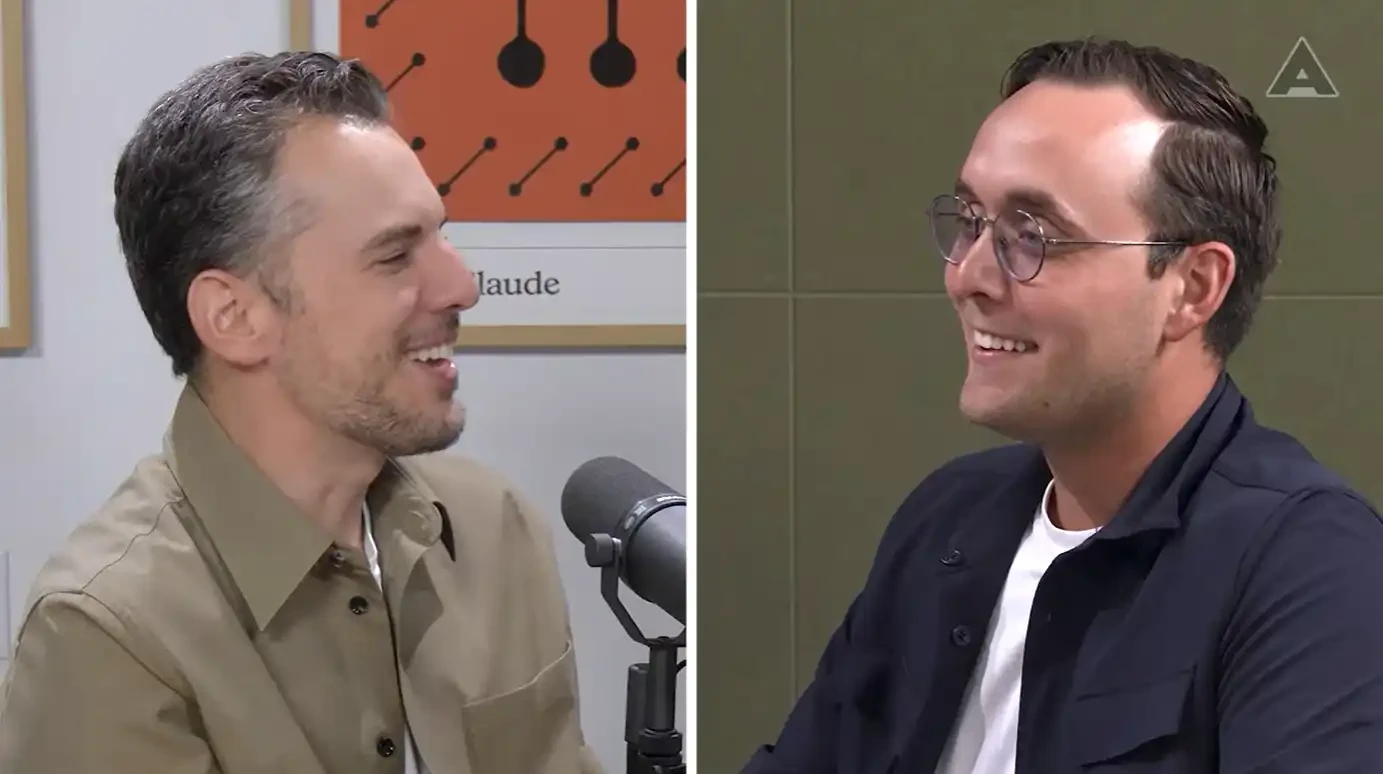
Alex Heath (left) and Mike Krieger (right)
In this conversation, Mike Krieger does not simply discuss what Anthropic's next product will be, but rather deconstructs the competition in AI products into a set of deeper structural questions: how model capabilities enter real workflows, how AI companies organize innovation internally, how platform companies manage boundaries with ecological customers, and where human judgment will be repositioned in the production chain as AI execution capabilities grow stronger.
First, the product form is shifting from "chat" to "tasks." In the past, large models mainly existed in the form of dialogue boxes, where users input prompts and models generate answers; now, Claude Code, Co-work, and Claude Design represent another product logic: to enable AI to continuously advance work around a specific goal while calling tools, generating results, and conducting verification in the process. This means that the key to AI products is no longer just the quality of answers, but the capabilities of task decomposition, contextual continuity, tool invocation, and result verification. Whoever can encapsulate these capabilities into a smooth workflow will be closer to the next generation of productivity entry points.
Second, the organizational method is shifting from "large team planning" to "small team trial and error." The operation of Anthropic Labs resembles an embedded startup unit within a large company: starting with two or three people, reviews every two weeks, using high-frequency feedback to determine whether to continue advancing the project. In the past, innovation labs in large companies often fell into long cycles, ambiguous responsibilities, and the procrastination of "it's good enough" projects; now, models have reduced construction costs, and the truly scarce resource is judgment, taste, and decision-making speed. This means that organizational efficiency in the AI era does not just depend on the number of engineers but on whether smaller teams can validate directions more quickly.
Third, the boundaries between the platform and applications are being redrawn. The success of Claude Code allows Anthropic to not just be a model supplier but also to begin defining application forms personally; the controversy around Claude Design and Figma demonstrates that when model companies engage in applications, it will inevitably touch on the interests of customers and ecological partners. In the past, foundational model companies mainly provided underlying capabilities, leaving the user interface and scenario packaging to vertical applications like Cursor and Figma; now, model companies also need to showcase the agent-first future forms through their own products. This means that competition among AI platforms is not only about API competition but also about product paradigm competition.
Fourth, as AI becomes stronger, human judgment becomes scarcer. Mike repeatedly emphasizes that while Claude can write code faster, generate prototypes, and execute tasks, it still cannot replace the most challenging parts of the process from 0 to 1: asking the right questions, understanding real users, defining the product North Star, and judging what is "right." In the past, execution capabilities were the main bottleneck of knowledge work; now, execution is accelerated by models, and human value is more concentrated on pre-judgment, creativity, relational networks, and organizational capabilities. AI will not automatically eliminate tough decisions; instead, it will amplify wrong directions more quickly.
If we condense this conversation into a judgment, it is: after Claude Code, Anthropic should not be looking for a single blockbuster product but rather a set of methods that allow AI to transform model capabilities into production systems. In this sense, the subjects discussed in this article are not just Anthropic's next steps but represent a structural turning point for the entire AI industry shifting from "model competition" to "system competition."
Below is the original text (for easy readability, the original text has been arranged):
TL; DR
· The competition for AI products has shifted from "stronger models" to "how capabilities are realized," essentially showing that large model companies are starting to compete for entry points into workflows.
· The significance of Claude Code is not just writing code but proving that agents can continuously execute tasks under clear goals, accelerating the transition of AI from chat tools to production systems.
· The core value of Anthropic Labs is not in how many products are released but in quickly validating what capabilities the next steps of the model should possess with small teams.
· Co-work represents Anthropic's intention to extend the methodology of Claude Code to non-programmers, fundamentally abstracting "programming capability" into automation capabilities for ordinary people.
· The competition of OpenAI Codex indicates that Claude's advantage is no longer just in technological leadership, but in whether Anthropic can integrate Claude Code, Co-work, and Claude.ai into a unified experience.
· When model companies personally engage in applications, it will intensify boundary conflicts with customers, but this is also an inevitable path for defining the next generation of AI product forms.
· The faster AI can execute, the more human value converges on pre-judgment, product taste, and problem definition, because wrong directions can also be amplified more quickly by AI.
· The impact of AI on employment is not a problem that a single company can solve; it essentially forces society to rethink skill reshaping, distribution mechanisms, and irreplaceable human capacities.
Original Text
Alex Heath (host): What will be Anthropic's next big product after Claude Code? In this week's episode, we have Mike Krieger. He is the co-founder of Instagram and is now leading the internal "moon landing project" team at Anthropic.
Mike Krieger (Chief Product Officer at Anthropic):
One of the darkest days during my time at Anthropic was when we named it 3.5 v2. As for why we ultimately chose this name, I can explain.
Alex Heath: Mike and I recorded this conversation in person during the recent Claude Code conference that Anthropic held in San Francisco. During that conference, Anthropic announced a new major computing power collaboration with Elon Musk. So, are you guys essentially going to space with Elon?
Mike Krieger: Exactly right. Yes, we are looking for new, even somewhat unexpected sources of computing power.
Alex Heath: We talked about what Mike is currently working on, the fierce competition between Anthropic and OpenAI, and Mike's perspective on which parts of human work will continue to be important even as AI becomes stronger.
Here is Access.
Mike, it's great to see you at the Claude Code conference in San Francisco. I was just recalling our last conversation. At that time, you had only recently taken over Labs, but now it's been a few months, right?
Mike Krieger: Yes, it's almost four months now.
How Labs Operates: Two-Week Eliminations, Small Teams Validate Big Products
Alex Heath: About four months. For those unfamiliar with Labs, I want to start here. Because it's a pretty special organizational structure. A few months ago when I visited your office, we also talked about this. What exactly is Labs? What is its mission within Anthropic?
Mike Krieger: Simply put, my understanding of Labs is—now at this version, I would call it Labs v2. We can elaborate later on what Labs v1 did and what Labs v2 aims to accomplish.
I believe Labs mainly does two things.
First, it aims to narrow the gap between Claude's theoretical capabilities and the everyday user experience of ordinary people. In other words, while Claude can do many things theoretically, how do those capabilities truly enter people's daily work and lives? What products, prototypes, or projects do we need to create to demonstrate how to unlock and minimize that gap?
Second, we act more like a "frontier reconnaissance team," judging which directions models need to evolve to meet the needs of different users.
Therefore, unlike the product labs at pure product companies where the measure of success may be "did you release a product," at Anthropic, the value of Labs can also manifest in other areas: it can influence the future direction of Anthropic.
Alex Heath: Labs has indeed produced some hit products, right? Claude Code is one of them, and MCP as well. What else?
Mike Krieger: Agent Skills is another important output from Labs. Additionally, I can discuss a project that was not published at the time but was very helpful for research: computer use, which involves Claude using a computer.
I joined Anthropic in May 2024. Next week marks my second anniversary, which we internally refer to as an "antiversary."
免责声明:本文章仅代表作者个人观点,不代表本平台的立场和观点。本文章仅供信息分享,不构成对任何人的任何投资建议。用户与作者之间的任何争议,与本平台无关。如网页中刊载的文章或图片涉及侵权,请提供相关的权利证明和身份证明发送邮件到support@aicoin.com,本平台相关工作人员将会进行核查。


