🚨Today I want to discuss a question: With the arrival of the Walsh era, how will the Federal Reserve's system change?
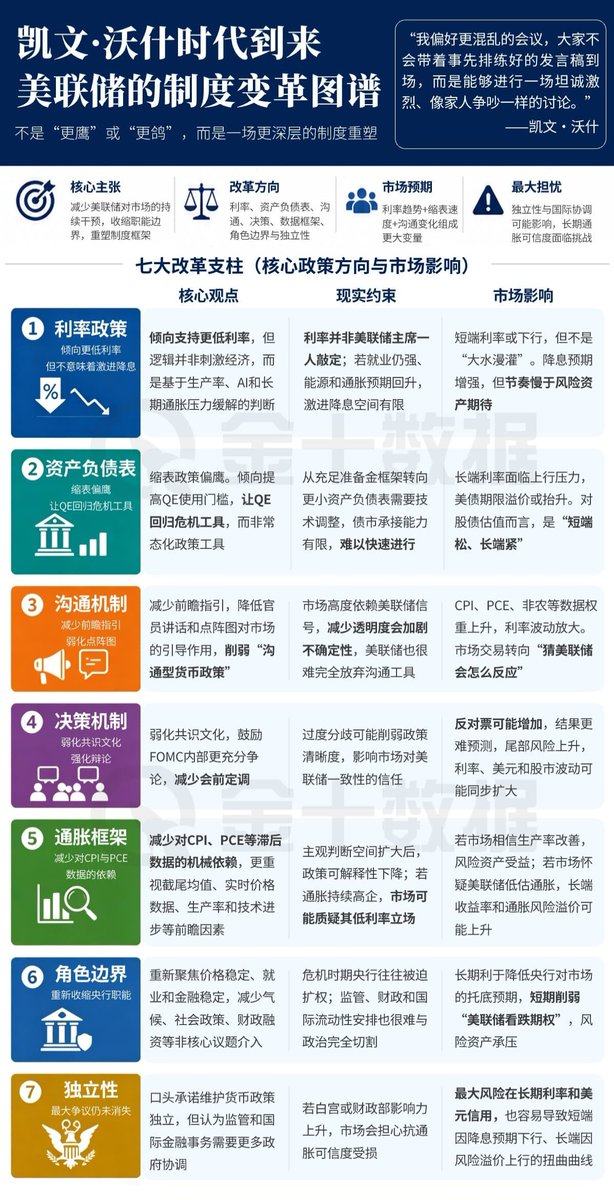
The most troublesome aspect of Walsh's policy framework in this diagram is not whether it leans hawkish or dovish, but that it puts the Federal Reserve in a very convoluted state:
On interest rates, it leans dovish, on the balance sheet it leans hawkish, verbally emphasizes independence, but in reality cannot completely cut ties with Trump, while also wanting to weaken forward guidance and reduce market dependence on the Federal Reserve's "spoilers."
No matter who sits in the position of Federal Reserve Chair today, it is no longer possible to make choices solely around inflation and employment like in the past. Clearly, Walsh, as a veteran in the political arena, understands this:
He cannot publicly advocate for aggressive rate hikes, because Trump doesn't like it;
He also cannot just speak about rapid rate cuts, otherwise Congress will think, isn't this just a tool sent by the understanding king?
So the safest statement is: rate cuts + balance sheet reduction, interest rates can be lower, but the balance sheet needs to be smaller.
This is actually also the biggest difference between Walsh and Powell —
Although Powell has often wavered over the past few years, his core logic has remained unchanged: market expectations cannot go out of control, so the Federal Reserve must continuously communicate, continuously adjust, and continuously guide.
But Walsh clearly dislikes the Federal Reserve overly guiding the market, which is why he proposes weakening forward guidance, reducing the influence of the dot plot, and even openly says he prefers "chaotic meetings."
This change is actually quite dangerous:
In the past decade, what has been most valuable for the Federal Reserve is not the interest rate itself, but expectation management.
Everyone assumes that the Federal Reserve will ultimately save the market, so they dare to engage in high valuations, leverage, and hold risk assets for the long term.
Walsh's policy framework would break all of this, but the problem is that many asset prices, fiscal structures, and financial stability in the U.S. have now become dependent on this model, making it hard to say whether such a radical change will backfire.
Talking about my reasoning regarding Walsh's approach, I think the market will go through three stages:
1⃣ The first stage, the market first trades on rate cut expectations. U.S. stocks, gold, BTC will all like the phrase "lower interest rates," especially risk assets, which will first take in the dovish part of the story.
2⃣ The second stage, the market begins to react to balance sheet reduction pressures. No one is stepping up for long-term U.S. Treasuries, term premiums rise, liquidity is not as abundant as imagined, and tech stocks and high-valued assets will start to realize: rates have come down, but it's harder to make money.
3⃣ In the third stage, the market will re-evaluate the credibility of the Federal Reserve. If Walsh wants both independence and to cooperate with Trump; wants to cut rates and reduce the balance sheet; wants to suppress inflation and stabilize assets, it will likely result in one conclusion: wanting everything makes it hard to do anything.
So currently, I don't really believe Walsh can completely change anything; it might not be accurate, and maybe Walsh will suddenly become divine and take us directly to 200,000, who knows!
The only thing that can be certain is that it will be harder to trade than during Powell's time!
Image source: Jin Shi
免责声明:本文章仅代表作者个人观点,不代表本平台的立场和观点。本文章仅供信息分享,不构成对任何人的任何投资建议。用户与作者之间的任何争议,与本平台无关。如网页中刊载的文章或图片涉及侵权,请提供相关的权利证明和身份证明发送邮件到support@aicoin.com,本平台相关工作人员将会进行核查。


