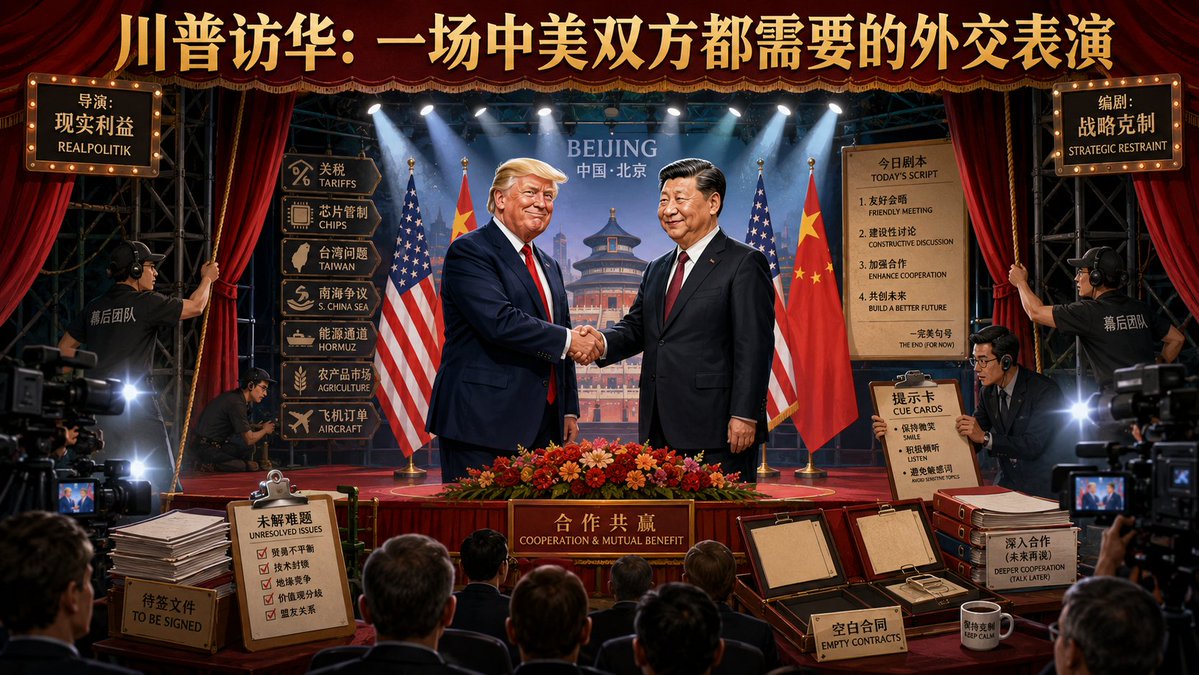
Trump's visit to China is a diplomatic performance that both China and the United States need.
This time, there are very few tangible achievements between China and the United States, with actual agreements or at least publicly acknowledged content being:
First, the Sino-U.S. relationship has been redefined as a constructive strategic stability relationship.
This is the core achievement in the Chinese side's press release, which states that the two heads of state agreed to use this as a strategic guide for the next three years and beyond. It mainly serves as a political framework, but its practical effectiveness may be limited.
Second, both sides agreed to continue communication, address each other's concerns, and enhance coordination on international and regional issues.
This is a mechanism result that can be considered a consensus, but it doesn't translate into specific policy implementation, remaining at the "talking" level.
Third, both sides confirmed that they discussed issues such as the Middle East, Ukraine, and the Korean Peninsula, and agreed to support each other in successfully hosting this year's APEC and G20.
This can also be regarded as a diplomatic consensus, meaning that both sides temporarily do not wish for the relationship to deteriorate further, but it cannot serve as actual execution.
Fourth, there is some consensus on the Strait of Hormuz and Iran issues.
The White House stated that both sides agreed that the Strait of Hormuz must remain open, and Iran cannot possess nuclear weapons, but the Chinese side's press release did not completely restate the White House's position, though it did emphasize the desire for a peaceful resolution and hoped for free navigation in the Strait of Hormuz. However, from the perspective of oil prices, the market clearly does not agree.
There have only been verbal statements, but no visible execution content.
Fifth, agricultural product purchases.
The U.S. side stated that it expects China to purchase U.S. agricultural products worth billions of dollars each year for the next three years, but it is unclear which specific products are included. The existing commitment of 25 million tons of soybeans per year was already arranged last October, and no new purchase contracts, tariff adjustments, or purchasing schedules were seen this time.
Sixth, Boeing aircraft and GE engines.
Trump mentioned that China would buy 200 Boeing aircraft, but the Chinese side did not confirm this, nor did Boeing. This is at most considered a potential commercial transaction.
Seventh, China will buy more U.S. oil.
The White House said that Xi Jinping expressed an intention to purchase more U.S. oil to reduce dependency on the Strait of Hormuz. However, there are no contracts, quantities, prices, delivery schedules, etc.
Eighth, expanding market access for U.S. companies and increasing Chinese investment in the U.S.
The White House stated that both sides discussed these issues, but there were no specific industries, no timelines, no regulatory documents, and no corresponding specific commitments from the Chinese side.
Ninth, control of fentanyl precursors.
The White House mentioned the need to continue efforts to prevent fentanyl precursors from entering the United States, but this was not mentioned in the Chinese side's press release. There were no new enforcement lists, export control lists, or joint enforcement mechanisms.
Tenth, H200 Nvidia chip exports.
I mentioned this previously; chip export controls were not the main topic of this discussion, and it was even stated that there was no discussion on chip export controls in the bilateral meeting. The U.S. had already approved some Chinese companies to purchase H200, but China was unwilling to buy.
Eleventh, the Taiwan issue.
The Chinese side explicitly listed Taiwan as the most important issue in Sino-U.S. relations and warned that mishandling it could lead to collisions or even conflicts, but U.S. Secretary of State Rubio stated that U.S. policy toward Taiwan has not changed. Therefore, there is no new agreement on the Taiwan issue; it is merely the Chinese side expressing the red line again, while the U.S. did not publicly concede.
My personal feeling about Trump's visit to China is that it does not seem aimed at achieving in-depth cooperation or agreements but rather serves to provide some buffer for a relationship that is already quite tense. The U.S. did not obtain substantial concessions from China regarding tariffs, rare earths, chips, or Taiwan, and China did not gain substantial retreats from the U.S. on technology blocks and the Taiwan issue.
免责声明:本文章仅代表作者个人观点,不代表本平台的立场和观点。本文章仅供信息分享,不构成对任何人的任何投资建议。用户与作者之间的任何争议,与本平台无关。如网页中刊载的文章或图片涉及侵权,请提供相关的权利证明和身份证明发送邮件到support@aicoin.com,本平台相关工作人员将会进行核查。


