Original|Odaily Planet Daily (@OdailyChina)
Author|Wenser (@wenser 2010)
Last September, the dispute over Hyperliquid's native stablecoin USDH became a focal point in the industry; however, this stablecoin, once filled with high hopes, has suddenly reached its “exit moment”.
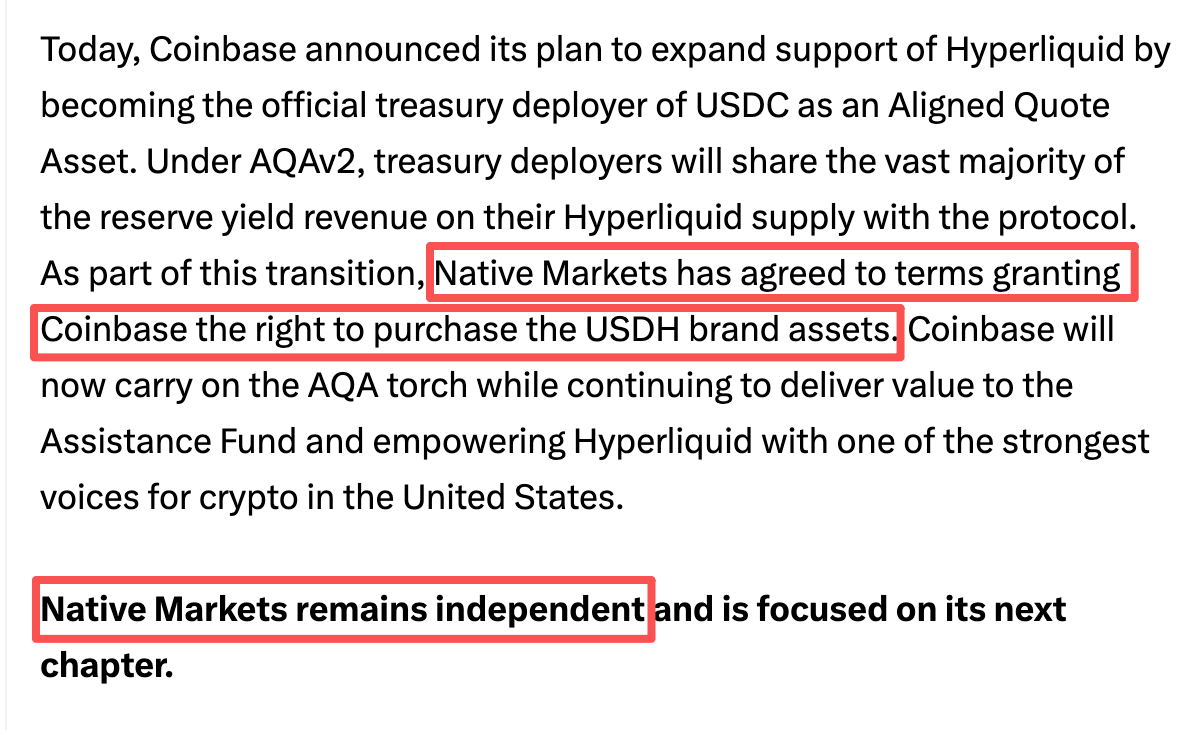
Last night, Coinbase announced that it will become the official treasury deployer of USDC on Hyperliquid, while Native Markets, the issuer of the Hyperliquid native stablecoin USDH, granted Coinbase the rights to purchase USDH brand assets. Subsequently, the USDH market will gradually close, during which users can still exchange USDH for USDC or fiat currency without any fees.
From then on, the once-famous USDH became an asset acquired by Coinbase, while USDC was officially established as the official stablecoin and quoted asset of Hyperliquid. Odaily Planet Daily will briefly analyze the details of this matter and its subsequent impacts in this article.
USDH Exit, USDC Rising: The Economic Account Behind 5 Billion Dollars
This grand drama of the “Hyperliquid ecosystem stablecoin competition” ultimately ended with Coinbase & Circle, Hyperliquid, and USDH issuer Native Markets all winning.
Coinbase thus further deepens its binding with the Hyperliquid ecosystem; Hyperliquid reaps the bulk of the USDC stablecoin reserve yield within the ecosystem; Native Markets, as the ultimate winner of USDH, reaps its return in the form of “selling USDH brand assets”.
Coinbase & Circle: Binding Hyperliquid's On-Chain Economy, Continuously Increasing Investment in HYPE
Currently, the size of USDC on Hyperliquid is approximately 5.164 billion dollars, a year-on-year increase of 2 times.
As the official partner and revenue-sharing entity of USDC, Coinbase's action is undoubtedly aimed at deepening its binding with the Hyperliquid ecosystem.
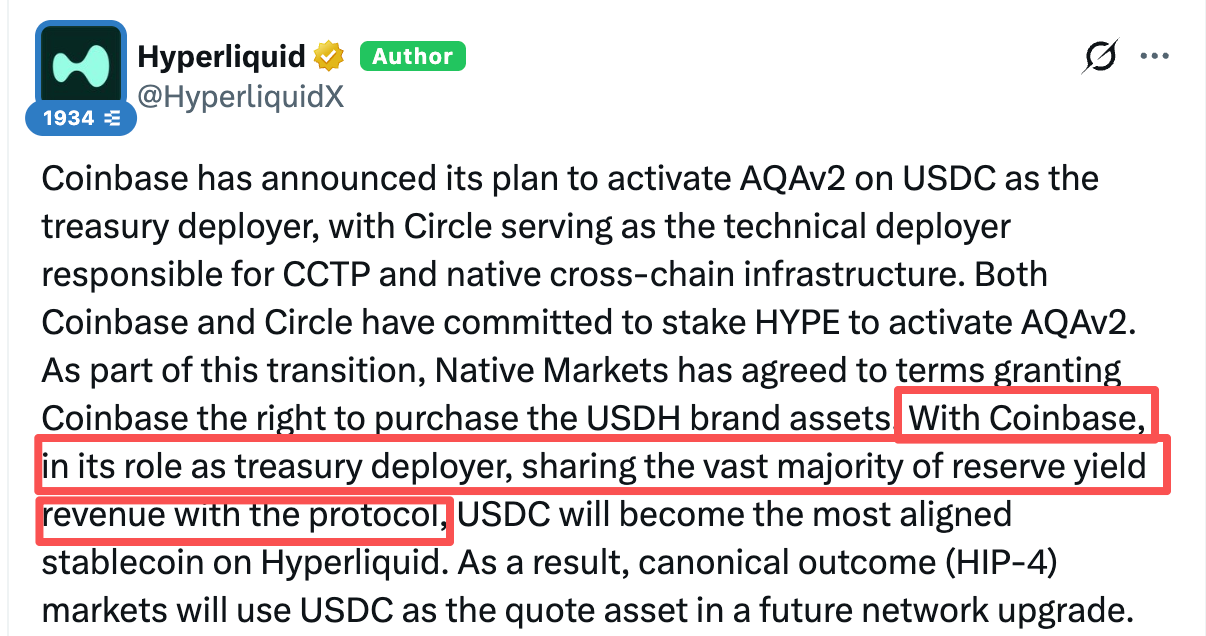
Moreover, according to the official announcement from Hyperliquid, both Coinbase (fund deployer) and Circle (responsible for CCTP and native cross-chain infrastructure technical deployment) have pledged to stake HYPE to activate AQAv2 (Aligned Quote Asset v2).
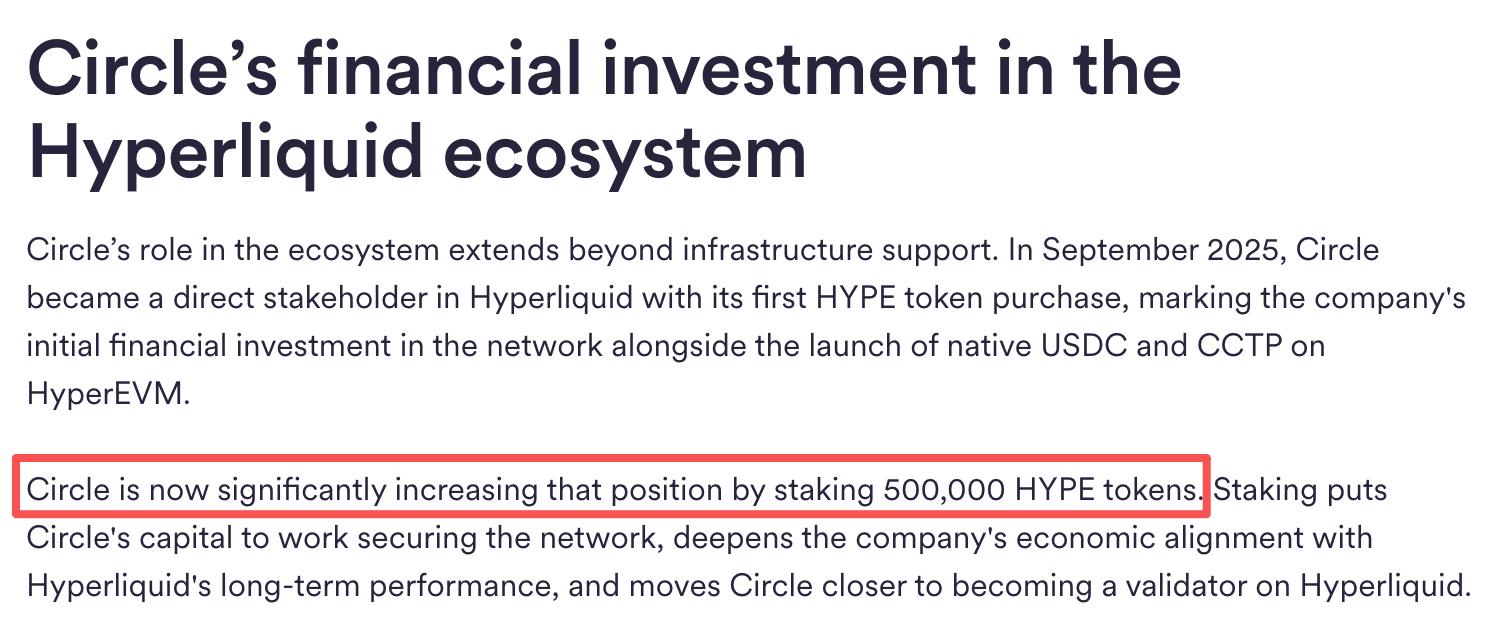
It is worth mentioning that last September, Circle had already purchased HYPE tokens, and currently, the staking scale of its HYPE tokens has increased to about 500,000 tokens.
Hyperliquid: Collecting the Bulk of USDC Reserve Yield, Enjoying the Convenience of Coinbase Ally Status
As for this cooperation, the biggest winner is undoubtedly Hyperliquid, as the ecosystem's foundation.
According to the official announcement, Coinbase will share the vast majority of the reserve yield income with the Hyperliquid protocol. Although the specific revenue sharing ratio has not been disclosed yet, based on the previous revenue sharing mechanism of USDH, Hyperliquid will actually obtain about 90% of the reserve yields.
According to calculations by a Hyperliquid community member, based on a scale of 4.7 billion dollars and a 3.8% yield rate, this income corresponds to about 160 million dollars; in other words, it corresponds to a daily buyback of 440,000 HYPE tokens.
Not only that, with the passing of the CLARITY Act in the U.S. Senate Banking Committee, the deep binding of Hyperliquid and Coinbase also indicates that HYPE and Hyperliquid have gained some support from the U.S. regulatory side.
Native Markets: Completing the Historical Mission of USDH
As the issuer of Hyperliquid's native stablecoin USDH, Native Markets seems to be the biggest loser in this “acquisition event,” but based on its official statements, its outcome could also be seen as “achieving success and retreating gracefully.”
On one hand, USDH provided an example and template for Coinbase and Hyperliquid to share USDC revenue; on the other hand, Coinbase likely directly acquired the USDH-related brand assets, thus the USDH stablecoin issued by the Native Markets team can be seen as “acquired by Coinbase,” and consequently, the team gained a certain economic return.
Subsequently, Native Markets also stated that it will maintain independence and seek development in other areas.
After USDH's Exit, In a Three-Way Win Situation, Only USDH Users Are Left Hurt
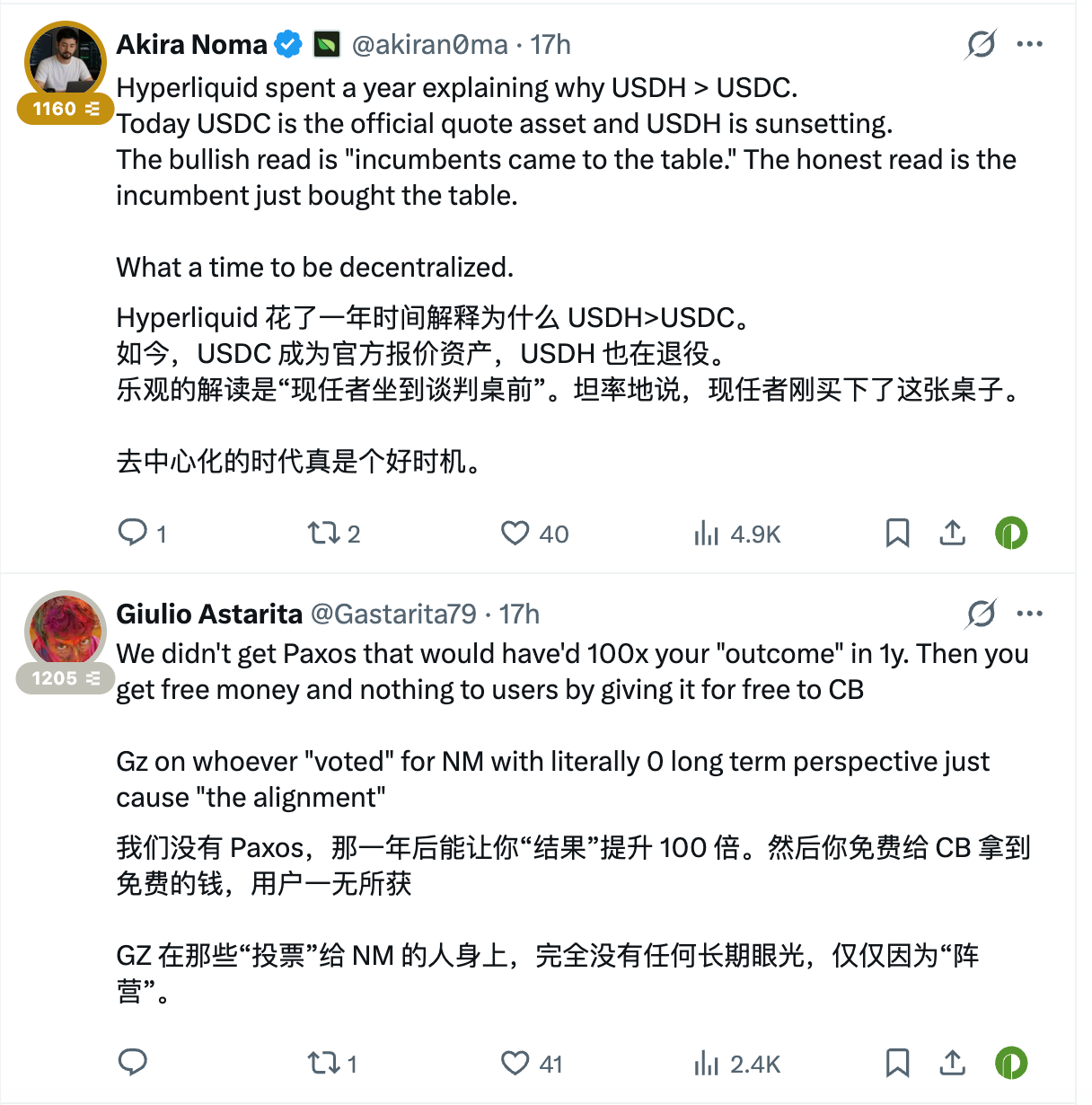
Of course, Native Markets' exit is not entirely met with “praise,” as Hyperliquid community users express significant dissatisfaction with the so-called “entering the negotiating table” claim.
Some believe that USDH's exit signifies a complete regression of the decentralized era;
Others pointed out that the initial vote for USDH's stablecoin issuer should have favored Paxos, as they were at least considering the users and the growth of stablecoins, while those who voted for Native Markets only did so for positioning and internal interests. Ultimately, the users gained nothing. These remarks have gained support from many.
From then on, the once dramatic “tyrant pursuing love” and “rebelling against the giant” storyline has finally come to an end.
However, looking back now at the “handshake and reconciliation” scene between Hyperliquid, Coinbase, and Circle, it inevitably evokes some sentiment and seems a bit ironic.
Everything was just about profit distribution, rather than the slogans once shouted like “for the community” and “for Hyperliquid”.
Recommended Reading
免责声明:本文章仅代表作者个人观点,不代表本平台的立场和观点。本文章仅供信息分享,不构成对任何人的任何投资建议。用户与作者之间的任何争议,与本平台无关。如网页中刊载的文章或图片涉及侵权,请提供相关的权利证明和身份证明发送邮件到support@aicoin.com,本平台相关工作人员将会进行核查。


