Original | Odaily Planet Daily (@OdailyChina)
Author | jk

On May 14, local time, the United States Senate Banking Committee voted 15 to 9 to pass the Digital Asset Market Clarity Act (CLARITY Act) through committee review, advancing the bill to the Senate floor for a vote.
The voting results were largely divided along party lines: all Republican committee members voted in favor, while two Democratic senators broke party ranks and voted in favor: Ruben Gallego from Arizona and Angela Alsobrooks from Maryland.
Notably, the latter stated after the vote that her yes vote today was a "vote to continue promoting work in good faith" and made it clear that she would not support the bill in the Senate floor vote until several core issues were resolved.
Committee Chairman and Republican Senator Tim Scott secured this bipartisan vote result through procedural maneuvers as the hearing drew to a close. The entire hearing lasted for several hours, during which both parties engaged in intense debates over multiple amendments, with several amendments proposed by Democrats being rejected or procedurally blocked.
What is the CLARITY Act? A layman's understanding:
Simply put, the CLARITY Act attempts to answer a core question that has plagued the U.S. crypto industry for years: Who should regulate digital assets like Bitcoin and Ethereum?
Currently, the SEC and CFTC have long grappled with ambiguous boundaries and competition over the regulatory authority of crypto assets. This uncertainty leaves companies adrift and investors unprotected.
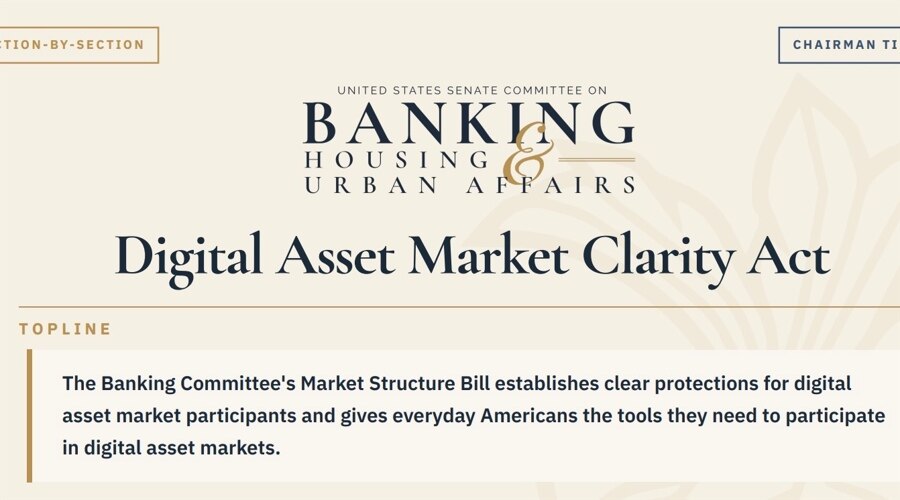
The core logic of the CLARITY Act is to clearly categorize digital assets as either "securities" or "commodities", assigning them to the SEC and CFTC, respectively, thus establishing a clear federal regulatory framework. This is the first comprehensive legislative attempt targeting the crypto industry in U.S. history, comprising 309 pages.
Additionally, the bill addresses several important issues:
- Stablecoin yield rules: In the past, some platforms allowed users to earn interest-like returns simply by holding stablecoins, which sparked strong backlash from traditional banking. The latest version of the bill prohibits paying interest on "passively held" stablecoins, but allows users to earn returns from active behaviors such as trading, transferring, or staking. The logic here is that the former directly competes with bank deposits, while the latter is considered a legitimate reward for actively participating in the market.
- Regulatory standards for DeFi platforms: Since DeFi lacks traditional "companies" and "managers," regulators have long struggled to find enforcement targets. The CLARITY Act attempts to establish rules requiring relevant platforms to fulfill anti-money laundering obligations, monitor suspicious transactions, verify user identities, and comply with sanctions regulations from the U.S. Treasury Department's Office of Foreign Assets Control (OFAC).
- Legal protection for software developers: This provision addresses a real dilemma: developers have previously been held accountable by regulators just for writing code for an open-source protocol that was then misused by criminals. The bill explicitly states that if bad actors use a protocol for illegal activities, legal responsibility should not automatically fall on the software developers of the protocol, provided the developers themselves did not engage in unlawful acts. This protection is seen in the industry as an important clause for encouraging compliant innovation and preventing "collateral enforcement."
What are the differences between traditional banking and the crypto industry?
This is one of the core contradictions that led to the bill being stalled over the past few months.
The banking industry is concerned that: If stablecoins are allowed to pay interest to holders like savings accounts, it will directly compete with bank deposits, leading to significant fund outflows and weakening banks' ability to lend to the real economy. Six major banking associations, including the American Bankers Association, jointly issued a statement explicitly calling for tighter restrictions on stablecoin yields.
The crypto industry believes that excessive restrictions on stablecoin yields will stifle innovation and cause the U.S. to fall behind in global digital finance competition.
The final compromise is that the latest version of the bill (May 11 draft) prohibits paying returns similar to deposit interest on "passive holdings" of stablecoins, but allows returns generated from active behaviors like trading, transferring, or staking. This distinction is viewed as a compromise solution that balances the interests of both parties, yet the banking industry has indicated it will continue to push for tighter restrictions.
What’s next for the bill?
Passing through committee review is just one node in the long legislative journey; several hurdles remain before it can officially become law:
First hurdle: Merging committee versions. The Senate Banking Committee and the Senate Agriculture Committee each have a version of the draft, which need to be merged into a unified text prior to further action.
Second hurdle: Senate floor vote. The merged bill must first pass a 60-vote procedural threshold (motion to terminate debate) in the Senate floor vote, then be approved by a simple majority. This means that Republicans must gain the support of at least 9 Democratic senators, with principal bargaining chips being the ethics clause and two unresolved enforcement issues.
Third hurdle: Coordination between the House and Senate. The House had already passed its version of the bill by a vote of 294 to 134 in July 2025, but it differs from the Senate version. The two chambers need to form a unified text, which must then be voted on and approved by both chambers.
Fourth hurdle: Presidential signature. Trump is widely expected to sign the bill. White House advisor Patrick White previously stated that signing is expected to be completed around July 4th, Independence Day, but this timeline is extremely tight.
The goal of the crypto industry is to complete all legislative procedures before the midterm elections in November this year; otherwise, congressional attention will fully shift to campaigning, potentially closing the legislative window.
Two Major Core Suspense Issues
1. Ethics clause for government officials
The bill includes provisions restricting government officials from owning or benefiting from crypto assets, indirectly targeting Trump himself—who promoted multiple crypto projects during his presidency. Democrats view this as a necessary prerequisite for supporting the bill, while Republicans have a more ambiguous stance. Cody Carbone, head of the Digital Chamber, stated that this negotiation will likely be completed before the bill enters the Senate floor vote.
2. Enforcement and anti-money laundering
Senator Elizabeth Warren and other Democrats insist that the bill lacks sufficient measures to combat illegal financial activities related to DeFi platforms. Relevant amendments were rejected in today’s committee vote by 11 to 13, making this issue continue to be a focal point in negotiations.
Market Reaction
After the announcement of the bill's passage, the crypto market immediately showed a significant rebound. Coinbase (COIN) saw its stock price rise by more than 10% at one point, and Bitcoin (BTC) increased by about 2.4%.
Industry institutions generally responded positively. Ripple CEO Brad Garlinghouse stated, “If the world’s largest economy is to lead in the crypto space—as it must—this is the moment.” Circle Chief Strategy Officer Dante Disparte called the vote "a meaningful bipartisan progress towards comprehensive digital asset regulation."
For the entire crypto industry, the significance of the CLARITY Act is comparable to a "legitimacy coronation." For years, U.S. regulators' vague definitions of crypto assets and inconsistent enforcement have caused many institutional funds to remain cautious. Once the bill is enacted, the regulatory boundaries of the SEC and CFTC will be clarified, compliance costs will become predictable, and the largest barrier for institutional participation will be removed.
This also represents a clear statement from the U.S. in the global digital asset regulatory competition— the European Union passed the MiCA regulations in 2023, and regions like Hong Kong, Singapore, and Dubai have also established regulatory frameworks, with the U.S.'s long-standing absence being exploited by competitors.
Of course, the bill still has a long way to go. Today’s committee vote is an important beginning.
免责声明:本文章仅代表作者个人观点,不代表本平台的立场和观点。本文章仅供信息分享,不构成对任何人的任何投资建议。用户与作者之间的任何争议,与本平台无关。如网页中刊载的文章或图片涉及侵权,请提供相关的权利证明和身份证明发送邮件到support@aicoin.com,本平台相关工作人员将会进行核查。