Our report "Aave vs. Morpho: Positioning for the Institutional Era" is now live!
DeFi lending is being unbundled.
Aave became the leader of DeFi lending because of its simplicity. A user could deposit collateral, borrow, and let the protocol handle liquidity and risk.
Morpho starts from a different premise. Markets should specialize around different types of risk rather than force every borrower and lender into one venue. The protocol provides the base infrastructure for curators and integrators to build around.
The difference shows up through distribution. Coinbase’s Bitcoin-backed loans route through Morpho with nearly 2B USD of BTC collateral tied to the partnership.
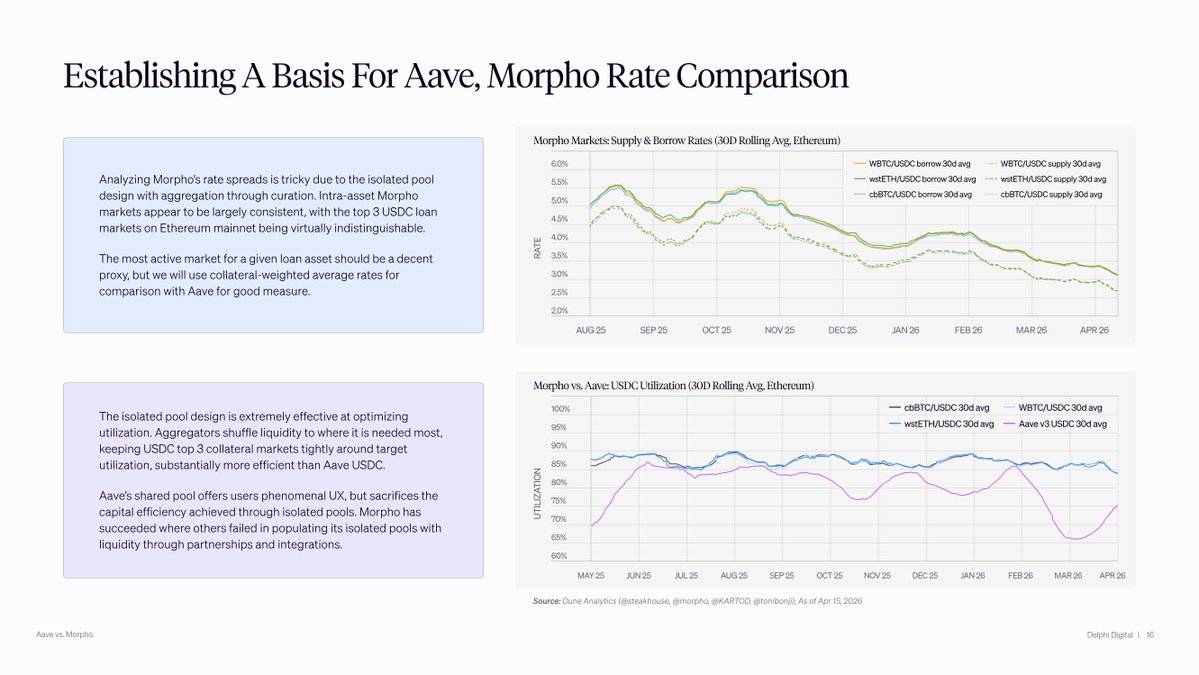
You can see the cost of Aave’s structure in the rate spreads. Across three of Aave’s largest Ethereum markets, WETH, USDT, and USDC, borrow/supply spreads create an estimated 50M+ USD of annual deadweight loss.
Morpho’s isolated markets have shown to be more capital efficient than peer-to-pool markets because capital can move towards the markets where it is most useful.
Kelp made this harder to ignore. After rsETH was exploited, four major Aave markets hit 100% utilization for 5 days while the system waited for a coordinated bailout. Pooled liquidity meant stress spread across markets.
Aave v4 strengthens the bundled model while Morpho is betting that model gets pulled apart.
The outcome will determine whether DeFi lending is shaped more by venue size or by market-level risk pricing.
免责声明:本文章仅代表作者个人观点,不代表本平台的立场和观点。本文章仅供信息分享,不构成对任何人的任何投资建议。用户与作者之间的任何争议,与本平台无关。如网页中刊载的文章或图片涉及侵权,请提供相关的权利证明和身份证明发送邮件到support@aicoin.com,本平台相关工作人员将会进行核查。


