Starting from Goldman Sachs' "Decoding the Agentic Economy," this dissects the value capture chain of the AI economy.
Author: Will Awang
In April 2026, Goldman Sachs released a research report titled "Decoding the Agentic Economy," with a core judgment summarized in one sentence: the AI industry is transitioning from a "cost narrative" to a "profit narrative." Token increments no longer dilute profits but instead bring positive marginal contributions. The profit inflection point will arrive within the next 3 to 12 months.
This is not an ordinary industry report. It attempts to answer the most anxious question for every technology investor over the past 18 months—can the annual $800 billion in AI capital expenditures be recouped?
Goldman Sachs provided an optimistic answer. Shortly after the report was released, Google, Amazon, Alibaba, and Tencent released their Q1 financial reports—these numbers, in a sense, are the first formal response to the capex anxieties of the past two years. Profit margins are indeed improving, token volume is indeed exploding, and revenues are indeed accelerating. However, at the same time, capex is also growing at a faster rate.
Allianz Research succinctly described the current situation: "Reducing investment is not a credible option—retreat means defeat, yielding ground to competitors." Everyone knows they might be overextending, but no one dares to stop first.
This article aims to piece together a complete value capture chain in the AI economy by using Goldman Sachs' arguments as the main thread, introducing Q1 financial data, peer research reports, and voices of industry experts as supporting or counter-evidence at each key judgment point. Then, it will probe two questions that Goldman Sachs did not directly answer—where exactly is the profit in this chain? If there is a profit inflection point, when will it come? The depreciation clock of GPUs provides the latest deadline.
During this dissection process, I discovered an analysis framework that is more fundamental than token economics. What Goldman Sachs refers to as the "profit inflection point" translates into more intuitive terms as: the building is completed, tenants are flooding in, rents are recovering, and vacancy rates are declining. We are now at the turning point of transitioning from the "construction phase" to the "rental phase."
The underlying structure of the AI infrastructure economy is astonishingly similar to real estate development—except that GPU depreciation over three years is much harsher.
I call this framework "Compute Real Estate."
Key Takeaways
Goldman Sachs' directional judgment is correct, but the timeline is overly optimistic. The profit inflection point indeed appears within cloud vendors (Google Cloud's profit margin improved from 9.4% to 32.9% in two years), and token demand is indeed surging. However, the inference that "the profit inflection point will resolve capex anxiety within 3-12 months" does not hold up against Q1 data—the profit is chasing capex but is currently outpaced.
The AI infrastructure economy is essentially a "Compute Real Estate" model. First, borrow money to construct buildings, then lease and collect rent, betting that rental income can cover the construction costs before GPU depreciation. GPU depreciation of 3-5 years is much harsher than land depreciation—construction timelines are dictated by accounting principles rather than market sentiment.
A portion of revenue growth is cyclical. AI companies are paying each other, and distributors are prepaying to stock GPUs—the money in the system is circulating. The actual non-cyclical payment from end enterprises and consumers may only be $20-30 billion per year, compared to a gap of over 20 times the $800 billion capex.
The risk structures of core players and marginal players are entirely different. AWS and Google have legacy businesses to fall back on and will not fail. The real risk lies with CoreWeave ($24.8 billion in debt), Oracle (highest CDS since 2009), and model companies that rely on financing for survival. If something is going to go wrong in this cycle, it will happen on the margins first.
Things will ultimately improve, but not everyone will make it to that day. We believe revenue will eventually outpace capex—but a more likely timeframe is 2-3 years, rather than the 3-12 months proposed by Goldman Sachs. During this window period, investors need to distinguish between "will AI win?" (yes) and "who can survive to that day?" (not everyone).
1. The Underlying Structure of Compute Real Estate
To validate Goldman Sachs' judgment, we first need to understand a prerequisite question: why is everyone focused on capex (capital expenditures, meaning the expenditures a company incurs to purchase equipment, build infrastructure, and other long-term assets)?
1.1 Why AI is a "Real Estate Business"
The traditional SaaS business model is asset-light—engineers write code, deploy it to the cloud, and can start selling subscriptions the next day. Marginal costs approach zero, which has been the basis for the high valuations of tech stocks over the past two decades.
AI is not like this. AI requires heavy upfront assets: first spending 6 to 24 months building data centers, buying chips, and only then can you start charging clients. Amazon CEO Andy Jassy explicitly stated during the Q1 earnings call: from signing a contract to completion and generating revenue, there is a time lag of one to two years.
This means the balance sheet structure of AI looks more like that of a real estate developer rather than a software company.
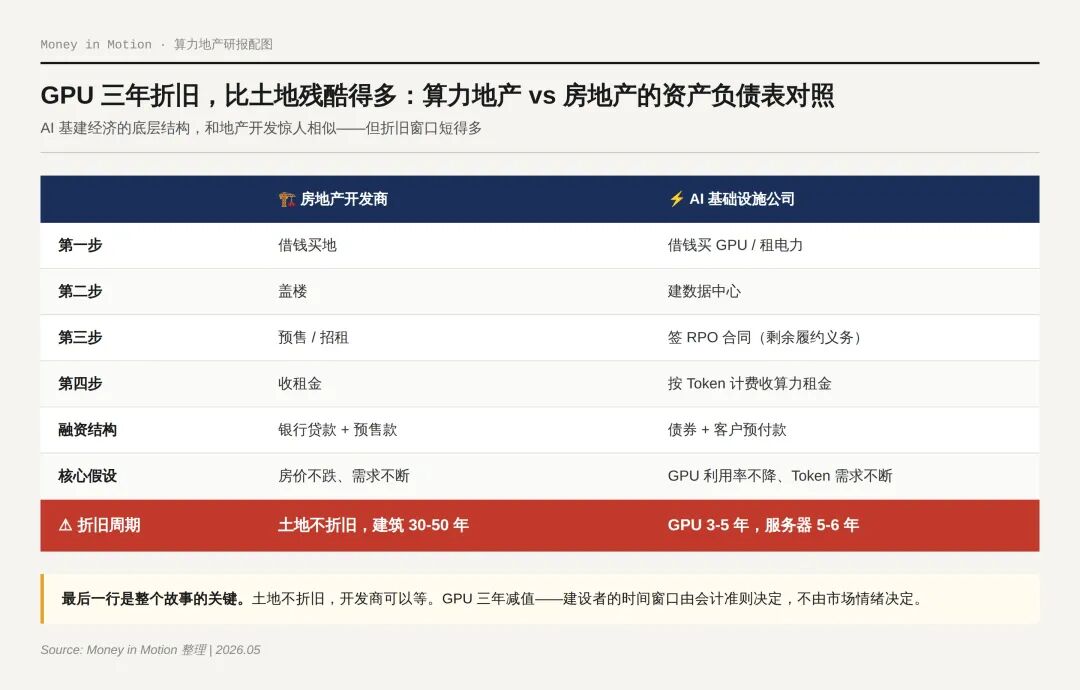
The last line is the key to the whole story. Land does not depreciate; in the worst case, the assets remain, and developers can wait. GPUs cause impairment in just three years—if utilization does not ramp up within that time frame, the assets directly lose value. The fault tolerance window for AI infrastructure is much shorter than for real estate.
Quantifying this window: The total capex of the five major hyperscalers is about $805 billion in 2026 and will exceed $1.1 trillion in 2027 (according to Morgan Stanley). To achieve a 10% return on these investments, annual AI revenue needs to generate $650 billion—equivalent to each iPhone user globally paying an additional $34.72 per month (according to JPMorgan Asset Management's estimates). Goldman Sachs admitted earlier this year: to maintain investor expected returns, the industry needs annual profits exceeding $1 trillion, which is more than double the $450 billion projected by the market for 2026.
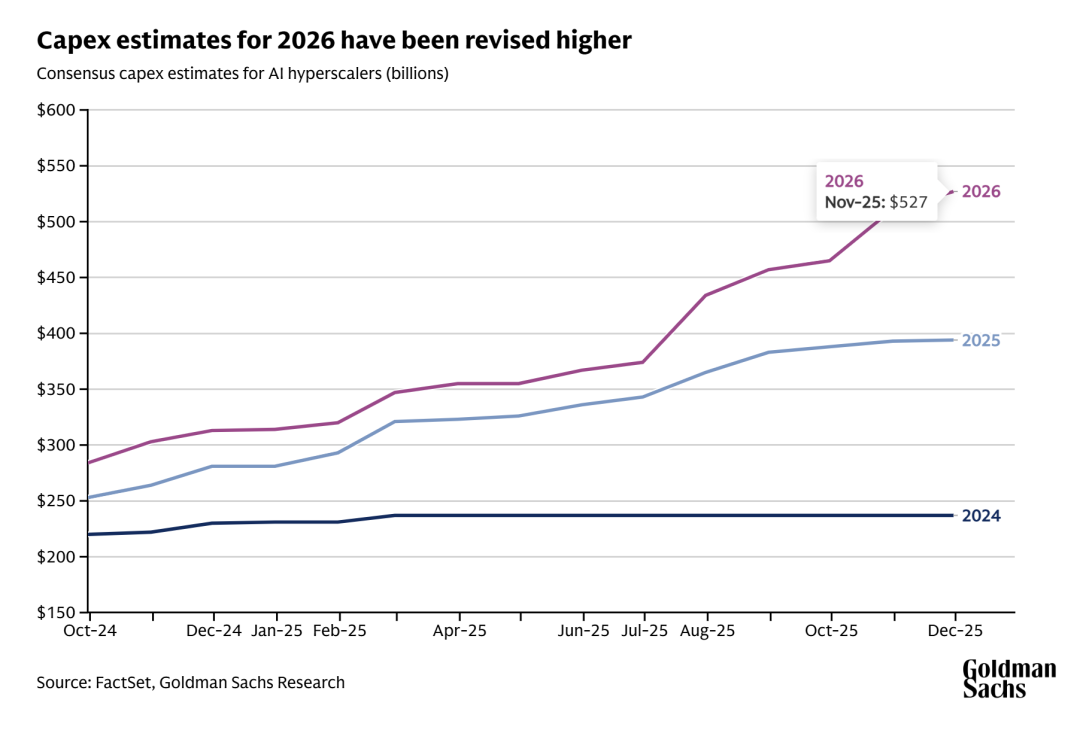
What is more noteworthy is the scale effect: Morgan Stanley pointed out that AI capex already accounted for about 75% of Q1 US GDP growth. This is not just a capital allocation decision by a few companies, it is a macro event.
So Goldman Sachs' theory of a "profit inflection point," translated into the language of compute real estate, is:
These $800 billion in "construction investment" must generate sufficient "rental income" within the 3-5 year GPU depreciation window. Goldman Sachs says the inflection point has arrived.
1.2 How Money Flows—The Value Chain and Its Circularity
Before validating Goldman Sachs' judgment, we also need to clarify one thing: how exactly does money flow within the AI economy?
The current AI value chain is an "inverted pyramid"—the closer to the end-user level, the thinner the profit margins.
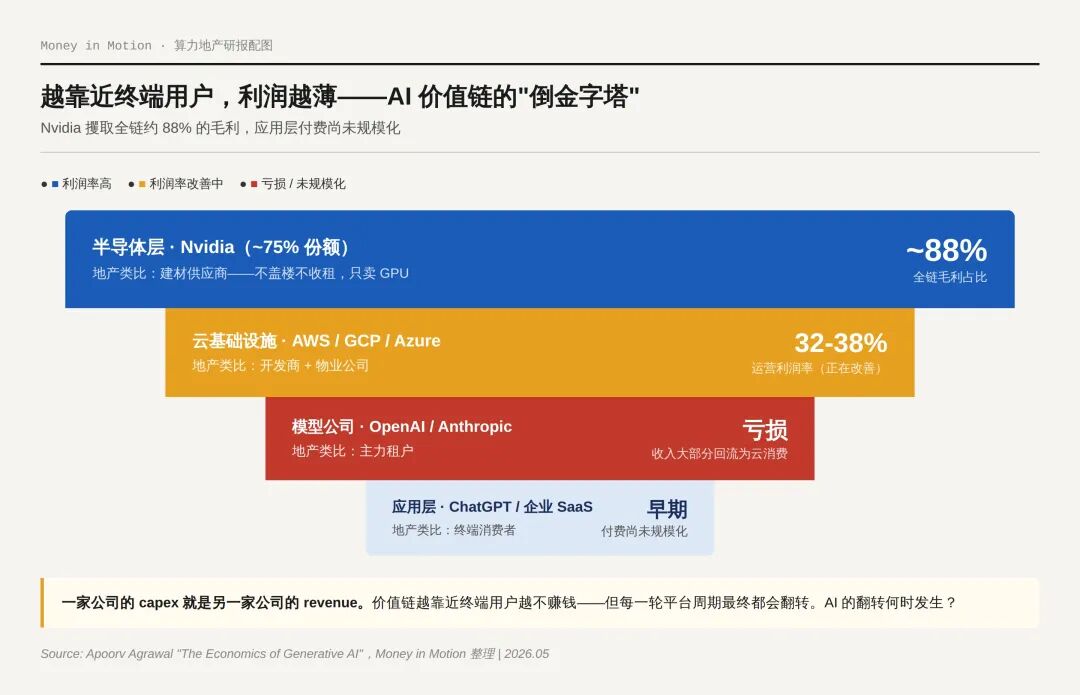
Nvidia captures most of the profits—one company's capex is another company's revenue.
However, there is a more insidious problem within this chain: money circulates within the system, akin to the "left-hand passing to the right-hand" in real estate cycles.
Nvidia sells chips to cloud vendors—that is the capex for cloud vendors. Cloud vendors sell computing power to model companies—that is the revenue for cloud vendors. But where does the money for model companies come from? VC and strategic investors. And strategic investors often are the cloud vendors themselves: Amazon invests in Anthropic, Anthropic uses this money to buy AWS computing power, which in turn boosts AWS revenue—and then Amazon uses this increased revenue for more capex. It's a closed loop.
Howard Marks noted directly in his February 2026 memo: this revenue chain "ultimately must depend on end users paying for real economic value." Research by JPMorgan provided a more sobering quantification: AI-related stocks contributed 75% of S&P 500 returns, 80% of profit growth, and 90% of capital expenditure growth. The market's growth almost entirely comes from the same group of companies transacting with each other.
1.3 Who are the "Building Material Suppliers" and Who are the "Developers"?
Having understood the flow of money, let's look at what each player does in the chain.
Nvidia is the building materials supplier. It does not build buildings, does not collect rent, it only sells GPUs. Capturing about 88% of the gross profit in the whole chain, with a gross margin of around 75%—the materials supplier takes away the largest share. As for how much of Nvidia's revenue comes from downstream "distributors" prepaying to stock up, that will need to be unpacked when discussing cyclical revenue later.
Cloud vendors are the developers and property management companies.
They are simultaneously doing five things: renting out GPUs (power landlords), operating model supermarkets (Bedrock/Vertex AI collecting commissions per token), building their own chip factories (Trainium/TPU replacing Nvidia’s materials), locking in corporate tenants (IAM/VPC/compliance—"enterprises choose AI platforms not because the models are good, but because their data is already on that cloud"), and strategically investing in model companies in exchange for occupancy rates.
In March 2026, Alibaba directly wrote this logic into its organizational structure—establishing the "Tongyi Qianwen Token Hub," merging model laboratories, Alibaba Cloud, and Tianshu Computing chips into a primary business cluster, parallel to e-commerce. Internally called "Tongyun Ge." Models drive occupancy rates, the cloud captures rent, and self-developed chips lower material costs. More notably, the first-line sales management of Alibaba Cloud has switched from traditional cloud metrics (compute, storage, network) to token consumption metrics—after discovering a new business opportunity, it will define it as "billion-token level" or "ten billion-token level." Tokens are becoming the universal language of the entire cloud industry.
Tencent took a different approach. Q1 2026 capex was ¥37 billion (+73% YoY), but they chose to allocate GPUs primarily to internal products—advertising precision, game user stickiness, enterprise service efficiency—rather than selling computing power externally through Tencent Cloud. Management directly stated in the earnings call that "we consciously delayed monetizing AI through Tencent Cloud." Also a compute real estate model, Alibaba acts as a developer (building and renting out), while Tencent resembles an owner-occupier—first improving their office decor, with profit growth outpacing revenue growth (+11% vs +9%) indicating that AI investments are already generating returns through internal efficiency improvements.
And in today’s Alibaba Q4 earnings call, management made another clear confession: the capex plan of ¥380 billion has not yet been fully realized, demand is outpacing supply, self-developed GPUs are still ramping up, "we do not rule out increasing investments." The cloud has a cash reserve of RMB 59 billion, with overall operational cash flow being positive—there is money to continue building. But management also provided a timeframe: proof of ROI within 3 to 5 years. Coincidentally, this corresponds to the GPU depreciation cycle.
Oracle is the most aggressive developer.
With $50 billion in capex and $45-50 billion in debt financing, the previously mentioned CDS level is the highest since 2009. The leverage ratio on the balance sheet is the most notable among all cloud vendors. In February 2026, Oracle issued $30 billion in investment-grade bonds and convertible preferred stock at once, with oversubscription greatly exceeding expectations—the market is still willing to finance it.
However, Ellison's decision to sell Ampere and abandon self-developed chips means that Oracle's computing power costs will completely depend on Nvidia pricing. If GPU prices do not drop and demand turns, Oracle faces the dual pressures of cost rigidity and declining revenue—without self-developed chips as a buffer or legacy businesses like AWS/Google for a safety net.
CoreWeave's situation is even more extreme: $24.8 billion in debt, losses doubling, with high client concentration. It is essentially Nvidia's GPU distributor—first stockpiling and then renting out, betting on utilization not declining. If we frame CoreWeave within the compute real estate framework, it resembles Evergrande in this cycle—except that in three years, GPUs depreciate faster than unfinished buildings.
3.5 Transitional Judgment
Goldman Sachs' "profit inflection point" is a fact, but "profit inflection point = capex anxiety resolved" is an inference. Q1 data does not support this inference—at least not yet.
Profit margins are improving, but capex growth is even faster. The benefits of profit improvement are being consumed by reinvestment. The two curves—rental growth vs construction cost growth—will determine the core variables of this cycle.
Moreover, GPUs only have a depreciation window of 3 to 5 years. GPUs invested in 2025 to 2026 must generate sufficient income before 2028 to 2029. If Goldman Sachs' profit inflection point materializes within the next 12 months, credit expansion might be sustained by operating profits. If not, around 2028, impairments may begin to appear on balance sheets.
Goldman Sachs' profit inflection point is a fact. But profit inflection point ≠ capex anxiety resolved—profits are chasing capex, but at the current pace, they might fall short.
The five major hyperscalers are investing 90% of their operating cash flow into capex, and all the gains from profit improvement are being swallowed up by reinvestment. Unless the revenue growth rate exhibits non-linear acceleration over the next four quarters (mass corporate penetration by agents), the GPU impairment window for 2028 may arrive first.
4. Stress Testing: Reflections of History and Wall Street Discrepancies
In every infrastructure cycle, the market always debates the same question: does the speed of this construction exceed the rate at which demand catches up? Historically, there have been three comparable "infrastructure real estate" cycles.
4.1 Quantitative Comparison of Three Cycles
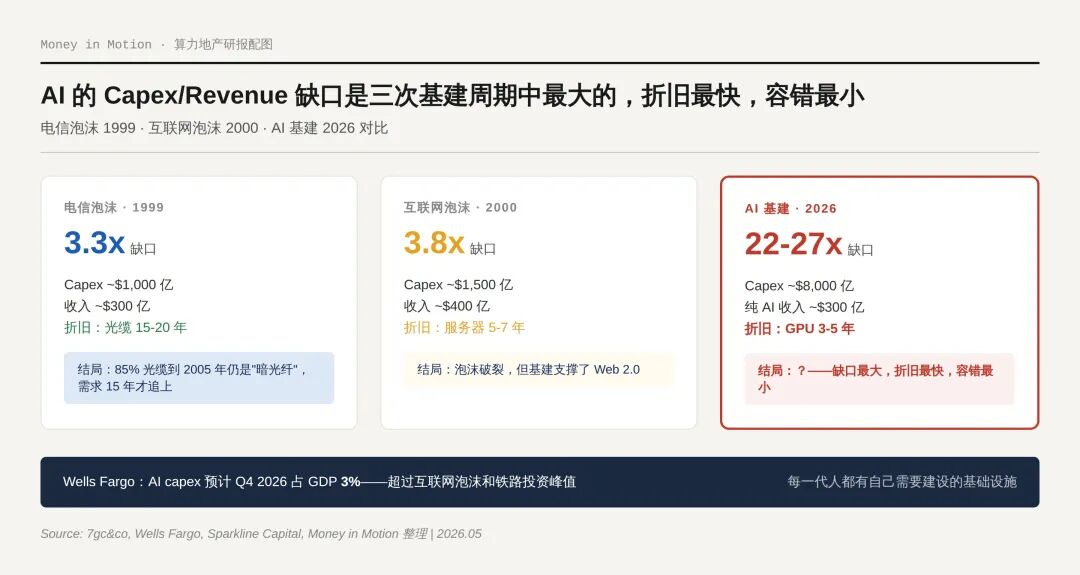
The capex/revenue gap for AI is the largest among these three infrastructure cycles, and the depreciation speed is also the fastest, with the smallest margin for error.
Wells Fargo’s latest estimates push this comparison further: Q1 2026 AI capex is $174 billion, driving 42% of Q1 GDP growth, accounting for 2.4% of US GDP. It is expected to reach 3% by Q4 2026—surpassing the peak of the dot-com bubble in 1999-2000, and also exceeding the peaks of railroad investments in the 1850s. This implies that the intensity of AI infrastructure is setting records in the history of the US economy.
4.2 Why This Time Might Be Different
Equating AI infrastructure simply with the telecom bubble is lazy analysis. There are structural differences between core hyperscalers and telecom operators of that era.
Funding sources are different. The telecom companies of the late 1990s largely relied on debt financing from capital markets—Global Crossing and Level 3 had extremely high leverage. Today’s hyperscalers primarily rely on their own operating cash flow, with net leverage ratios still around 0.9x (according to JPMorgan), far below the average 2.6x of investment-grade bonds.
Legacy businesses provide a safety net. AWS has Amazon ecommerce behind it, Google Cloud has search advertising, and Azure has Office 365. Even if the return on AI investments is below expectations, the parent companies will not collapse like WorldCom.
The auditing environment is stricter. During the telecom bubble, there were massive accounting frauds (WorldCom inflated assets by $11 billion), artificially amplifying demand expectations. Regulatory and auditing standards today are much stricter.
However, the risks of marginal players are real. CoreWeave: $24.8 billion in debt, profits doubling, with 67% of revenue dependent on a single client. Oracle: CDS levels reaching the highest since 2009. The balance sheet structures of these two are reminiscent of Level 3 and Global Crossing from back in the day, rather than AT&T.
Research from 7gc&co summarizes this differentiation: concerns about hyperscaler capex "stem more from sensationalism than historical factors that led to the bursting of the internet bubble"—but "warning signs have already appeared on the margins."
4.3 The Real Lesson from History
The outcome of the telecom bubble was not that "infrastructure is useless"—fiber optics were eventually absorbed by Web 2.0. From the time fiber optics were laid in 1999, demand took 15 years to catch up with supply.
But "long-term utility" and "investors make money" are not the same thing. Companies that laid fiber went bankrupt, while those that made money using fiber (Google, Netflix) thrived. Builders assumed all the risks, while users reaped the value.
Each generation has its own infrastructure to build. Railroads, power grids, fiber optics, data centers—someone always needs to build first. The question has never been "should we build," but whether builders can survive long enough to collect rent.
The compute real estate model might repeat the same misalignment. The GPU depreciation window of 3-5 years is much shorter than the 15-20 years of fiber optics—if the speed of demand catching up is not sufficient, builders may not survive to see "long-term utility."
4.4 Wall Street's Perspective
Demand acceleration, real technology, and monetization has begun—these are not points of contention. The disagreement lies in scale and pace.
Wells Fargo presents the most extreme bullish outlook—analyst Ohsung Kwon directly termed the AI capex cycle a "euphoric bubble," but concluded by advising investors to buy. "Admitting it's a bubble but suggesting not to get off"—this might be the most accurate reflection of the current market consensus.
Howard Marks stands on the opposite end: recurring revenues coupled with vendor financing give a sense of déjà vu to the telecom bubble. Morgan Stanley's credit team also used the term "bubble," but with a qualification: "It's not the risk of 2026, but rather what to be wary of in 2026." The "prisoner's dilemma" mentioned at the beginning manifests here: no one dares to slow down, as stopping means yielding market share to competitors.
Goldman Sachs' research at the end of 2025 revealed a more nuanced signal: investors are rotating out of debt-driven AI infrastructure stocks (like Oracle, CoreWeave) into platform stocks with clear capex→revenue conversion (like Google, Amazon). The market does not distrust AI; it is choosing "whose model is healthier." Sequoia's "$600B Question" framework recalculated with 2026's $800 billion capex suggests there may be an even larger gap; MIT's 2025 study found that 95% of organizations had zero returns from GenAI investments.
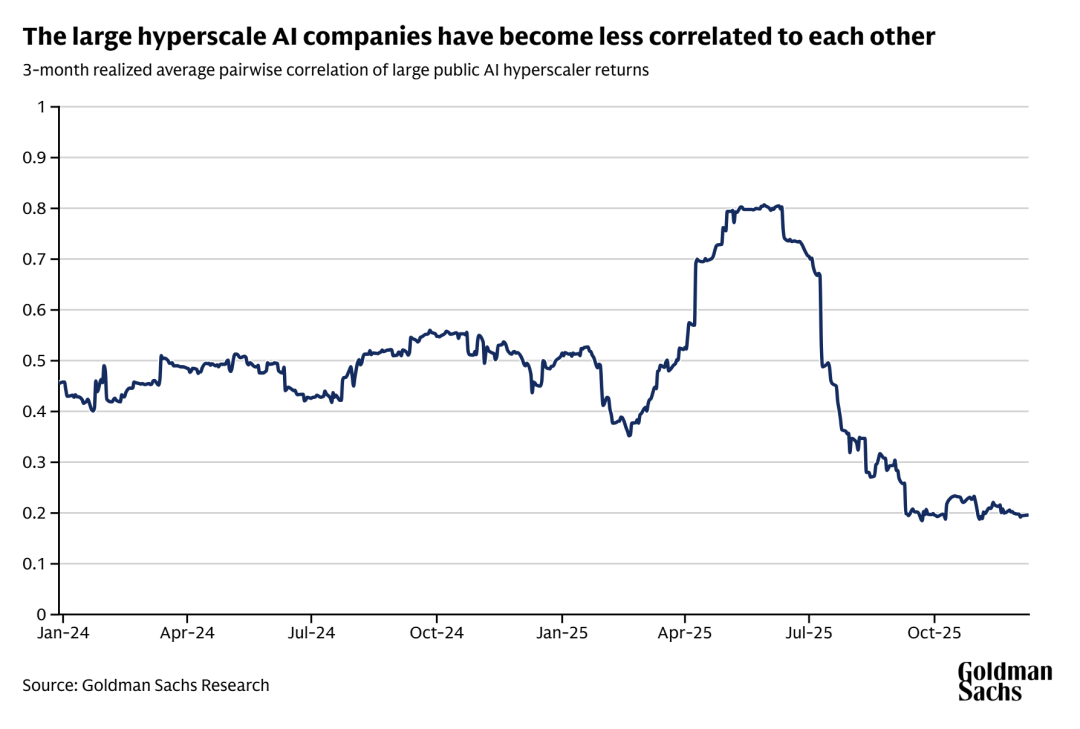
The primary market and the secondary market are looking at different things.
The secondary market asks, "Can stock prices increase?"—focusing on profit margin catalysts and EPS growth. The primary market asks, "Can the money come back?"—looking at unit economics and willingness to pay from end users. Goldman Sachs' report follows the logic of the former—judging catalysts for valuation, not the underlying investment returns.
AI is not a simple replication of the telecom bubble—core hyperscalers have legacy businesses as safety nets, and leverage ratios are far lower than those of the telecom operators of that time; they will not collapse.
However, the risks of marginal players are real and pressing. CoreWeave (with $24.8 billion in debt and single client concentration) and Oracle (with the highest CDS since 2009) have balance sheet structures more akin to Level 3/Global Crossing of the past. If something goes wrong in this cycle, it will first happen to them—before transmitting to market sentiment.
4.5 Two Blind Spots Not Discussed
Both sides of Wall Street debate the question of whether "capex can be recouped." But there are two deeper structural issues that hardly any research reports address.
When will the value chain flip? Currently, 88% of gross profits are captured by Nvidia, and application layers are hardly profitable. Every platform cycle eventually flips—Intel made money in the PC era, while the application layer profited in the mobile era. When will the flip happen for AI? Observable signals are that AI-native application companies (not model companies) show positive unit economics. Until then, Goldman Sachs' "profit inflection point" is only a story from one layer of the value chain, not the entire ecosystem's story.
How long can token pricing power last? Wholesale prices are declining while retail prices are increasing, creating room for profit—which forms the basis for the current disparity. However, Gemini Flash has reduced prices to $0.10 per million tokens, while China's wholesale prices are only 1/10 of the US prices. If competition at the model layer eventually forces retail prices to drop as well, the disparity will reverse. Whether revenue growth can consistently outpace capex growth is the core variable of the entire cycle.
5. Two Outcomes of Compute Real Estate
Goldman Sachs' judgment is correct in direction: AI is entering the rental phase from the construction phase, and the profit inflection point has indeed appeared at the cloud vendor level—Google Cloud’s profit margin has increased from 9.4% to 32.9% in two years, which is not a prediction; it is a fact. Q1 financial reports and token data from China corroborate the acceleration of demand. The 8% penetration rate of agents provides a micro basis for the token volume explosion.
However, throughout this analysis, there is a judgment that is more fundamental than all of Goldman Sachs' arguments: the AI infrastructure economy operates on a "compute real estate" model—first borrowing money to build, then leasing and collecting rent, betting that rental income can cover construction costs before GPU depreciation. This model has two outcomes, with little gray area in between:
Outcome One: Revenue growth outpaces capex growth. Corporate token consumption becomes a rigid expense (like Office licenses), occupancy rates continue to rise, retail pricing power persists, and cyclical revenue proportions decline—operating profits begin to succeed the credit expansion. Cloud vendors transition from "burning money to build" to "stable rent collection." GPU depreciation is covered by revenue, and balance sheets are restored. Goldman Sachs wins.
Outcome Two: Capex growth continues to outpace revenue growth. Token pricing power is eroded in price wars on the wholesale end, translating to the retail end. The proportion of cyclical revenue remains high—AI companies continue to exchange payments with each other. Operating cash flow continues to be consumed by capex, requiring developers to constantly finance for survival. Once the financing environment tightens—whether due to rising interest rates, a closed credit market, or a debt default by a marginal player causing a collapse in confidence—the music stops. By 2028 to 2029, GPUs invested in 2025-2026 begin to depreciate, leading to large write-downs on balance sheets. The story of laying fiber optics may be repeated.
Our judgment: Outcome One will ultimately arrive, but it will not come within the 3-12 months predicted by Goldman Sachs. A more likely timeframe is 2-3 years. The reason is that the acceleration on the demand side is real (agent multiplier effects + enterprise embedding + end pricing power beginning to form), but the scale of capex and the proportion of cyclical revenue determine that it will take longer for profits to catch up with construction costs. During this window, core hyperscalers (AWS, Google, Microsoft) will survive—they have the cash flow from legacy businesses as a safety net. However, marginal players will face a shakeout. Investors need to differentiate between two questions: "Will AI win?" (yes) and "Who can survive until that day?" (not everyone).
As mentioned at the beginning, GPUs depreciate over three years, which is much harsher than land. This is the most fundamental risk of the entire "compute real estate" model—land can wait, but GPUs cannot. The timelines of developers are not determined by market sentiment but by accounting principles.
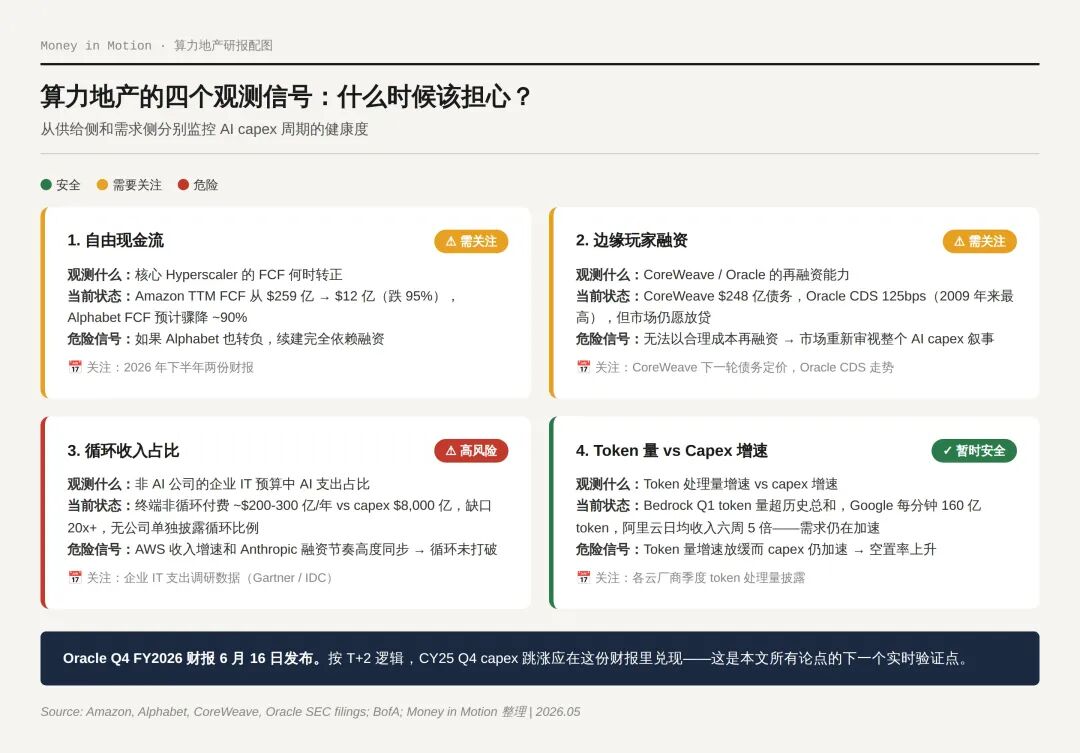
Four signals to watch
- When will free cash flow turn positive? Amazon's TTM free cash flow has fallen from $25.9 billion to $1.2 billion. If Alphabet also turns negative, it would indicate that even the strongest developer cannot cover construction investments with operating profits—continued construction would be entirely dependent on financing. Watch the two financial reports for the second half of 2026.
- The financing capability of marginal players. CoreWeave ($24.8 billion in debt, single client concentration) and Oracle (CDS at 125bps) are the canaries of this cycle. If they cannot refinance at reasonable costs, the market will reassess the entire AI capex narrative. Watch the pricing of CoreWeave's next round of debt issuance as well as Oracle's CDS trends.
- The proportion of cyclical revenue. Currently, no company separately discloses "how much of AI revenue comes from other AI companies." However, observable proxy variables can help: if AWS income growth closely synchronizes with the financing pace of Anthropic, the cycle hasn't broken. True validation would be whether the proportion of AI spending in enterprise IT budgets from non-AI companies is rising.
- GPU utilization rates. Cloud vendors have not publicly disclosed GPU utilization data, but token processing volume is the closest proxy indicator. If token volume growth begins to slow while capex continues to accelerate—indicating rising vacancy rates—it would signal overbuilding.
6. In Conclusion
Oracle's Q4 FY2026 financial report will be released on June 16. Following the T+2 conversion logic, the capex spike for CY25 Q4 should begin to show in this financial report. This will be the next real-time validation point for all arguments in this article.
Every generation must build its own infrastructure.
Railroads, power grids, fiber optics, data centers—the question has never been whether to build, but whether builders can survive to collect rent.
Goldman Sachs bets they can, but the GPU depreciation clock says: they don't have much time left.
免责声明:本文章仅代表作者个人观点,不代表本平台的立场和观点。本文章仅供信息分享,不构成对任何人的任何投资建议。用户与作者之间的任何争议,与本平台无关。如网页中刊载的文章或图片涉及侵权,请提供相关的权利证明和身份证明发送邮件到support@aicoin.com,本平台相关工作人员将会进行核查。
