Conversations with AI will become a valuable personal asset.
So I created a product that compiles AI conversations into personal data. CC and codex both have automatic summarization features. However, they are limited to their own conversations.
My script can aggregate data from claude code, codex, cursor, antigravity, and opencode.
It can be used to
1) summarize,
2) aggregate skill optimization,
3) search historical records,
4) write articles based on themes, etc.
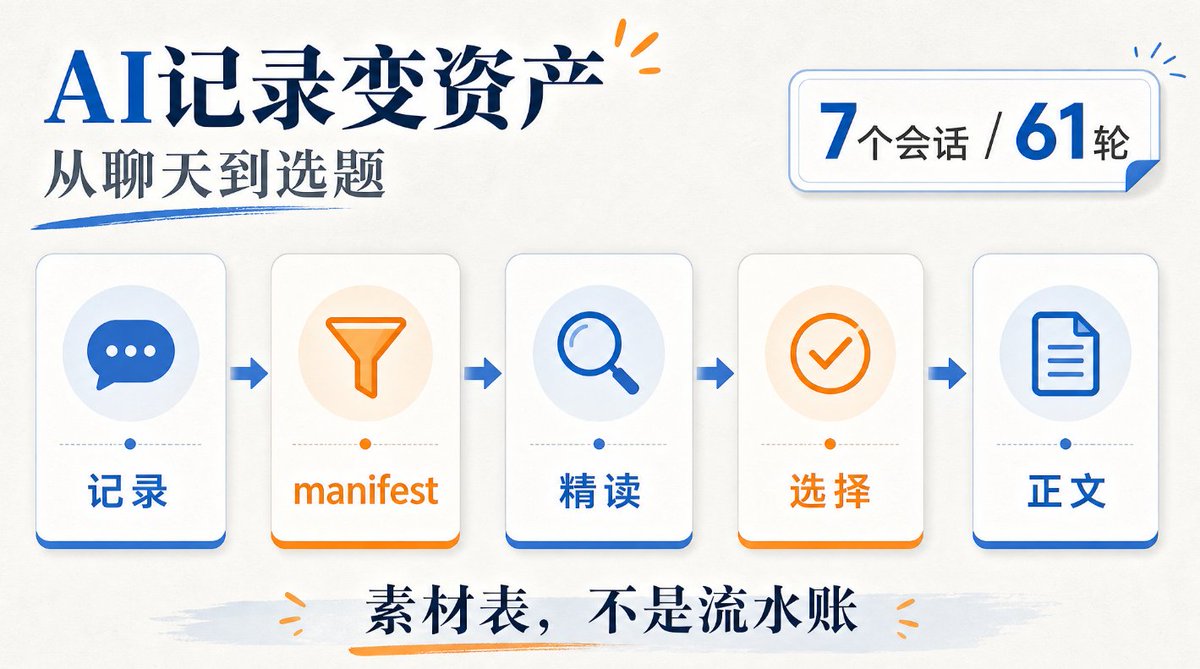
The process is: first compile all AI work records (some need to be decrypted), then generate a lighter manifest, then only look at the manifest for rough screening, and finally return to the original records for in-depth reading of candidate materials.
The key here is not to “let AI summarize what was done yesterday.”
That would be too rough.
What is truly useful is to first lower the reading cost. The original JSON is very large, containing complete answers, tool calls, paths, logs, and processes. If you dump all of it to AI at once, it will be overwhelmed by the details and may easily mistake ordinary operations for topics.
The manifest retains only a few things:
What the user asked at the time.
The beginning and end of the AI response summary.
What tools were used.
How long this round of content is.
If there are obviously low-value instructions.
Thus, the first round only does one thing: find "events worth writing about."
For example, the filtered results are not just “ran a certain script” kind of logs, but several categories of things that can actually be written: the reconciliation criteria of the trading system was wrong, `market_missing` actually denotes that the market was not found, the tweet's accompanying image was not about changing the model first.
They all have one thing in common: there are specific events, there is content, and there are final processing solutions.
That is the material.
The next step is to return to the raw JSON for in-depth reading of candidate rounds, extracting key numbers, user follow-up questions, locating processes, and deriving final conclusions. Finally, generate a topic report for selection by people.
After people have made their selections, the choices will also be written back to the front of the report.
This step is small but very important. Because it connects "what AI recommended" and "what I ultimately chose." The next time you review, instead of facing a pile of chat records, you will have a complete chain:
Record -> Rough screening -> In-depth reading -> Topic selection -> Manual selection -> Main text.
I increasingly feel that AI work records themselves are a type of content mine.
But a mine doesn’t turn into an article by itself.
You need to first create a material table that can be screened, reviewed, and further processed. Otherwise, it is just evidence of being busy yesterday, not an asset usable today.
免责声明:本文章仅代表作者个人观点,不代表本平台的立场和观点。本文章仅供信息分享,不构成对任何人的任何投资建议。用户与作者之间的任何争议,与本平台无关。如网页中刊载的文章或图片涉及侵权,请提供相关的权利证明和身份证明发送邮件到support@aicoin.com,本平台相关工作人员将会进行核查。


