Culper Research releases a detailed analysis on shorting Nvidia ($NVDA)
Culper Research is an American activist short-selling organization, and their model is very simple: first, they establish a short position, then they publish investigative reports attacking the listed company's financials, operations, regulations, related party transactions, or disclosure issues.
Therefore, Culper's reports are not neutral research but rather a part of trading.
However, the real value of such institutions is digging up abnormal clues that the market has overlooked, but from my personal understanding, it may more influence the short target's short-term price, while long-term performance still depends on the company itself. Especially for a company like Nvidia, which is at the forefront of AI.
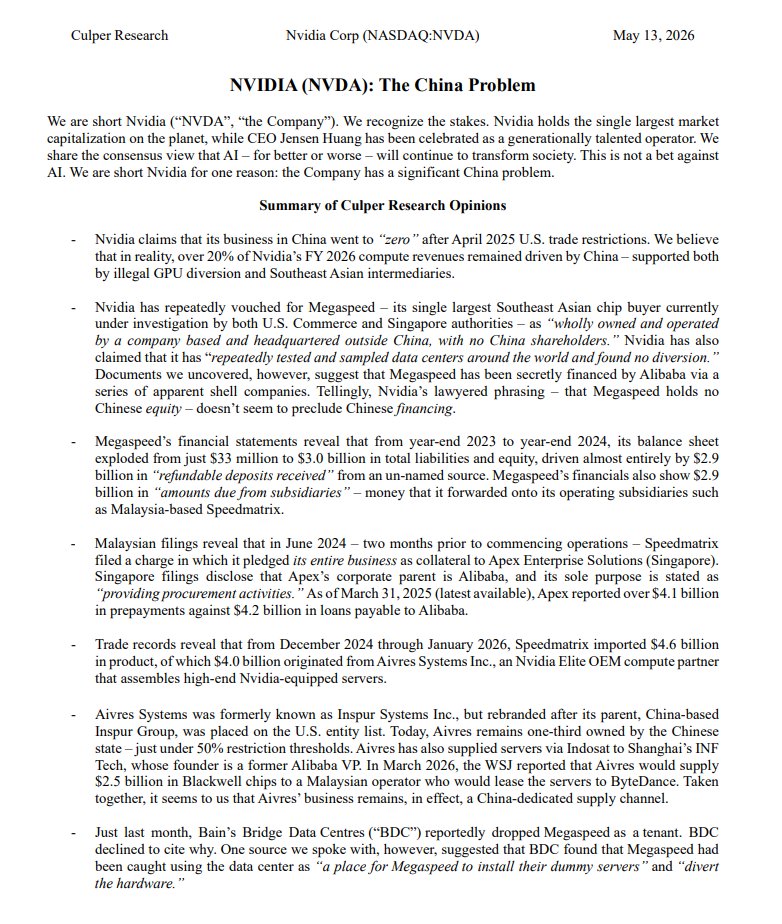
This time, Culper shorted Nvidia with a core statement that Nvidia's Chinese business might not be truly worthless. The implication is that Nvidia might not have fully complied with U.S. restrictions on China.
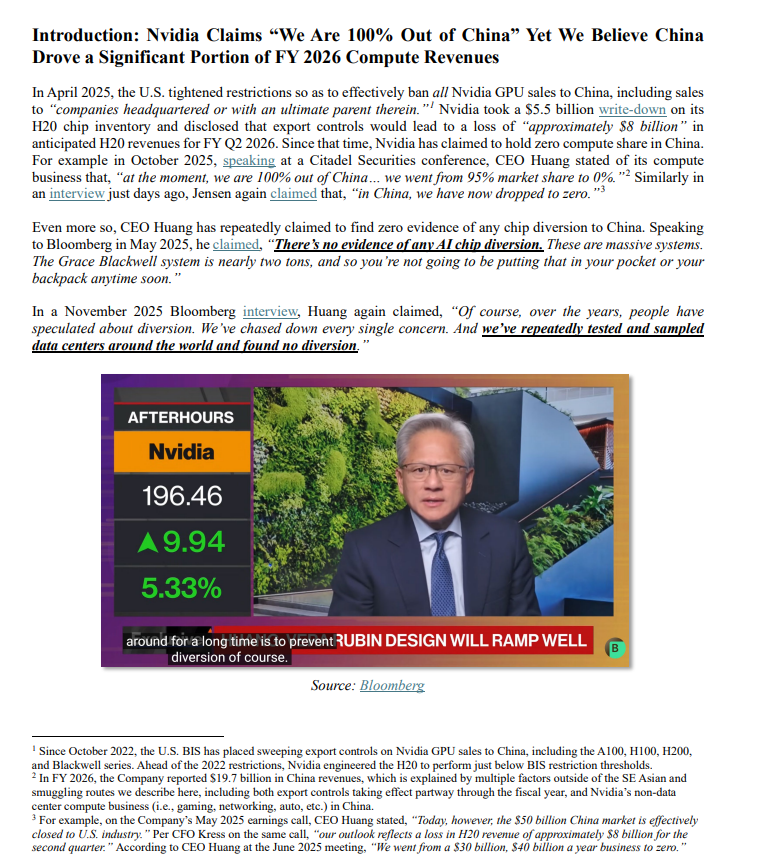
Nvidia's public statement to the market is:
After the U.S. tightened export restrictions in April 2025, the company's computing business in China has basically gone to zero. Jensen Huang has repeatedly stated that Nvidia's compute business in China has dropped from nearly 95% market share to zero.
As a result, the market would think:
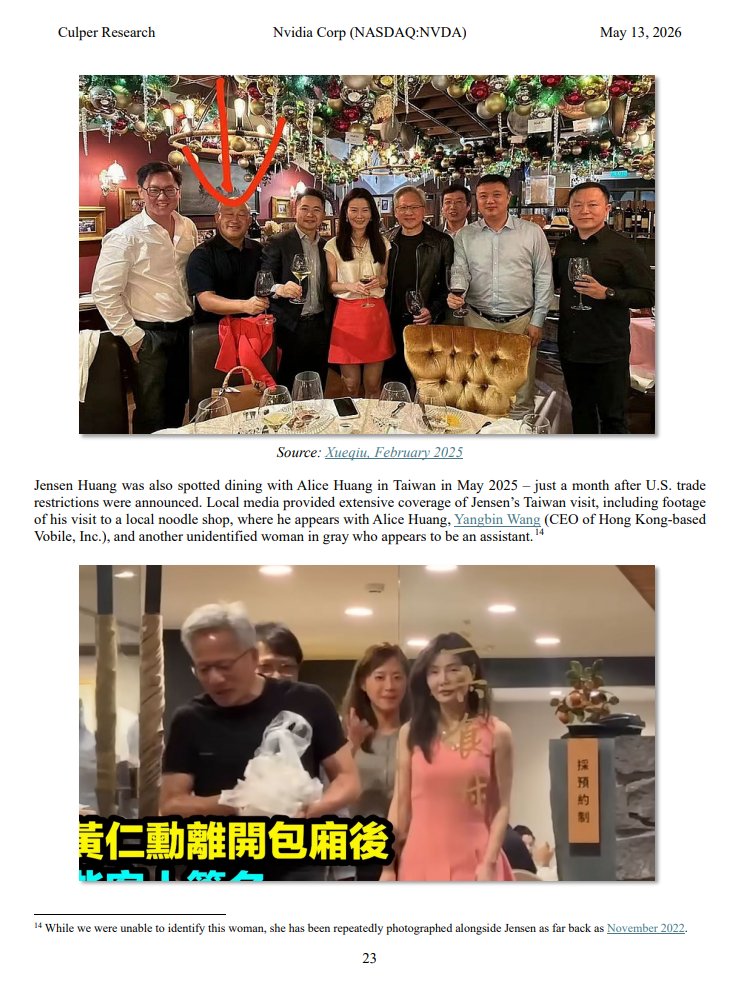
Since the Chinese business is gone, if U.S.-China relations ease in the future, or export restrictions loosen, China could be an additional increment for Nvidia. Especially since Jensen Huang also joined the delegation visiting China at the last moment, which could help open up Nvidia's sales in China.
But Culper's judgment is exactly the opposite; Culper believes that the demand from China has not disappeared; it has simply transformed from direct sales to Southeast Asia transshipment, cloud computing power leasing, OEM supply, and intermediary procurement.
In other words, what you see as revenue from China in Nvidia's financial reports may not actually reflect the true demand, which could still come from Chinese customers.
The most important clues from the Culper report are:
First, Megaspeed
Megaspeed is a Singapore-based AI computing power cloud service provider, ostensibly purchasing Nvidia servers in Southeast Asia and then leasing computing power to customers.
Nvidia has endorsed Megaspeed, stating it has no Chinese shareholders and found no evidence of chip transfers. But no Chinese shareholders do not mean no Chinese funding.
By the end of 2023, Megaspeed was still small, but by the end of 2024, its balance sheet suddenly ballooned to nearly $3 billion, primarily from $2.9 billion in refundable deposits.
At the same time, it had nearly $2.9 billion receivables from its subsidiaries, with funds continuing to flow to its Malaysian subsidiary Speedmatrix.
Second, Speedmatrix and Alibaba-related funding chain
Culper pointed out that Speedmatrix once pledged its business, equipment, and future assets to a Singaporean company, Apex Enterprise Solutions.
Documents from Singapore show that Apex’s parent company is Alibaba Group, with business purposes including procurement activities. Apex has more than $4.1 billion in advance payments, along with about $4.2 billion from loans related to Alibaba companies.
Therefore, Culper's inference is that Alibaba-related funds might enter the procurement structure through Apex and then purchase Nvidia servers via Megaspeed and Speedmatrix's system.
Third, Aivres
From the end of 2024 to early 2026, Speedmatrix imported about $4.6 billion worth of products, of which about $4 billion came from Aivres Systems. Aivres is an elite OEM compute partner of Nvidia, responsible for assembling high-end Nvidia servers.
However, Aivres was formerly Inspur Systems, which is part of the Inspur group. After Inspur Group was placed on the U.S. Entity List, Inspur Systems rebranded as Aivres.
Culper believes that Aivres appears to be a compliant OEM partner based in the U.S., but the relationship between it and the demand of China is highly sensitive. If Nvidia sells goods to Aivres, this may be reflected as revenue from U.S. customers in their financial reports.
However, if these servers ultimately serve Chinese customers through pathways in Malaysia, Singapore, Indonesia, etc., the regional revenue distribution that the market sees may underestimate Nvidia's reliance on actual demand from China.
Fourth, the Supermicro / OBON case
In March 2026, the U.S. Department of Justice filed charges against several individuals related to Supermicro, accusing them of smuggling at least $2.5 billion worth of Nvidia chip servers to China through Southeast Asian intermediaries.
This case is very important to Culper as it proves that Southeast Asia transshipment + false data centers + real server transfers to China are not fantasies, but actual cases that have entered judicial procedures.
Fifth, Malaysian data centers
Culper believes that Southeast Asian data centers are key nodes to bypass export restrictions. The U.S. restricts direct exports of high-end GPUs to China. However, if GPUs are placed in data centers in Malaysia, Singapore, Thailand, etc., and Chinese companies remotely lease computing power, formally it may not be chip exports, but essentially it still meets China's AI demands.
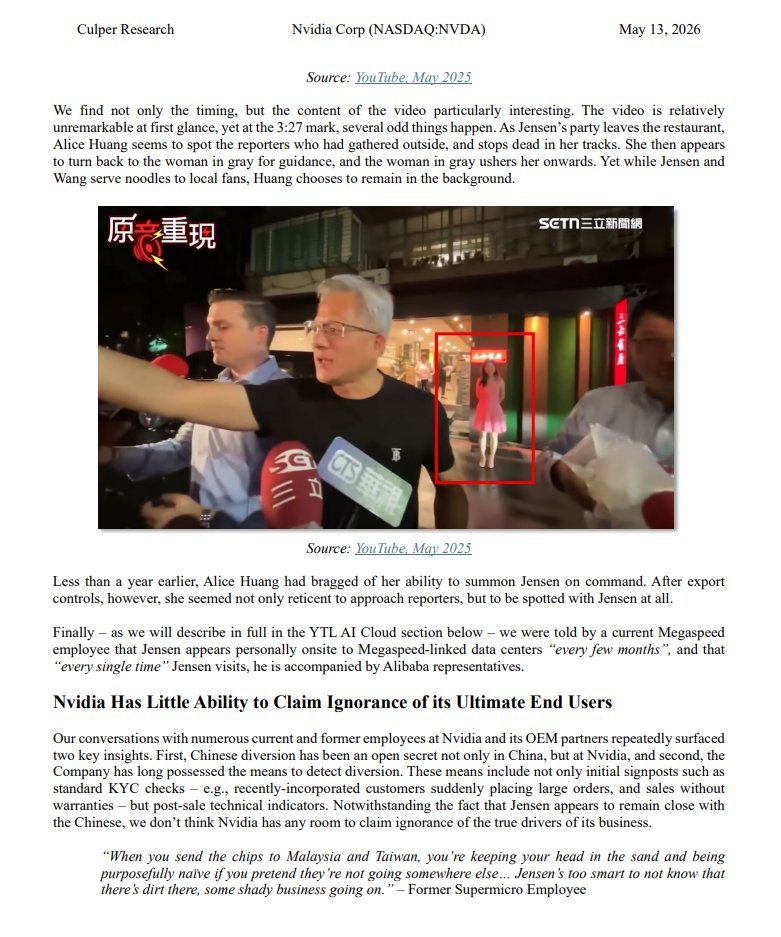
This is the complexity of Nvidia's issues in China. The issue is not whether chips have been directly imported into China. Rather, it is whether computing power has been actually utilized by Chinese customers. This is also Culper's most serious accusation against Nvidia, which is that Nvidia cannot be completely unaware.
Because theoretically, Nvidia can determine through customer KYC, order scale, customer establishment time, warranty records, server IP, software updates, latency data, device heartbeat signals, etc., whether GPUs are actually operating at the reporting location.
If tens of thousands of GPUs claim to be deployed in Malaysia and Singapore, but the actual usage path is abnormal, Nvidia should have some awareness. If Nvidia knows, condones, or allows this, it would turn into issues of export control, revenue quality, and management credibility.
Of course, at this stage, the situation becomes more complicated because proving Nvidia's subjective knowledge is very high threshold. Knowing and being able to know are entirely different matters.
Therefore, the true purpose of this report is not about whether Culper can convict Nvidia, but whether subsequent regulators will take over the investigation.
If the U.S. Department of Commerce, the Department of Justice, Singapore, and Malaysia continue to investigate Megaspeed, Speedmatrix, Aivres, YTL, Novagate, these chains, then it would not be merely a short report, but a regulatory event.
Overall, Culper's core logic for shorting Nvidia is that the market believes China is a potential increment for Nvidia's future. Meanwhile, Culper believes China is actually a hidden stock for Nvidia over the past year.
If the Chinese business has already gone to zero, then future relaxation of restrictions is a positive. But if the Chinese business has only been hidden in Southeast Asia, OEM, and cloud computing channels, then when the U.S. continues to tighten export controls and China promotes domestic alternatives, Nvidia would not face a disappearance of increments but rather a severing of hidden stocks.
This is the true logic behind Culper's shorting of Nvidia.
免责声明:本文章仅代表作者个人观点,不代表本平台的立场和观点。本文章仅供信息分享,不构成对任何人的任何投资建议。用户与作者之间的任何争议,与本平台无关。如网页中刊载的文章或图片涉及侵权,请提供相关的权利证明和身份证明发送邮件到support@aicoin.com,本平台相关工作人员将会进行核查。


