Attention to those who are shorting WTI (CLUSDT)‼️
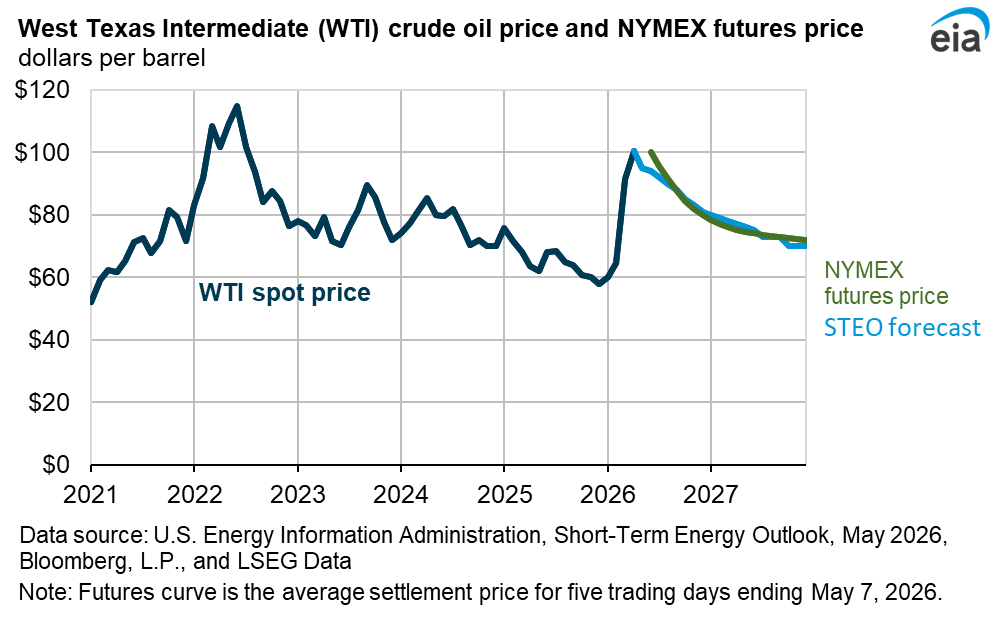
The U.S. Energy Information Administration (EIA) has just released a set of data today, reducing the 202 year average price expectation for WTI crude oil from the previous $87.41 per barrel to $85.68 per barrel, and lowering the 2026 average price expectation for Brent crude oil from the previous $96 per barrel to $94.85 per barrel.
The current price of WTI is $102.39, and the price of Brent is $107.81.
This is mainly because the EAI believes that the Strait of Hormuz will be able to resume passage by the end of May.
The EAI's concept is that since the military operation began on February 28, the Strait of Hormuz has essentially been in a de facto closed status, and by the end of May, it will have been nearly three months. This duration is long enough to cause a rapid decline in global inventories, refinery turnover, shipping detours, and forced compression of Asian demand.
In other words, the EAI does not have any internal documents indicating that the Strait of Hormuz will definitely be open by the end of May, but rather believes that the current global oil situation is insufficient for Iran to continue blocking the Strait of Hormuz.
To put it simply, if Iran continues to block the Strait of Hormuz, more countries may join the ranks of those resisting Iran. China, India, Japan, South Korea, and Europe are not parties hoping for a long-term closure of the Strait of Hormuz.
For Iran, blocking the Strait of Hormuz can create pressure on oil prices, force the United States, Israel, and Gulf countries to bear costs, and amplify its geopolitical leverage. However, if it continues to do so, more countries will transition from being bystanders of the conflict to being forced victims.
At that time, Iran may face not only military pressure from the United States but also diplomatic, sanction, and shipping pressures from more energy-importing countries, and even larger-scale maritime escort and military intervention.
Therefore, Iran's short-term blockade of the Strait of Hormuz is a form of deterrence. A long-term blockade of the Strait of Hormuz would transform itself from a negotiating chip into a common threat to global energy security. This is why the EIA has set the end of May as a critical time point.
This is also why, when WTI is above $100, once the war premium begins to loosen, the speed of price decline may be very rapid.
免责声明:本文章仅代表作者个人观点,不代表本平台的立场和观点。本文章仅供信息分享,不构成对任何人的任何投资建议。用户与作者之间的任何争议,与本平台无关。如网页中刊载的文章或图片涉及侵权,请提供相关的权利证明和身份证明发送邮件到support@aicoin.com,本平台相关工作人员将会进行核查。


