The U.S. stock market is still setting new highs, and there is no controversy about it.
As of May 11, Eastern Time, the S&P 500 rose 0.2%, closing at 7,412.84; the Nasdaq rose 0.1%, closing at 26,274.13, continuing to refresh its historical closing high.
But strong does not equal easy to operate.
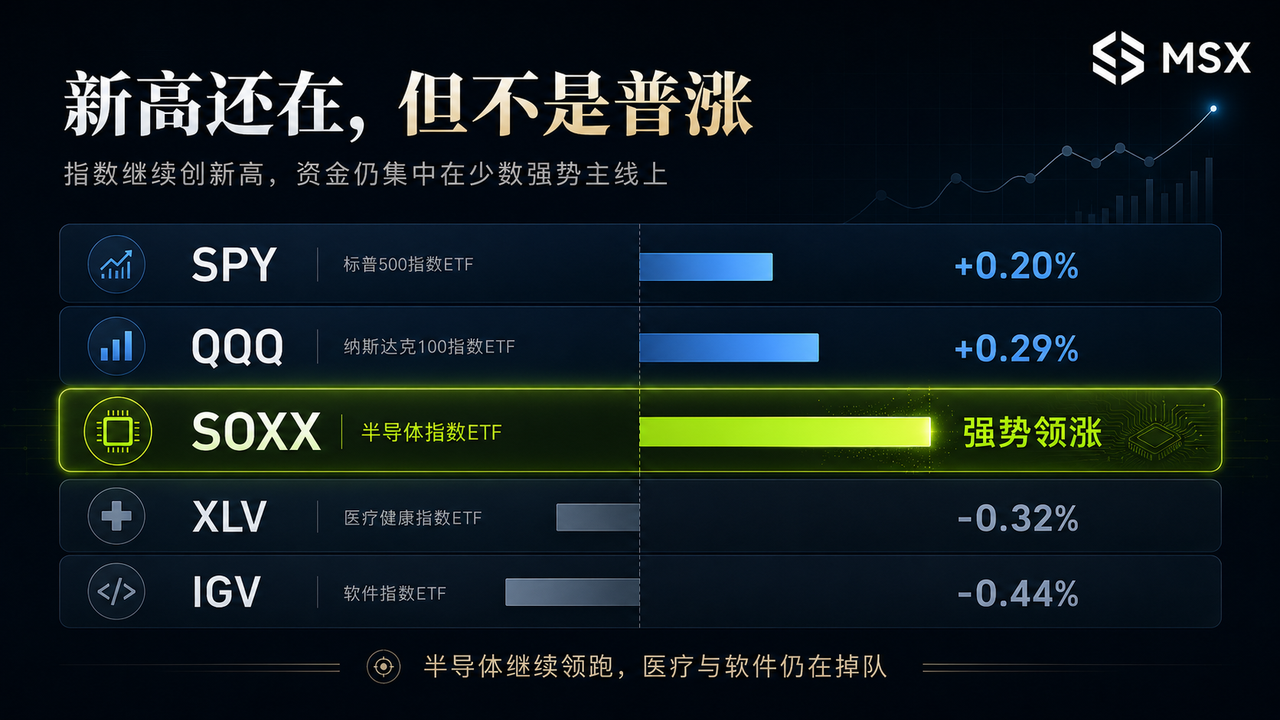
The current issue is not whether the index is rising, but who is rising—those that continue to push the index upwards are still the same few main lines, namely AI, chips, semiconductors, and data centers. For example, on May 11:
- The Philadelphia Semiconductor Index rose 2.6%, Intel (INTC.M) rose 3.6%, Qualcomm (QCOM.M) rose 8.4%;
- ETFs showed even clearer differentiation, SPY.M rose 0.20%, QQQ.M rose 0.29%, SOXX.M rose 1.74%;
- But healthcare ETF XLV.M fell 0.32%, software ETF IGV.M fell 0.44%;
If we look at the Maitong asset pool, these core ETFs and related stocks already have a clear trading mapping, which has long clarified the market. Semiconductors are still climbing, and the AI hardware chain is still attracting cash; funds are only willing to pay a high premium for the strongest lines, while healthcare and software are lagging behind, and other sectors are increasingly resembling a backdrop.
In Maitong's view, the current focus of market trading is no longer whether the index continues to rise, but whether the structure and breadth behind the rise can support the subsequent market. We are currently in a very typical state of a high market: funds are still willing to go long, but only for the most certain, crowded, and strongest elements.
To put it plainly, the market has not turned off its risk appetite, but it no longer intends to allocate risk budgets to most stocks. Therefore, when looking at the U.S. stock market now, it is essential not only to look at the index; the stronger the index, the more necessary to examine the structure; the more new highs there are, the more the breadth must be considered.
Because the real problem at high levels has never been that the index is not rising, but that the index is still rising while the places to make money are becoming fewer and fewer.
1. Is the U.S. stock market at its peak?
What many people are currently struggling with is not being wrong about the direction but having positions that feel off.
Sell and fear being squeezed further; don't sell, and worry that a pullback will erase previous profits.
This is also the most authentic typical state of a high market. Because the trend has not deteriorated, the main lines are still there, AI has not stalled, semiconductors have not weakened, and tech weights are still lifting the index upwards. As long as the group is not disbanded, the U.S. stock market will not fall automatically because it "looks too expensive."
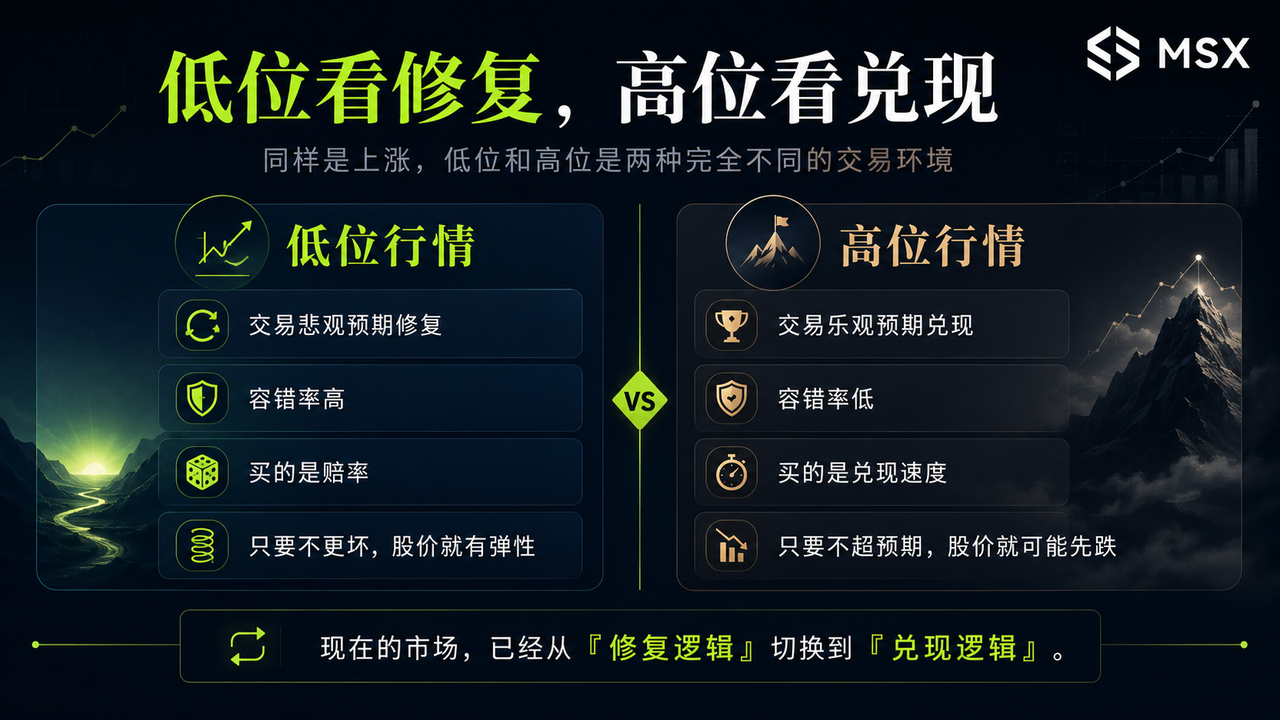
The problem is that the current rise is no longer the rise of a low repair phase. When at low levels, the market is trading the repair of pessimistic expectations; after all, as long as things do not continue to worsen, stock prices have elasticity; at high levels, the market is trading the realization of optimistic expectations; as long as there aren’t continued positive surprises, stock prices may fall first.
These are two completely different markets.
Low levels allow for errors, while high levels hardly tolerate mistakes. In other words, at low levels, you are buying odds, worrying about whether it will rise; at high levels, you are buying the speed of realization, worrying about why it should go higher.
So, objectively speaking, the last thing you should do now is to continue pushing your positions forward with the mindset of a low market. Because once earnings are not strong enough, orders are not fast enough, gross margins do not hold, capital expenditures are below expectations, or inflation and interest rates rise again, the directions that have risen most sharply often become the first to be smashed.
This is not because the logic suddenly disappeared, but because the price has already factored in the most optimistic part of that logic ahead of time.
In short, now is not the time to guess the peak; it is time to reassess positions.
As for whether the U.S. stock market has peaked?
I do not believe we can directly conclude that "the U.S. stock market has peaked" at this moment; it is too early to say this—after all, the trends have not deteriorated, the main lines have not deteriorated, and the funds have not dissipated.
But these three "have not deteriorated" do not mean you can do nothing. What we should truly guard against now is not a sudden crash this afternoon, nor a direct turn to bear tomorrow.
What we should genuinely guard against is a more significant and concentrated pullback sometime in the second half of the year.
The reasons are not complicated.
This round of the market has risen too concentratedly; for example, AI expectations have been fully priced in, the elasticity of semiconductors has been fully traded, options funds are too active, and interest rates and inflation have not really provided a sufficiently comfortable environment for overvalued assets.
As long as these conditions continue to coordinate simultaneously, the index can certainly push higher.
But the problem is also here; the current rise increasingly relies on "no conditions going wrong." As long as one link breaks, the market may shift from "continuing to squeeze" to "concentrated pullback."
Especially since the pricing now is very particular. The market is no longer trading whether "AI will grow" as a first-level judgment but whether AI can consistently exceed expectations, whether semiconductors can continually be stronger than expected, whether capital expenditures can continuously be revised upwards, whether large orders can sustain delivery, whether high valuations can continue to be supported by even higher expectations...... this is the most challenging aspect at high levels.
It is not that bad companies will fall; even good companies can fall; it is not that main lines lack logic; it is that main lines are too expensive, expensive enough that even slightly underperforming is unacceptable.
Thus, what is most important at this position is not to shout "bear," nor to continue to hype oneself up, but rather to first reduce the net risk in your portfolio.
2. How to operate in the current situation?
In a word, keep what should be kept, and reduce what should be reduced.
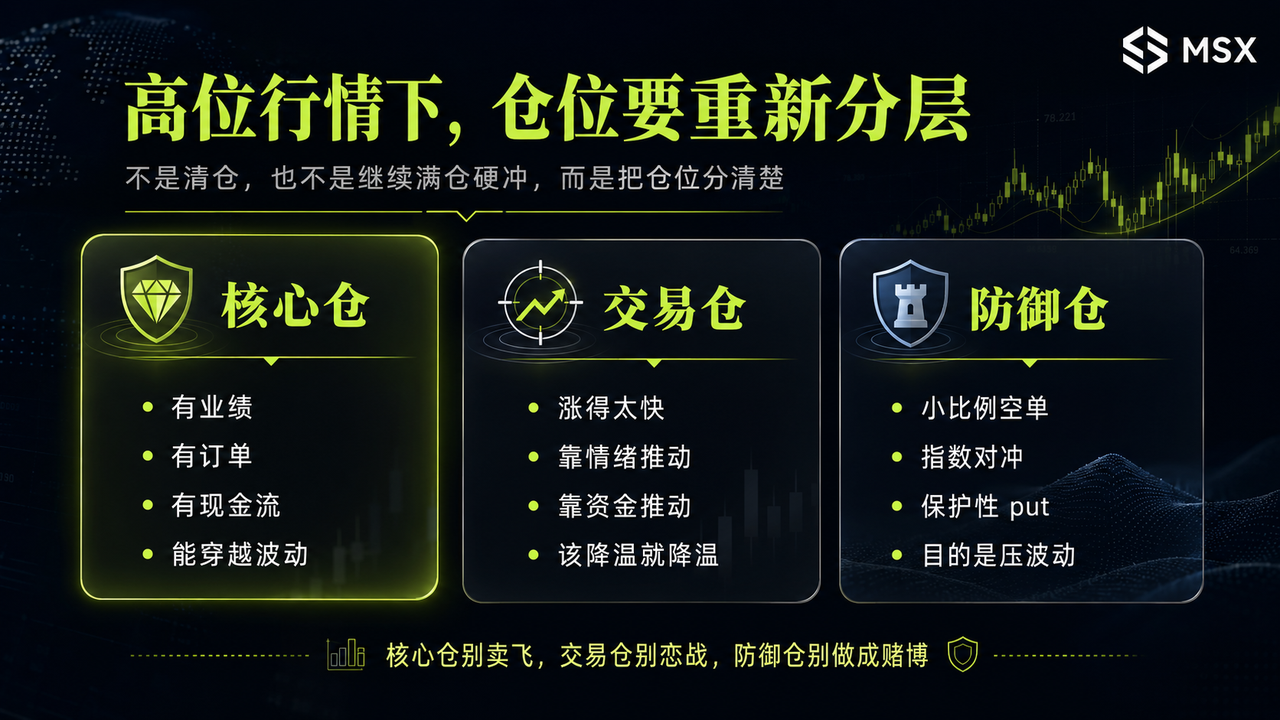
The most important thing next is to re-layer the positions; in essence, not all rising positions should be held in the same way.
For instance, core assets that genuinely have performance, orders, cash flow, and industry positions should not be entirely cleared out because of "fear of high positions," because the most common and expensive mistake in a bull market is not losing money, but selling the real main line too early and then not daring to buy back.
However, trading positions cannot be handled this way. Positions that have increased too quickly and relied mainly on sentiment and funds to push up cannot continue to use long-term logic as an excuse. They are inherently trading positions and should be handled as such:
- Fast rises with volume but cannot hold, can be reduced;
- Index new highs but it does not follow, can be reduced;
- Breaking short-term trend positions should not be stubbornly held;
The most common mistake in high markets is not misjudging the direction but treating trading positions as core positions and viewing short-term profits as long-term beliefs.
These two matters may sound like mindset issues, but they are fundamentally account issues. Core positions can endure volatility because you are buying fundamentally stronger companies with longer logic; trading positions cannot, and once a trading position loses elasticity, it is no longer a position but a burden.
So what should be done now is not to handle all positions together, but to first clarify which positions you are willing to hold through volatility; which positions you are just hesitant to move because they have risen quickly and vigorously.
The former can be kept, while the latter should cool down.
Additionally, we must pay even more attention to languishing stocks.
For instance, on May 11, SOXX.M rose another 2.39%. What does this indicate?
It indicates that the AI hardware chain has not stalled; the strongest market style continues to prevail, and the group has not dispersed. However, also because the strongest direction is still pushing, we should pay attention to those stocks that are struggling to rise.
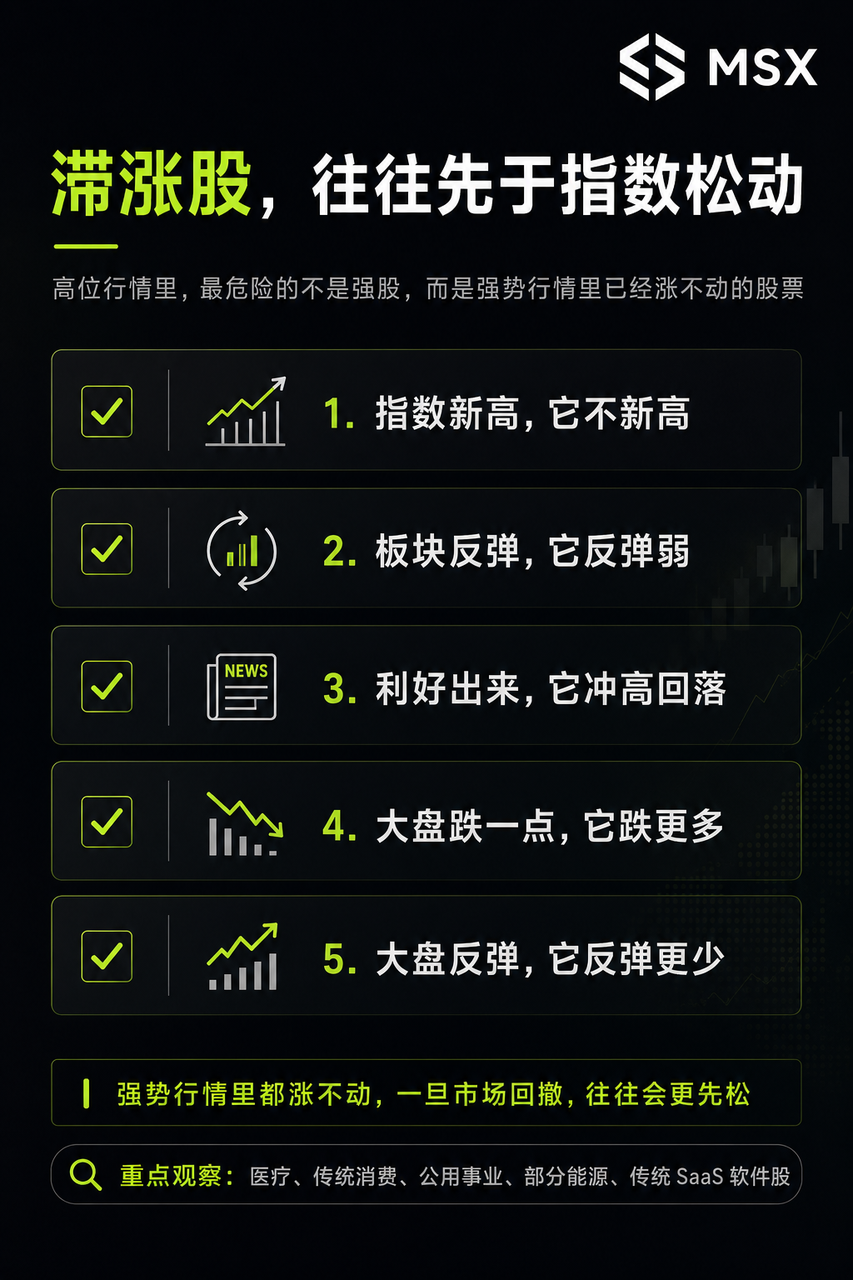
In high markets, the most dangerous things are never what everyone knows to be strong. The real danger lies with stocks that do not catch new highs when the index sets new highs, do not rebound strongly when sectors rebound, and fall back after good news is released.
These languishing signals are not complicated:
- New highs for the index, but it does not set new highs;
- Sectors rebound, but it weakly rebounds;
- Good news comes out, but it rises only to fall back;
- The market falls slightly, and it falls even more;
- The market rebounds, and it rebounds even less;
These kinds of stocks are already very dangerous in a strong market.
Because they cannot rise even when the market is good, once the market pulls back, they often do not participate in the rise but fall first; therefore, healthcare, traditional consumer, utilities, parts of energy, and traditional SaaS software stocks can all be placed in the observation pool for languishing stocks.
Software especially deserves to be singled out. In this round of the AI market, software is not entirely without opportunities, but the valuation logic of traditional SaaS is increasingly becoming unstable; companies like Salesforce (CRM.M), Adobe (ADBE.M), ServiceNow (NOW.M), and Intuit (INTU.M) are certainly not bad companies.
The problem is not the quality of the companies, but that the market is starting to reconsider a question: will AI help them raise prices, increase revenue, and create new demand, or will it reverse and weaken the old story of charging per seat and premium per tool?
In other words, the software sector is no longer rising together.
Funds are now looking very closely at who can turn AI into new revenue; who is merely borrowing AI to survive; who can maintain valuations; and who is merely the high valuation legacy of the old model.
Therefore, moving forward, one must not only focus on the strongest stocks but also observe languishing stocks, as strong stocks determine whether the index can stabilize, while languishing stocks determine where the pullback will begin first.
3. The necessary hedge is defense
At this stage, there can be defensive positions in the portfolio, but defensive positions are not for betting on an immediate market reversal.
If you have heavy long positions and do not want to sell your core positions straight away, you can hedge volatility with small proportion short positions, index hedges, or protective puts.
The focus is on "small proportion" and "hedging volatility."
In plain terms, you are not supposed to go all-in short; more importantly, it is not betting that the market will crash tomorrow. The significance of short positions here is to buy insurance because another common mistake many make at this stage is to see languishing stocks and think they can use them as a primary defense; this may not be correct.
Languishing stocks can be included in the observation pool, and small positions can be made as auxiliary shorts after confirmation of breakdown, but they may not be the best core insurance for your portfolio.
Because what defensive positions truly need to hedge against is not what you dislike, but what you are most afraid of falling.
If your main risk comes from QQQ.M, semiconductors, and AI tech weights, then what you genuinely need to hedge against should also be the pullback from these directions, for example, if you are afraid of a Nasdaq pullback, then look at QQQ.M; if you are afraid of semiconductor pullbacks, then look at SOX related directions; if you are concerned about excessive concentration in individual stocks, then start reducing high-elasticity positions yourself.
The most taboo at this moment is to hold crowded technology main lines while simultaneously shorting a medical or consumer stock that has been weak for a long time, thinking that you have completed a hedge.
That is not defense, but merely betting in a different place.
Always remember, the goal of defensive positions has never been to make big money but to ensure that your portfolio is not too uncomfortable when the tough times come.
4. The test on May 15 and the outlook for the second half of the year
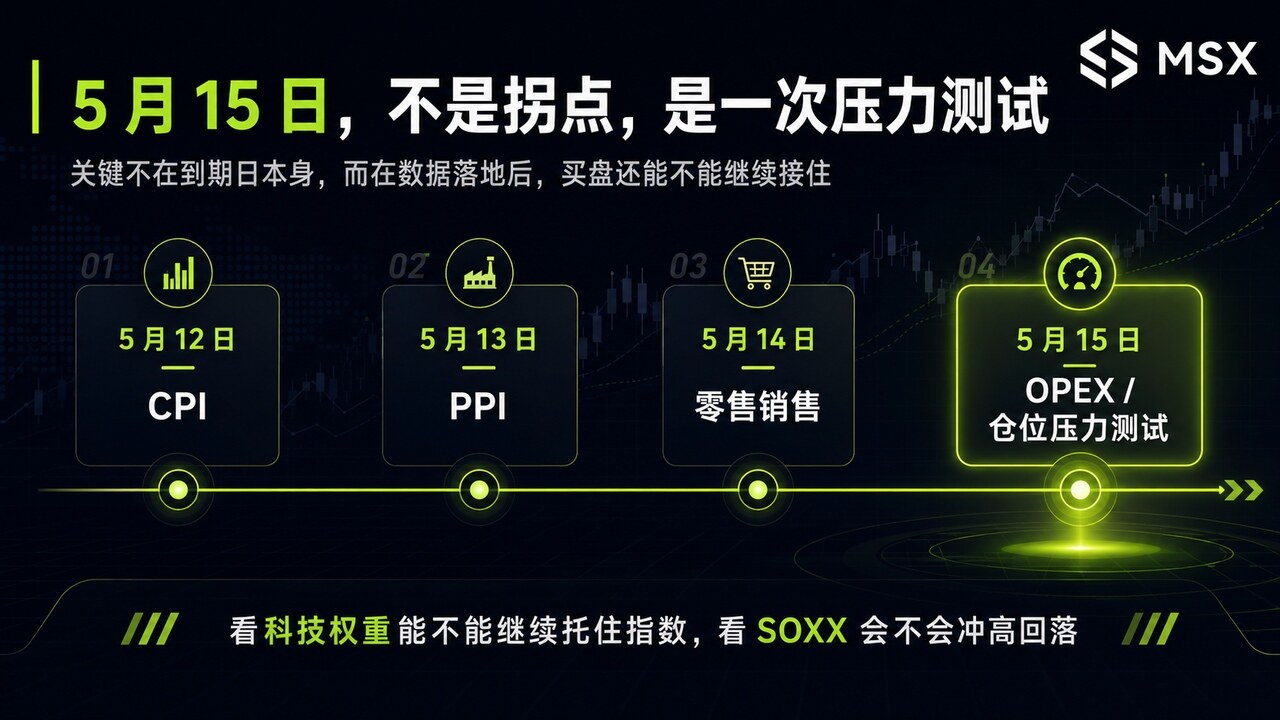
Looking forward in the short term, May 15 is an unavoidable window.
The reason is not mysterious; it is surrounded by a string of important variables—this day is the expiration date for May standard options, also known as OPEX; meanwhile, index options like SPX and XSP have long moved beyond purely monthly expirations, and the market’s reliance on 0DTE and short-term options is growing stronger.
Thus, option expirations are inherently more worth following than in the past.
However, the real importance of May 15 does not lie in whether "the market will fall that day," but that it just happens to fall after a series of key data points: April CPI will be announced on May 12 at 8:30 AM Eastern Time; April PPI will be announced on May 13 at 8:30 AM; and April retail sales are scheduled for May 14 at 8:30 AM.
In other words, the market will first process inflation, production-side prices, and consumption data before entering the options expiration window. This combination is sensitive enough.
If the CPI and PPI are not hot and retail sales do not strengthen enough to push interest rates back up, if tech weights remain stable and semiconductors continue to be strong, then May 15 may more likely just be a high-level fluctuation, and even the bulls may use the expiration structure to push upward.
But if the data is on the hot side, if interest rates rise again, and combined with pullbacks in QQQ.M and SOXX.M, the parts that rose based on short-term options and chasing funds might conversely amplify volatility.
Therefore, May 15 is not a "certainly down day," but it resembles a stress test:
- Testing whether tech weights can continue to support the index;
- Testing whether semiconductors can continue to be the strongest main line;
- Testing whether there will be new buying support after options expiration;
- Testing whether languishing sectors will loosen up first;
The real issue is not whether the market will drop on May 15, but whether there will be new money in the market afterward, and whether it will be willing to support prices at such high levels.
I am not in a hurry to say the U.S. stock market is about to peak, but I will cautiously guard against a significant pullback in the second half of the year, because the current market is indeed strong, but it is also expensive.
The trend has not deteriorated, but a large number of optimistic expectations have already been priced in. What needs to be validated in the second half of the year is not that kind of vague, big problem.
It is not about whether "AI is the long-term direction," such questions have long been answered by the market; what requires validation now are more concrete and harsh facts: Can orders continue to accelerate? Can revenue genuinely materialize? Can gross margins hold? Can cloud service CAPEX continue to be revised upward? Can interest rates cooperate with high valuations? Can funds continue to group together, etc.? As long as these conditions continue to align, the market will undoubtedly continue to rise.
However, if even one link is not strong enough, the pullback speed could very likely be faster than many people imagine because we are no longer in a market supported by cheap prices, but in a market supported by expectations.
A cheap market can fall back with valuations as a cushion; a market filled with expectations often relies only on who can run faster when it drops. Therefore, moving forward, the most important thing is not to flee or continue to charge hard, but to adopt a different way of holding positions.
- Core positions should not be sold off easily; trading positions should not be clung to;
- High elasticity positions need clear discipline; languishing stocks should be reduced in weight;
- Defensive positions should be allocated in small proportions;
- Keep some cash on hand;
You can hold at high levels, but you must know precisely what you are holding, whether it is based on long-term logic or short-term emotion; whether it is an asset that can endure volatility, or a position pushed up by a wave of emotion; whether the fundamentals are still being realized, or whether prices have already outrun realizations.
For users who want to continuously track these main line changes, relevant targets have now been launched on the MSX platform, and we will continue to follow the evolution of the main lines and the rhythm of the targets.
In conclusion, the real takeaway from this article is quite simple: after the new highs of the U.S. stock market, the most challenging part is no longer watching the direction but managing positions.
免责声明:本文章仅代表作者个人观点,不代表本平台的立场和观点。本文章仅供信息分享,不构成对任何人的任何投资建议。用户与作者之间的任何争议,与本平台无关。如网页中刊载的文章或图片涉及侵权,请提供相关的权利证明和身份证明发送邮件到support@aicoin.com,本平台相关工作人员将会进行核查。


