Reviewing the nearly hundred-year history of the Federal Reserve's monetary policy, the long-held market saying of the "leadership change curse" is not unfounded. According to historical data statistics and model calculations from institutions such as Barclays, from 1930 to the present, the S&P 500 index has generally seen a phase drop in the six months following the appointment of a new Federal Reserve chair, with an average maximum drawdown of up to 16%. This recurring market volatility essentially serves as a practical test for global investors regarding the new Federal Reserve chair's policy baseline, communication style, and attitude towards inflation.
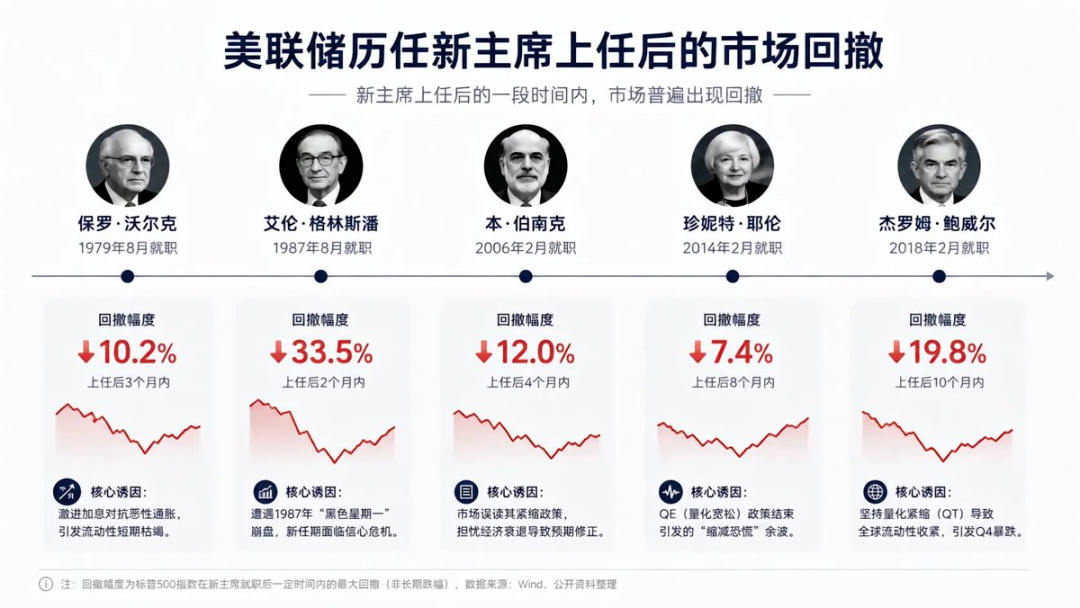
Market Performance Review in the Early Term of Past Federal Reserve Chairs
The transition of the Federal Reserve chair is often accompanied by shifts in policy ideas and control styles, causing market expectations to adjust, which in turn triggers phase market fluctuations. In the early terms of each new Federal Reserve chair, the US stock market has experienced varying degrees of pullback, as detailed below:
Paul Volcker (Took office in August 1979)
Within three months of taking office, the maximum drawdown of the S&P 500 index was 10.2%. Volcker was known for his tough monetary policy style and decisively suppressed high inflation by sharply increasing interest rates and tightening the money supply after taking office. Short-term market liquidity contracted rapidly, leading to a severe adjustment in the US stock market, resulting in a quick clearance of risks.
Alan Greenspan (Took office in August 1987)
Only two months into Greenspan's tenure, the market encountered a rare severe crash, with the S&P 500 index pulling back 33.5%. The "Black Monday" stock market crash of 1987 came unexpectedly and became the most severe market confidence shock faced by a new chair in the history of Federal Reserve transitions.
Ben Bernanke (Took office in February 2006)
Within four months of taking office, the S&P 500 index pulled back 12.0%. At that time, the market lacked sufficient understanding of Bernanke's proposedinflation targeting, with widespread concern that the Federal Reserve would continue to raise interest rates against the backdrop of a weakening economy. The quick reversal of market expectations directly led to a downturn in the US stock market.
Janet Yellen (Took office in February 2014)
Within eight months of Yellen taking office, the maximum drawdown of the index was 7.4%. Compared to previous terms, the policy transition during Yellen's era was relatively smooth, but with the formal exit of the quantitative easing policy, the lingering effects of the earlier "taper tantrum" continued to surface, resulting in noticeable market fluctuations again in October of that year.
Jerome Powell (Took office in February 2018)
During the ten months following Powell's appointment, the S&P 500 index experienced a maximum drawdown of 19.8%. In the early days of his tenure, Powell signaled a hawkish stance onbalance sheet reduction, leading to rapid tightening of market liquidity, which ultimately resulted in a deep adjustment in the fourth quarter of 2018, pushing the market close to a technical bear market state.
The Core Logic Behind the "Leadership Change Drawdown" Phenomenon
The reason that the Federal Reserve leadership change easily triggers market corrections is not a coincidental short-term market phenomenon; there are two sets of stable market logics supporting it:
First, establishing policy credibility requires market costs. To stabilize market inflation expectations and establish an authoritative image of inflation control, new chairs typically maintain a hawkish tone in the early stages of their tenure, with statements and policy actions leaning towards tightening. The rise in tightening expectations directly restrains stock market valuations, leading to market adjustments.
Second, there are frictional adjustments in market expectations. Each Federal Reserve chair has distinct communication styles, policy preferences, and control rhythms, making it impossible for the market to immediately adapt to new policy logics, which requires time to digest and validate the new policy framework. The process of expectation switching itself brings ongoing market volatility.
Market Outlook for 2026 Leadership Change
Looking ahead to 2026, Kevin Warsh is expected to officially take over as Federal Reserve chair in mid-May. Warsh has consistently been classified by the market as a "balance sheet hawk," with a strong stance on balance sheet reduction and liquidity control. Based on the century-long data patterns of leadership transitions, the market is likely to continue displaying **the characteristics of first adjusting and then recovering** in the coming six months.
For investors, the medium to long-term positions can be maintained steadily, but caution must be exercised regarding the liquidity repricing risks during the transition window, preparing in advance for the short-term market shocks caused by policy expectation changes, and calmly dealing with phase market fluctuations.
Public Account: Big Bull Says Market
Risk Warning: Historical market patterns do not guarantee future movements, and this article is intended solely for professional industry exchange and reference, not constituting any investment decision advice.
免责声明:本文章仅代表作者个人观点,不代表本平台的立场和观点。本文章仅供信息分享,不构成对任何人的任何投资建议。用户与作者之间的任何争议,与本平台无关。如网页中刊载的文章或图片涉及侵权,请提供相关的权利证明和身份证明发送邮件到support@aicoin.com,本平台相关工作人员将会进行核查。


