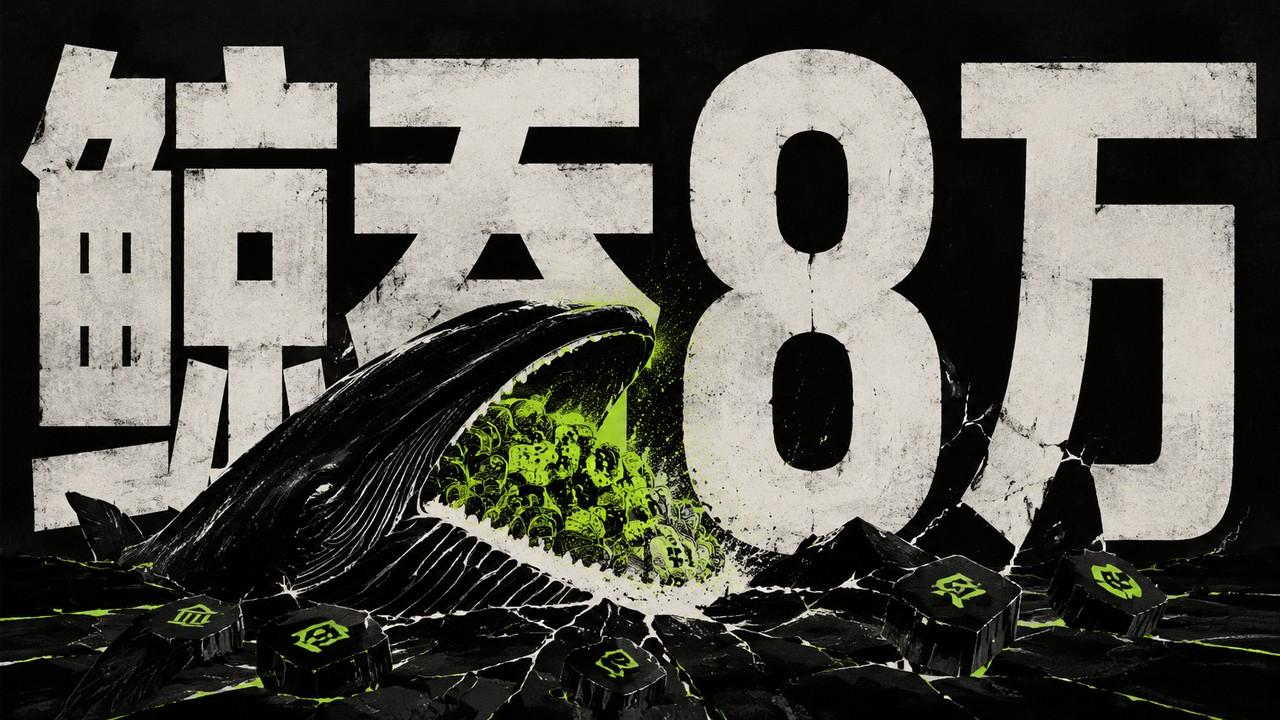
On May 9, 2026, the on-chain analysis institution Onchain Lens captured an exceptionally large transfer: an address marked as Garrett Jin deposited exactly 108,169 ETH into Binance. At the time's price, this amounted to nearly 250 million dollars, marking it as a “whale” stepping into deep waters at any point in time. Almost immediately after the monitoring report was released, several Chinese crypto media outlets including Odaily, Jinse Finance, Deep Tide TechFlow, and PANews quickly followed up, analyzing this on-chain transaction with the same figures and platform details, and collectively referred to Garrett Jin as “Bitcoin OG 10/11”—an early participant in the Bitcoin world who surfaced back in 2010-2011. Due to this identity label, the contrast of this operation was infinitely amplified: an address categorized as an early Bitcoin OG chose to stake a massive amount of Ether in a leading centralized exchange by global trading volume at this moment, raising various speculations from “asset reallocation” to “emotional turning point.” Historical experience tells the market that large holding addresses transferring chips to exchanges may lead to various paths, such as immediate selling, gradual reduction, hedging arrangements, or even re-transfer out, and this does not preset an outcome on its own. However, under the dual amplification of on-chain alerts and media dissemination, such actions are naturally viewed as significant signals and treated as variables that traders need to continuously monitor.
Transformation from Bitcoin OG to Ether Major Holder
The label “Bitcoin OG 10/11” is essentially a timestamp. In reporting on Garrett Jin, the media almost exclusively left this one note, which was enough to sketch a profile in readers’ minds: in 2010-2011, Bitcoin prices were still low, and the mining threshold was far lower than in subsequent years; just by entering early during that period and continuing to participate, it was possible to leave on-chain marks that subsequent generations would call “OG.” Thus, when a name uniformly described as “Bitcoin OG 10/11” reappeared in the headlines, the market automatically filled in the imagination that he might belong to the “early miners” or “long-term holders” group, while really verified details of his history were quite scarce.
From a longer time frame perspective, the roles of such early holders are also changing. After 2015, new public chains like Ethereum went live successively, and those holding early chips were no longer facing a single asset; they began to diversify across multiple public chains, gradually transforming from “an old miner of a single asset” into “a cross-chain, multi-asset major holder.” In every round of bull and bear cycles, terms like “early miner” and “OG” always emerge in market discourse, used to refer to those who consistently hold large chips across multiple cycles, yet rarely reveal themselves. When a wallet tagged as “Bitcoin OG 10/11” moves over a hundred thousand ETH on the Ethereum network today and is monitored by Onchain Lens, amplified by media like Odaily and Jinse Finance, the story's focus is no longer on how he mined his first Bitcoin back then, but on how this shadow of the old era mobilizes chips on the new public chain, with every cross-asset action seen as a potential starting point for changes in sentiment and structure.
The Impact Volume of 100,000 Ether Deposited into Binance
108,169 ETH on-chain is a cold, hard number, but when converted to approximately 250 million dollars at the reported price, it instantly embodies a chip substantial enough to shift the local market focus. More importantly, this is not the type of “ant migration” transfer split into dozens of transactions scattered across different platforms; instead, it is a one-time concentration deposited into a single Binance account—within the narrative framework of on-chain analysis institutions and media, such ultra-large transfers are extremely rare and can easily be highlighted as a signature event indicating “the whale's decisive action.”
For those accustomed to monitoring the markets, large assets entering centralized exchanges often equate to “walking out of the cold storage into a matching pool where orders can be placed at any time.” Chips originally lay in on-chain addresses, and as long as they don't enter exchanges, they appear more like passive inventory; once crossing this threshold, they are implicitly assumed by the market to enter the “waiting area,” ready to be thrown toward the buying side at any moment. Therefore, when this hundred thousand Ether was confirmed to have concentrated at Binance, the first emotional reaction was often—potential trading supply is increasing, and upward price resistance might be growing. However, it is important to clarify that on-chain records can only prove the act of “depositing” itself: no publicly reported data exists regarding subsequent orders, transactions, or derivatives hedging; historically, similar large inflows have also evolved into immediate sales, slow reductions, hedging arrangements, or even re-transfers. Solely relying on one deposit to stamp “sell” is more a projection of emotion than a factual determination; hence, this deposit of 108,169 ETH currently appears more like a large piece placed on the chessboard rather than a definitive move already made.
How Emotion Ferments After On-Chain Alerts Sound
The monitoring report released by Onchain Lens on May 9 was itself a spark to the market nerves. Over the past few years, mainstream traders have become accustomed to monitoring various “whale transaction alerts” services; when a mobile push notification sounds, they rush to see which large addresses are moving. When this alert was labeled with the combination of “Garrett Jin”, “Bitcoin OG 10/11”, and “108,169 ETH into Binance”, combined with the swift follow-up reports by Chinese media outlets like Odaily, Jinse Finance, Deep Tide TechFlow, and PANews, what began as merely a line of on-chain records was quickly placed on countless trading interfaces, K-line screenshots, and group chat dialogues, becoming the day’s most discussed “story material.”
In such a dissemination path, facts and emotions tend to be quickly intertwined. The objective information on-chain is limited to a few lines: whose label it is, how much was transferred, to which platform it went, and the research brief explicitly stating that “there is no reliable source to prove the specific purpose of this deposit.” However, once entering social media, these details are often automatically tagged with titles or comments like “possible dump” or “major holder fleeing”, and even packaged into seemingly certain conclusions such as “historical experience tells us” or “there must be follow-up actions with large sums entering exchanges.” Many investors, while scrolling through screens, subconsciously take these emotional labels as part of on-chain facts, thus amplifying their anticipated biases: some panic prematurely, while others attempt to “get ahead,” leaving even less room for calm judgment. For readers, what matters most at this point is not to rush into aligning with any particular narrative, but to strictly separate “what Onchain Lens reported” from “how others interpret it on social platforms,” based their decisions solely on the few lines of confirmed data.
Old Scripts of Major Holders Entering and Exiting Exchanges Are Revived
Like this case, large addresses pushing chips into exchanges have always been a classic episode in the crypto market. Looking back over the past few rounds of bull and bear cycles, on-chain analysis reports have repeatedly recorded similar scenes: some major holders choose to quickly sell after entering the exchange, causing a short-term price fluctuation; others show only once on-chain as “large entry into the exchange,” before slowly and gradually reducing their holdings internally within the exchange, effectively spreading the true selling pressure over time; there are also records indicating that large inflows paired with hedging operations or re-transfers leave only a “deposit” transaction on-chain while the specific risk exposure adjustments take place in invisible ledgers.
The differences in the macro environment, however, allow the same on-chain actions to present entirely different outcomes. During the 2020-2021 bull market, some actions marked as “miner addresses” or “early investor addresses” were emotionally interpreted by the market as “liquidation signals”, but later data showed that those addresses were simply selling a portion of their holdings; there are also cases that indicate large chips entering exchanges were not meant to exert direct selling pressure in the secondary market, but were instead participating in new coin subscriptions, or financial/staking products listed, or even just internal account transfers within the platform. These old scripts point to the same conclusion: a single on-chain transfer action does not inherently equate to a unilateral sell order, and the market often tends to imagine it as the only answer prior to the event, only to discover later that the price and sentiment paths taken are much more complex than the previously unified expectations.
What Signals to Observe After a Large Transfer
Returning to the starting point, as of May 9, 2026, the only two facts that have been repeatedly cross-verified are: first, Onchain Lens monitoring indicated that the wallet marked as Garrett Jin concentrated deposited 108,169 ETH into Binance, equivalent to 250 million dollars; second, several Chinese media outlets, including Odaily, Jinse Finance, Deep Tide TechFlow, and PANews, provided a high degree of agreement in their reports on key information such as the amount and platform. The research brief has explicitly listed the “purpose of deposit” as an information gap, prohibiting filling in blanks with speculations like “may be a sale” or “may be a hedge,” while other dates, amounts of so-called “associated transfers,” and Garrett Jin's more detailed history currently remain at Class C source levels, not constituting conclusive evidence. Under such information density, a more valuable perspective for observation is not to weave an immediately coherent story but to patiently wait for supplementary insights that unfold over time: on-chain, whether this address and its potentially associated addresses exhibit continuous entry and exit behaviors, chip splitting or re-aggregation; at the exchange level, whether future publicly available transaction structures, changes in holdings, or even data disclosed by platforms form verifiable correspondences with this transfer. It can be concluded that every action by early major holders like "Bitcoin OG 10/11" will continue to impact market sentiments, but to translate a 250 million dollar level entry action from emotional impacts into a convincing judgment on mid-to-long-term prices, the only path is to wait for more on-chain patterns and trading data to surface, rather than trusting the scripts that quickly circulate on social media.
Join our community, let's discuss and grow stronger together!
Official Telegram community: https://t.me/aicoincn
AiCoin Chinese Twitter: https://x.com/AiCoinzh
OKX Benefit Group: https://aicoin.com/link/chat?cid=l61eM4owQ
Binance Benefit Group: https://aicoin.com/link/chat?cid=ynr7d1P6Z
免责声明:本文章仅代表作者个人观点,不代表本平台的立场和观点。本文章仅供信息分享,不构成对任何人的任何投资建议。用户与作者之间的任何争议,与本平台无关。如网页中刊载的文章或图片涉及侵权,请提供相关的权利证明和身份证明发送邮件到support@aicoin.com,本平台相关工作人员将会进行核查。