Original Title: National survey of voters shows bipartisan support for American leadership in cryptocurrencies and passing the CLARITY Act.
Original Author: HarrisX
Original Translator: Peggy, BlockBeats
Editor's Note: Cryptocurrency regulation is becoming a new variable in the 2026 U.S. midterm elections.
The HarrisX survey shows that voters nationwide not only support bipartisan American leadership in the digital finance and cryptocurrency fields, but also generally support passing the CLARITY Act.
Note: HarrisX conducted an online poll of 2,008 registered voters from May 1 to 4, 2026.
This bill was originally a legislative framework for regulation, centered on clarifying the regulatory boundaries of the SEC and CFTC over digital assets, establishing registration rules for exchanges and custodians, and enhancing consumer protection. However, according to the HarrisX survey results, its political significance has exceeded the cryptocurrency industry itself: 37% of voters indicated that they would be more inclined to support a senator if that senator voted in favor of the bill; overall, support for the CLARITY Act could yield a net election benefit of 20 percentage points.
Of greater concern is the bipartisan movement. The survey shows that 47% of voters indicated they would consider voting for a candidate outside their preferred party if that candidate supported the CLARITY Act, and their preferred party did not. This proportion is even higher among cryptocurrency holders, voters familiar with digital assets, and voters who understand the bill.
This implies that the CLARITY Act is not just a legislative attempt for regulatory clarity within the cryptocurrency industry; it may also become a tool for candidates to attract younger voters, cryptocurrency holders, and swing voters. For American politicians, the core issue of cryptocurrency regulation is shifting from 'should it be regulated' to 'who can mobilize votes with it.'
Below is the original text:
Introduction
Digital assets and their federal regulatory framework are at a critical turning point.
The Digital Asset Market Clarity Act (H.R.3633), currently under consideration in Congress, will clarify three things: which federal agency, the SEC or CFTC, regulates different types of digital assets, the registration rules for cryptocurrency trading platforms and custodians, and consumer protection standards at the industry level. This is one of the most important pieces of digital asset legislation Congress has considered to date.
Continuing its long-standing accumulation of public opinion research, HarrisX conducted a national survey of 2,008 registered voters, aiming to measure four things: voters' awareness and ownership of digital assets, their attitudes towards American leadership in the digital finance space, their support for the CLARITY Act, and whether a candidate's stance on cryptocurrency regulation would influence their voting in the 2026 midterm elections.
Among the world's top ten cryptocurrency exchanges, eight are based outside the United States. If the U.S. fails to produce clear federal rules promptly, it risks ceding dominance in a strategic financial technology to overseas jurisdictions—this would have real implications for national security, the global status of the dollar, the retention of developers and businesses, and the overall competitiveness of the U.S. in financial technology innovation.
Bipartisan voters are aware of this risk and want Congress to act quickly.
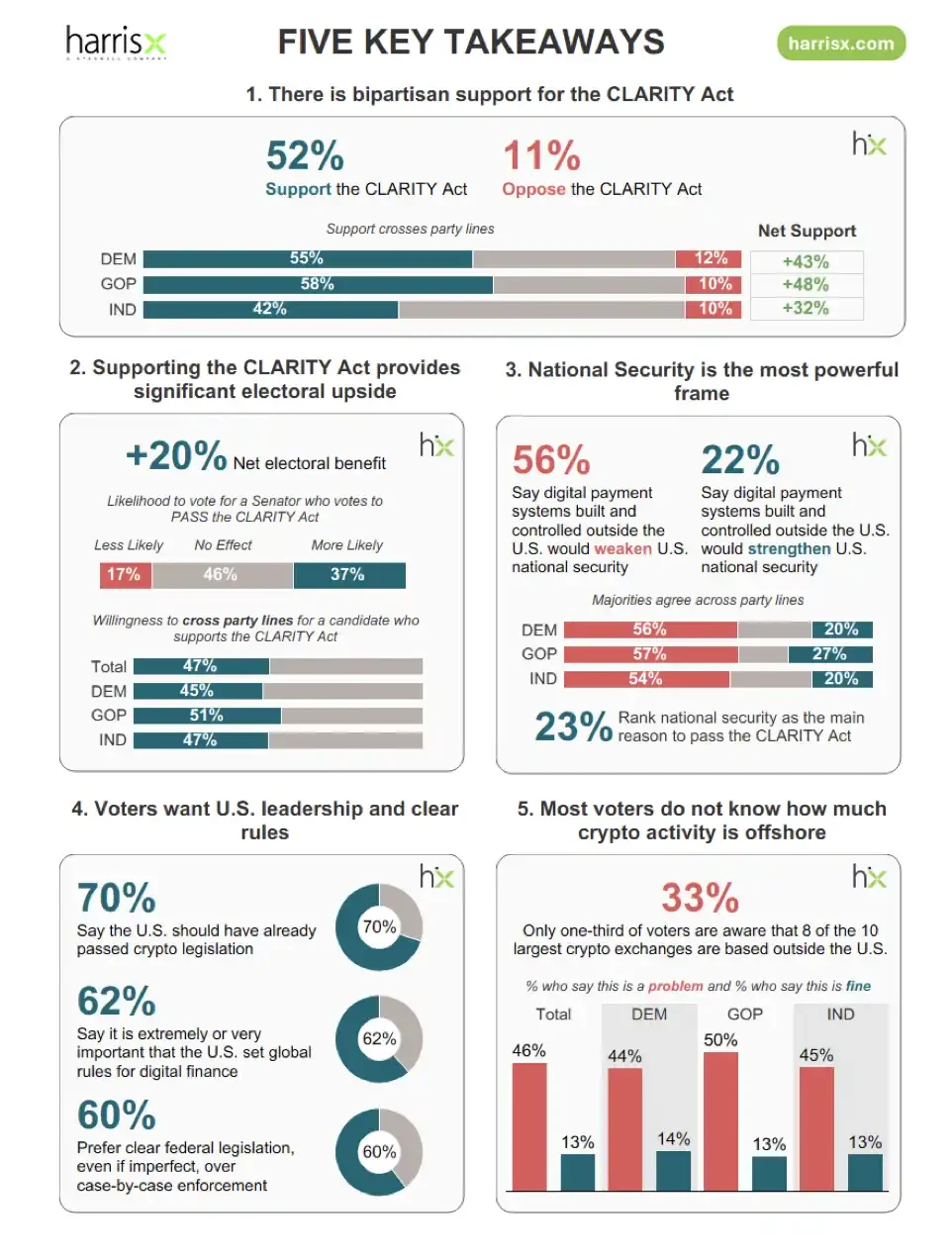
This is a HarrisX voter survey regarding the CLARITY Act (U.S. cryptocurrency market structure legislation), with five charts presenting five core findings:
Chart 1 | The bill has bipartisan support. 52% of respondents support the CLARITY Act, with only 11% opposing it; the net support rates are +43% for Democrats, +48% for Republicans, and +32% for independents, with Republican voters showing the highest level of support.
Chart 2 | Supporting the legislation can lead to significant electoral gains. The net election benefit is +20%—37% of voters indicate they would be more willing to vote for a senator who pushes for the passage of the CLARITY Act, while only 17% indicate they would be less willing; 47% of voters are willing to cross party lines to do so, with the highest proportion being Republican voters (51%).
Chart 3 | "National security" is the most compelling narrative framework. 56% of respondents believe that the construction and control of digital payment systems outside the U.S. would weaken American national security, while only 22% believe it would strengthen it; this assessment is a majority consensus across all three major parties (DEM 56%, GOP 57%, IND 54%). 23% of voters cite national security as the primary reason for pushing the bill's passage.
Chart 4 | Voters want the U.S. to maintain leadership and establish clear rules. 70% believe the U.S. should have passed cryptocurrency legislation long ago; 62% believe it is "extremely important" or "very important" for the U.S. to set global rules for digital finance; 60% prefer a clear but imperfect federal law to continuing reliance on a "case-by-case enforcement" regulatory model.
Chart 5 | Most voters are unaware of the offshoring situation in the cryptocurrency industry. Only 33% of voters know that "eight out of the top ten global cryptocurrency exchanges are based outside the U.S." After being informed, 46% see this as a problem, while only 13% see it as acceptable; this concern is most pronounced among Republican voters (50%).
The necessity of American leadership and clear federal rules
Voter understanding of digital assets remains limited, but their views are clear and consistent: the U.S. should establish rules for digital finance and do so quickly.
Awareness of digital assets is still low, but cryptocurrency holders represent a significant voting bloc
· 39% of voters say they are familiar with digital assets and blockchain technology, while 61% say they are not.
· Two-fifths of voters have purchased cryptocurrency, and 30% have done so in the past year.
· Familiarity and ownership rates are primarily concentrated among male voters and those under 35 years old.
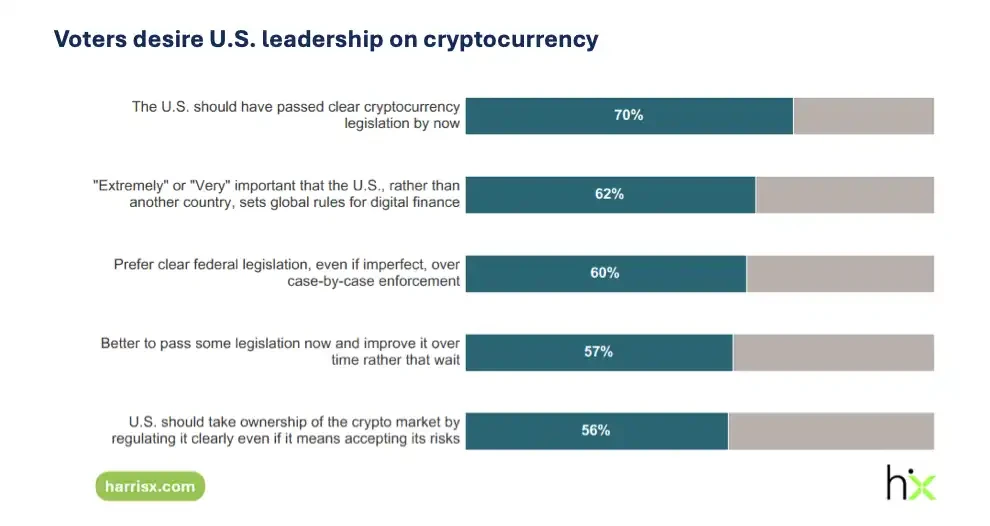
This chart focuses on a core issue—a strong expectation among U.S. voters for the country to establish a dominant position in the cryptocurrency field. HarrisX utilized five questions to depict a rather clear public opinion orientation on five dimensions: "urgency, global status, regulatory path, legislative pace, risk-taking":
70% | Legislation should have been in place long ago. Seven in ten voters believe that the U.S. should have passed clear cryptocurrency legislation by now. This is a judgment about "a sense of timing"—voters are no longer discussing "whether to legislate," but expressing anxiety about "why legislation has not yet been enacted."
62% | Global rules should be written by the U.S. On global rule-making in digital finance, 62% of voters believe it is extremely important or very important for "the U.S. rather than other countries to lead." This effectively elevates cryptocurrency regulation from being merely a "financial issue" to a "national competition issue."
60% | A clear federal law is preferred over case-by-case enforcement. Sixty percent of voters explicitly state they would prefer a clear but imperfect federal law over continuing to operate in a gray area relying on "agency-by-agency determinations." This directly negates the past few years of the SEC's "litigation in lieu of legislation" approach.
57% | Legislate first, iterate later. 57% of voters believe that rather than waiting for a perfect bill, it is better to pass the existing version first, then gradually improve it based on practice. This echoes the common legislative logic of "don't let perfect be the enemy of good" and reduces political resistance in the bill's advancement process.
56% | Willing to take risks for dominant control. Even if it means bearing risks from the cryptocurrency market itself, 56% of voters believe the U.S. should "take over" this market through clear regulation. In other words, voter concerns about "letting the market flow overseas" have already surpassed worries about "regulation itself causing trouble."
Voters want the U.S. to maintain leadership in the cryptocurrency field
Despite the fact that most voters are not familiar with the technical details of digital assets, they express a strong, broad, and stable demand for American leadership and clear federal rules.
70% of the majority of voters believe that the U.S. should have passed clear cryptocurrency legislation long ago; 62% of voters believe it is very important for the U.S. to establish global digital financial rules.
Voters also do not support the continuous reliance on case-by-case enforcement: 60% of voters prefer clear federal legislation, even if the legislation is not perfect; 57% of voters believe it is better to pass partial legislation now than to wait for a perfect law, to be improved gradually in the future.
Even if clear compromises are acknowledged, voters still tend to favor taking action. 56% of voters believe the U.S. should establish dominant control over the cryptocurrency market through clear regulation, even if it means accepting risks.
Overall, these results indicate that voters are not asking Congress to continue discussing "whether to act," but are instead demanding Congress to take prompt, clear, and federal-level action.
Offshore centralization is an important but under-recognized issue
Voters support U.S. regulation. The high concentration of cryptocurrency trading platforms abroad provides another concrete reason for voters to support federal cryptocurrency regulation rules.
The survey shows that voters generally do not understand how much digital asset market activity occurs outside U.S. regulation; however, once this fact is known, few believe it is acceptable.
· Only one-third of voters are aware that eight of the top ten global cryptocurrency exchanges are based outside the U.S.
· After learning this fact, 46% of voters believe that the majority of cryptocurrency trading occurring outside U.S. regulation is, at least to some extent, a problem; only 13% of voters believe this is acceptable or even a good thing.
National security is a key factor driving voter support for federal action
When this issue is framed within the context of national security, voters' concerns about foreign control of digital payment systems potentially weakening U.S. security and the global status of the dollar are further heightened.
· 56% of voters believe that if future digital payment systems are constructed and controlled by countries outside the U.S., it would weaken American national security. Only 22% of voters believe this would strengthen American national security.
· More than two-fifths of voters believe that if foreign-issued stablecoins dominate, it will weaken the global status of the dollar; only 17% of voters believe this will enhance the dollar's status.
Voters have long desired better rules and regulation for digital assets
The demand for federal action did not just start from the current debate. Over the past three years, multiple studies by HarrisX have shown that voters have consistently favored clearer rules, stronger protective mechanisms, and more proactive U.S. regulatory approaches to digital assets.
Our previous research findings include:
· Voters want clear cryptocurrency rules rather than regulation through enforcement. In a 2024 study, voters supported clear rules over enforcement regulation by a ratio of 48% to 23%; by 2025, this gap remained fairly stable, with 49% supporting clear rules and 26% supporting enforcement regulation.
· Voters believe that the U.S. is falling behind, creating a leadership gap. In 2024 and 2025, only about one-fifth of voters believed the U.S. was leading in cryptocurrency regulation, while 36% of voters believed the U.S. had already fallen behind.
· But voters want the U.S. to lead this field. In 2025, 69% of registered voters and 84% of cryptocurrency investors believed it was very important for the U.S. to lead the world in the development of blockchain technology; 82% of voters supported Congress setting stricter rules for cryptocurrency trading platforms and brokers.
Note 2: Sources include a survey of 1,717 U.S. registered voters conducted by HarrisX/Blockchain Association from October 25 to 28, 2024, and a survey of 1,861 U.S. registered voters conducted by HarrisX/Blockchain Association from December 3 to 4, 2025.
The CLARITY Act receives bipartisan support
After receiving a neutral description, 52% of voters support the CLARITY Act, with 11% opposing it. Support has bipartisan characteristics, and there is a large persuadable middle group.
Current voter awareness of the bill remains low
· 64% of voters have not heard of the CLARITY Act; 14% say they have heard a lot, and 22% say they have heard a little.
· The first explanation of the bill voters hear will determine the political support ceiling for this bill. The neutral description used in this survey provided solid majority support.
Support is strong after receiving a neutral description, with limited opposition
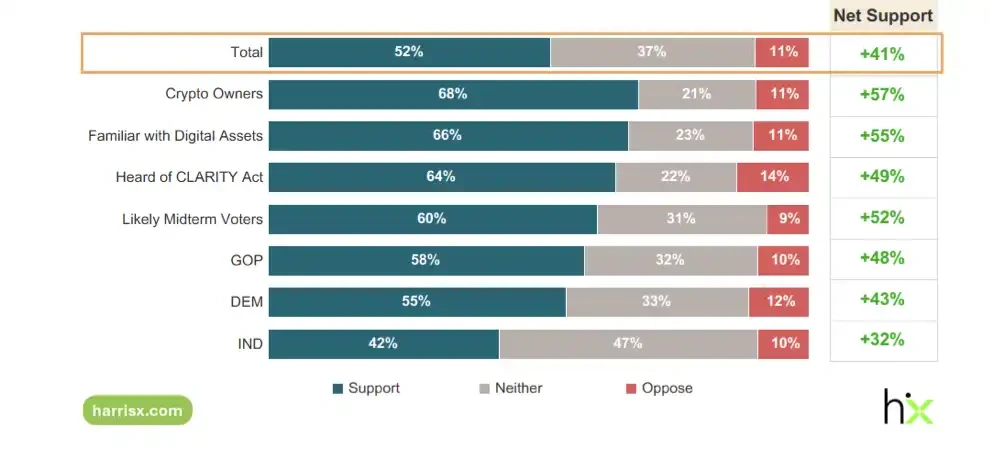
Survey Question CL12: "The CLARITY Act will clarify which federal agency, either the SEC or CFTC, regulates different types of digital assets; establish registration rules for cryptocurrency trading platforms and custodians; and set consumer protection standards for the industry. Based solely on this description, would you support or oppose this legislation?"
The CLARITY Act receives strong support among key groups
· Support is clearly bipartisan: net support among Republican voters is +48, +43 among Democratic voters, +52 among voters likely to participate in the midterm elections, and +32 among independent voters.
· Only 10% of independent voters oppose the bill, with the vast majority in the persuadable middle ground: 47% are neither supporting nor opposing.
· Voters most familiar with the issue have the highest level of support: net support among cryptocurrency holders is +57, among voters familiar with digital assets it is +55, and among voters knowledgeable about the CLARITY Act it is +49. Higher education levels and information exposure increase support.
Support for the CLARITY Act is based on broader national security concerns
When asked which reasons best support the passage of the CLARITY Act, voters' responses included:
· National security and the dollar's status (23%): "Keeping the dollar and American payment systems at the center of global finance is a national security priority."
· Law enforcement and illegal financial activities (17%)
· Consumer protection and fraud prevention (16%)
· Jobs and businesses leaving the U.S. (11%)
The electoral impact of supporting the CLARITY Act
Voting in favor of the CLARITY Act is clearly a net electoral advantage across party lines. Nearly half of voters indicate that this issue may prompt them to vote across party lines.
Senators who vote in support of the CLARITY Act will gain support across various voter segments
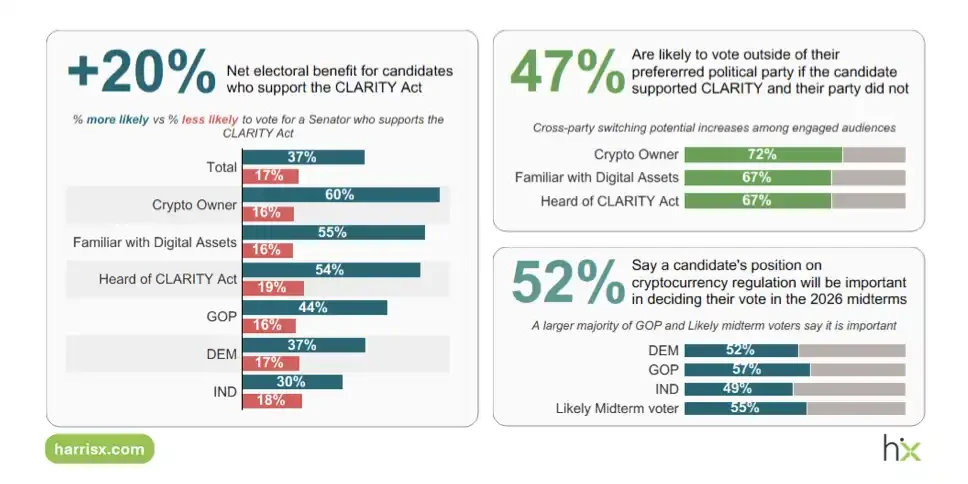
37% of voters indicate that they would be more inclined to support a senator if that senator voted in favor of the CLARITY Act; 17% said they would be less inclined to support; 46% stated it would make no difference. Overall, the net gain is +20.
This effect is strongest among Republican voters, with 44% saying they would be more inclined to support; there remains a positive impact among Democratic voters at 37%; among independent voters, it is at 31%.
Bipartisan appeal: 47% of voters would consider changing party voting choices due to this issue
· In a midterm election environment where most issues tend to reinforce existing party divisions, the CLARITY Act is one of the few legislative issues that may create bipartisan movement.
· 47% of voters said that if a candidate supports the CLARITY Act while their preferred party does not, they would at least consider voting for a candidate outside their preferred party to some extent.
· Among cryptocurrency holders, voters familiar with digital assets, and voters informed about the CLARITY Act, this willingness to cross party lines is even higher, reaching 72%, 67%, and 67%, respectively.
Most voters indicate that this issue will influence their vote in 2026
· 52% of voters say that a candidate's stance on cryptocurrency regulation will be "extremely important" or "somewhat important" in their voting for the midterm elections in 2026.
· Among cryptocurrency holders, this figure rises to 78%; among voters familiar with digital assets, it is 74%.
· The issue's intensity is at a moderate level, with 16% of voters saying it is "extremely important." While it is not yet a top-tier voting driver, it has a broad political reach: many voters are willing to include cryptocurrency regulation in their considerations for voting in 2026.
The cryptocurrency voters are a significant and influential voting bloc
In addition to general voter support for the CLARITY Act, survey results also show that engaging cryptocurrency voters has unique political value. Cryptocurrency voters form a considerable and influential group; prior research by HarrisX shows they are highly engaged, issue-driven, and willing to vote across party lines when a candidate's cryptocurrency policy aligns with their stance:
· High participation: 92% of cryptocurrency holders plan to vote in the 2024 U.S. elections.
· Issue-driven: 49% of U.S. voters consider it important for a candidate to support pro-cryptocurrency policies; this rises to 85% among cryptocurrency holders.
· Persuadable across party lines: If a candidate supports their preferred pro-cryptocurrency policies, U.S. voters are more likely to vote for a candidate outside their party, with a net increase of +13 percentage points; among cryptocurrency holders, this increase is as high as +58 percentage points.
· Influential in swing states: In Michigan, Pennsylvania, and Wisconsin, the number of issue-driven cryptocurrency voters has surpassed the margin of victory in previous presidential elections.
· Already recognized as a political force: CBS News reports that in congressional races actively engaging with the cryptocurrency industry, candidates supported by the cryptocurrency industry won 85% of their races.
Note 3: Source from a survey conducted by HarrisX/Consensys from September 4 to 14, 2024, covering 1,664 registered U.S. voters nationwide, and surveying 1,512 to 1,774 registered voters in Pennsylvania, Michigan, Wisconsin, and Texas.
Note 4: Source from CBS News, December 8, 2024, reporting "Big crypto spent big money to reshape the political landscape."
Strategic implications
The reason voters are responding positively to the CLARITY Act is that it pertains to a broader issue: American leadership, national security, and whether digital finance remains under U.S. regulation.
Voters do not need to become cryptocurrency enthusiasts to support the CLARITY Act. They are responding to a simple judgment: digital finance is happening regardless, with a large part already shifting overseas, and the U.S. should bring it under regulation through clear federal rules.
The political rationale for passing the CLARITY Act is stronger than the political rationale for stopping it. Senators who vote in favor of passing the bill will gain a net electoral advantage of +20 and create conditions for bipartisan support.
For targeted voter demographics, this may be the issue that truly influences voting choices. Among cryptocurrency holders, voters familiar with digital assets, young men, and voters who are already aware of the CLARITY Act, this issue is sufficient to change voting preferences and even prompt bipartisan voting. For the broader voter population, supporting the CLARITY Act is also a clear net positive political label.
免责声明:本文章仅代表作者个人观点,不代表本平台的立场和观点。本文章仅供信息分享,不构成对任何人的任何投资建议。用户与作者之间的任何争议,与本平台无关。如网页中刊载的文章或图片涉及侵权,请提供相关的权利证明和身份证明发送邮件到support@aicoin.com,本平台相关工作人员将会进行核查。


