📌 #Binance HODLer Airdrop Project 63 – http://USD.AI $CHIP Research: How far can the AI computing power financing track go?
http://USD.AI $CHIP performed quite well after launching the Binance Holder Airdrop, as the current Binance Holder Airdrop is stable at once a month and is rather selective.
After launching sturdily, it experienced a downward move, and looking back at it now, it might be undergoing value regression.
After all, the most interesting part of http://USD.AI is that it is not an ordinary AI coin; it transforms GPU, a heavy asset in the real world, into on-chain credit assets that can be collateralized, financed, and priced.
If Ethena captures the funding rate; then http://USD.AI aims to capture the credit yield in AI infrastructure.
1️⃣ Why is this direction worth observing?
The AI industry has now entered a very heavy capital expenditure cycle: GPUs, cabinets, power, data centers, all are very expensive.
But GPUs are a rather awkward asset: they can generate cash flow, but depreciate quickly; they have real demand, but technology iteration happens swiftly; they are important for AI companies, but difficult to value for traditional banks.
Thus, a mismatch arises: AI infrastructure requires a lot of financing, while on-chain stablecoin funds are seeking real yields.
http://USD.AI just happens to be at this intersection: if AI infrastructure loans can be packaged as yield-bearing assets that DeFi can participate in, if this direction holds, the future sources of real yield in DeFi may not be limited to government bonds, funding rates, or on-chain lending.
A new category will emerge: AI infrastructure credit, that is, AI infrastructure credit yield.
2️⃣ The structure of http://USD.AI is divided into three layers:
USDai: Liquidity layer: can be understood as the base dollar asset in the protocol, mainly responsible for settlement and liquidity.
sUSDai: Yield layer: the one that truly bears the yield is sUSDai, with yields coming from GPU collateralized loans, AI infrastructure financing, and part of the underlying asset yields.
CHIP: Governance layer: CHIP is not a direct dividend token.
The long-term value of CHIP lies in whether http://USD.AI can genuinely form a sufficiently large AI credit market in the future.
3️⃣ Price trend judgment
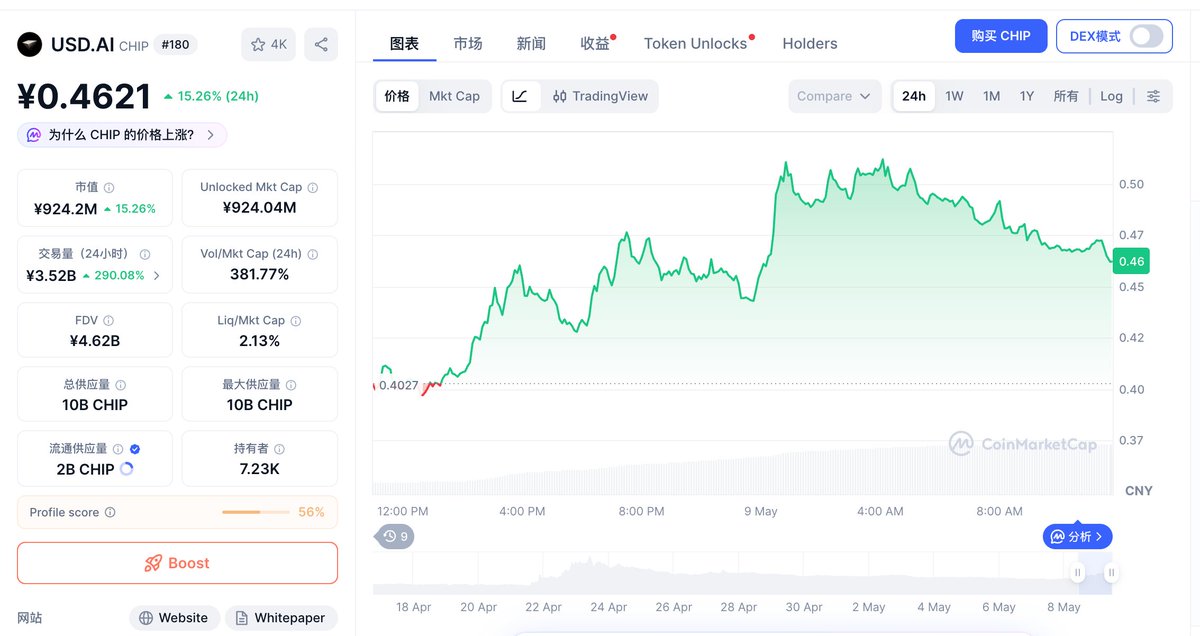
From the price trend, CHIP has followed a fairly typical new coin structure after launching on Binance: low opening → rapid increase → high retreat → low sideways consolidation → short-term rebound.
The early price surged rapidly from a low position, indicating that the market has a clear pricing for the narrative of "AI infrastructure financing + Binance launch." However, the price then continued to drop from the high position, indicating that early airdrops, short-term funds, and new coin profit-taking completed a round of concentrated release.
At present, CHIP has not returned to the initial high after listing; it remains in a repair phase after a deep retracement, and cannot yet be defined as a full reversal.
More accurately, it is not in a strong upward trend right now, but rather:
After the downward trend slows, it enters a phase of low-level handover and rebound verification.
If the price can maintain a higher range of sideways consolidation after a rebound, it suggests that chip reception is beginning to strengthen; if it returns to near previous lows after the rebound, it indicates that the market remains cautious about this narrative's short-term pricing.
Its future trend is essentially not simply determined by the "AI concept," but by whether the market believes http://USD.AI can continue to turn GPU financing into a real credit market.
It's a good direction, but everyone should research independently and pay attention to risks!
免责声明:本文章仅代表作者个人观点,不代表本平台的立场和观点。本文章仅供信息分享,不构成对任何人的任何投资建议。用户与作者之间的任何争议,与本平台无关。如网页中刊载的文章或图片涉及侵权,请提供相关的权利证明和身份证明发送邮件到support@aicoin.com,本平台相关工作人员将会进行核查。


