Summary
•Polymarket's trading volume and active users are generally rising in sync; the platform does not rely solely on a few large accounts to amplify data, but retention is still noticeably influenced by hot cycles.
•The rise in fees and revenue comes from both trading demand and the gradual expansion of the fee range and rate system changes since the first quarter of 2026.
•Platform trading is highly concentrated in a few high-interest areas such as politics, sports, and geopolitics, making it difficult for long-tail categories to independently support overall liquidity.
•Polymarket simultaneously has attributes of both an information market and an emotion market, but currently resembles an event trading platform activated in a high attention window.
•Gate's prediction product is not a weakened on-chain version, but solves different problems in account integration, access friction, user conversion, and product distribution.
Introduction
As of April 2026, Polymarket's trading volume and fees are at historically high levels. The platform has evolved from an early on-chain experiment into an event market capable of supporting large trading volumes in political, sports, macroeconomic, and geopolitical events.
The core of this article is not to repeatedly introduce what a prediction market is, but to answer four more specific questions: First, is Polymarket's growth structural; second, is the expansion of fees and revenue demand-driven or rule-driven; third, what are users actually trading; and fourth, why are leading exchanges like Gate starting to incorporate prediction products into their trading systems.
Based on these questions, this article will break down the prediction market Polymarket through data, comparison, explanation, and judgment.
Trading and Activity
Polymarket's trading volume shows a clear stepwise increase. In April 2024, the monthly trading volume was only $38.9 million, rising to $59.2 million in May; by October 2024, it had surged to $2.28 billion, reaching $2.577 billion in November, and although it fell to $1.7 billion in December, it remained far above mid-year levels. Entering the fourth quarter of 2025, the platform entered another acceleration phase, with monthly trading volume from October 2025 to March 2026 rising from $4.1 billion to $10.57 billion. In terms of scale alone, Polymarket is no longer an experimental nature on-chain product but has formed an event trading market comparable to some mature trading scenarios.
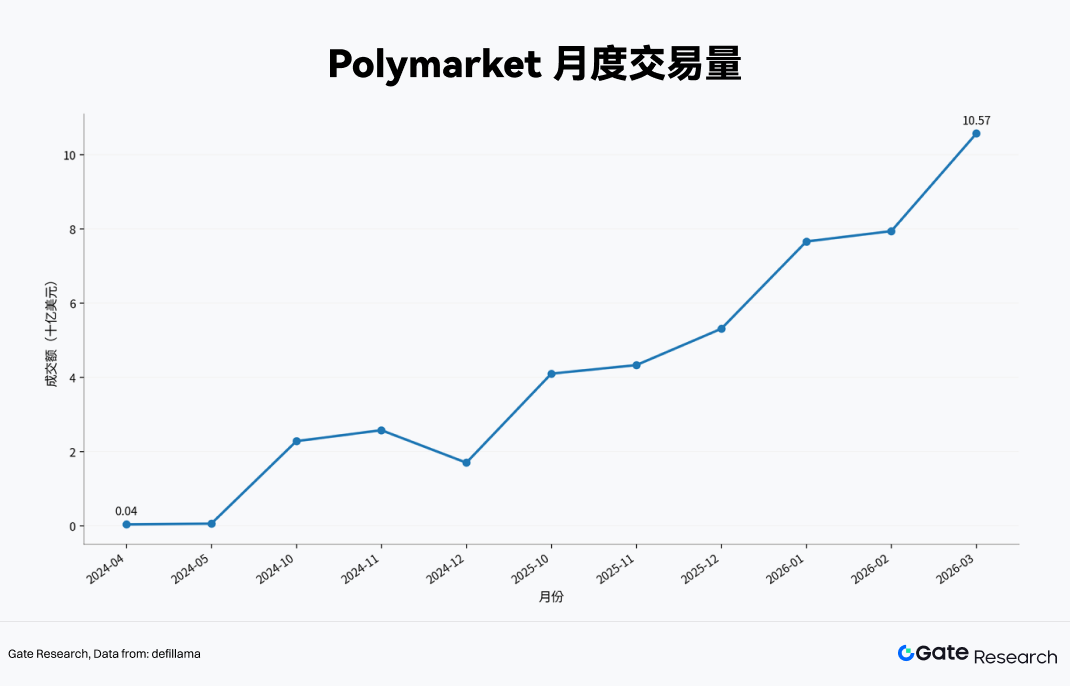
The growth curve of Polymarket is a result of both event-driven and platform capacity. The significant rise from October to November 2024 resonated highly with election-related trading; while the new round of growth from the fourth quarter of 2025 to the first quarter of 2026 was driven by sports, macroeconomics, finance, and geopolitical themes. The platform has shifted from “gaining popularity from a single major event” to “multiple high-interest themes alternating relay.”
Active user expansion has synchronized with trading volume. In July 2024, the platform had only 41,300 monthly active trading users, which rose to 293,700 in November 2024 and reached 462,600 in January 2025. After a phase of decline in mid-2025, the monthly active traders in October 2025 rebounded to 477,900, and currently, the near-month active count has reached 764,700. In other words, the growth in Polymarket's trading volume has been accompanied by a continuous expansion of the user base. However, active data also clearly shows that user expansion still shows strong cyclicality: when the hot topics wane, platform retention decreases, indicating that while the user base has thickened, loyalty and daily necessity have not been strong enough to completely hedge against major event cycles.
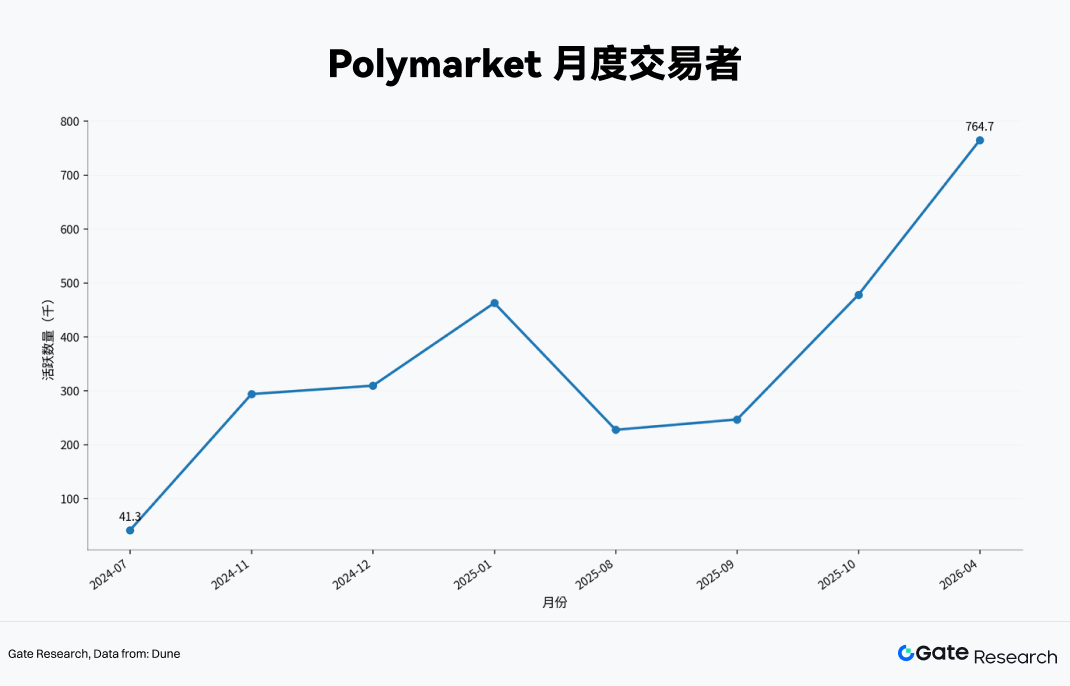
Overall, Polymarket's growth is relatively genuine, but its authenticity is closer to structural expansion driven by events. It has proven its ability to absorb traffic and convert it into trading during major information windows, but it has not yet fully proven it can maintain the same steep growth slope in the absence of strong narratives.
Fees and Revenue, Cautiously Understanding High Revenue
Compared to trading volume, Polymarket's fee data needs to be interpreted with caution. First, the fee metrics have undergone institutional changes. According to official fee documents, Polymarket uses a dynamic rate model that only charges Takers, with different rates for different categories; geopolitical events and world events currently maintain a zero fee rate. This means that the growth in Polymarket's fees is not only a function of demand growth but is also directly affected by the expansion of charging scope and rate structure adjustments. Simply annualizing the fee curve can easily misinterpret rule changes as permanent improvements in operational ability.
Key fee milestones saw noticeable jumps around the end of March 2026. Publicly verifiable data shows that the gross protocol revenue of Polymarket for the first quarter of 2026 was $16.23 million, while the fees from the nearly 30 days as of early April 2026 reached $14.75 million, with nearly 30 days of revenue at $10.36 million; after expanding the fee range on March 30, the first complete week's fees reached $6.8 million, and on April 1, a single day's fees even broke $1 million.
The fee scale over the recent 30 days is approaching the revenue level of a previous complete quarter. This certainly indicates that the platform has strong trading demand, but a more important explanation is that a large number of event trades that were originally free have been incorporated into the monetization system, resulting in a natural leap in the revenue curve, which cannot be simply understood as a sudden doubling of underlying demand.
Therefore, the current high fees are driven by both demand and rules. The former is reflected in the platform's capacity to handle a sufficiently large event trading flow, while the latter is reflected in the gradual opening of the "monetization" switch. From an operational analysis perspective, these two cannot be conflated. If one only looks at the single-day fees exceeding $1 million and simply extrapolates it to annual revenue in the hundreds of millions, it is easy to overlook two real constraints: first, high rates may compress high-frequency trading and market-making enthusiasm; second, the market categories that attract the most attention—geopolitical ones—still have zero fees, meaning that the hottest traffic pool of the platform does not necessarily translate into proportional protocol revenue.
Thus, what Polymarket's fee curve truly indicates is that the platform has proven it can charge fees, which means the business model is beginning to take shape; however, whether the platform can prove high revenue can be stably replicated over the long term requires more time to observe transaction structures, market-making subsidies, rate elasticity, and user reactions.
Market Structure and Event Concentration
Polymarket is far from a uniformly distributed broad market. Politics, sports, and geopolitics alone account for 92% of the total trading volume of major categories. If we include smaller categories such as culture, economy, crypto, weather, and finance for comparison, we can see that while a long tail market exists, its contribution to total trading is extremely limited.
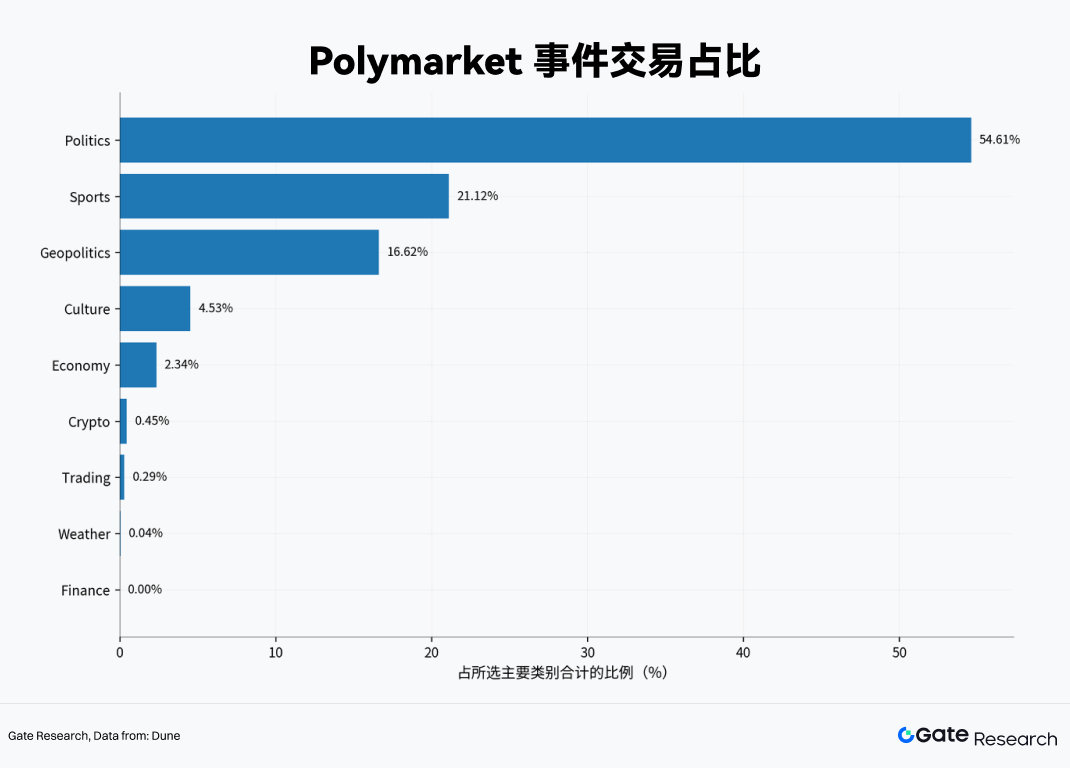
The core demand of Polymarket does not stem solely from the universality of being "able to price anything," but rather from a few high-interest, high-controversy, and frequently updated information tracks. Additionally, users are most willing to trade events that have strong media dissemination properties and clear result nodes. Politics, sports, and geopolitics have been able to maintain long-term dominance precisely because these three categories possess narrative intensity, information increments, and clear settlements simultaneously. Thirdly, while the platform may appear to be an open market, it is actually more like a collection of leading event markets. As long as major themes continue to emerge, liquidity will gather; once there is a lack of sufficiently strong event supply, the long tail market will struggle to support overall transactions alone.
This could also bring about some structural risks. Highly concentrated markets tend to facilitate depth and price discovery efficiency on hot events, but they also rely heavily on the supply side. Polymarket has room for category expansion, but current actual trading still largely depends on a few thematic pools. This means its sustainability, beyond user growth, also relies on whether the platform can continuously launch new, tradable, and settlementable high-interest event flows.
Trading Behavior and Time Distribution
From a product intuition perspective, prediction markets are often described as "information markets" because prices compress dispersed information into probabilities. However, on Polymarket, this definition may only partially hold true.
On one hand, weekends do not mean the platform is quiet. On a Sunday in January 2026, the whole prediction market saw a single-day trading volume exceeding $814 million, of which Polymarket accounted for about $127 million; during the geopolitical conflict trading window in March 2026, Polymarket also handled risk expressions during traditional market closures along with other 24-hour crypto trading platforms. On the other hand, thin liquidity on weekends is also a real issue. In January 2026, there were cases where traders utilized weak weekend liquidity to impact short-cycle price markets. This indicates that Polymarket's weekend trading tends to exhibit an “imbalance structure where it sharply spikes in the presence of events and has thin depth in their absence.”
Therefore, a more accurate judgment is that Polymarket simultaneously has attributes of information markets and emotion markets, but at the current stage, the characteristics of an emotion amplifier are still very pronounced. It can rapidly compress news, opinions, public sentiment, and odds into trading prices, which represents one side of an information market; however, its high dependence on hot events, dissemination rhythm, and collective narratives determines that it is not a purely rational information aggregator. In other words, Polymarket's price discovery function is mainly activated in high attention scenarios.
Positioning of Polymarket
Polymarket is often compared to three existing product variants: DEX, sports betting, and perpetual contracts. However, it is not entirely the same as any of these three.
It is not like a DEX, because the trading objects are not generic assets, but rather conditional outcomes of discrete events; it is also different from traditional betting because on-chain positions can circulate freely before settlement, and prices themselves bear continuous probability changes; and it is not like perpetual contracts, as its core is not directional leverage and funding rates but rather engaging in limited-period probability trading around specific events.
A more appropriate positioning would be to view Polymarket as the "event derivatives market" or "information trading market" within crypto. It converts macro, political, sports, and public sentiment events that are inherently difficult to standardize for trading into binary or multi-party contracts that can be ordered, matched, and exited midway. It does not replace spot or futures but provides the market with a new tradable object: the future state of the world itself. It is precisely because of this that it is particularly easy to attract attention during macro turning points, election cycles, major sports events, and geopolitical conflicts, as these scenarios are naturally suited to express expected discrepancies through "probability pricing."
This also highlights Polymarket's unique role in the crypto ecosystem. It does not primarily serve asset allocation but rather facilitates information expression, attention monetization, and event risk pricing. As long as this function exists, it will not be simply categorized as an ordinary trading platform; however, as long as it is highly dependent on event flows, it will be difficult to establish completely stable daily demand like mainstream spot or perpetual markets.
Observations on Gate's Prediction Market Product
Gate's entry precisely indicates that prediction markets have entered the product expansion logic of trading platforms. According to Gate's official announcement, Gate has integrated the Polymarket entry into the App, providing two interaction modes: "prediction mode" and "trading mode," supporting USDT participation under exchange accounts as well as participation in USDC on Polygon via Web3 wallets. The key feature of this design is transforming a process that originally needed wallets, networks, stablecoins, and on-chain interaction experiences into an account-based experience closer to spot trading.
Centralized platforms are not making a weaker on-chain copy but are solving another set of problems. The first is custody and account systems. Polymarket’s native path emphasizes self-custody and on-chain settlement, with advantages being openness, transparency, and composability; Gate’s entry instead unifies funding, positions, orders, and settlements within the exchange account system, significantly lowering the learning costs. The second is access friction. For existing exchange users, directly entering the prediction market with USDT and their current accounts is smoother than separately preparing a Polygon wallet and USDC. The third is liquidity organization. The advantages of on-chain markets lie in open matching and external market-making access, while centralized platforms are better at migrating their own user traffic, order book interfaces, charting tools, and trading habits directly to new products, shortening cold start time.
However, the advantages of on-chain and centralized are not symmetrical. Polymarket's advantages lie in verifiable on-chain positions, higher market openness, easier access for external developers and market makers, and its products are inherently closer to the native form of information trading. Gate's advantages are its low educational costs, low account-switching costs, and high user conversion efficiency, making it more suitable for importing existing spot and contract users into event trading. In terms of compliance boundaries, the two are also different. On-chain platforms often emphasize open infrastructure and global liquidity, whereas centralized platforms focus more on managing product visibility and usage paths by region and account system.
Therefore, the significance of Gate's prediction market product should be understood as the emergence of two different product paths for prediction markets. Polymarket emphasizes on-chain openness and native information trading, while Gate's product emphasizes low-friction access, account integration, and existing user conversion, with both coexisting over the long term across different user tiers and different regulatory environments.
Risks, Constraints, and Future Evolution Paths
Polymarket faces external constraints, with regulation being the foremost. In November 2024, French regulators have pushed for its implementation of geoblocks in France; by April 2026, the CFTC openly sued three states to maintain its claims of federal jurisdiction over prediction markets. Putting these two issues together shows that whether prediction markets are more like derivatives, gambling or information tools in different regions still lacks a unified answer. If the platform continues to penetrate mainstream financial scenes, this categorization issue will directly affect reachable users, events that can be listed, and the adopted settlement frameworks.
Internal structural risks cannot be ignored either. One is determination and oracle risk. While Polymarket uses clear rules and the UMA Optimistic Oracle for decision-making, complex events, vague expressions, and boundary conditions can still lead to disputes, and the more disputes there are, the harder it becomes for users to treat it as a low-friction tool for long-term use. The second is liquidity concentration risk. Currently, transactions heavily depend on major events, and if there is insufficient popular subjects, issues of insufficient depth in the long tail market will resurface. The third is unstable fees. The platform has recently proven its charging capacity, but it has also exposed the sensitivity of revenue to rule adjustments; if the rates are too high or subsidies insufficient, market-making and high-frequency trading may cool off first. The fourth is user retention uncertainty. Many users may come for a specific election, a certain war, or a particular event, yet may not continue to stay after the hottest period subsides.
The key to future evolution lies in whether the platform can transform event trading from one-off peaks into more stable trading habits. This requires it to simultaneously address three issues: improving market creation and settlement quality, expanding sustainable themes that are not one-off explosions, and finding a more balanced structure among fees, market-making, and user experience. Only by achieving this can Polymarket potentially evolve from a high-heat application to a more durable product category.
Conclusion: The Current Real Value and Boundaries of Polymarket
It is undeniable that Polymarket has proven three things. First, it is not a fleeting on-chain experiment but has formed a truly trading scale, real user expansion, and true charging capacity as an event trading platform. Second, its growth is not purely superficial; active users and transaction volume have indeed risen in tandem, indicating that the platform is not relying solely on a few whales to inflate data. Third, it has established a clear and rare position in crypto, transforming future events into tradable objects.
However, it has not yet proven three other things. First, rapid trading growth does not equate to the decoupling of demand from events; the platform remains deeply driven by political, sports, and geopolitical events. Second, the rapid rise in fees does not automatically prove that revenue can stabilize annually, as the expansion of chargeable scope itself is an important variable. Third, it has not yet demonstrated that it has become a universal, low-volatility, and strong-retention long-term product form; it is still an exceptionally efficient market mechanism within a high information density window.
Therefore, the real value of Polymarket lies in its ability to create a truly liquid market for a category of objects that were previously difficult to trade and demonstrate the possibility of commercialization. Its boundaries lie in the fact that this market still heavily relies on event supply, regulatory environments, and user attention. Looking ahead, both the on-chain native path and Gate's centralized integration path are likely to continue to coexist: the former represents an open information trading infrastructure, and the latter represents a lower-friction product distribution channel. What is truly worth observing is who can first transform prediction markets from trendy products during peak times into a normalized trading category.
References
•DeFiLlama, https://defillama.com/protocol/polymarket
•Polymarket Docs, https://docs.polymarket.com/trading/fees
•Blockworks Analytics, https://blockworks.com/analytics/polymarket/polymarket-overview/polymarket-trading-volume
•Dune, https://dune.com/kosard/polymarket-wallet-tracker
•Gate, https://www.gate.com/en/learn/articles/gate-integrates-polymarket-prediction-market-a-new-era-of-event-based-trading
•The Block, https://www.theblock.co/post/377214/polymarket-rebounds-kalshi-leads
•RootData, https://www.rootdata.com/news/411172
Gate Research Institute is a comprehensive blockchain and cryptocurrency research platform that provides readers with in-depth content including technical analysis, hot insights, market reviews, industry research, trend forecasts, and macroeconomic policy analysis.
Disclaimer
Investing in the cryptocurrency market involves high risks. Users are advised to conduct independent research and fully understand the nature of the assets and products being purchased before making any investment decisions. Gate does not bear any responsibility for any losses or damages resulting from such investment decisions.
免责声明:本文章仅代表作者个人观点,不代表本平台的立场和观点。本文章仅供信息分享,不构成对任何人的任何投资建议。用户与作者之间的任何争议,与本平台无关。如网页中刊载的文章或图片涉及侵权,请提供相关的权利证明和身份证明发送邮件到support@aicoin.com,本平台相关工作人员将会进行核查。