Original|Odaily Planet Daily (@OdailyChina)
Author|Wenser(@wenser 2010 )
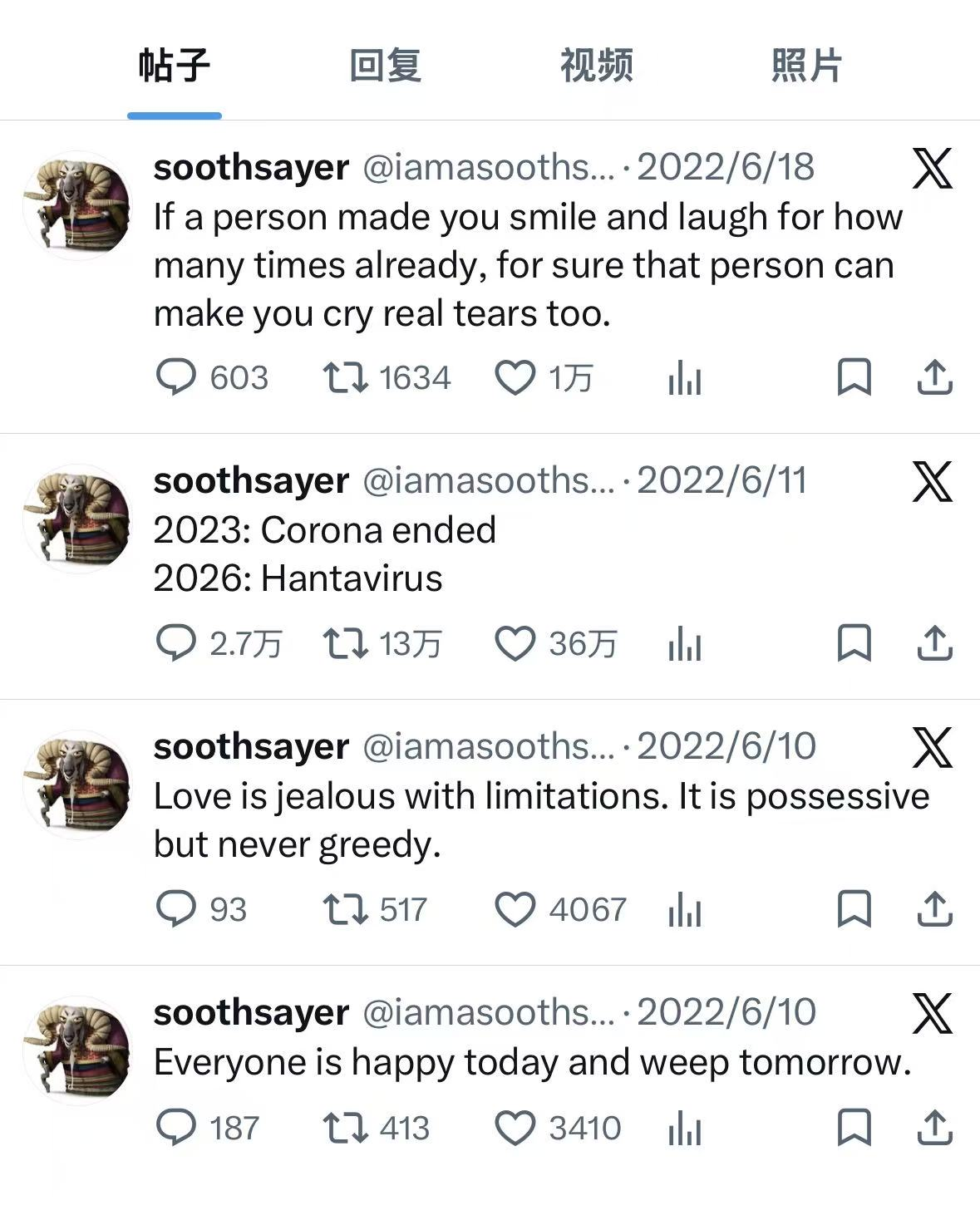
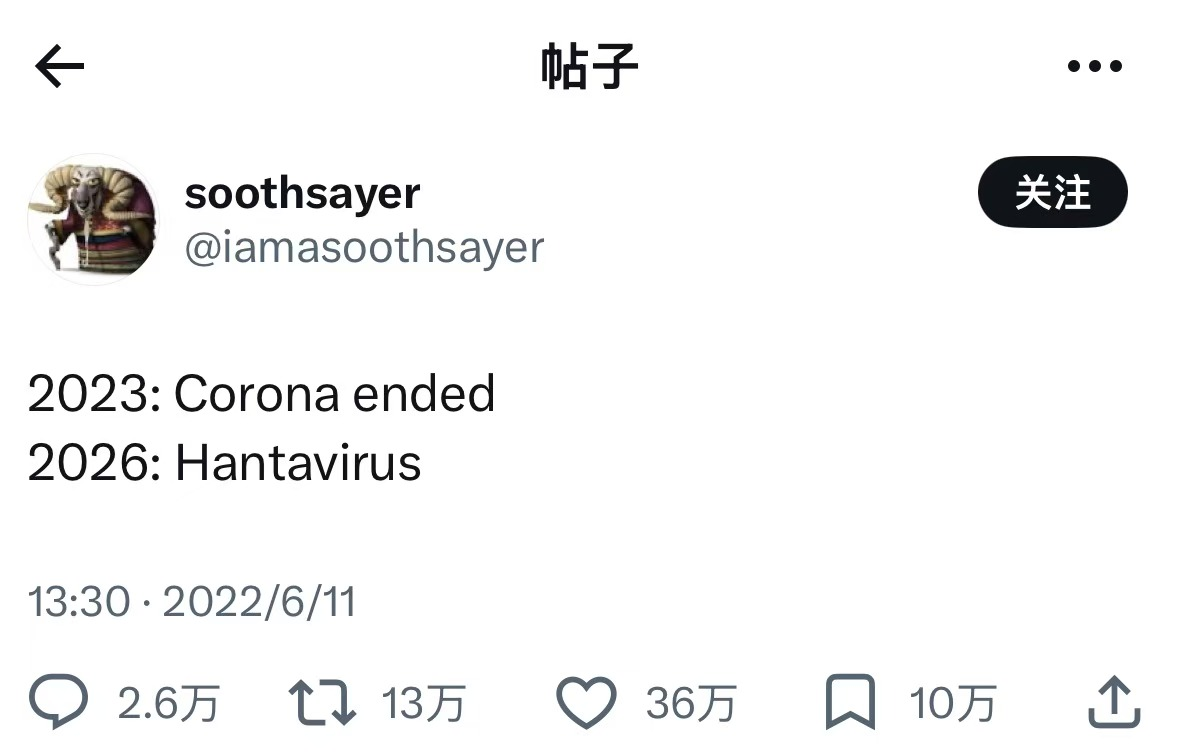
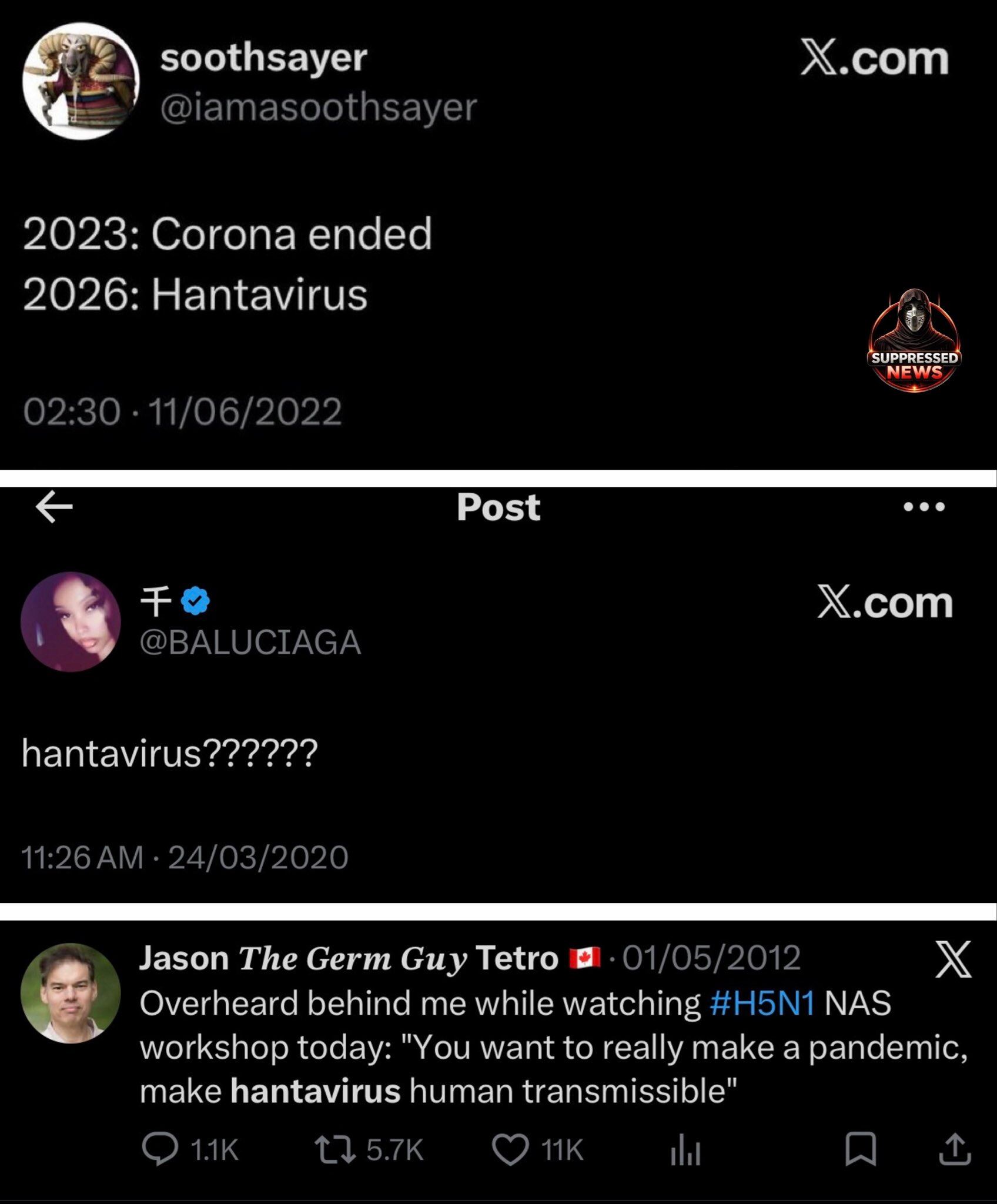
Last night, an old tweet dated June 11, 2022, exploded on the X platform like a nuclear bomb in the public opinion arena. The tweet came from a self-proclaimed fortune teller who claimed to be able to "read the future," predicting that the COVID-19 virus would end in 2023 and accurately foretelling the recent emergence of Hantavirus.
In no time, countless people flocked to comment, but this account vanished after just 5 tweets, casting an air of mystery upon the incident like an urban legend.
Amid the uncertainties left in the post-pandemic era, discussions about Hantavirus quickly spilled over from public health issues, evolving into an emotional amplifier on social media, and were swiftly absorbed by the crypto market as a new trading narrative, from meme coins to prediction markets; speculative funds always find the emotional hotspots at the first opportunity.
In the flow of ambiguous information and the resonance of group emotions, the crypto market once again displayed its instinct: to rapidly convert attention, anxiety, and expectations into tradable products and prices.
The mysterious tweet from 4 years ago links to the recent cruise virus that killed 3 people
The story begins with an account called @soothsayer.
This account, which had only posted 5 tweets, was largely ignored until now. Ignoring that "Hantavirus prediction" tweet, one might think that this account was no different from ordinary ones on the X platform that send daily "inspirational quotes" and "motivational sayings."
However, as the topic of Hantavirus has been brewing in recent days, this old tweet has taken on the flavor of "cyber mysticism."
In April this year, a cruise ship named "Hondius" departed from Argentina in South America, originally planning to cross the Atlantic Ocean to the Canary Islands in Spain. However, en route, a Dutch man suddenly died on board, later confirmed to have succumbed to Hantavirus. As of May 6, the death toll had risen to 3, with 8 infected, including tourists from the Netherlands, the UK, and Germany. The cruise ship is currently temporarily prohibited from docking due to Hantavirus, and the World Health Organization is closely monitoring the situation. It is worth mentioning that about 30 passengers had disembarked from the ship in the previous two weeks without tracing procedures, dispersing to 12 countries.
Therefore, despite the WHO clarifying that there had not been a large-scale transmission of the virus previously, it is still inevitable that people are anxious, with many recalling "the fear once dominated by COVID-19."
It is noteworthy that, according to tests by the National Institute for Communicable Diseases in South Africa and the University Hospital of Geneva in Switzerland, the virus type of this outbreak has been confirmed as Andes Hantavirus.
The vast majority of hantaviruses do not transmit from person to person, but the Andes virus is the only exception, with such transmission typically occurring among closely contacted family members or healthcare workers. Additionally, hantaviruses are primarily transmitted to humans through "rodent-borne" routes, divided into three main transmission methods: respiratory infection, meaning inhaling aerosols contaminated by rodent excreta; contact infection, meaning direct contact of broken skin or mucous membranes with the excretions of infected rodents; and digestive infection, meaning consuming food contaminated by rodent excreta.
Regarding many people's concerns about whether this virus will spread to the mainland,reliable news indicates that in our country, diseases caused by hantaviruses are referred to as "hemorrhagic fever with renal syndrome," and our control measures against this virus and related diseases are effective, with no risk of large-scale outbreak; the Chinese Embassy in Cape Verde also previously issued a notice confirming that there are no Chinese nationals on board.
Looking back at the "fortune teller's" tweet, it is found that it not only directly mentioned Hantavirus but also dates back to four years ago, indeed making it quite a hot topic.
Hantavirus in crypto: Meme coins and prediction markets
Following the emergence of Hantavirus, the crypto market also shook, with meme coins and prediction markets commencing their performances.
One group member unearthed a meme coin created a year ago, formally launched on the external market on May 4, HANTA (Hantavirus), currently reporting a market cap of 12 million USD, becoming a true "OG coin."
Additionally, in prediction markets, Polymarket and Predict.fun both launched betting events related to Hantavirus.
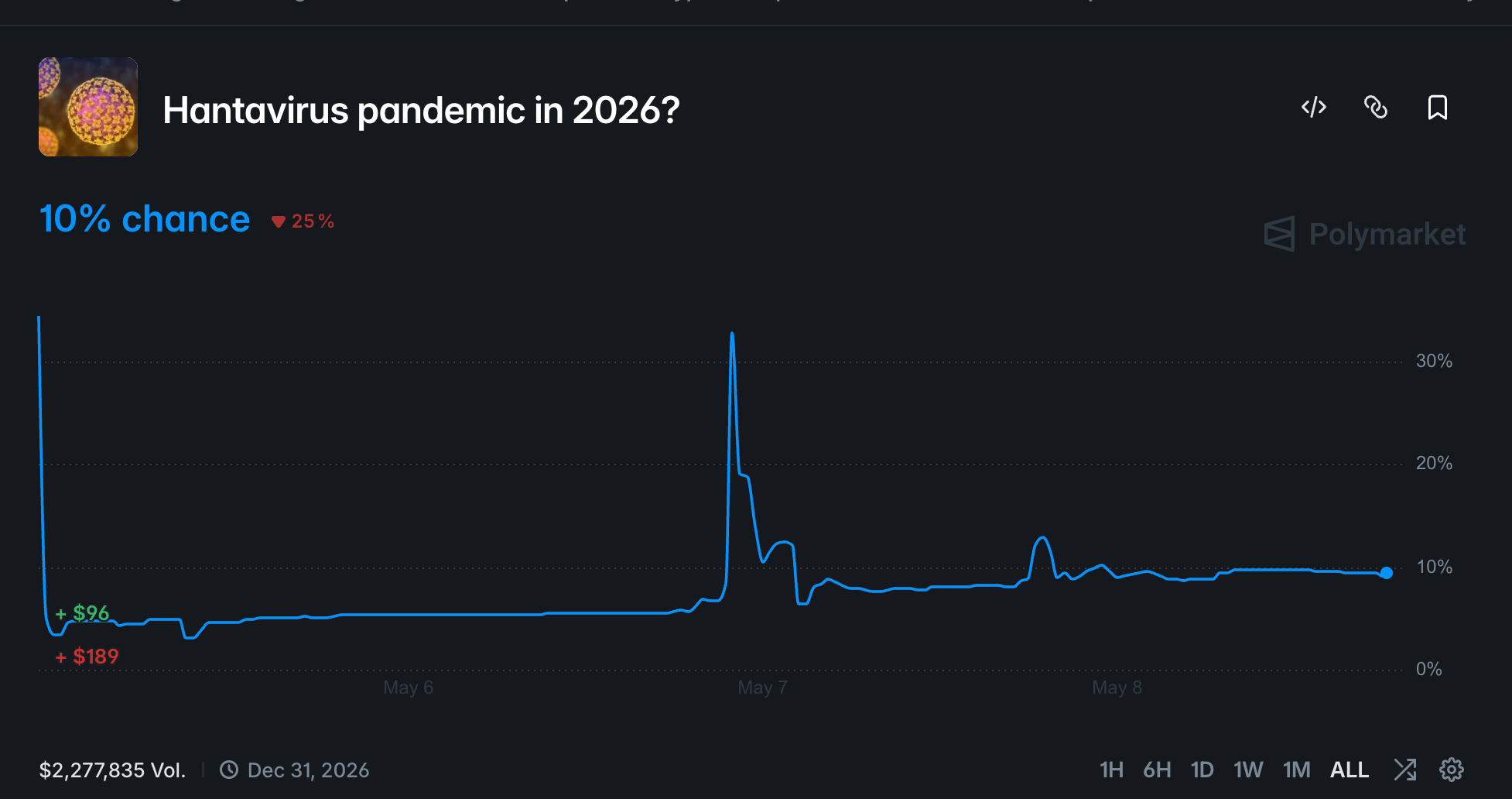
On Polymarket, the "Hantavirus Pandemic in 2026" event has a current probability reported at 10%, which previously rose to nearly 35%; the betting amount is currently reported at around 2.27 million USD. The determination rule is that "if the World Health Organization, by 11:59 PM Eastern Time on December 31, 2026, in an official public announcement, clearly qualifies Hantavirus, Hantavirus Pulmonary Syndrome (HPS), hemorrhagic fever with renal syndrome (HFRS), or an outbreak related to Hantavirus as a 'pandemic,' then the market will settle as 'yes'; otherwise, it will settle as 'no.' Clear qualifications include an official statement, report, press conference, or publication from the WHO that explicitly describes the outbreak as a 'pandemic.' Merely declaring it an international public health emergency (PHEIC) does not meet the criteria unless it is also described as a pandemic. The primary settlement basis for this market will be the WHO's official announcements. Credible reported consensus can also serve as a basis."
On the Predict.fun platform, the similarly named betting event currently reports a probability of 11%, slightly higher than Polymarket data; the betting volume is small, amounting to only around 4400 USD. Its determination rule is similar to that of Polymarket and also relies on official statements from the WHO.
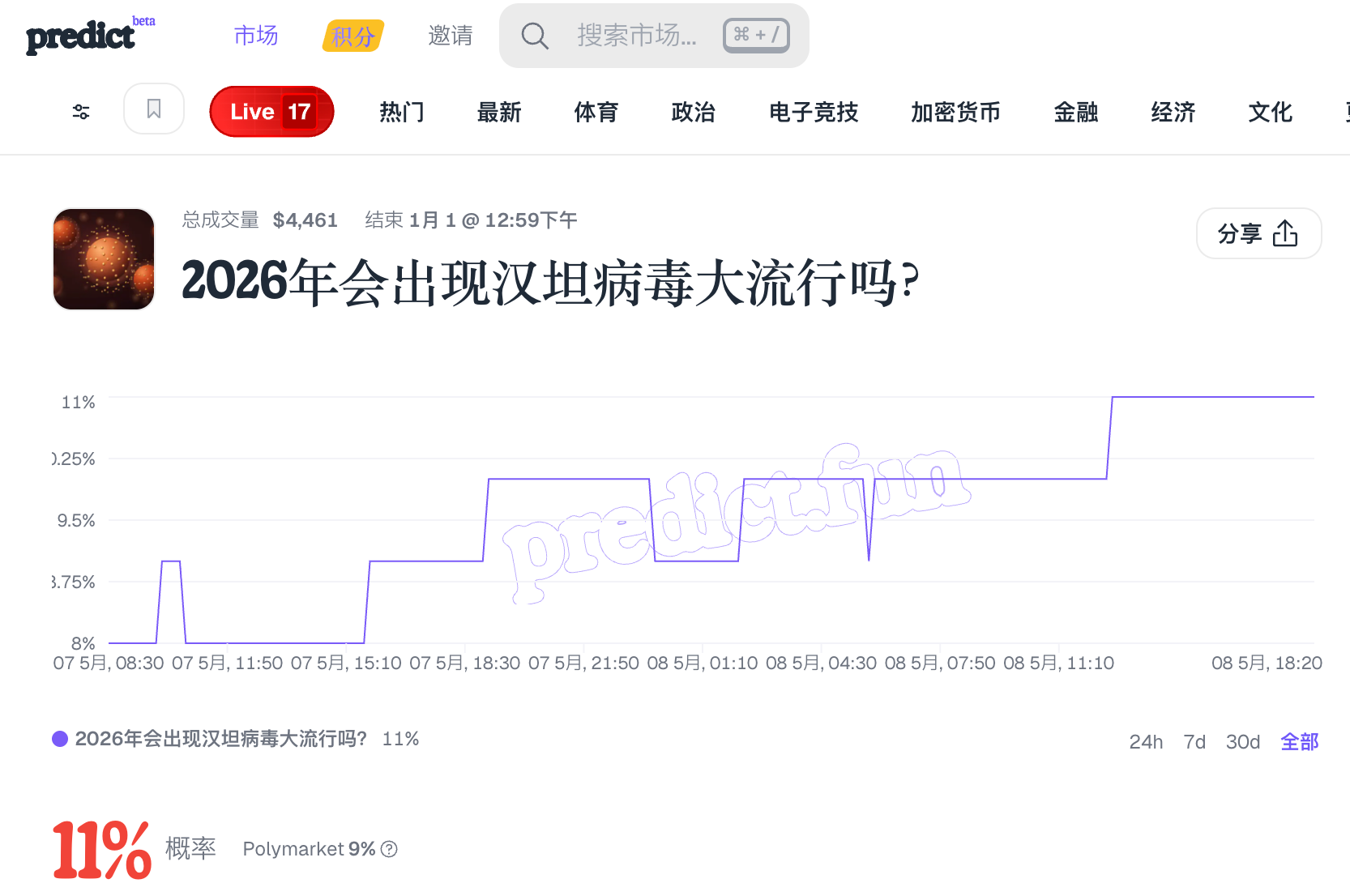
For many, betting real money on the future is inherently an addictive endeavor. The growing popularity of prediction markets fundamentally stems from their ability to turn human anxiety, curiosity, and desire about the unknown directly into tradeable commodities.
In conclusion, we turn our gaze back to the X platform. There, a plethora of ancient posts about "Hantavirus" still lie scattered, some dating back to 2020, and some even traceable to 2012. Some have extracted snippets as "prophecies," others have pieced together vague screenshots into complete stories, while some firmly believe that everything has already been written in advance.
The truth or falsehood is unimportant; what truly fascinates is how the internet can mix coincidences, fears, emotions, and imagination into something that hovers between reality and urban legend, compelling you to click in and take a peek.
As the fortune teller @soothsayer left behind a saying: “Laughter today, tears tomorrow.”
免责声明:本文章仅代表作者个人观点,不代表本平台的立场和观点。本文章仅供信息分享,不构成对任何人的任何投资建议。用户与作者之间的任何争议,与本平台无关。如网页中刊载的文章或图片涉及侵权,请提供相关的权利证明和身份证明发送邮件到support@aicoin.com,本平台相关工作人员将会进行核查。


