Original | Odaily Planet Daily (@OdailyChina)
Author | Azuma (@azuma_eth)

After the close of the U.S. stock market on May 8, commercial space company Rocket Lab (RKLB) announced its Q1 2026 financial report, which greatly exceeded market expectations.
The financial report showed that Rocket Lab's revenue in Q1 reached $200.3 million, a year-on-year increase of 63.5%, surpassing the expected $189 million; the Q2 revenue guidance was raised to between $225 million and $240 million, far exceeding the analyst estimate of $205 million. Although an operating loss of $56 million indicates that the company is still in a "burning cash" mode, the adjusted gross margin has risen to 43% (compared to just 33.4% in the same period last year), which means the company is significantly improving its unit economics while scaling up — in simple terms, its cash burning "efficiency" has become higher.
Driven by the positive financial report, RKLB rose nearly 7% in after-hours trading, with a total increase of 240% over the past year.
As SpaceX’s historic IPO approaches, commercial space has become another hot line in the U.S. stock market, with capital beginning to assign internet-level valuation imagination to the idea of "building rockets." In this wave, apart from SpaceX, which has a valuation aimed at $1.75 trillion to $2 trillion and a clear pre-market premium, Rocket Lab has positioned itself as the "most similar pure commercial space concept stock to SpaceX," becoming a substitute option for many investors.
SpaceX's "Only Substitute"?
The reason Rocket Lab is viewed as SpaceX's current "only substitute" is because Rocket Lab is perfectly replicating the successful path validated by SpaceX — first running a commercial closed loop with small rockets and reusable technology, then using large rockets to optimize costs and seize core markets.
Electron: The Dominator of Small Rocket Segment
In the rocket-building endeavor, many companies have flashy presentations, but only a few can reliably deliver rockets into space. Currently, Rocket Lab's "Electron" is the only small launch vehicle in the world capable of high-frequency, reliable commercial operations and is the second most frequently launched rocket in the U.S., only behind SpaceX's Falcon 9.
The "maturity" of Electron is not only reflected in its dozens of launch records and extremely high success rates but also in the successful implementation of its recovery technology. Rocket Lab has repeatedly succeeded in recovering first-stage boosters from the sea and has even reused engines for launches. This engineering mastery of "reusable" technology is SpaceX’s winning weapon in dominating the commercial space market.
Neutron: The Challenger to Falcon 9
If small rockets are Rocket Lab's entry ticket, then the medium to large rocket "Neutron" currently under development is the main engine for its assault on a market valuation of $100 billion.
Neutron is not just a simple enlargement of Electron; it was conceived with a strong "target" — to chase Falcon 9. Falcon 9 remains the only commercially viable reusable medium to large rocket on the market, with SpaceX holding a monopoly in this field.
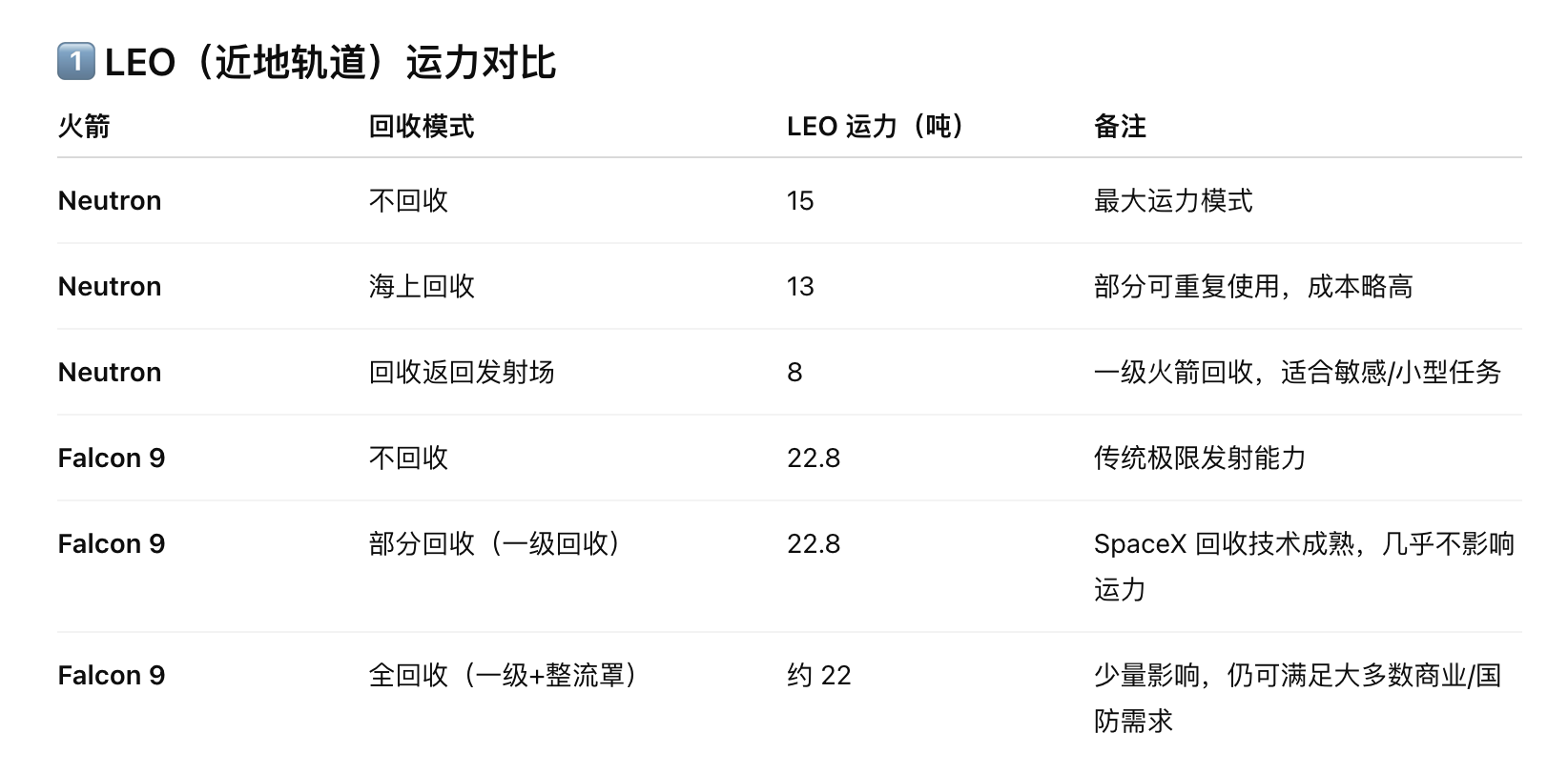
The emergence of Neutron is significant as it aims to become the only viable alternative to Falcon 9, although its design capacity (approximately 8-15 tons) is still somewhat inferior to Falcon 9. However, it tries to leverage "latecomer advantage" to overtake its predecessor — thanks to unique designs like the HungryHippo fairing and Archimedes, Neutron is expected to surpass Falcon 9 in efficiency for fairing recovery and engine reusability.
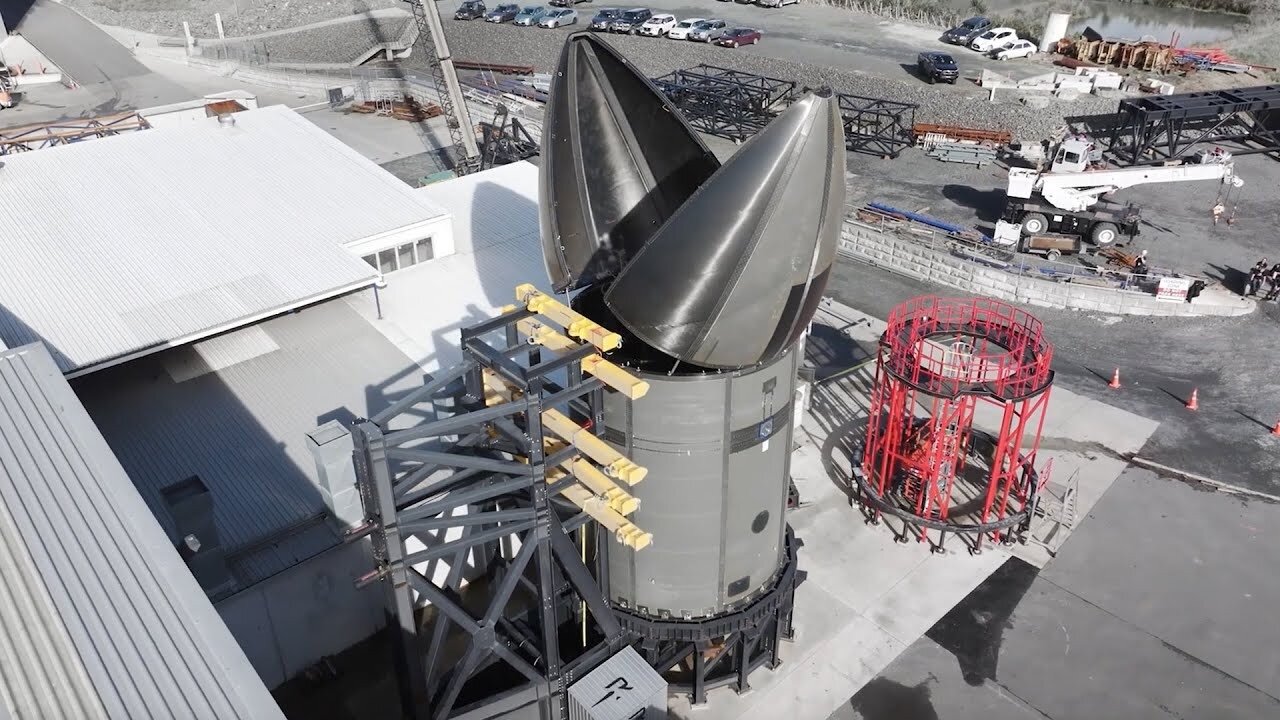
- Note from Odaily: HungryHippo is the biggest design highlight of Neutron. Unlike SpaceX, which needs to recover fairing debris worth millions of dollars at sea after each launch, Neutron's fairing features a fixed design that connects to the first stage and cannot be separated. When releasing the second stage rocket, it opens like a "hippo's mouth" and closes back after payload delivery, landing alongside the first stage for recovery. This means the fairing avoids the difficulties of maritime recovery and complex post-launch assembly, allowing it to be reused right after landing.
From the disclosed testing progress so far, Rocket Lab is rapidly closing the gap with SpaceX in medium to large launch capabilities.
"Building Rockets" Plus "Building Satellites": Replicating SpaceX's Ecosystem Closed Loop
Just as SpaceX has Starlink, Rocket Lab is also creating its own dual-driven "launch + manufacturing" ecosystem. Rocket Lab's "space systems" business (covering satellite platforms, star communications, solar arrays, etc.) currently accounts for nearly 70% of total revenue. This means that even while Neutron is still in development, Rocket Lab can still generate significant revenue by selling satellite components.
This "full industry chain" business model can hardly be found outside of Rocket Lab in the public market prior to SpaceX's online launch.
Massive Valuation Discrepancy: A Reflection of Reality and an Investment Opportunity
Currently, SpaceX's primary market valuation has reached $1.75 to $2 trillion, while Rocket Lab's market capitalization just surpassed $45 billion. The huge valuation gap objectively reflects the reality of the differences in the two companies' statuses, but it is precisely this contrast that is most enticing for investors.
In the current global commercial space sector, there is only one company that can reliably achieve high-frequency launches, reuse through recovery, large capacity, and low costs — SpaceX. The cost advantages of Falcon 9 have reached a point of despair for the vast majority of competitors, and this advantage is forming a terrifying positive spiral — the cheaper the launch, the more frequent the launches, the more data collected, the faster the upgrades come, and the quicker the upgrades, the cheaper the launches become… This moat built by scale, data, and rhythm has left many newcomers in awe.
However, Rocket Lab's opportunity lies in the fact that Neutron currently appears to be the most promising reusable medium to large rocket that could catch up with Falcon 9's pace. The only label of being "the only choice after SpaceX" is already sexy enough. Once Neutron successfully flies, Rocket Lab's valuation logic will completely shift from "a small rocket company" to "the second global platform company with medium to large reusable rocket capabilities," potentially taking substantial business away from SpaceX — thus, the market's current enthusiasm for Rocket Lab is largely a bet on the success probability of Neutron.
By 2026, when SpaceX has shattered the trillion-dollar valuation ceiling, Rocket Lab, with a market capitalization of only about 2.5% of that, will clearly have more upward elasticity in terms of imagination.
Biggest Risk: "Neutron" Hasn't Flown Yet…
But there remains a significant suspense — Can Neutron actually fly on schedule?
According to the latest disclosures, Neutron's maiden flight is scheduled for the end of 2026, but looking back at history, no new rocket has ever launched without experiencing delays. There is a harsh reality in the space industry — PPT rockets ≠ real rockets.
Historically, many rockets never get off the ground; some explode on their first flight; and many fail in cost-control designs. If Neutron fails to achieve its maiden flight, any setbacks in its development timeline or delays in its first flight will put immense pressure on the current market capitalization, making it difficult to continue spinning the tale.
免责声明:本文章仅代表作者个人观点,不代表本平台的立场和观点。本文章仅供信息分享,不构成对任何人的任何投资建议。用户与作者之间的任何争议,与本平台无关。如网页中刊载的文章或图片涉及侵权,请提供相关的权利证明和身份证明发送邮件到support@aicoin.com,本平台相关工作人员将会进行核查。


