In the past year, AI+Crypto has been one of the most crowded narratives in the cryptocurrency industry.
Initially, the market was more concerned with AI tokens, decentralized computing power, data networks, and various concepts of AI Agent coins. However, as we enter 2026, project parties are no longer just discussing "how AI will change Crypto," but are starting to incorporate AI into wallets, exchanges, payment protocols, and on-chain execution processes.
Within just a week, three landmark events occurred:
- On April 24, Binance Wallet launched Agentic Wallet, an independent non-custodial wallet designed specifically for AI Agents. It features independent balance, configurable permissions, and real-time monitoring, with Agentic Wallet Skills built-in by default, allowing Agents to perform automated operations within preset boundaries;
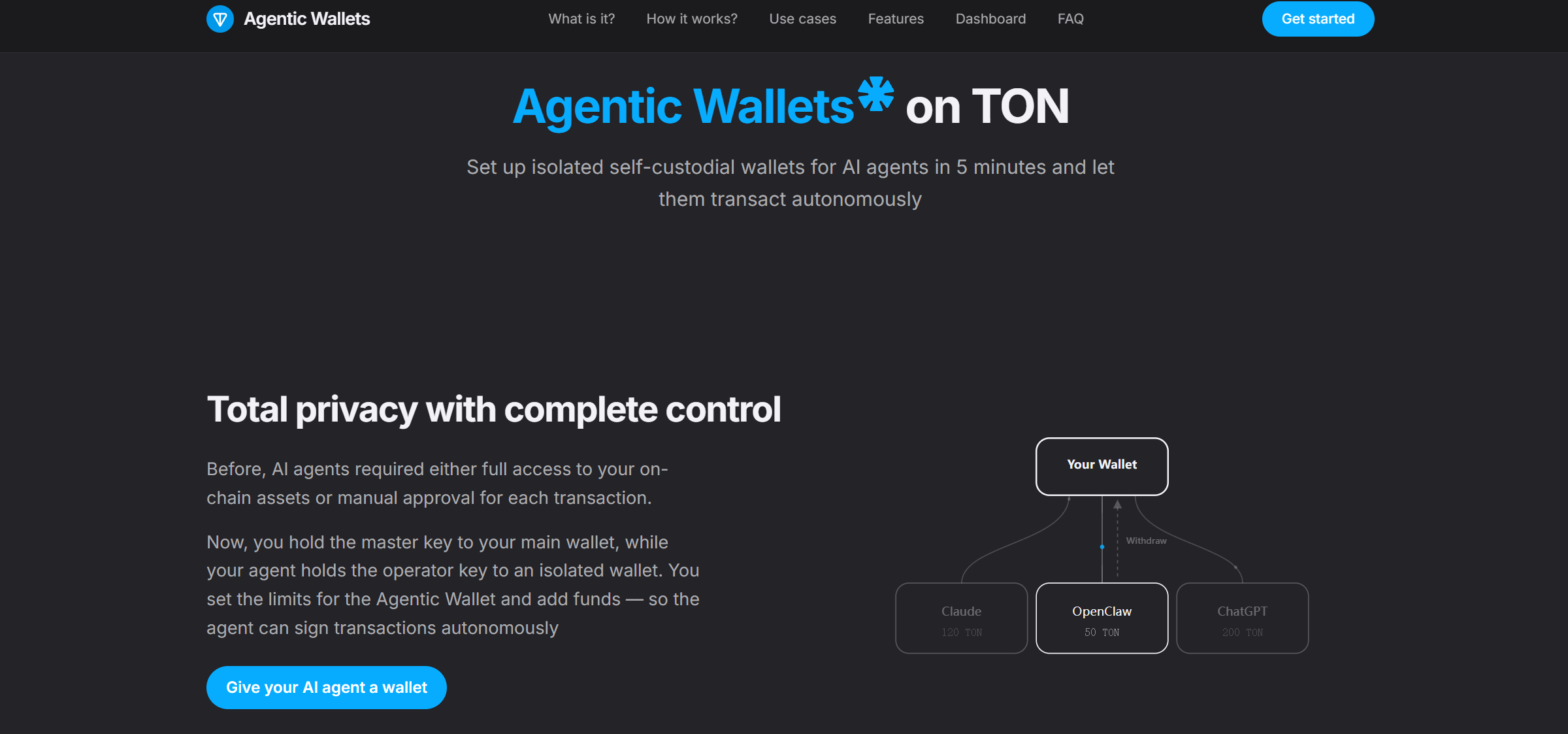
- On April 28, TON launched the self-custodial wallet contract Agentic Wallet for AI Agents, allowing users to set up independent wallets for AI Agents within minutes, enabling the Agents to autonomously complete on-chain operations such as transfers, swaps, and staking without touching the user's private keys;
- On April 29, OKX released the open payment standard Agent Payments Protocol designed for the commercial behaviors of AI Agents, covering the complete business processes of quoting, negotiation, escrow, measurement, settlement, and dispute handling, trying to provide a workable payment and settlement framework for the future Agent economy;
On the surface, this appears to be a competition among giants centered on "allowing AI to take over on-chain execution." However, if you zoom out a little, you'll discover that the real crux of this competition lies in permissions, reuse, and co-creation.
This may also be the most important change in Web3 wallets for the next decade.
1. The Evolution of AI+Crypto
Let's first sort out the evolution of AI+Crypto over the past few years.
As is well known, for most ordinary users, the biggest problem in the on-chain world has never been the lack of information, but rather the overload and complexity of information. For instance, a token may appear simultaneously on 𝕏, Telegram, DEX Screener, block explorers, project documentation, and various KOL discussions, while the vast majority of users find it difficult to pinpoint the gains and risks within a limited timeframe.
Thus, many wallets and trading platforms initially focused their AI functionalities on "information comprehension."
For example, some AI features launched by Binance Wallet this January are typical cases: Social Hype attempts to rank token popularity based on social attention and interaction data; Topic Rush generates thematic cards for emerging narratives and categorizes them by phases of capital inflow; and AI Assistant provides summaries of narratives, sentiment, and event timelines on token pages.
In fact, the value of such features lies not in making decisions for users, but in helping users lower the threshold for understanding. After all, for newcomers to the on-chain world, a sufficiently clear AI summary may be more helpful than dozens of fragmented tweets. Even for experienced users, AI can serve as a filter for information, helping them quickly identify leads worth further investigation.
But this is just the first step. Because in the Crypto world, after "understanding," users often have to consider how to operate, such as authorization, cross-chain transactions, how to set slippage, how to control risks, how to revoke permissions, and how to identify phishing pages, meaning that if AI only stays at the level of "helping users summarize information," it still cannot truly enter the core processes of on-chain interaction.
Therefore, if the first phase of AI resembles a research assistant, the second phase of AI is moving closer to that of an executor (see further reading "A New Ticket to the Era of AI Agents: Pushing ERC-8004, What Is Ethereum Betting On?").
Gemini’s Agentic Trading is a very representative signal. According to Gemini, users can connect AI Agents to their trading accounts via MCP, allowing Agents to invoke trading-related APIs to perform actions such as reading market conditions, placing orders, monitoring markets, and managing risks. Gemini also designed some trading capabilities as Trading Skills, such as fetching real-time market data, querying buy-sell spreads, and reading candlestick data, enabling Agents to call these modules like tools.
This indicates that exchanges are rethinking how users will interact with trading systems in the future; it may no longer involve simply clicking buttons, entering prices, and confirming orders, but instead require users to set goals using natural language, with AI assisting in breaking down paths, invoking tools, and completing execution.
Similar changes are also occurring at the wallet level.
Cobo’s Agentic Wallet introduced the Pact protocol to define what Agents can and cannot do, and under what conditions to stop; simultaneously, utilizing a Recipe-driven skill layer to provide pre-set execution paths for Agents, such as lending, swapping, DCA, grid strategies, and micropayments; Coinbase is also developing Agentic Wallets and Agent Skills aimed at AI Agents, integrating them with payment protocols like x402, allowing Agents to send, trade, and earn revenues within predetermined limits, even automatically paying for resources like APIs, computing power, data, and storage.
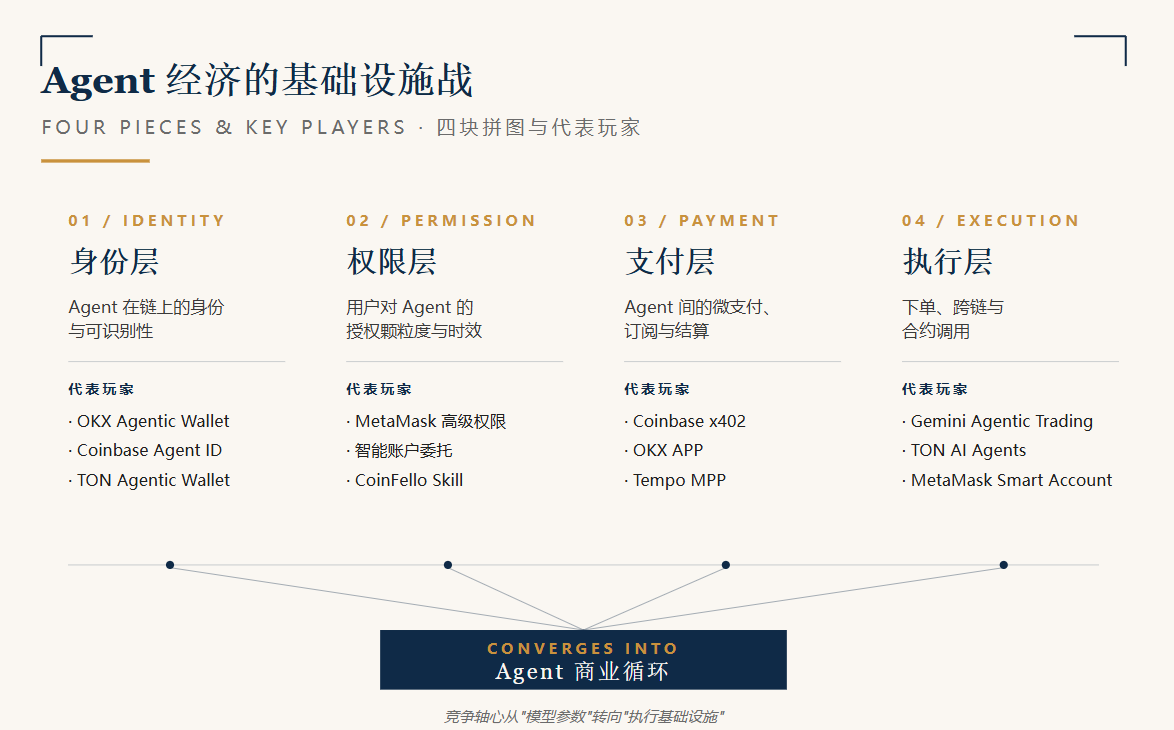
The core change behind this is that Crypto is providing AI with a set of callable financial and account infrastructures, and if we look at these actions on a diagram, we’ll find that they converge structurally, with each company assembling the same four puzzle pieces:
- Identity Layer: On-chain identity and recognizability of Agents (OKX's Agentic Wallet, Coinbase's Agent identity);
- Permission Layer: Granularity and timeliness of user authorization for Agents (MetaMask's ERC-7715 advanced permissions, Coinbase's safety barriers);
- Payment Layer: Micropayments, subscriptions, and settlements for Agents (x402, APP, MPP);
- Execution Layer: Ordering on exchanges/public chains, cross-chain, invoking contracts (Gemini Agentic Trading, TON Agentic Wallet);
After all, in the traditional internet, while AI Agents can help you search, summarize, write emails, and generate code, once it comes to payments, authorizations, and asset operations, they face identity, trust, account, and settlement issues. Blockchain naturally provides accounts, signatures, assets, payments, contracts, and traceable records, which allows AI Agents the opportunity to evolve from "digital assistants" to "on-chain executors."
However, execution capability is just the first step.
If these infrastructures are about "building hands" for Agents, another more important and easily overlooked question is: Where do the "working methods" of Agents come from?
2. AI Agents Need More Than Just Wallets; They Need Reusable Skills
This is also why the concept of Skills is worth focusing on.
How to understand Skills? Essentially, they are capability units that encapsulate specific working methods; for instance, each Skill is like a folder containing a SKILL.md document that tells AI what the Skill is for, when it should be used, and how to operate it specifically.
Models like Claude can simply load the corresponding Skills on-demand based on user intent while running, transforming from a general model into an Agent specialized in a particular task.
This design seems simple, even a bit "low-tech," but what’s truly important behind it is that the emergence of Skills means that the competition within the Agent ecosystem is no longer just about model parameters, reasoning abilities, and calling speeds; it also becomes a competition over working methods, community knowledge, and reusable capabilities.
The moat of an Agent platform may no longer be merely "my model is larger, faster, and smarter," but rather "can experts, businesses, developers, and ordinary users encapsulate their experiences into reusable assets on my platform for others and other Agents to repeatedly call upon."
Putting this judgment in the wallet industry leads to a more interesting proposition: After wallets enter the Agent era, competition in the second half is not just about excelling in "execution," but also about becoming a workspace for users to accumulate methods and co-create.
In fact, whether it’s Gemini's Trading Skills, Coinbase's Agent Skills, or Cobo's Recipe-driven skill layer, they are essentially doing the same thing: breaking complex operations into standardized, modular, and callable capability units.
This is particularly important for ordinary users because on-chain operations have never been a simple command. A seemingly ordinary Swap may involve token recognition, contract address verification, authorization limit management, slippage settings, gas estimation, phishing risk identification, and trade confirmation; a cross-chain transaction may involve bridge selection, arrival time, transaction fees, target chain asset displays, and failure handling; participating in DeFi may involve sources of yield, smart contract risks, liquidation risks, and exit paths.
If these experiences only exist in individuals' minds, they are hard to pass on; if they are just written as an ordinary tutorial, they are hard to be automatically invoked in real operations. But if they can be distilled into Skills, templates, checklists, or interactive works, they might become reusable knowledge assets for every user in the AI era.
This also represents a new value for wallets in the AI era.
Overall, what truly deserves attention in the future wallet race is not just "can AI help me complete an operation," but whether the experiences behind these operations can be distilled, reused, and collaboratively improved.
This is precisely the direction imToken can further explore as it proposes UI 3.0.
3. The Vision for Wallets in the AI Era Over the Next Decade
Objectively, the wallet industry has undergone multiple iterations over the past decade, transitioning from mnemonic phrases to multi-chain asset management, from DeFi to NFT, from L2 to account abstraction, and now to AI Agents.
However, regardless of how industry narratives change, wallets consistently face the same fundamental problem: how to enable users to manage their on-chain lives more safely, autonomously, and clearly. In the AI era, this question will become more complex and important.
As users begin to involve AI in on-chain operations, wallets will need to answer not just "can this transaction be signed," but also what this transaction means? Does it align with the user's true intent? Is the authorization scope reasonable? Have the risks been adequately explained? Especially, if an Agent makes a mistake, does the user still retain ultimate control? If this operation proves valuable, can the user distill the experience and share it with future users?
This is also a new direction that UI 3.0 can convey. The future wallet interface will not only be more visually appealing and smoother but will also better understand users, explain risks, carry knowledge, and be more suitable for collaborative creation by users.
From this perspective, imToken's reflections on Verifiable UI over the past year encapsulate the first bottom line for wallets in the AI era (see further reading "From the Kelp DAO Incident to Verifiable UI: Why Will a 'Verifiable Interface' Be the New Decentralized Security Bottom Line?").
This is a crucial and somewhat counterintuitive judgment. In most industry discussions, AI often implies more natural inputs, smarter parsing, and smoother human-computer dialogue. However, from the wallet's perspective, the smarter AI becomes, the more the interface needs to be verifiable.
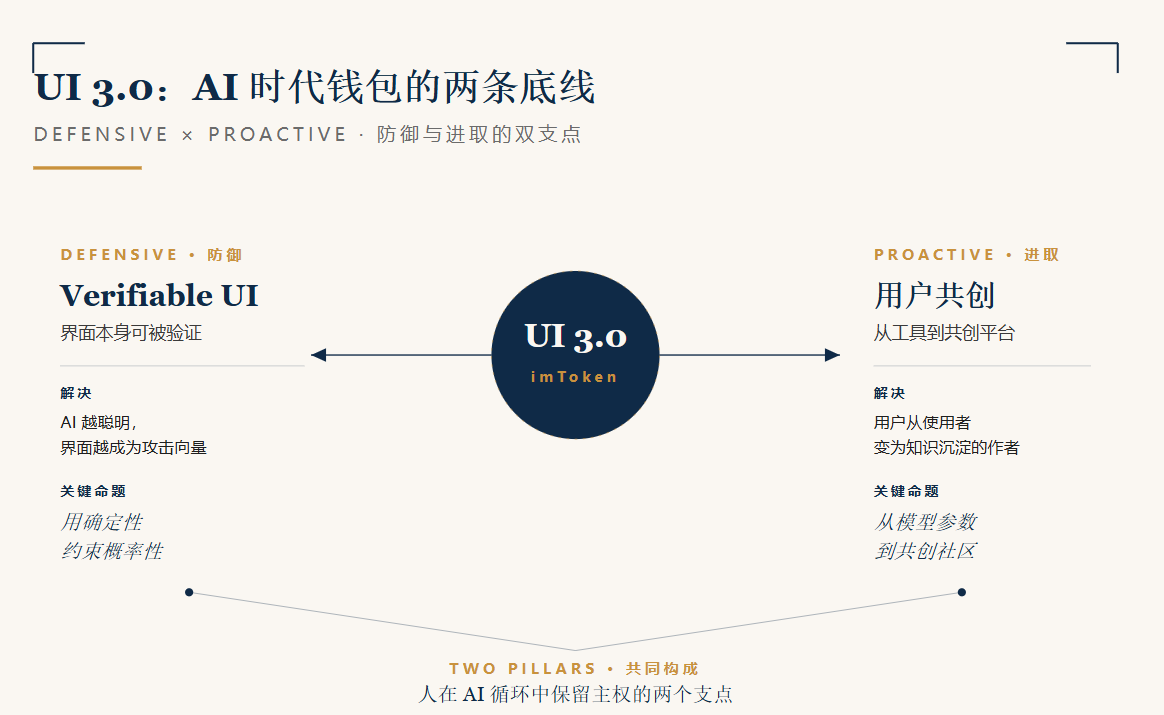
What Verifiable UI aims to address is the need for users to be able to verify the authenticity of the interface itself; even if centralized services go offline, even if the interpretations provided by Agents are off, users should still maintain ultimate control over their assets and interactions, which aligns with imToken's long-standing non-custodial principle.
The non-custodial model addresses the question of "who owns the private key," while Verifiable UI further resolves the question of "is what I see actually what I am about to sign."
It is also under this bottom line that imToken believes "using certainty to constrain probability" is more suitable for wallet judgments in the AI era. After all, regardless of how smart AI is or how powerful the models are, whether a transaction is executed ultimately still has to be governed by the deterministic codes, rules, and permission boundaries within the wallet. The wallet should not be an auxiliary entry point for AI, but should instead be the final checkpoint for user asset security in the AI era.
Beyond defense, UI 3.0 also has another more proactive mainline: transforming from a tool to a co-creation platform. As execution gradually gets taken over by Agents and interfaces start to become verifiable, the next question wallets need to answer will be, what else can users create here? The logic behind this is isomorphic with that of Skills.
As more wallets connect to Agents, design permissions, and provide execution capabilities, long-term differentiation may not stem from "who integrates AI first," but rather from whether users can distill their own creations in this wallet, such as an on-chain strategy, a security rule template, a wallet application for a specific scenario, a shareable operation checklist, or a Skill that future users and Agents can invoke.
Overall, the evolution of wallets over the past decade has transitioned from "address book + signature tool" to "DApp browser" to "multi-chain gateway." The questions it will need to address in the next decade may be: When Agents execute for me and I validate the interface, what can I still co-create here?
Because as users begin to involve AI in on-chain operations, the wallet needs to answer not just "can this transaction be signed," but also what this transaction means? Does it align with the user's true intent? Is the authorization scope reasonable? Have the risks been adequately explained? Can users distill this operation experience and share it with future users?
This is also a new direction that UI 3.0 can convey: The future wallet interface will not only be more visually appealing and smoother, but also better at understanding users, explaining risks, carrying knowledge, and being more suited for collaborative creation by users.
This means that users are not just there to share stories, but can also co-create works, such as a Skill on "how to safely add tokens," an interactive guide on "using Layer2 for the first time," a risk checklist for "identifying phishing authorizations," a process template for "hardware wallet cold storage," or even a learning path for beginners.
These creations do not have to be complex from the start; they can be a diagram, a tutorial, an operation checklist, a security reminder template, or even a prototype of a Skill that AI Agents can call upon in the future.
The important thing is that users transition from being "the educated" to "the co-creators."
This may be the most anticipated change in user education during the AI era: Knowledge is no longer just output unilaterally from project parties but is continually supplemented, amended, verified, and reused by real users in real scenarios.
Conclusion
Looking back, the combination of AI+Crypto is rapidly moving from concept to product.
Exchanges are beginning to enable AI to access accounts and trading capabilities, wallets are starting to design asset permissions and execution boundaries for Agents, payment protocols are exploring automatic settlements between machines, and Skills and Recipes are beginning to turn complex operations into reusable modules.
Ultimately, these changes may not point towards a world "where everything is completed by AI," but rather one where user capabilities are amplified anew. In this world, wallets remain an entry point, but they are no longer just an asset entry; they become gateways to identity, authorization, knowledge, operations, and co-creation.
For imToken, the tenth anniversary marks not only a review of the on-chain journey over the past decade with users but also serves as an invitation towards the future, encouraging every user to distill their experiences, questions, methods, and creations together, participating in building the knowledge network of wallets in the AI era.
After all, the truly vibrant Agent ecosystem is not just about competition among models but about the community of collaborative creation.
And wallets may very well be the most natural starting point for this community, the path we will walk together in the next decade.
免责声明:本文章仅代表作者个人观点,不代表本平台的立场和观点。本文章仅供信息分享,不构成对任何人的任何投资建议。用户与作者之间的任何争议,与本平台无关。如网页中刊载的文章或图片涉及侵权,请提供相关的权利证明和身份证明发送邮件到support@aicoin.com,本平台相关工作人员将会进行核查。


