Original | Odaily Planet Daily (@OdailyChina)
Author | Asher (@Asher_ 0210)

Kalshi has once again brought the prediction market into the spotlight of the capital market.
Last night, the prediction market Kalshi announced the completion of a new round of financing of $1 billion, led by Coatue Management, with a post-financing valuation of $22 billion. The prediction market is moving from a marginalized event trading tool to the views of mainstream capital and institutional finance.
In the past, prediction markets were more frequently discussed in the context of elections, sports, entertainment, and short-term hotspots. This round of financing for Kalshi indicates that investors are looking not just at how hot a market is, but whether the uncertainties in the real world can be transformed into a long-term trading mechanism. Once this path is established, the prediction market will no longer just be a volume business, but will be closer to financial infrastructure.
Behind the $1 Billion Financing, Capital is Betting on a New Market Category
This round of financing for Kalshi is not an isolated event of high valuation.
In the past 7 months, Kalshi has completed three rounds of financing in succession, with valuations nearly doubling each time. In June 2025, Kalshi completed a $185 million Series C financing, with a valuation of about $2 billion; in October, a Series D financing of about $300 million, with a valuation rising to $5 billion; in December, a Series E raising another $1 billion, reaching a valuation of $11 billion. After this new round of financing, Kalshi's post-financing valuation has reached $22 billion. In just a few months, the valuation skyrocketed from $2 billion to $22 billion, an increase of over 10 times.
If user bets were solely attracted through elections, sports, and hot events, it would be difficult to support such a valuation. The true story that Kalshi tells is that the prediction market has the opportunity to transform from a niche trading venue into a new event trading market.
Traditional financial markets can trade stocks, bonds, commodities, foreign exchange, interest rates, and volatility, but there are still many uncertainties in the real world that are hard to price directly. Election results, policy changes, economic data, weather events, and geopolitical changes all affect corporate decisions, asset prices, and public expectations, yet there has long been a lack of standardized trading tools.
The aim of the prediction market is to break these uncertainties into individual tradable contracts, allowing prices to directly reflect the probability of an event occurring. This is where Kalshi’s potential lies. It is not just about allowing more people to bet on the future, but also about trying to turn the uncertainties of the future into tradable, manageable, and hedged risk assets.
From Betting on Elections to Pricing Real World Risks
The prediction market first gained wider recognition primarily through elections. Compared to polls, it is more direct, compressing dispersed judgments into a real-time price. The probabilities of a candidate's victory, the chances of policy passage, and whether economic data exceeds expectations can all be quickly expressed through market prices.
However, relying solely on elections and sports makes it difficult to support today’s valuation. What Kalshi truly wants to convey is whether the prediction market can enter broader risk pricing scenarios. For instance, interest rate decisions, CPI, employment data, weather disasters, policy changes, and supply chain shocks—in the past, these risks were mostly traded indirectly, but now they could be broken down into individual event contracts.
Therefore, the long-term value of the prediction market does not lie in getting more people to guess the outcomes correctly, but in whether it can convert uncertainties in the real world, which are difficult to trade, into a continuously updated price system that can be referenced by the market.
Kalshi’s Most Valuable Asset is Its Regulatory License
In Kalshi's growth story, trading volume and transaction fees are certainly important, but what’s more crucial is its position within the U.S. regulatory framework.
Unlike platforms like Polymarket, which are more crypto-native and globally liquid, Kalshi follows a U.S.-compliant route. It is a designated contract market regulated by the CFTC, meaning Kalshi attempts to integrate the prediction market into the federal financial regulatory framework, rather than merely operating as an open event betting platform.
For ordinary users, the prediction market is just a platform for trading event outcomes; but for institutional capital, compliance is the first threshold. Hedge funds, asset management institutions, and market makers must first verify that contract attributes, clearing and settlement, audit records, and risk control processes are clearly understandable.
Thus, a part of Kalshi's valuation is pricing in growth, and another part is pricing in the value of its license. The more the prediction market moves towards mainstream finance, the more critical regulatory identity becomes. For Kalshi, which has secured a federal compliance entry, regulation is not just a constraint but may also become the core moat.
The Biggest Controversy Remains Whether Prediction Markets are Financial or Gambling
The core issue regarding budget markets is whether event contracts belong to financial derivatives or constitute a form of gambling. Especially in markets related to sports, entertainment, and elections, there can easily be boundary conflicts with traditional gambling. Regulatory agencies across multiple states believe that some of Kalshi's products bypass state gambling regulations; Kalshi emphasizes that event contracts are financial products regulated by the CFTC and should be treated within the framework of federal commodity trading law.
This game of cat-and-mouse doesn't just concern Kalshi, but the entire potential of the prediction market industry. If the logic of state gambling regulation prevails, the prediction market may be forced to enter a model of applying for licenses on a state-by-state basis, with product approvals limiting expansion speed and boundaries. If the logic of federal financial regulation is further established, event contracts could exist as independent financial products, thus amplifying the value of Kalshi's license.
Therefore, the regulatory controversy is not a sideline in Kalshi's narrative, but rather part of the valuation logic. The capital's willingness to attribute high valuations to Kalshi is precisely because it believes Kalshi has a chance to emerge victorious in this regulatory battle and convert its compliance advantages into market share.
Insider Trading is an Unavoidable Dark Side of Prediction Markets
In addition to regulatory belonging, prediction markets face another challenging issue: insider trading.
The value of prediction markets comes from information entering prices. The more informed participants there are, the closer market prices may be to the true probabilities. However, in the real world, the distribution of information is inherently unequal. Politicians, campaign teams, athletes, production staff, and corporate insiders often know the results earlier than ordinary users or are closer to them.
The contradiction lies here. If informed individuals do not participate, the information efficiency of prediction markets may decrease; if many informed individuals participate, ordinary users may feel like they are just being exploited for liquidity. The more prediction markets emphasize information efficiency, the harder it becomes to avoid fairness issues stemming from information advantages.
Currently, Kalshi is strengthening its monitoring and punitive mechanisms, including restricting relevant individuals from trading in their own markets, investigating unusual trading activities, and punishing violative accounts. But this is far from sufficient. If prediction markets are to transition from being traffic platforms to serious financial markets, they must not only prove their ability to attract trades, but also demonstrate their capability to handle insider trading, information asymmetry, and market fairness issues. Otherwise, institutional capital is unlikely to regard it as a serious market for long-term participation.
Kalshi is Not an Isolated Case; Prediction Markets are Heating Up Overall
As of April 2026 data, prediction markets are no longer just a fierce competition between Kalshi and Polymarket. Kalshi occupies about 50% market share with a transaction volume of $14.8 billion, becoming the first platform to capture more than half the share in a single month this year, and has maintained leading trading volume for eight consecutive months; during the same period, Polymarket has a transaction volume of $10.2 billion, accounting for 34%, still one of the most important competitors. More notably, predict.fun and Limitless also reached transaction volumes of $1.5 billion and $1.7 billion, respectively.
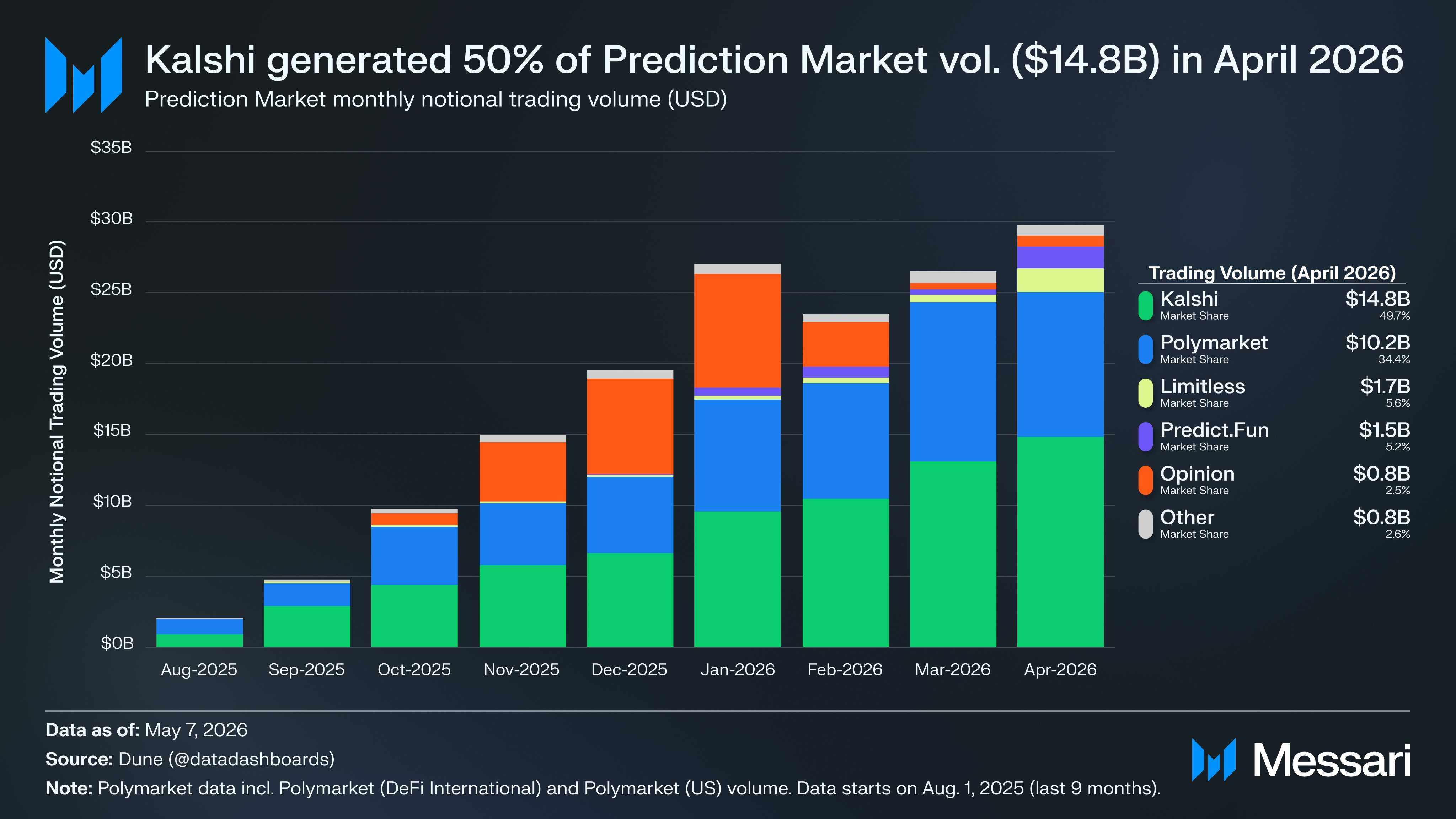
April Transaction Volume Data for Prediction Market Platforms
Kalshi has established a leading advantage, but the prediction market has not turned into a one-company show, and other platforms are also ramping up efforts. More accurately, Kalshi’s lead has not suppressed the growth of other platforms, but rather indicates that the demand for prediction markets is spreading from top platforms to more entry points.
The future prediction market is likely to have more than one winner. Compliance institutions, crypto-native markets, exchange entrance platforms, and vertical event markets may all coexist. The competition among different platforms is not only for users but also for liquidity and pricing power of real-world events.
Capital has Already Entered the Scene, Prediction Markets Still Need to Prove They Deserve a Seat at the Main Table
Financing is not the end, but the beginning of a larger test.
The significance of Kalshi's round of financing is not just pushing its valuation to $22 billion but marking the first time the prediction market has been so clearly integrated into the mainstream financial narrative. In the past, it was more of a gateway for trading election, sports, and hot event outcomes; now, capital is starting to believe that uncertainties in the real world can be transformed into a continuously operating pricing system.
However, this task cannot be accomplished solely by Kalshi. Platforms like Polymarket, predict.fun, and Limitless are also expanding liquidity, improving user experience, and exploring different market entrances. Kalshi represents the compliant institutional route, Polymarket represents crypto-native and global liquidity, while predict.fun capitalizes on Binance resources to bring prediction markets to exchange users, while creating discussions and spreading news through differentiated events on the X platform.
Only when prediction markets are not merely chasing hot topics but can be used by institutions for hedging, by enterprises for decision-making, and accepted by markets as signals for observing real-world risks, can they truly sit at the financial main table.
Capital has already put a price tag in advance. Moving forward, what Kalshi and the entire prediction market industry need to demonstrate is that the prediction market can not only turn news into trades but can genuinely transform the uncertainties of the real world into trusted and usable prices.
免责声明:本文章仅代表作者个人观点,不代表本平台的立场和观点。本文章仅供信息分享,不构成对任何人的任何投资建议。用户与作者之间的任何争议,与本平台无关。如网页中刊载的文章或图片涉及侵权,请提供相关的权利证明和身份证明发送邮件到support@aicoin.com,本平台相关工作人员将会进行核查。


