"Making money in A shares can prove that you have strength, fortune, ambition, skill, vision, recognition, and patience."
"Making money in US stocks can only prove that you are putting money in US stocks."
This is the current situation for most investors in US stocks in 2026.
Those who quietly bought US storage stocks and casually uninstalled the app have logged back in one day to find their accounts multiplied several times.
A shares are also taking off in response to the momentum from US stocks, with storage stocks starting to soar.
Meanwhile, those in the cryptocurrency circle have shifted their discussions from memes and fakes to US stocks: "I live every day in the fear of rising US stocks and falling BTC."
Newly opened accounts in group chats are asking soul-searching questions: How can it be so easy to make money in US stocks?
1. Who is really rising in US stocks?
The main capital thread in the global market for 2026 is clearly storage.
Sun Yuchen was the first to call for investing in the storage sector at the end of 2025.
According to internet users, assuming you bought US storage concept stocks at the time Sun Yuchen made his call:
If you bought Micron, you’ve gained +222%; if you bought Seagate, you’ve gained +256%; if you bought Western Digital, you’ve gained +280%; if you bought SanDisk, you’ve gained +515%.
If you had spent 500,000 yuan on SanDisk stocks a year ago, you would now have 15 million yuan.
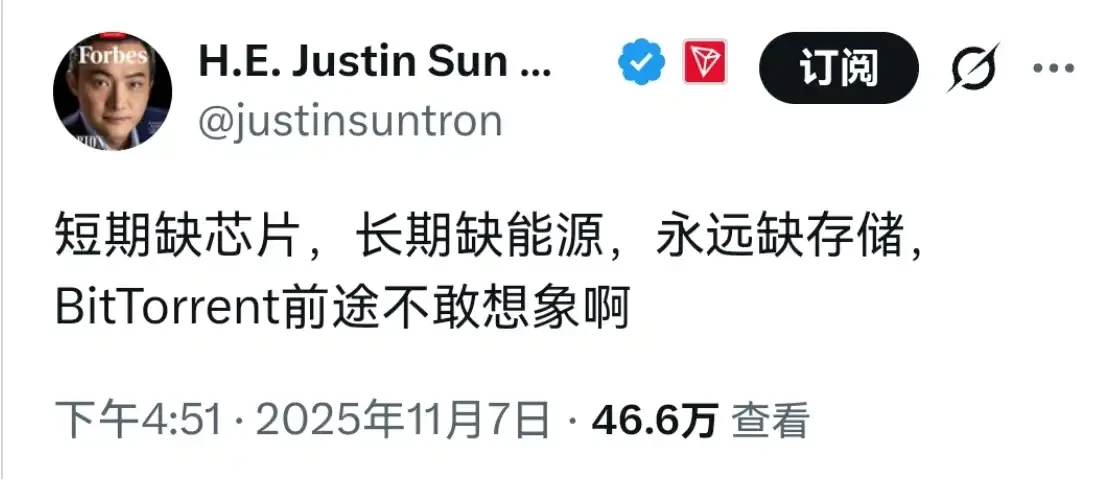
What exactly is storage?
Storage chips are the parts in computers and phones that remember things, divided into two types: DRAM is responsible for short-term memory, used to temporarily store data during program execution; NAND is responsible for long-term memory, where the photos and files on your phone are stored. Choosing between 128G or 256G when buying a phone refers to that capacity, which is NAND.
No more than five companies in the world can manufacture these two types of products.
The stocks of these five companies have surged over the past year as follows:
SanDisk, split off from Western Digital in February 2025, is an old company making USB drives and solid-state drives, with its stock price rising up to 22 times.
Micron, previously overlooked by fund managers for ten years, surged over 550% in a year, with gross margin growing from 18% to 56%. Apple's gross margin is around 43%, already recognized as a high-profit level in technology, and Micron's is now higher than Apple's.
SK Hynix increased by 123% this year. Samsung rose by 94%.
Seagate and Western Digital have both reached historical highs.
Then there’s South Korea.
Samsung and SK Hynix together account for over 30% of the South Korean KOSPI index, and in 2025 they led the entire South Korean stock market to rise by 76%, claiming the annual championship among major global indices.
The performance of these two memory manufacturers exploded, and the stock market of an entire country soared with it.
The pricing side is even more direct. DDR4 memory chips rose from $1.45 at the beginning of 2025 to a peak of $17 in February 2026, an increase of nearly 12 times in one year. A Kingston 16G memory stick at Huaqiangbei went from 200 yuan to 800 yuan. The reason why purchasing a new phone or computer has become more expensive is partly due to these stocks you didn’t buy.
In the first quarter of 2026, SK Hynix’s net profit surged by 398%, with an operating profit margin of 72%. Samsung Electronics' overall operating profit increased by 755% year-on-year.
Selling memory for 100 yuan results in 72 yuan in profit and 28 yuan in cost. This is no longer just business; it's mining.
2. Institutions Losing Control More Than Retail Investors
In a typical market, institutions are the ones in sharp suits, expressionless, saying "we are optimistic about the fundamentals in the long run," while retail investors are the ones shouting "charge, charge, charge" in group chats.
In the storage sector from 2025 to 2026, it was the institutions that went crazy first.
Google, Microsoft, and Amazon began placing "unlimited price, unlimited quantity" open orders with Micron.
The term "unlimited price" is worth contemplating; it means you quote a price, and I will give you that amount without negotiation. This type of procurement usually appears in wartime government purchases of military supplies.
From 2025 to 2026, it appeared in tech companies buying memory sticks.
Broadcom locked in supplies for three years up to 2028.
SK Hynix stated in an investor conference that "the capacity for HBM in 2026 is already sold out."
Sold out. For the whole year.
HBM is high-end memory specifically designed for use with AI chips. For every AI chip Nvidia sells, it must be paired with an HBM. Only three companies globally can manufacture HBM: SK Hynix, Samsung, and Micron, with SK Hynix controlling about 57% of the market. "Sold out" means one of the most critical components in global AI infrastructure construction will have no surplus throughout the year 2026.
Next came the analysts.
Within three months, Wall Street raised the consensus earnings forecast for SanDisk in 2026 by 172%. Citigroup predicts that the average price of server DRAM will increase by 144% year-on-year in 2026. Nomura states that the super cycle will last at least until 2027, with meaningful supply increases not occurring until at least 2028. After the stock price had already risen by several hundred percent, Melius upgraded Micron's rating to buy, adding, "there is still a 41% upside potential in the next 12 months," without batting an eye or losing breath.
DeepMind CEO Hassabis openly stated that the overall memory supply chain is limited and is constraining a large number of AI deployments. Intel CEO Chen Litai said that the memory shortage will not ease before 2028.
Then SK Hynix secretly submitted a request to the SEC to issue ADRs in the US stock market, raising up to $15 billion. A company whose capacity is sold out and has a profit margin of 72% decided to raise more money in New York, citing that valuations in the Korean market are too low and US investors understand AI better, willing to pay a higher price.
A shares have followed suit.
Demingli hit the limit, Baiwei Storage surged, Jiangbolong rose by 41%, and the small company Shannon Innovation projected a net profit increase of 6714% to 8747% in the first quarter, a four-digit growth rate. The topic of discussion in finance groups shifted from "Can we still buy the CSI 300" to "Which should we buy, Micron or SK Hynix?" People who didn’t even know how to spell HBM two months ago began educating others in the group about the working principles of high-bandwidth memory.
Even many dating groups are discussing storage stocks.
3. The Most Ironical Scene
On February 24, 2026, Citron Research announced a short position on SanDisk, providing three lines of logic.
First, storage is a cyclical stock. In 2008, 2012, and 2018, high profits always ended with a bust, and the existing capacity is already twice that of the peak in 2018, so supply release is only a matter of time.
Second, SanDisk sells commodities.
"Nvidia has a moat; SanDisk is just a commodity." Nvidia's moat is its CUDA software ecosystem, and almost all global AI models run on it, making replacement cost extremely high.
Samsung can produce a solid-state drive identical to SanDisk's as soon as tomorrow, probably at an even lower price.
Third, major shareholder Western Digital is significantly reducing its holdings in SanDisk at a 25% discount to market price.
Selling your own stock at a 75% discount suggests one possibility is an urgent need for cash, while the other possibility is a belief that prices will be cheaper in the future. In neither scenario does it indicate confidence in the future market.
Two trading days later, SanDisk rebounded and continued to reach historical highs. Citron's report circulated in various finance groups and became meme material.
One question that everyone skipped over: who ultimately received those stocks sold at a 75% discount?
4. Making money in US stocks, is it as simple as breathing?
The three most profitable storage companies in the world collectively chose not to expand production at their peak profitability.
SK Hynix's capital expenditure related to HBM fell by 50% year-on-year in 2025, with the official explanation being concerns about oversupply in 2027. Samsung's DRAM production capacity growth in 2026 is only about 5%, far below the demand growth rate.
The overall industry's capital expenditure growth rate is only 14%, whereas historically, during every expansion period, it is usually between 30% to 50%.
The three companies control 92% of global DRAM production capacity while choosing not to expand; this is something that would be called supply-side coordination in any other commodity market. OPEC has done this with oil, leading to the 1973 oil crisis. The concentration in the storage chip market is even higher than OPEC's; the combined market share of the three is not something thirteen oil-producing countries can match.
Investors interpreting "manufacturer restraint on production expansion" as good news, logically, is not wrong; prices can indeed be maintained longer. But what this structure means for the buyers on the other end is not reflected in any analyst reports.
This market situation can represent two equally valid narratives.
The first: demand for storage from AI is a structural change. AI models in the reasoning era require memory for increasingly long contexts, resulting in a leap in required memory capacity. The three major storage manufacturers control 92% of capacity, and new factories will not be operational before 2027; the gap won’t disappear before then.
The second: just like each time in history. The narrative during the 2000 internet bubble was that "the internet changes everything," and that was true. The narrative during the 2008 subprime crisis was that "housing prices would not fall nationwide," which also made sense in the historical data of that time. The real question has never been whether the story is correct or not, but whether the price has already anticipated that story.
There is an iron law in the storage industry that has not been broken for 30 years: prices rise very slowly, while they fall very quickly.
The super cycle in 2018 declined from peak to halving in less than two quarters.
No one knows where the peak will be this time. Including those who sold at a 75% discount, or rather especially those who sold at a 75% discount, because they are selling chips, and selling chips to people who believe in the story is the most efficient.
The last time you upgraded your phone from 128G to 256G, you spent an extra three to four hundred yuan. That three to four hundred yuan passed through a supply chain, with layers of profit sharing, and ultimately a small part appeared in SK Hynix's 72% operating profit margin, in Samsung's 755% profit growth, in all those stocks you didn’t purchase.
Of course, it also all eventually aggregated into that moment when you opened all social media and saw others asking soul-searching questions: Why is it so easy to make money in US stocks?
免责声明:本文章仅代表作者个人观点,不代表本平台的立场和观点。本文章仅供信息分享,不构成对任何人的任何投资建议。用户与作者之间的任何争议,与本平台无关。如网页中刊载的文章或图片涉及侵权,请提供相关的权利证明和身份证明发送邮件到support@aicoin.com,本平台相关工作人员将会进行核查。


