Written by: Silicon Valley Alan Walker
The Silicon Valley is burning 700 billion dollars, betting not on whose model is smarter — but on whether the four narrow places on Earth can produce the parts on time. Those who do not understand this layer will spend the next three years building on quicksand.
At eleven thirty at night, in a small alley off University Ave, there is a little restaurant only the old people know about. The owner has been running a business in the Bay Area for twenty years, and the menu never appears on Yelp. Behind the bar hangs a photo of Sun Microsystems employees from 1998. Alan Walker is leaning against the booth at the back, having his third glass of whisky, the conversation getting colder, "Tonight I want to tell you some real stuff. Everyone has misunderstood the direction of this round of AI."
You think AI is a software problem. Wrong, it's a problem of a few machines.
"You see the news, all you're seeing is the foam layer." Alan pushes his glass aside, "Model benchmarks, who raised a hundred billion, which startup has an eightfold valuation — these things get reshuffled every six weeks and have little to do with the real fate of AI. What truly determines the next decade is the 700 billion dollars of capex hyperscalers will burn each year, transforming it into wafers, transforming it into optical fibers, transforming it into concrete, transforming it into electricity. It's a matter of the physical world."
"If you follow this line downwards, peeling layer by layer, it gets colder the more you peel — everyone is arguing around the same five companies, and no one is paying attention to the layers below. But the real constraints are all below. Not in the cloud, not in the model, not in the keynote slides. It's in a few buildings, in several small towns, in the hands of thousands of engineers around the world whose names you can't recall. To put it plainly — AI is not a software problem at all, it's a problem of a few machines you haven't even heard of. If you don't understand this layer, any investment judgment is just guessing."
Machines in a small town in the Netherlands determine the ceiling of all AI.
"Let me first talk about one machine for you to grasp." Alan lights a cigarette (the restaurant owner acquiesces). "There’s a small town in the Netherlands called Veldhoven, and there’s a company called ASML. A machine sells for 400 million dollars and is the most complex commercially available object ever made in human history, bar none. What does it do? In a vacuum chamber, it shoots fifty thousand drops of molten tin per second and fires a laser twice: the first time it flattens the tin drops into discs, the second time it vaporizes the discs into plasma, at a temperature higher than the surface of the sun, emitting
1
3.5 nanometer extreme ultraviolet light."
"This kind of light is absorbed by air, even glass, so it cannot be used with lenses — only mirrors can be used. Who polishes the mirrors? Carl Zeiss in Germany. To what degree? If scaled up to the size of German territory, the highest peak cannot exceed one millimeter. Light bounces back and forth between the mirrors, finally landing on a silicon wafer moving at several meters per second, etching circuits finer than a virus, with alignment precision controlled by magnetic levitation to a few atoms." He pauses, "Five thousand suppliers worldwide contributed to this machine. The light source is made by a company in California — ASML could only buy it whole back then because no one could get it to work stably. There is no country on earth capable of making this independently. China has spent hundreds of billions to try to bypass it but can't get around it. This is not an industrial product, it’s a product of civilization. The thin software shell of AI is built on top of such things."
Every layer down, the number of players drops by half.
Marcus interjects, "How many of these narrow places are there?" Alan laughs, "More than scary. If you dismantle the AI supply chain — cutting-edge large models rely on GPUs; GPUs rely on CoWoS packaging; CoWoS relies on a couple of production lines at TSMC's southern science park; HBM memory relies on a couple of hybrid bonder companies in Europe; coherent optical modules above 800G rely on InP indium phosphide substrates; InP relies on two suppliers that can only grow one batch every couple of weeks; all of this also relies on transformers, gas turbines, and a power grid that has never been designed for AI. Every layer down, the number of players drops by half. At the very bottom, often only two or three companies remain, sometimes just one."
He takes a sip of his drink. "Civilization looks like a smooth water surface from a distance, but up close it’s actually supported by a few load-bearing columns. If one column breaks, the entire system stops. An Icelandic volcano erupts, a ship blocks the Suez Canal, a notice of export controls on a Tuesday afternoon — normally you can't see these columns, but when you see them, it's already too late. This game is about who can draw this column chart the earliest. The majority of financial media revolve around the bulbs at the top of the columns, and they have no idea what the rebars below look like."

The first choke point: Indium Phosphide. Two companies determine the speed of AI.
"Let me tell you about the first choke point — Indium Phosphide, InP." Alan's voice lowered. "Now all
1.6T coherent optical modules rely on this thing for the substrate. Can you guess how many suppliers make 4-inch and 6-inch polished InP substrates that are not in China? Two companies. One is a division of Sumitomo Chemical, and the other is a small American company; the majority of investors haven't even opened its 10-K. The order backlog is at an all-time high, and the production capacity is doubling — but the market still values it like a cyclical telecom materials stock because it was one eighteen months ago."
He taps the table. "You do the math: a training cluster with one million GPUs, assuming a fat-tree topology, requires at least one optical module per GPU, and often more. Millions of optical modules, and each one has to fit a small piece of InP. The annual production capacity of global non-Chinese InP substrates, after expansion, would fit on one line in an Excel sheet. This math problem is unbalanced — either it will raise prices, or ration, or both. When the market is out of balance, it ultimately depends on price to balance it. This is not a cyclical stock; it's a structural shortage. Those who don't understand this layer will pay tuition fees in the next three years."
The second choke point: Advanced Packaging. TSMC is also in line.
"The second choke point is advanced packaging." Alan orders another drink. "There are many people in the world who make cutting-edge silicon chips, but very few who make cutting-edge packaging. CoWoS, ABF substrate, hybrid bonders — these determine the ceiling for all products after Blackwell, after Rubin. Aligning and fusing two die at a nanometer precision into a single logic chip, globally there are probably four companies that do this."
"You won't believe it — one European company is listed on the pink sheets in the US because US brokerages are still confused about the secondary listings on European exchanges. This kind of mispricing is not subtle; it’s a glaring structural undervaluation." He leans back in his chair, "This packaging layer is the real bottleneck. TSMC is actually also in line waiting for hybrid bonders. The AI arms race at the end doesn't compete over who has money to buy GPUs — everyone has money — but over who can obtain packaging capacity. The capacity at this layer determines the upper limit of computing power increments for 2027 and 2028. Media never mention this because they can't interview the engineers in those few factories."
The third choke point: Electricity. Three companies call the shots, orders are already booked until 2030.
Kai leans over from across the table: "So what about electricity? Silicon Valley keeps shouting that data centers are short on electricity." Alan smiles a bit bitterly. "The shortage of electricity is a result, the root cause is gas turbines. A GW-level data center campus needs eight to twelve large industrial gas turbines, plus an equal number of backup units. There are three companies in the world that do this — GE Vernova, Siemens Energy, and Mitsubishi Heavy Industries. Orders are already booked until 2030. If you pay today, delivery is in 2029. Backup generators, switch cabinets, medium-voltage transformers — all are in this state, with lead times measured in years."
He shakes his head. "Hyperscalers' capex guidance for 2026 starts with '7', 700 billion dollars. This money cannot be converted into electricity faster than turbine casting and transportation. The bottleneck is never capital — this time, capital is surplus. The bottleneck is the people producing the parts. The core blades of a gas turbine take a year to process through casting, heat treatment, inspection, and assembly. The ceiling of AI is ultimately defined by the capacity of a few foundries. This won’t be talked about on cable TV because it's not sexy. But physics is physics; no matter how much money is thrown at it, casting time cannot be compressed."
The fourth choke point: November 27, 2026. The biggest catalyst of the entire decade.
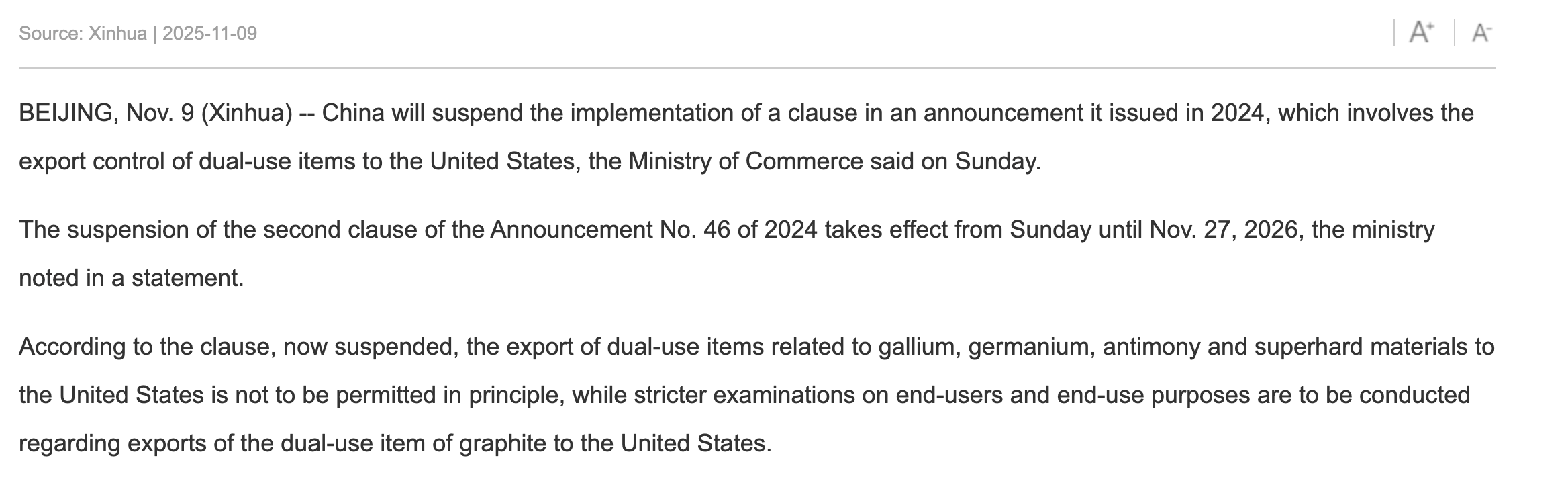
Alan looks at his watch. "The fourth choke point, the spiciest — critical minerals. At the end of 2025, China suspended the export controls on gallium, germanium, and antimony. Listen closely — it's 'suspended', not 'canceled'. When does the suspension end? November 27, 2026."
He enunciates clearly. "This day is the biggest known catalyst on the entire financial calendar from now until the end of 2030. But if you open CNBC, Bloomberg, or mainstream financial media — no one is taking it seriously." He sneers lightly, "If on November 27 the controls restart, non-Chinese gallium, germanium, and antimony suppliers will become the entire market the next day. III-V semiconductors, night vision optics, a long list of defense components — all may change overnight. If it doesn’t restart, optionality continues to lie within a few small-cap stocks; you can wait. But regardless of the outcome, you need to know — who stands on the right side of that line. Such a date comes along once every few decades. By the time everyone sees it, half the market has already moved. Smart money has quietly started to position itself in spring 2026 — not because they are better informed but because they read the calendar."
Every era is defined by a few people who first see the physical boundaries.
The night is deep, the restaurant is about to close. Alan finishes the last sip of whisky in his glass and slowly says, "I want to leave you with one last thought — geopolitics and supply chains are fundamentally the same thing, just looked at from a different table. Export controls, tariffs, sanctions, friend-shoring, reshoring — at their core, they are all about the government belatedly discovering what experts had figured out years ago: a few narrow places hold undue power. China understood rare earths in the early 2000s and established a dominant position. The United States understood EUV, blocking China from the forefront. Japan figured out specialty chemicals decades ago and quietly pocketed the rent. Whichever country seizes a narrow place gains extraordinary influence in the next economic paradigm."
He stands up and puts on his coat. "For the past three hundred years, every major upheaval can be told as a story of a 'neglected choke point' — saltpeter and gunpowder, coal and steam, Suez and oil, silicon and memory, lithium and cobalt. Every time, it’s a few people who saw the bottleneck early on, built an entire new order around it, and ultimately took the biggest slice of the cake of that era." He extinguishes the cigarette, "AI is the same story. The only question left is — do you want to see it now, or wait ten years to see it in a Harvard Business School case study? The names of this time's narrow places are already written there. Few see them, even fewer dare to bet on them. But it’s always like this — the next era is not defined by the loudest voices, but by the few who first see the physical boundaries."
He settles the bill, leaving a message: "Come find me at this little restaurant after you figure it out. I will likely still be in this booth."
This article is a dialogue-style essay.
The data and viewpoints are compiled from a lengthy article by Dylan Bristot published on WhatLLM.org.
For research and reflection only, not investment advice.
The market has risks, and so do narrow places.
免责声明:本文章仅代表作者个人观点,不代表本平台的立场和观点。本文章仅供信息分享,不构成对任何人的任何投资建议。用户与作者之间的任何争议,与本平台无关。如网页中刊载的文章或图片涉及侵权,请提供相关的权利证明和身份证明发送邮件到support@aicoin.com,本平台相关工作人员将会进行核查。


