Original author: Kaori
Original editor: Sleepy
Sam Altman once referred to advertising as ChatGPT's "last resort."
For a long time, this statement was a form of restraint. OpenAI still presents itself as a research company, an infrastructure company, a company trying to democratize AI capabilities for everyone. Advertising, the traditional monetization method of the old internet, was seen as a backup option.
However, the transition to the advertising model came quickly.
On May 5, OpenAI launched the self-service advertising platform Ads Manager, allowing advertisers to place ads on ChatGPT either directly or through agencies like Dentsu, Omnicom, Publicis, WPP, etc. It was less than three months since the advertising pilot program started on February 9.
The platform is still in testing, but the direction is clear: ChatGPT is no longer just a conversational product; it is also becoming an advertising inventory. OpenAI aims to achieve $2.5 billion in advertising revenue by 2026 and push that figure to $100 billion by 2030.
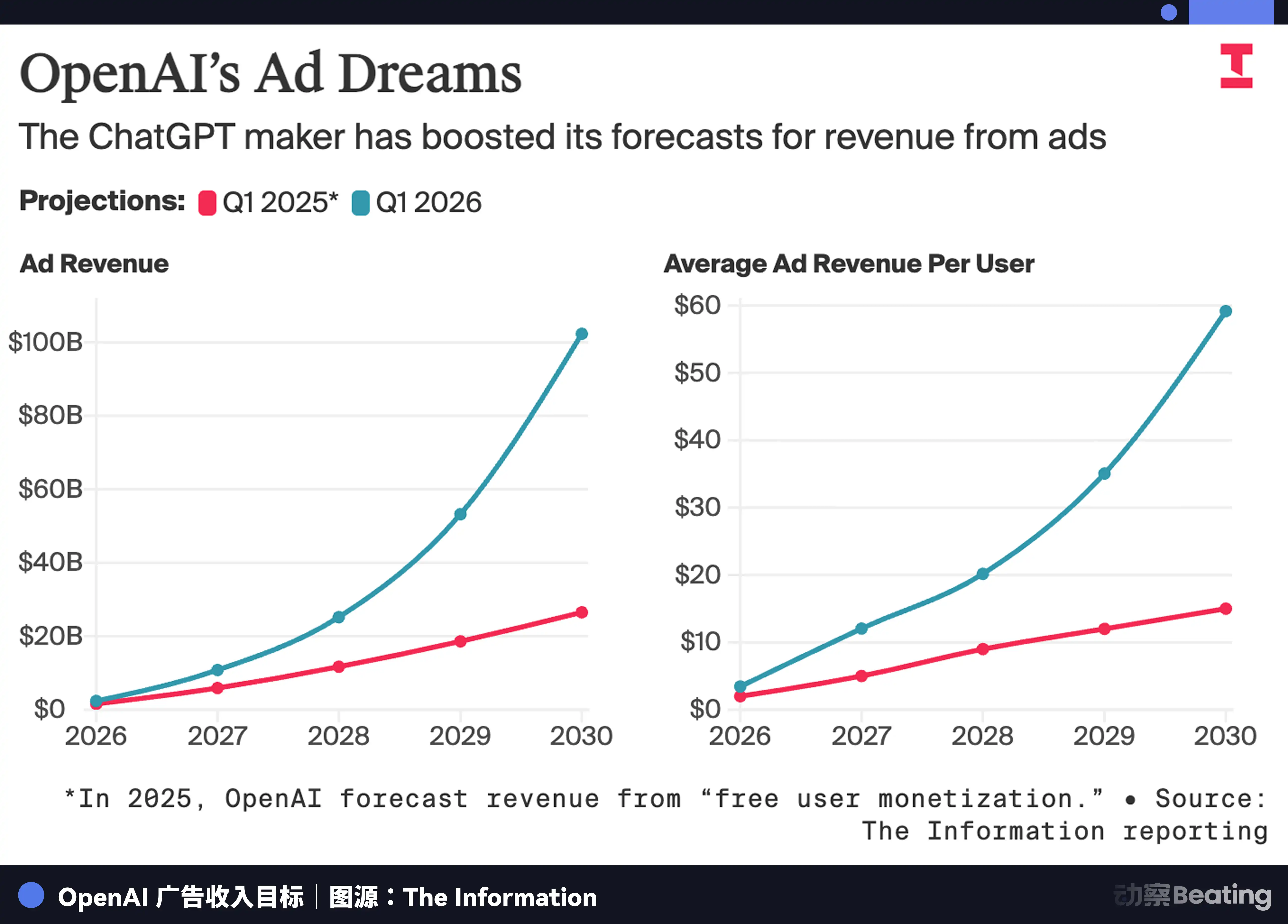
With a user base of 900 million, ChatGPT finds it increasingly difficult to rely on free access.
Annual losses in the billions, relying on advertising for rejuvenation
OpenAI is growing rapidly, too fast for traditional internet companies to find a comparison.
But it is also burning money quickly.
HSBC analysts estimate that by the end of 2025, OpenAI may face a funding gap of $207 billion by 2030. Its cloud and AI infrastructure spending could reach $792 billion between the second half of 2025 and 2030, with long-term computing commitments approaching $1.4 trillion by 2033.
This set of numbers explains why they are venturing into the advertising business.
Subscription revenue can demonstrate users' willingness to pay but is difficult to cover the reasoning costs of all free users. Business APIs can contribute cash flow but face price wars and model convergence. Capital financing can prolong life but dilutes equity and pushes higher valuation pressure back onto the company.
Advertising is the fastest source of non-dilutive revenue. It does not require free users to spend money, does not need to re-educate the market, and is easier to explain to investors.
According to Reuters, OpenAI's advertising pilot generated an annualized revenue of over $100 million within six weeks. Ads are directed only at free and Go plan users, do not affect ChatGPT's generation of responses, and do not share user data with marketers.
Aside from user privacy, this strategy hides a more fundamental issue.
Ads sold to free users, but advertisers want paying users
ChatGPT has 900 million weekly active users, while paying subscribers are about 50 million, and the free-to-paid conversion rate is less than 6%. Ads being directed only at free users indicates that OpenAI's advertising inventory entirely comes from that 94% unwilling to spend money.
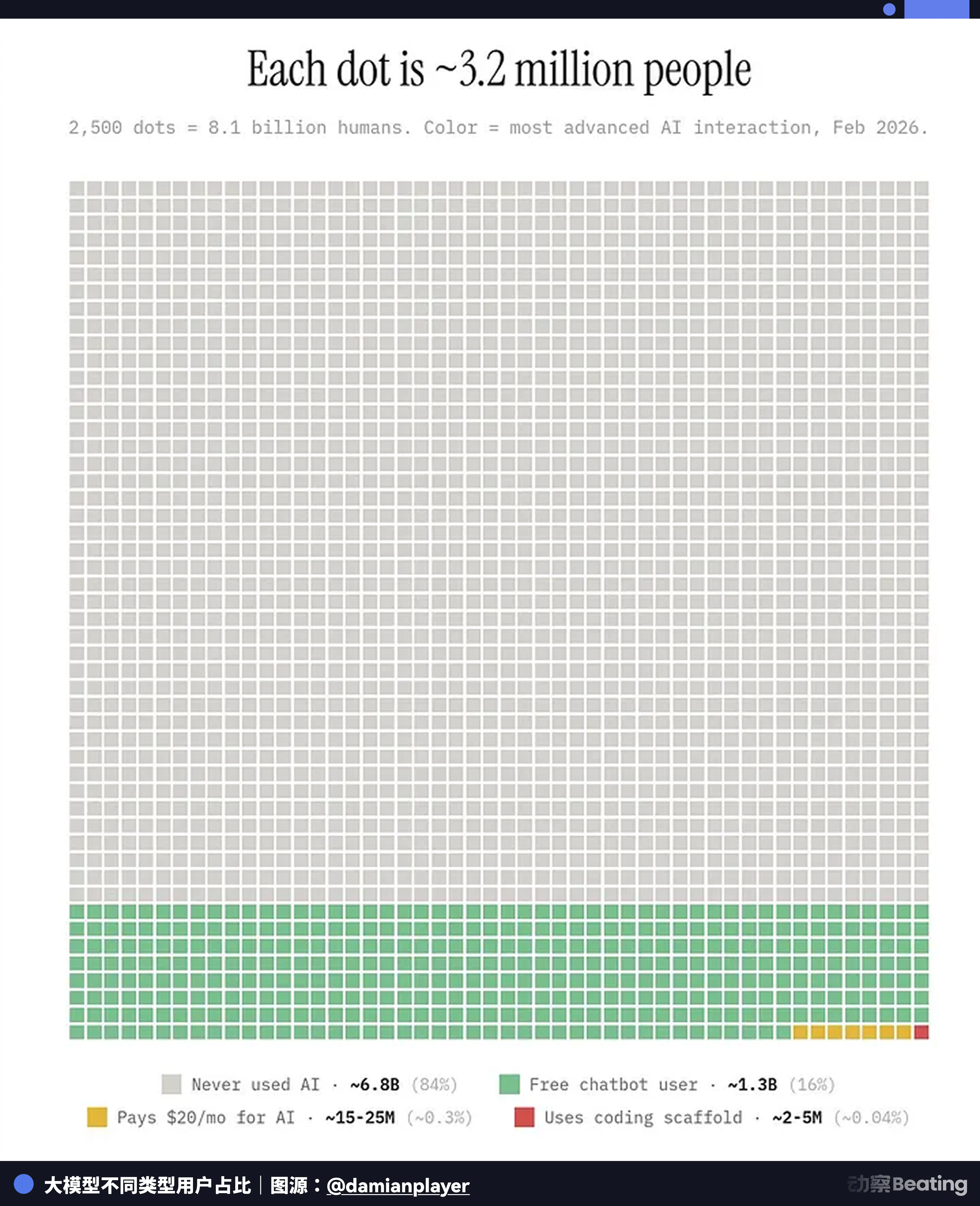
The problem is that advertisers who can spend at least $50,000 often do not sell products aimed at individual consumers. Decisions in high-ticket categories like enterprise software, SaaS tools, and B2B services are often most likely made by ChatGPT's paying users. They spend $20 to $200 per month to purchase stronger models and larger context windows, while advertisements will never appear on their screens.
Aside from audience mismatches, there is a deeper issue: even if the ads successfully reach free users, how much advertising value can these users' usage scenarios actually support?
High intent does not equal high conversion
OpenAI's advertising narrative is built on a core assumption: ChatGPT users enter the dialogue with genuine intent; ads reached in such high-intent scenarios command higher prices.
This assumption is only half-true.
For the past twenty years, brands have wanted to dominate the search box because it represents intent. When users search for hotels, it implies they may be booking a room; searching for corporate tax software indicates potential procurement; searching for the best noise-canceling headphones suggests the user is poised to make a purchasing decision.
Google built its advertising empire on this concept. With ChatGPT, users are directly handing the decision-making process over to AI. For advertisers, this is more enticing than search ads, but also more frightening. The enticing part is that ChatGPT sees a complete segment of demand; it knows not just what users want to buy but also why they want to buy it. The frightening part is that if AI directly provides the answer, users might not even look at the search results page.
However, "help me buy a pair of running shoes" and "help me write an email" are two completely different intents. The former is a consumption scenario; the latter is a productivity scenario. In ChatGPT's daily usage, the latter far outweighs the former. Users come here to write, translate, debug code, create plans, organize emotions—high-frequency actions that do not naturally correlate with product purchases.
This will directly lower advertising effectiveness metrics. Advertisers are willing to pay a premium for high-certainty purchase intent. Google search ads are expensive because users often enter the search box with explicit intentions to buy, compare, book, or place orders. Meta ads are somewhat cheaper, but it has social profiles and massive conversion data that allows algorithms to sift lower-intent users into potential consumers repeatedly.
ChatGPT is caught in the middle. It is more like a demand entry point than social media but harder to gauge commercial intent than search. It is more private than search yet harder to attribute than search. It can solve users' problems but does not necessarily create ad clicks.
This is also why OpenAI's shift from CPM (cost per mille) to CPC (cost per click) is not just a product upgrade; advertisers are unwilling to pay long-term based on the vision of being the "next-generation search entry." They ultimately want to know, who brought this click? Where did the conversion occur? How much of the budget should be shifted from Google, Meta, TikTok to ChatGPT?
Category fit is also an issue. Low-risk categories like home goods, travel, education, and software tools can be trialed first. High-margin categories often come with high regulation, such as finance, healthcare, insurance, and recruitment. Once ChatGPT starts advertising in these areas, the platform will bear risks not just related to advertising effects but also misleading information, discrimination, and compliance.
Google’s approach is a mirror. In Q1 2026, Google's search advertising revenue was $77.25 billion. Yet, even so, Google remains very cautious with ad placements in AI Mode and AI Overviews, with the standalone Gemini app yet to officially carry ads.
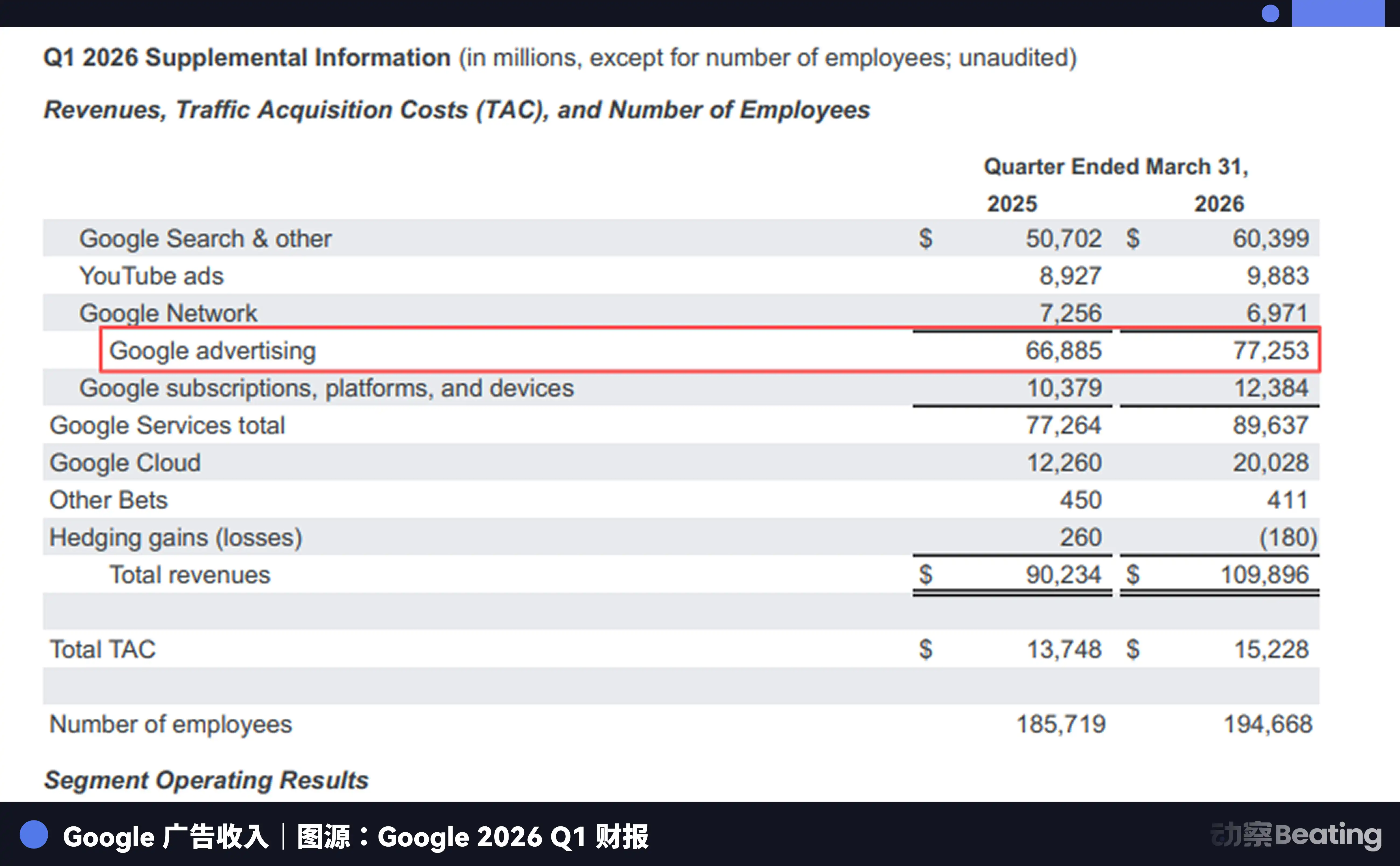
OpenAI's expansion into advertising is exploring broader business models for the entire large model track.
OpenAI must make users feel that AI is close enough while also convincing advertisers that there is enough commercial intent. If this balance gets out of control, ChatGPT will lose on both ends: users will feel it is not authentic, and advertisers will feel it cannot convert.
But the changes brought by advertising go beyond that; it is also reshaping brand competition.
The focus of GEO is shifting
In the past year, brands have worried about whether they will disappear from AI responses. The market has packaged this as GEO, but it is essentially an old search marketing anxiety repackaged for the AI era.
OpenAI's launch of Ads Manager neatly hits this anxiety, but it also shifts the direction of that anxiety.
In the ad-free era, GEO's core question was "how to enter AI's context." Brands strove to be referenced by models through product documentation, media coverage, third-party evaluations, and community discussions, competing over information quality and data structuring levels.
After the advertising platform's launch, precise traffic can be purchased directly, and brands no longer rely just on natural references. However, the focus of competition has not reverted to the traditional "buy more exposure," but shifted from "how to enter AI's responses" to "how AI evaluates my product."
The reason is simple: after seeing the ad, the most natural next step for users is to ask AI, "Is this product any good?" AI's response then becomes the real conversion gate. Advertisers can purchase exposure but cannot buy AI's good reviews. If AI provides negative feedback based on public data, every penny spent on ads accelerates user churn rather than facilitates conversion.
This means brands must establish a positive reputation within AI's evaluation system. The product's quality itself, the density of user evaluations, and the coverage of third-party assessments—these signals that AI can read will be more decisive in conversion effectiveness than the ad placement itself.
The shift from "entering context" to "winning evaluations" is another trend worth noting after OpenAI rolled out its new advertising business platform.
Not advertising is the most expensive advertising in 2026
Having discussed OpenAI, we must mention its archrival Anthropic, which is pursuing a completely different "advertising model."
On February 4, 2026, two days before the Super Bowl, Anthropic published a blog stating that Claude will never run ads. No sponsorship links, no third-party placements.
This statement itself is an expensive ad.
Super Bowl ads are not cheap; Anthropic is spending heavily to tell users that they do not sell ads, essentially purchasing the brand perception of being ad-free.
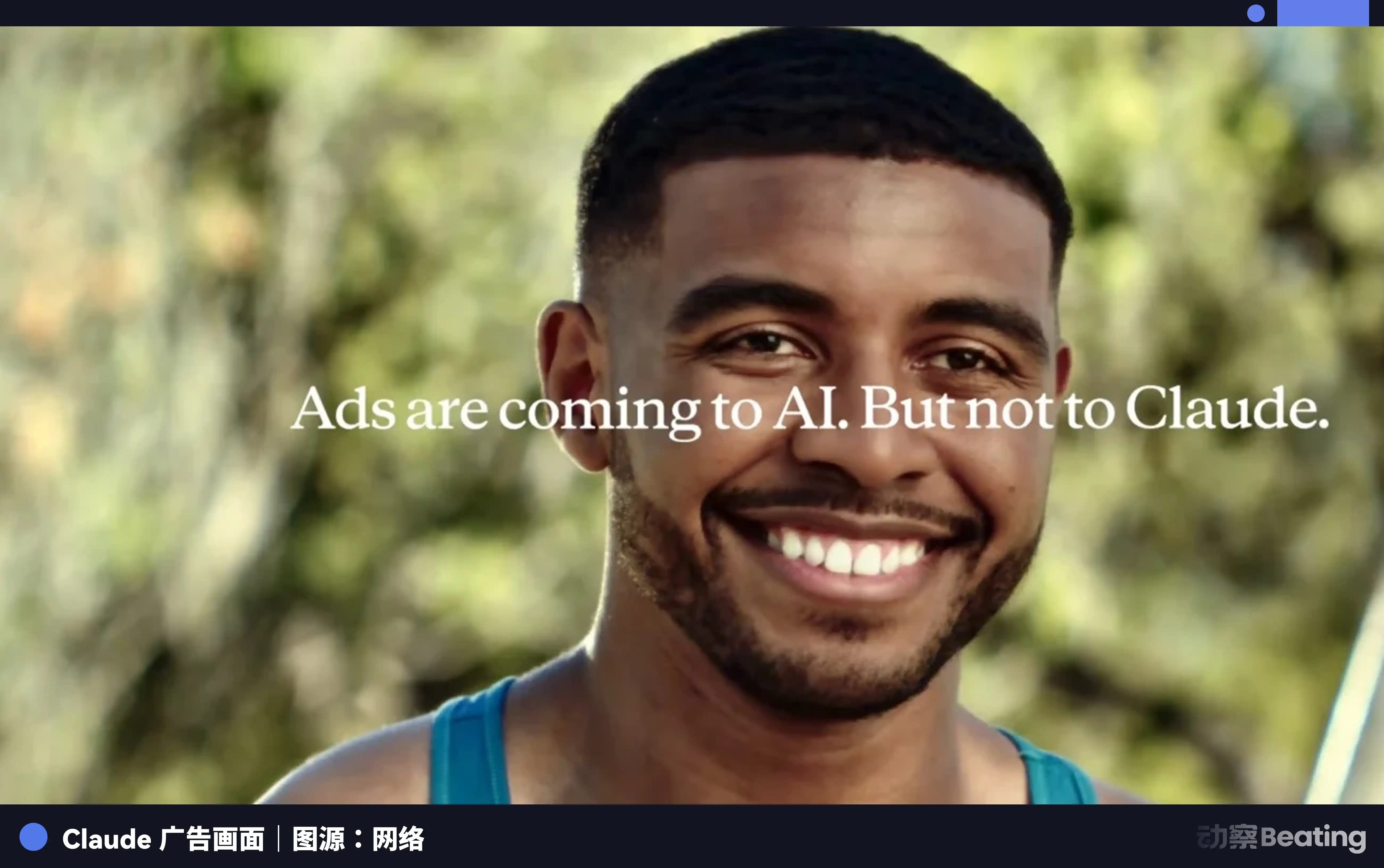
Being ad-free has never just been a moral stance; it is also a business positioning. It conveys to enterprise clients, professional users, and users in sensitive scenarios that Claude's responses will not be influenced by advertisers, Claude's product direction will not optimize around advertising inventory, and Claude's revenue comes from the money paid by users.
The effects are immediate. Claude's rankings in the U.S. App Store climbed from 42nd at the beginning of the year. On February 28, after OpenAI signed a Pentagon contract triggering the QuitGPT movement, Claude became the top free app in the U.S. App Store for the first time, surpassing ChatGPT. Free active users increased by 60%, daily registrations quadrupled, and the number of paying users doubled within a week.
Anthropic's revenue structure is completely different from OpenAI's: over 80% comes from enterprise clients, with annual recurring revenue soaring from about $9 billion to $19 billion. Tools like Claude Code and Cowork have already contributed at least $1 billion in revenue. Anthropic does not need the advertising value of free users; what it needs is a trust premium from enterprise clients that their data will not be used for ads.
Not advertising in this context is a precise business decision, reinforcing the trust barrier for enterprise clients by foregoing advertising revenue to support higher subscription pricing.
However, "not doing ads" is not an everlasting virtue.
The Stanford AI Index shows that the cost to reach GPT-3.5 equivalent performance has dropped 280 times in two years, from $20 per million tokens in November 2022 to $0.07 by October 2024. If model capabilities continue to converge and API price wars commence, the enterprise subscription premium that Anthropic enjoys today may gradually erode. When model costs drop to where all competitors can provide similar performance, why would enterprise clients continue to pay more for Claude?
There is currently no conclusion to this question, but time will provide an answer for this choice.
There is no free lunch
OpenAI chooses advertising; Anthropic chooses to make not advertising a premium. They may seem like two opposing paths, but they are both addressing the same question: when the reasoning costs of AI products cannot be covered long-term by a free model, who will foot the bill?
OpenAI's Ads Manager is not just an advertising product; it is also a signal that the AI industry is moving from free expansion to cost recovery.
However, the way OpenAI has chosen to stop the bleeding highlights the most vulnerable aspect of this business. It needs to support an advertising pricing three times higher than Meta using a user base with the least purchase intent.
This is not a problem that can be solved by user scale. 900 million weekly actives is a beautiful number, but if these 900 million are coming to ChatGPT to write emails instead of buying, advertisers will eventually vote with their feet.
Advertising can be a revenue source for AI products, but it should not be seen as the only answer. Because when a product's business model necessitates that users stay as long as possible and expose their intent as much as possible, that product is no longer an assistant to the user; it is an assistant to the advertiser.
免责声明:本文章仅代表作者个人观点,不代表本平台的立场和观点。本文章仅供信息分享,不构成对任何人的任何投资建议。用户与作者之间的任何争议,与本平台无关。如网页中刊载的文章或图片涉及侵权,请提供相关的权利证明和身份证明发送邮件到support@aicoin.com,本平台相关工作人员将会进行核查。


