Original Title: Micron Stock vs. Sandisk Stock: One Is a Much Better Buy, According to a Wall Street Analyst
Original Author: Trevor Jennewine, The Motley Fool
Original Translator: Peggy, BlockBeats
Editor's Note: The US stock market's storage sector is becoming the latest protagonist in AI trading.
This week, the stock prices of storage chip companies like Micron and Sandisk continued to surge. Micron's daily increase was about 11%, with its market value surpassing $700 billion for the first time; Sandisk's rise was around 12%, with its market value also exceeding $200 billion since it split from Western Digital in 2025. Over the past year, the market's pricing focus on AI has been shifting from GPUs, cloud manufacturers, and large model companies, further spreading to the underlying storage supply chain.
This wave of increase is not just the overflow of the "AI concept," but rather the very architecture of data centers is changing. AI training and inference require a storage system with higher speed, larger capacity, and lower latency: HBM is responsible for delivering data and models to GPUs at ultra-fast speeds, while NAND SSDs provide storage support during the training data, model files, and inference calls. As computing power competition enters the system engineering phase, storage is no longer merely a cyclical supporting product in the semiconductor industry chain but a key link that affects the efficiency, cost, and scalability of AI infrastructure.
This article focuses on Micron and Sandisk, which correspond to two important positions within this storage chain. Micron's core focus is on DRAM and HBM, particularly playing the role of high-bandwidth data transmission in AI servers; Sandisk's advantages lie in NAND flash memory and enterprise-grade SSDs, and it gains cost competitiveness through cooperation with Kioxia. The high-bandwidth flash memory HBF that Sandisk is advancing also reflects storage vendors' attempts to solve the mismatch between GPU speed and storage bandwidth.
However, what is more concerning is not how much these two companies' stock prices have risen, but rather that the capital markets are beginning to re-understand the value of "storage." In the past, the storage chip industry has been highly cyclical, with rising prices often indicating future supply expansion and price declines; however, against the backdrop of sustained AI demand expansion, investors are starting to bet that this cycle may be prolonged and even partially alter the traditional supply-demand fluctuation logic. IDC's latest report also suggests that AI demand may push the storage chip market into a different phase than before.
Of course, risks are equally clear. The historical patterns of the storage industry have never disappeared: today's shortages may turn into tomorrow's surpluses after capacity expansion. Once DRAM and NAND prices fall, the profit elasticity of Micron and Sandisk will also reverse and amplify. Therefore, what this article really discusses is not "how much further can AI storage stocks rise," but how investors can distinguish between true demand-driven growth and that which has already been reflected in stock prices amid the re-evaluation of AI infrastructure and the semiconductor cycle.
This is also the core contradiction of the current storage sector. AI is pushing storage chips towards a strategic asset position, yet this business still cannot entirely escape the cycle. The rise of Micron and Sandisk is both a result of AI infrastructure expansion and a concentrated bet on the "storage super cycle" by the market.
The following is the original text:
The rapid popularity of artificial intelligence (AI) has greatly propelled the growth of storage chip manufacturers Micron Technology (MU, +10.95%) and Sandisk (SNDK, +11.98%). Over the past year, the stock prices of both companies have risen by 571% and 3,350% respectively.
Although stock prices have risen significantly, Cantor Fitzgerald analyst CJ Muse still believes that both stocks are currently undervalued. However, based on his target prices, Sandisk seems to be the more attractive investment at this moment.
· Muse sets Micron's target price at $700 per share, indicating a 29% upside from the current price of $542.
· Muse sets Sandisk's target price at $1,800 per share, indicating a 52% upside from the current price of $1,187.
Below are the key points investors need to understand about these two semiconductor stocks.
Micron Technology: Implied 29% Upside
Micron Technology primarily produces memory chips and storage products for smartphones, personal computers, automotive systems, and data centers. According to Counterpoint Research, Micron is the third-largest DRAM memory supplier in the world, with products that include high-bandwidth memory (HBM) and NAND flash memory.
For AI-optimized data centers, the demand for storage is far higher than that of traditional data centers. The almost "supply-deficient" demand has led to unprecedented supply shortages across the entire industry. According to The Wall Street Journal, the contract prices for DRAM and NAND have increased by about seven times over the past year.
Micron's second-quarter financial report showed impressive results. The company's revenue grew by 196% to reach $23.8 billion; non-GAAP net profit surged by 682%, with diluted earnings per share reaching $12.20. CEO Sanjay Mehrotra stated, "AI has not only increased the demand for storage but fundamentally reshaped the role of storage, making it a strategically significant asset in the AI era."
Investors have reason to remain optimistic. HBM can transfer data and models to GPUs at ultra-fast speeds, making it crucial for AI workloads. Over the past year, Micron's market share in the HBM segment has increased by 12 percentage points, and the company is likely to continue expanding its share, as its HBM3E is currently the fastest and highest-capacity HBM product on the market.
However, it's important to note that memory chip sales have historically shown significant cyclicality. The industry is currently in an upcycle, but historical experience shows that supply shortages often eventually translate into supply surpluses. At that point, both memory prices and Micron's profits are likely to decline. Wall Street expects this trend may reverse around the fiscal year 2029, but in reality, no one can accurately predict when the current cycle will peak.
According to Wall Street consensus forecasts, Micron's adjusted earnings per share are expected to grow at an annual rate of 13% over the next few years leading up to the fiscal year 2029. Based on this, the current valuation at 25 times earnings appears slightly expensive. I believe investors should wait for a better entry point before buying Micron stock or at least limit new positions to a relatively small scale.
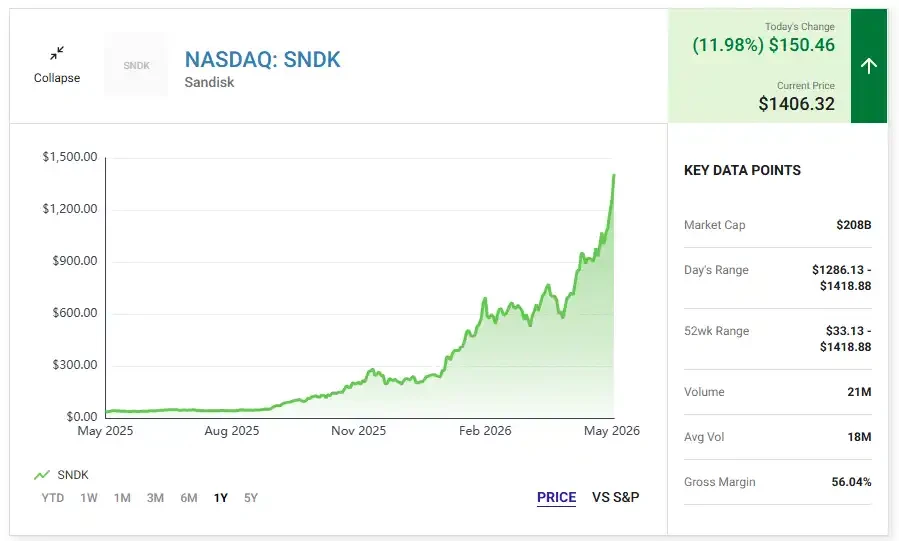
Sandisk: Implied 52% Upside
Sandisk primarily develops storage devices based on NAND flash memory. Its product portfolio includes external and embedded flash drives for mobile devices, game consoles, and automotive systems, as well as enterprise-grade solid-state drives (SSDs) for data centers.
NAND-based SSDs are a critical part of the storage hierarchy needed to support AI workloads. They are responsible for storing training data and models until this data is loaded into HBM. Sandisk is increasing its market share in the NAND storage market, partly due to its joint venture with Japanese manufacturer Kioxia. This partnership allows Sandisk to obtain low-cost wafers, helping it maintain price competitiveness.
Sandisk reported remarkable financial results for the third quarter of the 2026 fiscal year (ending in March). Driven by particularly strong demand for data center storage solutions, the company's revenue grew by 251% to reach $5.9 billion; non-GAAP net profit rose to a diluted earnings per share of $23.41, compared to a diluted loss of $0.30 per share in the same period last year.
CEO David Goeckeler stated, "NAND flash memory is gradually becoming the only economically viable solution that can provide the capacity, performance, and efficiency required for large-scale real-time inference, keeping models accessible. The market's renewed recognition of the criticality of our technology is happening precisely at a time when our product differentiation advantages are at their strongest."
Sandisk is designing a new type of NAND called high-bandwidth flash (HBF) to bridge the performance gap between GPU speeds and storage bandwidth. HBF will be able to load data and models into HBM more quickly. Sandisk announced this technology last year and plans to start providing HBF storage samples in the second half of this year.
Wall Street expects Sandisk's adjusted profits to grow rapidly before the fiscal year 2028, followed by a significant drop in the fiscal year 2029. Nevertheless, consensus forecasts still indicate that the company's profits will grow at an annual rate of 25% during this period. Based on this, the current valuation at 38 times adjusted earnings remains reasonable. I believe that CJ Muse's view that Sandisk is the better buy at the current price makes sense.
Is Micron Technology a generational wealth opportunity?
Before buying Micron Technology stock, consider this: The Motley Fool Stock Advisor analyst team has just selected their ten stocks they believe are most worth buying right now, and Micron Technology is not on that list. Generational wealth is rarely built on a single hot stock bet and is more often the result of a resilient, adequately diversified portfolio that can compound growth over decades. If your goal is to truly pursue generational wealth, you may want to check out the ten stocks our analysts believe are the best buys right now.
Looking back in history, Netflix entered this list on December 17, 2004. If you had invested $1,000 based on our recommendation at that time, it would now have turned into $490,864. Similarly, Nvidia was added to this list on April 15, 2005. If you had invested $1,000 then, it would now have grown to $1,216,789. This is the power of picking a few long-term potential winners and letting time work its compounding magic.
As of now, Stock Advisor's average total return is 963%, significantly outperforming the S&P 500's return of 201% over the same period. If your goal is to begin building true generational wealth, do not miss Stock Advisor's latest top ten stock list and take the next step towards building an investment portfolio that will benefit not only yourself but also your family for years to come.
免责声明:本文章仅代表作者个人观点,不代表本平台的立场和观点。本文章仅供信息分享,不构成对任何人的任何投资建议。用户与作者之间的任何争议,与本平台无关。如网页中刊载的文章或图片涉及侵权,请提供相关的权利证明和身份证明发送邮件到support@aicoin.com,本平台相关工作人员将会进行核查。


